


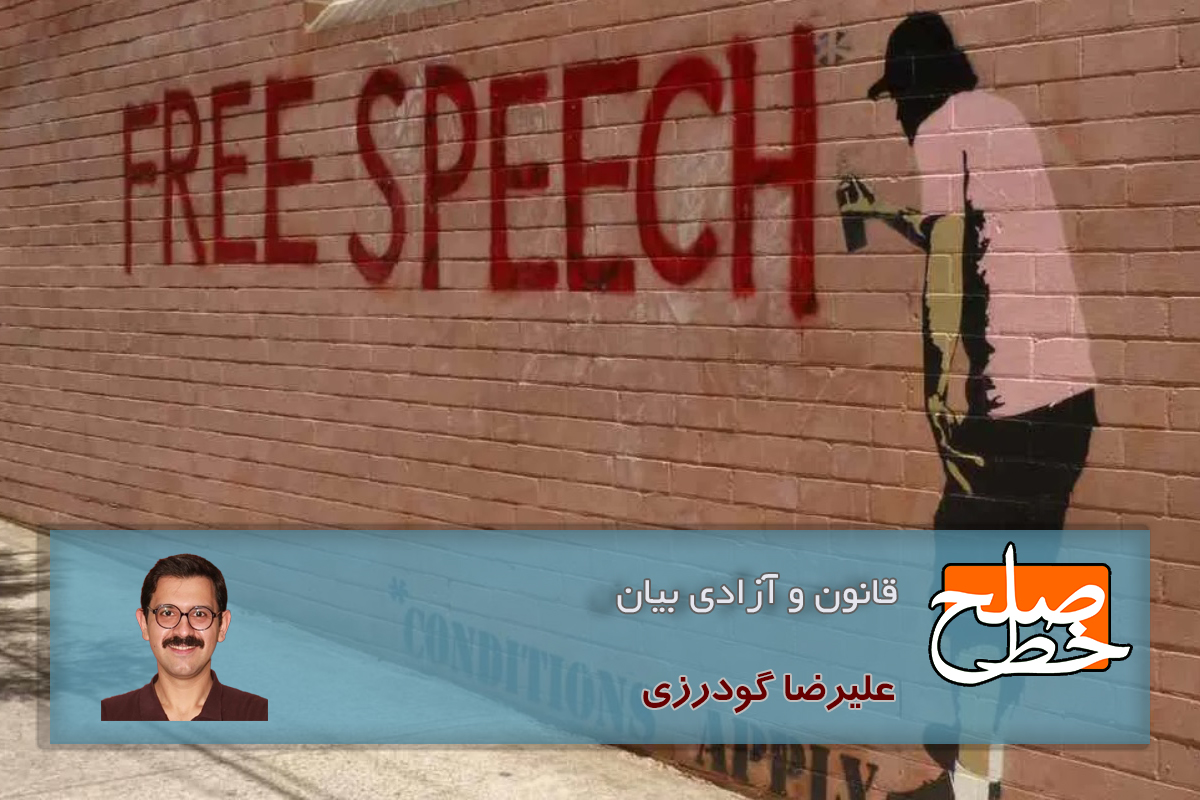
Law and Freedom of Speech / Alireza Goodarzi
There are several major barriers to freedom of speech, one of which is the law. I see other barriers as: extra-legal restrictions, customs and norms of societies, pressure groups, and the inability of governments to guarantee the right to freedom of speech.
“I defend this from a few examples. According to the 27th principle of the Constitution of the Islamic Republic of Iran, “the formation of gatherings and processions, without carrying weapons, is free as long as it does not violate the principles of Islam.” There are two limitations mentioned in the constitution for the formation of gatherings and processions. This means that no other limitations can be imposed. One of these limitations is justifiable; an armed procession can disrupt public order and safety and can even cause financial and physical harm to citizens. The other limitation is due to the ideology governing the constitution. Now, the Parties Law of 1360 (officially known as the Law on the Activities of Parties, Associations, Political and Trade Unions, and Recognized Islamic or Religious Minorities) imposes conditions such as obtaining approval from the Article 10 Commission, obtaining permission from the Ministry of Interior, and several other limitations, mainly mentioned in Article 16 of this law, which contradict the freedom granted
In this example, the constitution established a legitimate limitation and an ideological limitation, an ordinary law violating the constitution (in Chapter 3, namely the rights of the nation) added another limitation, namely the approval of an administrative council, and ultimately, in the absence of sufficient transparency, the opportunity for discretion in issuing licenses was given.
The second barrier is the extra-legal restrictions that we call “censorship”. In censorship, pressure on freedom of expression is not through the law, but rather by powerful actors without any legal basis. On the eve of the presidential election in 1400, a number of journalists and media activists announced that they had been warned by institutions to stop publishing certain news or materials. This pressure was not based on the enforcement of press laws or other current laws of the country, but rather by powerful institutions or individuals who imposed extra-legal restrictions. There are many examples of such pressures.
The third dam is the customs and norms of societies. In addition to famous examples such as the attack on Charlie Hebdo, two examples – both of which happened in Pakistan by coincidence – may be useful. Mashal Khan, a student at Abdul Wali Khan University Mardan in Pakistan, was brutally tortured and murdered in 2017. This followed an announcement by university officials accusing Mashal Khan and two other students of blasphemy on Facebook. An angry mob tortured and then killed him in the presence of the police. Later, the prosecutor announced that there was no evidence of blasphemy committed by Mashal Khan; nevertheless, his fate can serve as a lesson for others who even commit such a crime in secret. Another incident was related to Asia Bibi in 2009. This Christian woman was accused of blasphemy for drinking from the same water tap as her Muslim colleagues during a small argument. She was sentenced to death by a lower court, but the decision was later overturned by the
The fourth dam is also very familiar to us. Pressure groups, unlike the previous category which are usually angry men who resort to violence based on immediate emotions, are by nature organized groups with specific leaders who raise the cost of freedom of expression. For our generation, pressure groups are reminiscent of those who caused chaos in the 1970s by holding speeches, licensed assemblies, and even screening films. These groups may be affiliated with certain governments or act independently from them; but in any case, they are more or less seen in all societies.
The reality is that the law itself can be a violation of freedom of speech. However, this is not the only role of the law. The law must also be able to calm society and protect potential victims from totalitarian or violent social groups. If the law cannot restrain influential individuals, extremist groups, or pressure groups, even if it is not a violation of freedom of speech, it will still be a premeditated act and the right to freedom of speech will be violated due to the deficiency of the law.
 Created By: Alireza Goodarzi
 February 20, 2023
Tags
Alireza Goodarzi Censorship Charlie Abdo Constitution Criticism Expressing opinion Freedom of speech Ideology Law Monthly Peace Line Magazine peace line Peace Line 142 Standard