


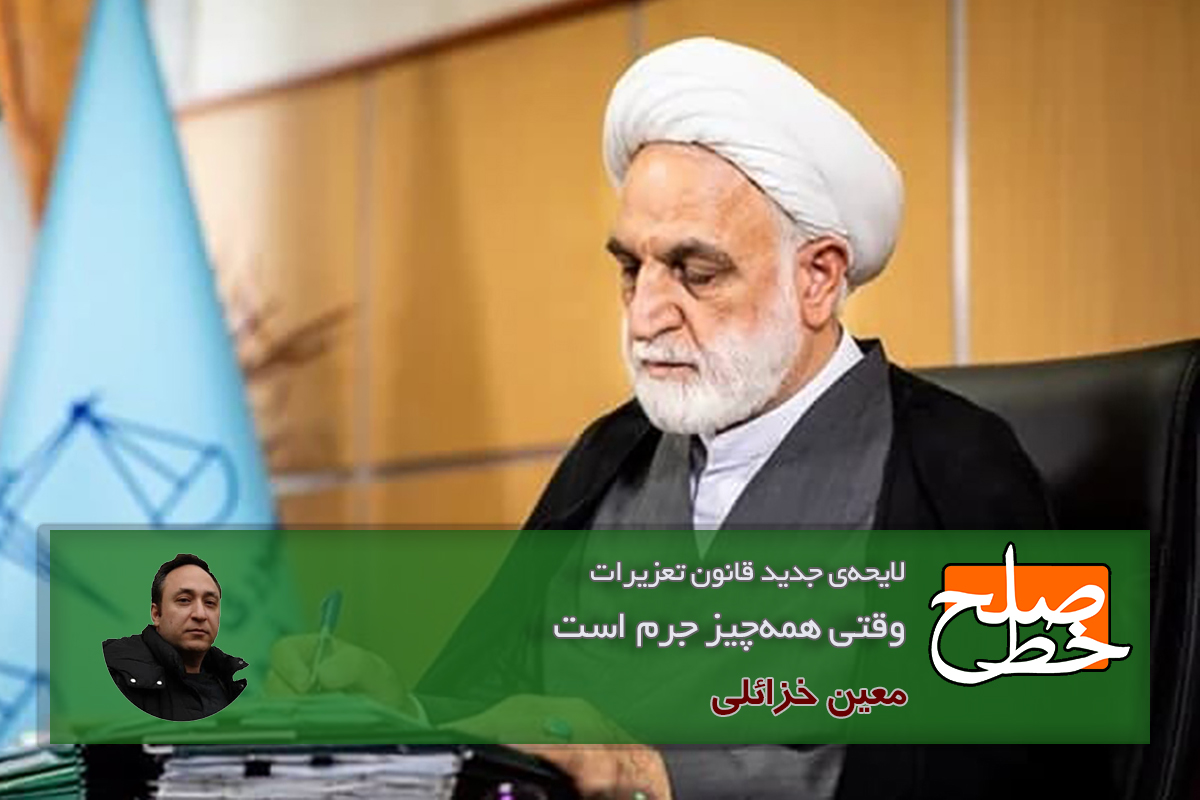
The new draft of the Penal Code; When everything is a crime / Moein Khazaei
Finally, after speculations and guesses, the judicial power of the Islamic Republic of Iran has sent its proposed draft for amending and changing the law of deterrent punishments to the government to be sent to the Islamic Consultative Assembly. It has been previously mentioned that the judicial power is preparing this draft and it is better for its text to be published, at least in the form of a preliminary draft, for the information of the legal community of the country, including lawyers, jurists, and academics.
The current law of deterrent punishments and penalties was approved in 1375 and remained untouched during the final approval of the Islamic Penal Code in Ordibehesht 1392.
But what is the basic perspective of the law of punishments and what major changes will the new bill make if it is approved?
Penalties; the authority of the Islamic ruler to impose punishment.
In Islamic criminal laws, punishment for criminal acts is what “sacred law” has determined in the form of prescribed limits, retribution, and blood money. The extent and manner of implementing these punishments are also determined by the sacred law, and as a result, the Islamic ruler does not have the power or authority to change, amend, or decrease or increase them.
On the other hand, the Islamic ruler has the authority, according to the claims of Shia jurists, to control society and support Islam and Muslims, to determine certain actions as criminal and to prescribe punishments for them. These actions and behaviors are not considered crimes (haram) according to criminal laws, but it is solely the Islamic government that deems them punishable. The prescribed punishments for such crimes are called retributive punishments.
Contrary to the prescribed punishments, such as retribution and blood money, which neither the Islamic ruler nor the judge have the authority to change, in disciplinary punishments, the amount of punishment is determined by the Islamic ruler and the judge, depending on their opinion and in proportion to the committed act, determines the final amount for each individual.
It is clear that crimes of a disciplinary nature do not fall under the criminal laws of Islam, and any justification for their legalization is invalid. Crimes against national security, crimes against the physical integrity of individuals, harassment and insults, and crimes committed by government officials are among the disciplinary crimes that have been considered criminal offenses by Islamic rulers.
Unveiling is also considered a punishable offense and one of the few religious prohibitions for which Islamic criminal laws do not specify a punishment, and for this reason, it is considered a punishable offense in disciplinary crimes.
Increase in criminal titles, increase in number of prisoners.
Perhaps it can be said that the most important point in the proposed draft of the Penal Code is the significant increase in criminal titles. The judiciary in this draft has not only failed to fulfill its promises and threats in recent years regarding crime prevention, but has also unexpectedly increased the number of legal criminal titles. This increase in criminal titles comes at a time when current criminal laws in Iran already cover nearly two thousand criminal titles, making Iran the ninth country in the world in terms of the number of prisoners relative to its population.
Organizing and participating in strikes, identifying and exposing the identities of human rights violators, insulting the national anthem and flag of the Islamic Republic, keeping dogs in apartments, carrying and walking dogs in public streets, and sharing images of unveiled women in virtual spaces are among the criminal acts that have been explicitly recognized as crimes in the proposed bill, and punishments have been determined for them.
Adding these criminal titles to the two thousand previous criminal titles in the criminal laws of Iran means that the likelihood of Iranian citizens being arrested for committing a crime is about one in forty-five hundred, while the likelihood of committing a criminal act in a country like France with a smaller population is one in two hundred and forty-three thousand.
On the other hand, the increase in criminal titles has a direct relationship with the increase in the likelihood of citizens committing crimes, resulting in the formation of legal cases and an increase in the number of prisoners; because with the high number of criminal titles, the likelihood and possibility of citizens adhering to all of them decreases, and in practice, the likelihood of committing a criminal behavior increases due to the abundance of these cases; especially in a society like Iran, where some of the criminal titles have religious and spiritual roots and a significant portion of the society does not associate with them, the collective will and desire to escape from unjust laws, which seem to be more of a threat to people’s security than a provider, increases and ultimately, it is this law that is violated.
The proposed draft of the Law of Punishments differs significantly from what was previously promised by Ibrahim Raisi in his role as the head of the judiciary. In April 2019, Raisi emphasized the high volume of legal cases in Iranian courts and spoke about the necessity of “purging crimes in the approval of laws.”
Hijab-less; a religiously forbidden act that carries a punishment.
The proposed bill by the Judiciary Power regarding the criminalization of hijab has also made significant changes, and according to Article 178 of this bill, it seems that from now on, only “unveiling” will be considered a crime. Therefore, according to this article, the consequence of appearing in public without a hijab will result in the immediate and direct involvement of the judiciary for obtaining a written commitment, and in case of repetition, the punishment will be one of the eighth degree penalties.
Despite claims by some that only unveiled women will be punished due to the lack of mention of “bad hijab” in the text, it must be noted that in the current law (passed in 1996), which considers bad hijab, “tabarruj” and even wearing sunglasses and removing boots as crimes for women, there is no mention of bad hijab and the only crime is not wearing the proper Islamic hijab. However, the practical approach and actions taken show that the interpretation of the judiciary and police is much broader than what is mentioned in the text as not wearing the proper Islamic hijab.
As a result, it is clear that the main problem still persists; because this bill, like the current law (passed in 1375), has not been able to provide a definition of hijab that satisfies the legislator and it is still unclear what is meant by “unveiling” which is considered a crime in this bill. Is the criterion for hijab the same as the current law, which is based on religious hijab, or is what is recognized as customary hijab sufficient for being considered veiled?
The product of this lack of definition in practice will be the same thing that Iranian society is currently facing; the society’s definition of hijab is heavily based on cultural norms and it decides for itself what the criteria should be, but the legal definition in the current penal code is different and has placed the criteria as a vague religious hijab with undefined boundaries.
On the other hand, some domestic media in Iran have interpreted Article 178 of the proposed bill as a ban on the entry of law enforcement forces into the issue of hijab and have mentioned it as a positive point in this bill; while this analysis is fundamentally wrong and incorrect. The entry of law enforcement forces into the issue of dealing with what is considered as immodesty and improper hijab has not been based on a legal necessity for this force, but rather as a judicial authority.
What will make a difference, however, is the mere presence of a judicial authority in a location where it is intended to obtain written commitments from unveiled women, otherwise in the proposed bill, the necessity of guiding unveiled women to the desired center for obtaining commitments by police officers has not changed at least on paper.
Another important point in Article 178 of the proposed bill is the prescribed punishment for unveiled women who refrain from giving a commitment or repeatedly appear in public without a hijab. According to this article, the court can sentence these women to “social punishments of grade eight.”
Although the proposed bill may seem better compared to the current law, which imposes a penalty of ten days to two months in prison or a fine for not wearing a hijab, in practice, there will not be much difference in the severity of the punishment and the convicted person may face a travel ban, forced residence (exile), and employment restrictions for up to one year.
Undoubtedly, the approval of the proposed bill on punishments as presented by the judiciary will create a new wave of legal-police challenges for the government in Iran and will significantly increase the inflation of criminal cases. On the other hand, considering the strong resistance of Iranian citizens towards unfair accusations, especially those that go against cultural norms and the attempt to impose a specific way of life, the disregard for new accusations in this bill will lead to an increase in the number of criminals and prisoners. As a result, it can be expected that in the near future, after the approval and implementation of this bill, Iran’s position will rise from the ninth country with a high number of prisoners to one of the top five countries.
 Created By: Moein Khazaeli
 January 21, 2023
Tags
German Judiciary Monthly Peace Line Magazine peace line Peace Treaty 141 Punishment Sanctions