


The blazing flames of creation / Nima Rahi
A brief note on the relationship between art and revolution.
Socrates did not like tragedy and the reason he gave was very simple: “tragedy is beneficial.” This usefulness later became one of the fundamental principles of tragic writing, theorized by tragedians such as Sophocles. In simple terms, this usefulness referred to promoting a universal perspective and ethical standards of the official religion of that time, Hellenism. What did Hellenism want? It wanted to remove all human life on earth in favor of a self-centered existence. This was also the reason why before the tragedies of Euripides, all tragedies “had to” end with the death of the hero. It was only through denying life that Hellenism could defeat the metaphysical and superstitious beliefs of its time, and this was only possible with the help of tragedy as the most important form of Greek art. Let’s go back to Socrates; so if tragedy tainted the wise philosopher’s mind, what pleased him? Simple stories and sometimes childish tales of Aes
But it seems that art cannot be profitable or intentional. Art has always played a key role in elevating humanity and preserving the ability to create; how can one say that art “should not” be profitable? This contradiction is addressed in the theory of “intentional art without intention” (2).
Art has been trapped in the chains of religions and traditions for centuries, and today it is still under the control of the money and capital-driven market, struggling to survive. The Western entertainment industry has turned art into a job, a source of value, and a commodity for exchange, taking away its beating heart and reducing it to a mere tool of the body. The purpose of this artistic product is to generate profit and capital, not to focus on humanity. It is not original or pure, as similarity and uniformity are characteristics of industrial goods. (3).
The purpose of art is to discover and express truth and beauty; art searches for humanity and creates humanity, and the intention to extract economic or ideological gain from it makes art futile. An artist is someone who, on behalf of human society, sees suffering, internalizes it, and uses their creative powers of intuition to convey a message of liberation, truth, and beauty to the ears of human society. The artist’s work is driven by emotion and human feelings, and their message comes from this gateway to the audience.
Functional theories are opposed to the idea that art is a mere tool. In fact, they are aware of the power of art to penetrate the deepest layers of human consciousness and control the grip of this power. For example, in the former Soviet Union, a form of art called “socialist realism” was created and it was expected to serve the party’s agenda. Everything had to be in service of the party’s ideology. The party used Alexei Tolstoy, a manipulator of history, and forced Fadeyev to commit suicide. Sholokhov told him that he had done something that made him neither a writer nor even a good secretary. (Fadeyev was once the secretary of the Union of Soviet Writers.) Alexei Tolstoy in his three-volume novel…
Passing through hardships.
That is a novel produced by the October Revolution, and each volume is weaker than the previous one, recording the conquests under the name of Stalin, which was actually the work of Trotsky. (4).
But.
Peaceful world.
“Mikhail Sholokhov’s masterpiece is a diverse work of art that has not lost its artistic value despite being censored numerous times throughout the years. In the first edition of the novel, Sholokhov introduced a communist commander as a ruthless killer who showed no mercy even towards his fellow prisoners. Stalin was offended by this and Sholokhov was forced to change certain sentences in later censorships. Stalin had a dual relationship with Sholokhov.”
Quiet day.
He was saying that “Padniyalikov” had rendered great services to the revolution and it is not right to portray him in such a negative light, but the work contains valuable content and it is a shame to announce a few unprintable cases because of it. This confirmation had caused the work to be safely taken out.
Passing through hardships.
The intention was for the party to show off and demonstrate its lack of errors, and to sacrifice its effect for this purpose. However, Sholokhov, in the form of a historical novel, tried to turn human suffering into beauty (which represents Schopenhauer and Nietzsche’s definition of art), and remained faithful to history and reality, portraying the scenes of the October Revolution in Russia without judgment and without any party or personal bias. Both works are attributed to the revolution and have a common historical background. Both are born of a historical era that could not have expected art to conform to the revolution and its standards, but they went their separate ways.
The role of revolutions in art is a formal role. The material relationships of society, which are transformed, also change the aesthetic relationships of the time. The French Revolution removed the aristocratic art of France, which had reached its peak during the reign of Louis XIV, and replaced it with bourgeois art; of course, it should not be assumed that this event happened in a short period of time and only after the revolution. The transition from Baroque and Rococo to simple French classicism took more than three hundred years. During the turmoil of the revolution, houses in Paris could be seen with classical exterior architecture and Rococo interior architecture; meaning they were bourgeois on the outside and feudal on the inside. (5) The social classes had lived side by side for years and their art had also influenced each other, but they were strangers to each other until the great tension and conflict, the French Revolution, arrived and disrupted the social class structure. The most important painter of the revolutionary era in France was
On the other hand, Adorno believed that artistic creation necessarily involves breaking away from traditional forms and transcending previous standards of beauty. The time of revolution is the right time to break all the common artistic forms. We can no longer think of the modern era with the rules of our predecessors, and art is not exempt from this rule. New content requires a new form, and without dismantling the foundations that the past has established, we cannot criticize and protest the current content that is devoid of truth and humanity. This disclosure of truth demands new languages…
Footnotes:
1- Lukacs, Georg, The Theory of the Novel, translated by Mortazavi, Hassan, Ashktian Publications, 1392.
2- Adorno, Theodor, Notes on Literature, “The Artist as Representative”, translated by Shirin Nikolsen, published by Columbia University Press, 1991.
3- Adorno, Theodor, Dialectic of Enlightenment, Farhadpour, Morad and Mehragan, Omid, “The Industry of Cultural Enlightenment; Enlightenment as a Mass Deception, A New Step, 1389.”
4- Roule, Jürgen, Literature and Revolution, Volume 1, Haddad, Ali Asghar, Niloufar Publications, 1395.
5- Hawzr, Arnold, Social History of Art, Volume 3, translated by: Younsi, Ibrahim, Khwarizmi Publications, 1377.
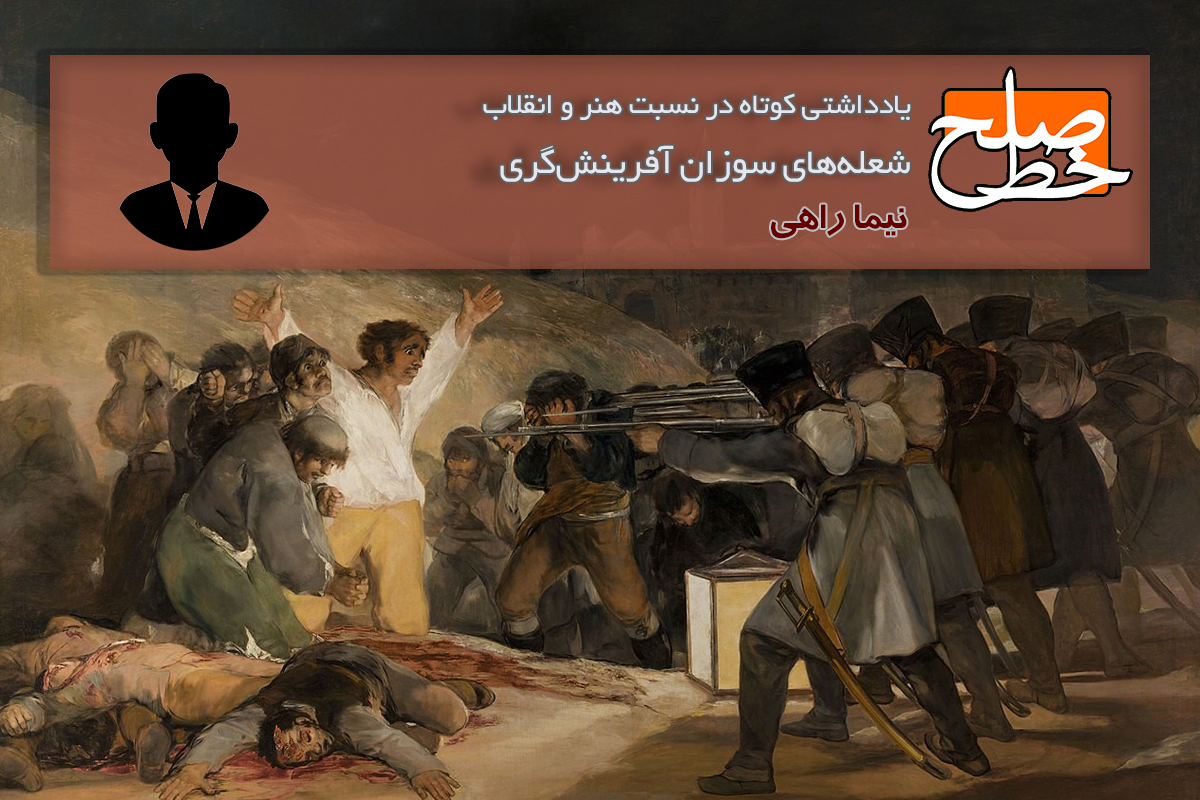
The image is related to the painting of the third of May 1808, by Francisco Goya, a Spanish painter who depicted the execution of Madrid citizens by soldiers of the French Empire during the years of Napoleon’s occupation of Spain.
 Created By: Nima Rahi
 November 22, 2022
Tags
7 Peace Line 1397 Art Baroque Beauty appreciation Mikhail Shulukhov Monthly Peace Line Magazine Nima Rahi peace line Revolution Rokoko Theodor Adorno ماهنامه خط صلح