


Music for Revolution/ Purifying
An exploration of Iranian revolutionary songs; from the blood of the youth of the homeland to the anthem of women.
An announcement, no matter how good it is, will never be read more than once; but a song, learned by heart, is repeated over and over again.
These are some of the words of Joe Hill; a Swedish labor activist and socialist who ended his life in 1915 in the fire squad of the “Sugar House” prison in Utah. He was mostly known for his revolutionary songs such as “The Rebel Girl” and “There is Power in a Union”. The connection between music and revolution spans centuries. This art, without a doubt, occupies a place in people’s lives that governments resort to a thousand blows and force to obtain. In this article, we will explore the path of revolutionary songs from the French Revolution’s “Marseillaise” to the Iranian women’s anthem.
History of Revolutionary Song.
Finding the first revolutionary song is not an easy task; one cannot know which song, as Jo Hill puts it, teaches the revolution to the heart of its audience. However, one of the most important revolutionary songs is the French national anthem, known as “La Marseillaise”, which was introduced as the official anthem of a revolution. This song was sung by the soldiers of the French army during the French Revolution, led by the two revolutionary officers, Roget de Lisle. Other songs, such as “Chant du départ” and “La Carmagnole”, are also known as revolutionary songs of the late 18th century, which were sung by French protesters in the streets and revolutionary gatherings. One of the main characteristics of revolutionary songs is their ability to unite people, showing a sense of solidarity.
During the American Revolution in 1776, the song “Yankee Doodle” became popular among the revolutionaries. This song was originally created by British soldiers to mock the American independence seekers (Yankee Doodle came to town, riding on a small horse…), but after the success of the revolution and the independence of the people from British rule, it became beloved among Americans and is still sung today. Although the content of the French national anthem, “La Marseillaise,” is clearly revolutionary (take up arms, citizens! Form your battalions!), “Yankee Doodle” does not have a revolutionary message and the irony present in it has made it known as a protest-revolutionary song. It is not easy to distinguish between a protest song and a revolutionary one.
The difference between revolutionary songs and protest songs.
One of the Twitter users had asked their friends to name their favorite revolutionary songs. The result was interesting, and the comment that received the most likes was “Imagine” by Siavash Ghomayshi. What stirs the revolutionary spirit in the mind of someone who is living in the midst of crisis, can even be a love poem; in a land where even the expression of love is suppressed. But in texts related to the history of music, those songs are referred to as revolutionary songs, which belong to a revolutionary movement. Like the examples above in the 18th century revolutions in France and America…
But what are the characteristics of revolutionary and protest songs and how much do they differ? In short, the fundamental difference between protest and revolutionary songs is that revolutionary songs are more political. These songs are composed to incite and encourage people towards change and always contain a political message. They also rely on these political messages to announce the establishment of a new order and revive its components. It could be said that revolutionary songs come from politics to society, but protest songs go in the opposite direction; they emerge from social movements and lead to political demands. Therefore, the number of protest songs is much greater than revolutionary songs and anthems.
One of the other structural differences between these two forms of poetry can be seen in the way they convey meaning and message; revolutionary poetry has a clear purpose and is closer to a statement, even if it is said in a subtle way; “the air became pleasant, I picked flowers from the ground…”. However, protest poetry, with more complexity and ambiguity, usually does not have a specific target and may ultimately refer to a particular social crisis; “the black clouds are shedding blood, on Fridays the rain is shedding blood” or express demands in poetic ways; “imagine a world where you are imprisoned in a myth…”.
History of Protest and Revolutionary Songs in Iran.
“Laleh” is Aref Qazvini.
Like many important movements in the social construction of recent centuries in Iran, in order to find the first protest songs of the country, we must also go back to the Constitutional Era; a time when the subjects became a nation and demanded justice, freedom, and even the rule of law. Ali Akbar Shida (1222-1285) is considered the first songwriter and composer in his new form, but his popular works are often romantic, such as “Bacheen” and “Selsele-ye Moo-ye Doost”. The first musician who can be seen expressing protest and demand in his songs is Aref Qazvini (1260-1312). He creates songs like “Aman Aman” which is played when Sardar Asad Bakhtiari (from the south) and Setareh Khan and Baqer Khan (from Tabriz) meet at the gate of Qazvin, and they are welcomed with this song. Or “Az
The first feminist anthem in 1306.
It is interesting to know that by taking a critical approach to music in Iran, we quickly come across women’s songs; in 1306 (during the first Pahlavi era), songs titled “Daughters of Cyrus” were released by Qamar, which clearly had feminist and egalitarian demands.
“Girls of Cyrus, until when will you be in sorrow?”
Under the control of men, until imprisoned.
No one knows, there is no thought of good or evil.
Oh men of Iran, is woman not human?
How long will you be in veil? Until when will you be asleep?
The existence of a sheikh causes such destruction.
The country is in ruins, its people are asleep.
“Sensitive girls during the revolution.”
This song, despite having some overlap with the modernization desired by Reza Shah, ultimately sings the praises of the revolution. It is said that the composer of this piece was Mohammad Ali Amirjehad and the lyricist was Morteza Nidavood, who at the time preferred to remain anonymous due to the potential backlash from religiously conservative groups. However, the voices of Qamar and later Molouk Zarabi in their performances and renditions of this song are evident and undeniable.
“Morning Bird” Spring
In the same year (1306), Nedaavood creates another enduring protest song; “Morning Bird” with lyrics by Mohammad Taghi Bahar, which was widely heard among the people during the time of minor tyranny and the end of the constitutional period. There are various accounts about the first singer of this song, but apparently the first published version was sung by Molouk Zarabi. It is also said that the first performance by a female singer without a veil in Iran was related to the singing of “Morning Bird” by Qamar al-Molouk Vaziri on stage, which happened shortly after the publication of this song.
The commotion of the stars after the coup.
By taking a look at the protest songs in the midst of the struggles of social and political movements in contemporary Iranian history, we come across the songs after the coup of August 28, 1953, many of which, including “Peacock” and “Song of the Heart” with the voice of Marzieh (1957), were met with censorship by the Radio Editing Department. Even simple songs like “Twenty Stars” with the voice of Vigen (No one has seen the stars tonight, except for the wandering star…) and “The Noise of the Stars” sung by Parvin (Tonight I am full of excitement…) were not favored by the court due to their popularity among the imprisoned members of the Tudeh Party.
The most important protest song of this era, however, is “Kiss Me” composed by Majid Vafadar, which was first performed by Parvaneh, but shortly after, tens of thousands of copies were sold in Tehran with the voice of Hassan Golnaraghi.
Revolutionary songs of Bahman 57.
Since the 1950s, protest songs have once again been seen among popular songs in pop music. Farhad, Dariush, Shahyar Ghanbari, and Iraj Jannati Attai have gained attention for their protest songs and have even been imprisoned. Fereydoun Farrokhzad and Manouchehrzadeh have also been interrogated by security forces. The protest songs of the 1950s gradually became more revolutionary and closer to a manifest approach as the revolution approached. In 1978, dozens of revolutionary songs were released, most of which were produced by leftist groups. These include “Sunworkers of the Jungle” with lyrics by Saeed Sultanpour and music by Mehrdad Baran (Saravamad-e Zemestoon…) and “Bahaaran Khajastehbaad” with lyrics by Karamatollah Daneshian and music by Esfandiar Manouchehrzadeh
With the advancement of the 1957 revolution and the noticeable changes within society, songs began to receive more attention from the revolution’s supporters, meaning the Islamic forces. These songs became lasting during their rule and had traces of a religious approach, such as “Iran Iran” (Allah Allah…) composed by Fereydoun Khoshnoud and sung by Reza Royegari, as well as “Khomeini, O Imam” composed by Hamid Shahangian and written by Hamid Sabzavari, which was performed by a male group at Mehrabad Airport during the reception of Ayatollah Khomeini on February 12th. The creators of these revolutionary songs later benefited from privileges such as membership in the Poetry Council of the Islamic Republic of Iran Broadcasting (Hamid Sabzavari) and the presidency of the Poetry and Music Council of IRIB (Hamid Shahangian). Another composition that was played at the airport upon Khomeini’s arrival was
Protest songs after the revolution.
After the 1957 revolution and the establishment of theocracy in Iran, as many had warned, the state of art was practically distorted. Music became “anthem” for ideology. Musicians were exiled and fled from Iran, but occasionally they would produce protest songs such as “Bread and Cheese and Vegetables” and “Goodbye Bright Days”. However, inside Iran, the musical voice of protest has been silenced. Even in the late 1970s, during the first nationwide protest after the 1960s in the “University Avenue” incident, protesters often used older protest or national songs such as “Oh Iran” and “Schoolmate”. One of the main reasons for the lack of production and widespread use of protest songs among protesters can also be attributed to the lack of easy access to produce and distribute music, which became possible a few years later thanks to software and the internet.
During the uprising of 88, old songs are still being noticed by protesters and once again, “Yar-e Dabestani” (My Schoolmate), “Sar Oomad Zemestoon” (Winter Has Come) and “Ey Iran” (Oh Iran) are sung together by the protesters. Perhaps the most important music produced during the protests of 88 is “Zaban-e Atesh” (Language of Fire) with lyrics by Fereydoun Moshiri, composed by Mohammad Reza Shajarian and sung by him (Put your gun down). This composition can be considered a reference in the history of protest music in Iran after the revolution; it is the first time that songs are directly made to accompany a protest movement. Another important song related to the protests of this period, which was released in February 2010, is the rap song “Ye Rooz Khoob Miad” (A Good Day Will Come) by Hich
Popular Iranian musicians outside the country also gained popularity during the 1970s and 1980s with songs such as “I Will Rebuild You, Homeland” becoming widely loved.
It is not possible to mention the protest songs produced by musicians outside of the country and not mention the name of Dariush Eghbali. He may have sung the most number of songs protesting the situation in Iran after the Islamic Republic. Immediately after emigrating, Dariush worked on an album titled “Dariush Speaks of Homeland” in 1979, with the song “Homeland” featuring lyrics by Janti Ataei, music by Jose Feliciano, and arrangement by Varoujan, becoming popular among the people (Homeland, a bird flying in the blood…).
The entrance of rap into the realm of protest.

One of the notable events in the field of music in Iran, which took place a few years after the start of its global wave, was the birth of Persian rap. This event, more than being significant in terms of music, is worth examining in terms of its social impact and popular base. Rap music is primarily formed in the underground scene of Iran, and the Islamic Republic never issues a “legal” permit for the release of rap music, except in rare cases such as the satirical album “Eskanass” by the masterpiece of insight in 1383 or the song “Energy Hastei” by Tataloo in 1394, as a pretext for the negotiations of the JCPOA. This genre, which has an underground nature, in addition to the eruption of songs about a free life (referring to parties, free sexual relationships, marijuana, etc. in rap songs), in some cases overlaps with the underlying protest and underground of the city, and in the
Protest rap songs are advancing and expanding with the rise of protest movements. The number of critical works on inequality in the rap genre has increased after the popular protests in 96 and 97 and finally in November 98. The literature of this genre, which has always been more rebellious due to its disregard for obtaining a “legal license”, now has a more daring confrontation with oppressive forces, to the extent that in the current protests of 1401, there are songs containing insults and curses towards the agents of the Islamic Republic, as well as songs with content of attacking and shooting at them.
Revolutionary songs of the movement “Women, Life, Freedom”.
The protest songs that were released from the beginning of the 1401 uprising evolved and revolutionized with the progress of the protests; this evolution is evident both in the structure of these songs and in their lyrics.
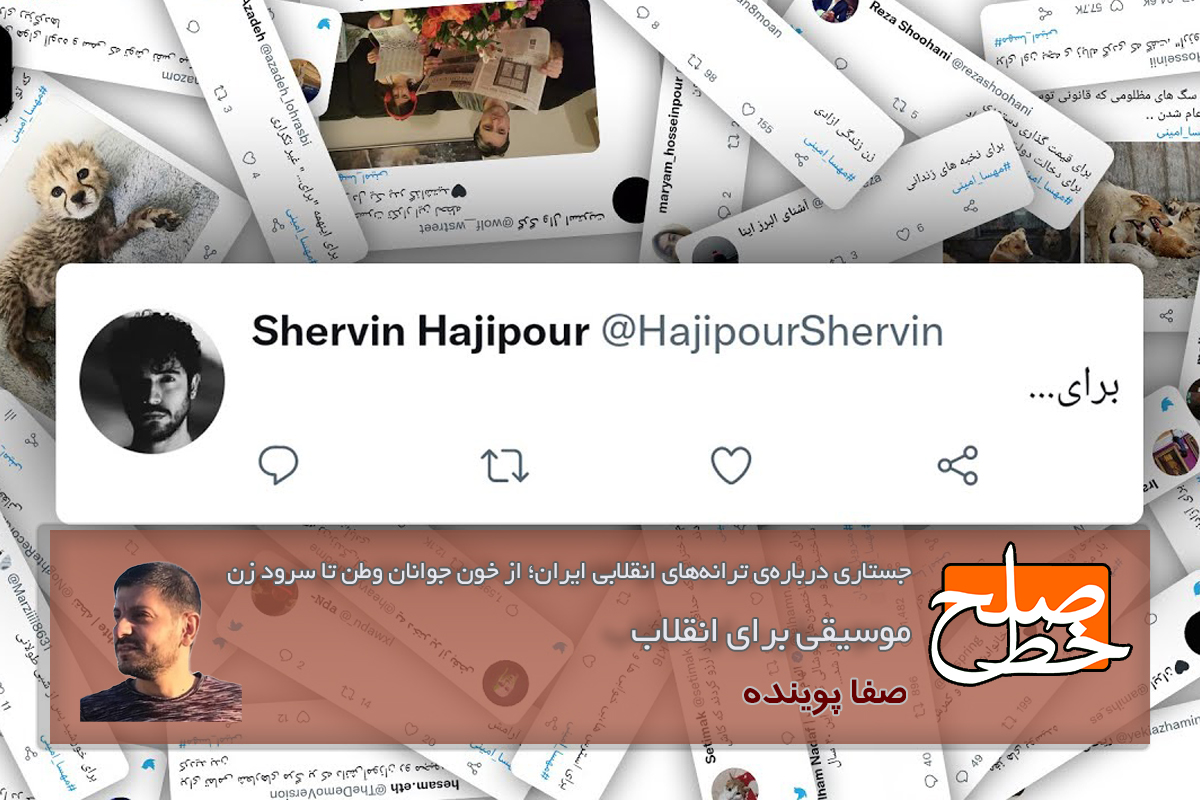
The first songs that became popular and still have the highest level of reception are “For…” by Shervin Hajipour, a 25-year-old artist, which we will discuss in the following lines. The number of pieces produced for “Woman, Life, Freedom” has increased and now it can be claimed that the number of protest songs related to current protests in Iran has become comparable to the songs released for the 1957 revolution.
The reason for the abundance of songs.
In general, there are several points that can be mentioned as the main reasons for the abundance of protest songs in the “Women, Life, Freedom” movement:
Internet.
Access to the internet has made it easy to publish works. If you have a passion for poetry and also have a hand in music, you can even work independently in one room and as soon as you have the output, you can publish it.
b) Facilitating the conditions for music production.
Despite the thousands of different music programs and sound effects available, music production no longer necessarily requires recording in a studio, arranging, mixing, and mastering by professionals in a studio; anyone who knows (or even doesn’t know) music can use these facilities to produce their work in the shortest possible time without the need for recording musicians in the studio and professional sound recording. They can produce their work in these software programs, which have a wide variety of options for beginners and professionals alike.
C) Formation of Protests.
Many words have been said and countless articles have been written in describing the concept of “woman, life, freedom”. What is clear is that protests with this key slogan have placed a large portion of society among those seeking change and demanding their rights. Therefore, the number of amateur and professional musicians who have reacted to this and have produced works is greater than previous protests.
D) Learning.
This case has a close connection with case number 3, but this pen has separated it in order to attract more attention from readers to the issue of learning. The current protests are more revolutionary than other prominent protests after the war (78, 88, 96, 97, and 98). Every day, the number of protesters who have moved beyond reform and demand the formation of a new government increases. This issue has also entered other forms of songwriting into the protest movement, which is no longer “behind the scenes” and directly raises its demands (for imprisoned elites…).
Song categories.
Pieces scattered from the beginning of the current protests can be categorized into various forms such as genre, structure, geographical location of the creator, and so on. However, let us stay true to the classical categorization from the perspective of form and content in this short essay.
a) Form.
For the reasons mentioned above (4 reasons for the abundance of songs), it is evident among the pieces produced in each genre and musical structure; from short pieces (so-called) keyboard pieces often with different dialects (mostly Kurdish) to various rap and classical pieces.
Keyboard pieces.
With a simple search, you will even come across pieces that may have had less than 500 listeners, but have worked for the “Women, Life, Freedom” movement; among these are a few short works in the trance style with Kurdish dialect such as “Pegah Omid” in which, above all, the keywords “Jina” and “Jin, Jiyan, Azadi” have been used.
Composition.
The number of works of (so-called) traditional Iranian music that have been produced during this period is much less compared to previous movements. Perhaps one of the reasons for this is the lack of connection between this music and the new generation, who make up a significant part of the active force in current protests – both in the streets and in the online space.
Pop music pieces.
Dozens of pieces in the pop genre were produced and released in line with current protests, including works by musicians such as Behnam Dariush, Googoosh, and Mehdi Yarrahi, as well as lesser-known artists like Shervin Hajipour. A notable point among these pieces is the popularity of songs that speak about demands instead of just mourning for the homeland.
Rap songs.
The number of rap pieces that have been released in the past two months is hardly countable. From unknown rappers to big names like Hichkas and Toomaj Salehi, they have all produced pieces that are in line with the current atmosphere. These pieces, with a rougher tone and more aggressive lyrics, express their demands more strongly compared to other genres.
Pieces of meat.
Harmony in a group is a symbol of solidarity and harmony among protesters and reformists. Many protest and revolutionary songs around the world are sung by a chorus. Even in pop songs produced for protests, a chorus is often used alongside the main singer’s voice.
b) Content.
More content related to the “Women, Life, Freedom” movement may be categorized as follows:
1. Ruzmi: Songs that openly speak of struggle and revolutionary determination.
2. Claimant: Parts in which claims are expressed directly.
3. Mourning: Works that go beyond demands and protests, and sit in mourning for the tragedies that have occurred.
4. Patriotism: In all of the above forms, it is the homeland that is sacred, but some of the published songs talk more about the subject of patriotism than the protesting people.
Five prominent songs.

“For…” Shervin Hajipour.
“Despite two months passing since the beginning of protests over the death of Mahsa (Zhina) Amini, there has been no response or heard songs like “For…” This song, despite its soaring and falling melody, which especially in the final vocal section makes it difficult for harmony, has been sung more than other songs in gatherings inside and outside of Iran. The most important feature of this work, which may have led to its widespread popularity, is perhaps its “inclusiveness,” which includes the following elements: “
Being young and the author: He resembles one of the street protesting students and activists, which is also evident in the way he arranges his room and his appearance.
Simple musical structure: The music has no complexity and listening to it is not difficult for any ear.
Western Music Form: This piece is both simple and familiar to the ears of today’s youth, who tend to choose their favorite music from among the current musical trends. On the other hand, the structure of this piece has made it popular beyond borders and among Western audiences, as it lacks any sign of quarter tones or complex melodic devices; the most eastern aspect of it is its minor tonality.
Simplicity of Demands: The song directly addresses a number of demands that include freedom and the decaying trees on “Valiasr” street.
News: One of the functions of this song for its foreign audience is to convey some news in the form of its lyrics. Many foreign users on YouTube can be seen who, after encountering this song, have just learned about the realities of “forbidden dogs” and “a girl who wished to be a boy” in Iran.
The interactive nature of the song: Perhaps the most prominent feature of this piece. It seems that instead of being sung by a group, this song has been written by a group.

“Anthem of Women” by Mehdi Riyahi/ Mona Barzoui.
This work, which has a martial and march-like structure, expresses “woman, life, freedom” as its main demand. The song, due to its formal characteristics and the unison of its melody, which is sung by a choir, is suitable for the harmony of protesters; as we can see in many universities as well.
Read, so that the city may become a song of women.
“That this land becomes a homeland…”
”
“Anthem of Freedom” Cover: “United people never lose.”“
From Sergio Ortega and Victor Khara.
This revolutionary piece is also entirely rebellious. Its original melody is the work of the Chilean socialist group Kilapawun, which was formed during the 1973 revolution against Pinochet, the dictator of Chile. This song, whose performance video was released by students of the Music College (Rise up for Women’s Freedom…), was also translated into Persian with a different poem during the 1957 revolution and was sung in criticism of the monarchy; “Rise up, shake the foundations of the enemy’s palace…”.
“Equality Anthem” by the group Koor.
This anthem, clearly feminist, has been sung multiple times in recent years by women’s rights activists. According to Shirin Ardalan, this song was produced in Khordad 1386 (May 2007) for the anniversary of the March 8, 1385 (June 12, 2006) protests, which were attacked by security forces, with lyrics by Maziar Samiei, piano by Samin Baghchehban, and vocals by Shirin Ardalan and Azadeh Faramarzi. This anthem has been performed numerous times by feminists, including three women who sang it without hijab on March 8, 1396 (February 27, 2018) on the Tehran metro. In the current revolution, women have also repeatedly sung this piece.
I am sprouting on the wound on my body.
It is only by being that I am a woman, a woman, a woman…

This one is for no one.
This rap song is one of the most confrontational works that has recently been released. Other rap songs have also been published during this period that insult the opposite side (Islamic Republic), but this song has been shot on a loose beat. The singer explains the reason for each shot he takes: “Each bullet is for something… for justice, for good, for bad, for discrimination, for fear,…” He also mentions “women, life, freedom” and finally shoots the last bullet towards the enemy for “a good day that we bring.”
 Created By: Safa Pouyande
 November 22, 2022
Tags
No one can be better than you. 7 Peace Treaty 1397 Mahsa Amini Mehdi Yarahi Monthly Peace Line Magazine peace line Safa Point Shervin Haji Pour Woman, freedom of life