


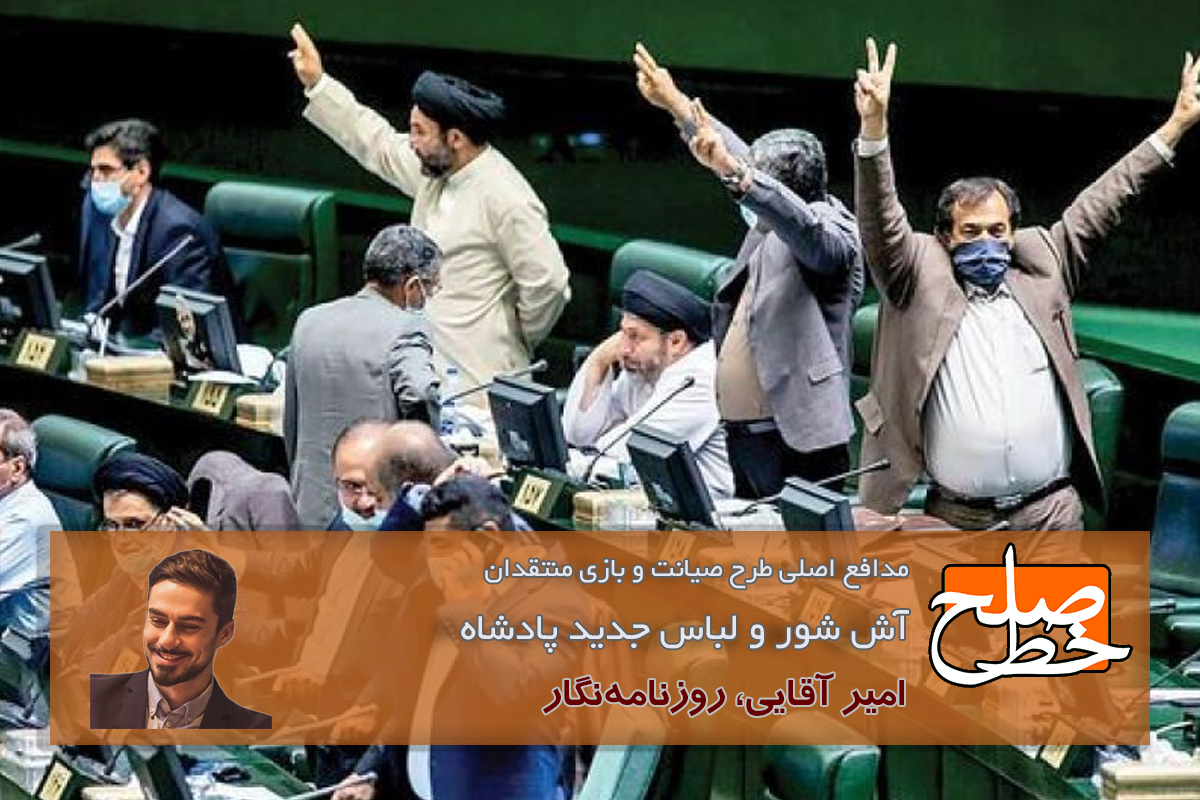
The king’s soup and new clothes; the main defender of the preservation plan and the critics’ game/ Amir Aghaei.
“Unfortunately, in our country’s virtual space, despite all the emphasis I have made, the necessary precautions are not being taken and in some aspects, it is truly neglected that those who are responsible should be aware. All countries in the world manage their own virtual space, while we take pride in abandoning ours. This is not something to be proud of; it is in no way an honor. Virtual space must be managed. We must not give this tool to the enemy to conspire against our country and our nation.”
These are the words of the leader of the Islamic Republic on the first day of the year 1400. In these remarks, he warns about the “evil” nature of the country’s virtual space, which according to the announcement of the American non-profit organization “Freedom House”, provides one of the most restricted internets in the world to its users. In the 2021 report, “Freedom House” ranked Iran lower than countries such as Pakistan, Belarus, Russia, Uzbekistan, and Kazakhstan, earning sixteen points out of one hundred on the internet freedom index, making it known as one of the worst countries in terms of internet freedom. However, it seems that officials are not satisfied with this level of internet restriction.
The revolutionary council, which is said to be in charge of affairs, less than five months after Ali Khamenei’s talks about the internet and his warnings about managing this space (which was not the first time it was heard), clarified a plan in parliament, initially called “Protecting Users in the Virtual Space”, but in a short period of time, it became so enthusiastic that its name was changed to “Supporting Users’ Rights and Basic Services in the Virtual Space”, and then once again they put the name “Regulating Regulations for Virtual Space Services” on it, but the enthusiasm not only did not decrease, but it became more apparent every day.
At the same time, the plan was referred to a special joint commission according to the rules of the parliament and with the vote of the members of the eleventh parliament, to be examined in the open session of the parliament as much as possible. A humorous contradiction is evident in the fact that during this time, most of the meetings of this commission were broadcast live on Instagram, far from the center of attention. According to the plan, the protection, provision, and operation of foreign essential services require the introduction of a legal representative and the acceptance of the obligations communicated by the “commission”; a commission that is referred to here, practically takes control of the virtual space and government institutions such as the Ministry of Communications and its affiliated organizations, such as the Radio and Telecommunications Regulatory Authority and the Telecommunications Infrastructure Company, which may sometimes act in a less restrictive manner towards the internet with the change of governments, lose their legal authority. In this commission, representatives from various institutions, including the Revolutionary Guards,
One of the aspects of the plan for safeguarding the powers of the country’s communication sector is the transfer of these powers to the mentioned commission. This includes the authority of the commission for regulating regulations; for example, according to the safeguarding plan, the commission for regulating regulations loses the power to set tariffs, which is one of the highest current institutions in regulating the country’s communication sector. It also cannot issue frequency allocation licenses and remains unable to receive the royalties for issuing these licenses.
According to a decision made on June 26th, another part of the plan will be sent to the Joint Commission for review. This essentially gives the authority for internet access to the country and bandwidth management to the General Headquarters of the Armed Forces. Based on Article 10 of the plan, “Access System, Duties, and Authorities of Related Agencies at Safe Border Passages and Necessary Regulations for Implementing the Decisions of the Working Group, based on the policies approved by the Supreme Council of the Virtual Space, will be submitted to the Commission for approval within three months, upon the recommendation of the General Headquarters of the Armed Forces.” Therefore, only the technical and executive aspects related to bandwidth will remain under the control of the Ministry of Communications.
In one of the clauses of this article, the presence of the private sector in international bandwidth development is prohibited; also, in article 11, the formation of a committee is foreseen to implement article 25 of the Constitution in the virtual space under the supervision of the Judiciary and the Attorney General of the country. Article 25 of the Constitution of the Islamic Republic of Iran states: “Inspection and opening of letters, recording and disclosing telephone conversations, disclosure of telegraphic and telefax communications, censorship, non-communication and non-delivery of them, eavesdropping and any form of espionage is prohibited, except by law.”
The argument between the goldsmiths continues.
The protection plan during the meetings of the Joint Commission could not withstand the criticisms and attacks, even from within. The Minister of Communications of the thirteenth government, Eisa Zar’epour, who repeatedly considered the main mission of his ministry to be the development of the national information network and even emphasized the management of the virtual space, has mentioned in several occasions that he has criticisms about this plan; to the extent that in Azar month of 1400, Zar’epour confidentially asked Qalibaf, the Speaker of the Parliament, to pay attention to the opinions of the Ministry of Communications and the critics about the protection plan; of course, Zar’epour showed a few months later that he not only does not care about the freedom of the internet, but also has problems with transparency. He had stated about this plan that it was not right to make it a media issue from the beginning and it would have been better if this plan was examined in the “elite
After Zar’epour wrote this letter to Ghalibaf, the Joint Commission decided to send the proposal to the Parliament Research Center to also receive the expert opinion of other stakeholders. In its report, the Parliament Research Center pointed out multiple flaws and violations of constitutional principles in this proposal. The Deputy Director of the Parliament Research Center also criticized the previous time when the proposal was sent to the center before being passed in the Parliament. He had mentioned that at that time (summer of 2021), when Alireza Zakani was the head of the Parliament Research Center, most of the deputies of this institution had also pointed out these flaws, but the opinions of relevant parties and the audience were not heard, and the center did not send a formal written report to the Parliament to expedite the review process.
In the next phase, when the Minister of Communications presented his criticisms to the plan and the plan for safeguarding the return to the research center, as mentioned, the situation changed slightly. At that time (December 2021), it had been a few months since Alireza Zakani – who had a degree in nuclear medicine and had taken over the Tehran City Council with many controversies – had left the parliament and no longer held the presidency of the research center for the legislative power. The criticisms of the research center to the plan, of course, did not sit well with the taste of Taqi Pour and his colleagues, and after receiving the report of the research center, the members of the commission held a meeting and accused the center, which apparently is the wing of the parliament’s research and expertise, of “political maneuvering.” However, the situation continued to escalate. After the report of the center, the commission members faced more criticism than ever before. The supporters of the plan, who
Finally, the deputy of the parliament’s laws deemed the vote that was given for the approval of the general plan at the beginning of Esfand month to be against the parliament’s regulations, and the parliament’s presiding board also confirmed this deputy’s opinion. The parliament had approved on 26 Tir month that a plan should go to a special joint commission that would have significant differences from what was signed in the previous year’s Esfand month. However, the plan’s file is still open and a decision about it will likely be pursued in the year 1401.
The Ivory Tower with no windows of the officials of the Islamic Republic.
“Chairman of the Joint Commission for the Protection Plan, Reza Taghipour, said in a meeting held after the controversies surrounding the approval of the general plan, which Fars News Agency had organized to clarify the issue, ‘For eleven years, they have been talking about cutting off the internet, but it has not happened yet.’ Taghipour is right. He looks at the issue from the same angle that the more radical spectrum of Islamic Republic officials look at the country’s issues; the same angle in which they selectively choose and cover issues with a veneer of ideological appearance to show that their concerns are the same as the people’s concerns, and they are pursuing a solution with a tint of ideology. Taghipour and his colleagues and peers look at the issues from a perspective that, if they speak in a way that denies the complete shutdown of the internet during the November 1998 protests, it should not be surprising. This view is a continuation of a perspective that sees the
The official political arena of the country has regressed to the point where even the main critics of the protection plan, including reformist conservatives of the tenth parliament or the compromising moderate cabinet of Hassan Rouhani, are not satisfied. Instead, the voices of radical reformists and even some traditional conservatives have become so outspoken in blocking the virtual space. Of course, they also know very well who the main defender and initiator of restricting the virtual space is and where they are sitting.
 Created By: Amir Aghayi
 March 21, 2022
Tags
Censorship Filtering Freedom of speech Internet Maintenance plan Monthly Peace Line Magazine peace line The Commission for the Protection of the Parliament