


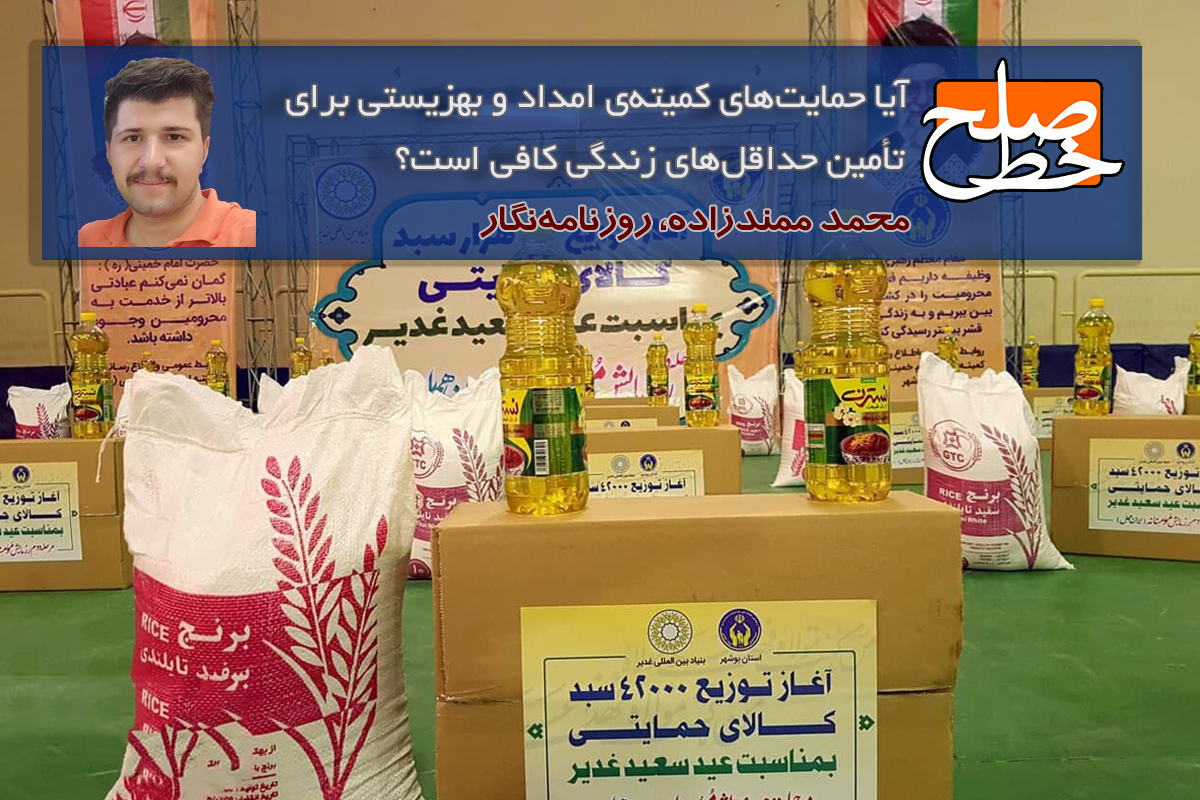
Is the support of the Relief and Welfare Committee enough to provide for basic living necessities? / Mohammad Momenzadeh
The living conditions of Iranian households have worsened day by day as a result of economic corruption, inefficiency of managers, the widespread COVID-19 pandemic, and sanctions imposed due to nuclear activities. In a country with vast oil and gas resources, a considerable percentage of families are in need of economic support. In such a situation, the government is obligated to assist low-income families. According to a study by the Welfare Deputy of the Ministry of Cooperation in 2019, more than forty-one percent of the country is living in poverty in terms of health and food. Other factors, such as housing and healthcare, also indicate the dire situation of citizens.
Support institutions emerged in Iran after the 1957 revolution, claiming to improve the situation of the poor. The Welfare Organization, Relief Committee, and Foundation for the Oppressed are three government support institutions with similar responsibilities, such as supporting needy families, children, the elderly, and socially vulnerable individuals. However, it should be noted that since December 2010, the Iranian government has gradually removed indirect subsidies for fuel, food, water, electricity, and other items, and instead deposits 45,000 tomans per person into the account of the head of households. This amount has not increased since 2010, despite the significant increase in the exchange rate of the dollar. As a result, the direct cash assistance deposited into household accounts is insignificant, and currently, with the government subsidy, one can buy less than one kilogram of rice.
A large number of citizens have joined support institutions in order to benefit from their assistance and benefits. According to the official statistics of the Relief Committee, which is one of the first support institutions after the 1979 revolution and covers several million people. The Director General of the Relief Committee’s Welfare Services Center announced in 2019 that “in the current situation, 2.23 million households, consisting of 4.28 million people, are covered by the Relief Committee.” These families are individuals who receive regular assistance as ordinary welfare recipients and households covered under Article 14 of the Relief Committee’s services. The amount of monthly allowance for Relief Committee beneficiaries in 2021 has increased by nearly 67% compared to 2020, with a monthly allowance of 350,000 tomans for a one-person household, 500,000 tomans for a two-person household, 700,000 tomans for a three-person household, 900,000 tomans for a four-person household
One of the supportive institutions of welfare is, according to its managers, aimed at “efforts to preserve the well-being of vulnerable and disadvantaged families, care and rehabilitation of the disabled, and preparing them for reintegration into society, developing applied research to prevent disabilities and social harms, and rehabilitating socially vulnerable individuals.” According to published statistics, more than one million people receive welfare benefits, which is similar in amount to the Relief Committee.
The peace line has been negotiated with a number of individuals who are members of the Relief and Welfare Committee.
Khadijah, a fifty-two-year-old woman who lives in the city of Sardasht in West Azerbaijan with her brother. They are both single. Khadijah speaks of peace.
“My brother and I were under the protection of the Relief Committee. My brother was in charge and my monthly allowance was deposited into his account, but he never gave me any money. I continued in this situation for years. I complained to the committee several times, but received no response. I eventually left the committee and later came under the protection of the Welfare Organization. Because my brother was in charge, the money was deposited into his account and he never gave me any. With the high cost of living, the money we receive is not enough to cover our daily expenses. Prices have gone up significantly. The cost of a bag of rice is three hundred thousand tomans. If it weren’t for the help of family and benefactors, I wouldn’t be able to afford my daily needs.”
Fatemeh, a sixty-year-old resident of Sardasht who is the mother of five children, speaks of peace.
“My spouse is unemployed and I am a tenant. We have no source of income and I am a homemaker myself. I decided to go to the relief committee and be under their coverage. I wrote a letter and went to the committee. The female employees there responded to me with indifference and did not ask about our living situation at all; they only asked if I was married, to which I replied yes. Then they told me to leave. A woman who has not divorced is not eligible to be under the coverage of the committee.”
Maryam’s husband has passed away and she has taken on the responsibility of caring for her five sons and three daughters. Maryam speaks of reconciliation, saying:
“After the death of my husband, I joined the relief committee. The allowance that the committee provided for us was very little and did not cover our expenses. I raised my children in difficult circumstances. Every summer, we would go to brick kilns to earn a living. But when my children grew up and got married, the committee called and said that since my children were now adults, I could no longer be under their coverage. Meanwhile, my children have gone on to live their own lives and I am struggling to provide for myself.”
Leyla, a forty-three-year-old woman whose husband was a border guard and was killed by the border forces, speaks about peace:
After my husband’s death, because I had two children aged five and twelve, I went to the relief committee several times. I was able to become a member of the committee and with difficulty, I pay for my rent. They said if I ask the committee, they will build a house for me. I also went to the committee. They told me that I had to buy the land myself. Buying land is not within my means and for a piece of land, I have to have a sum close to one hundred million tomans, which I cannot afford to pay.
Limited support from the Relief and Welfare Committee is not enough to provide for the minimum necessities of life. The paid subsidies cover only 15% of expenses according to the World Bank’s absolute poverty line; nevertheless, many citizens living below the poverty line seek membership in these institutions. Despite their stated goals, support institutions have not been able to bring about significant changes in the lives of citizens. According to the concept of “poverty porn,” charities ignore the issue of poverty and keep people satisfied by giving them insignificant charity. For example, in most public places, charity boxes for the Relief Committee are installed. According to the managers of the Relief Committee, in the first nine months of this year, 444.4 billion tomans were collected in charity. This is happening while every few months, the curtain is lifted on corruption scandals worth billions of tomans.
Notes:
1- The increasing trend of poverty in Iran, Meydan, 18 Shahrivar 1400.
2- The new level of family subsidies under the coverage of the Relief and Welfare Committee was announced, Tasnim, 5 Ordibehesht 1400.
3- Empowering the target community is the main goal of welfare, welfare, 7 Mordad 1399.
4- The statistical yearbook of the Welfare Organization of the country, welfare, 1 Aban 1400.
 Created By: Mohammad Mamandzadeh
 February 20, 2022
Tags
Mohammad Momenzadeh Monthly Peace Line Magazine Paragraph peace line Peace Line 130 Relief Committee The Relief Committee Welfare