


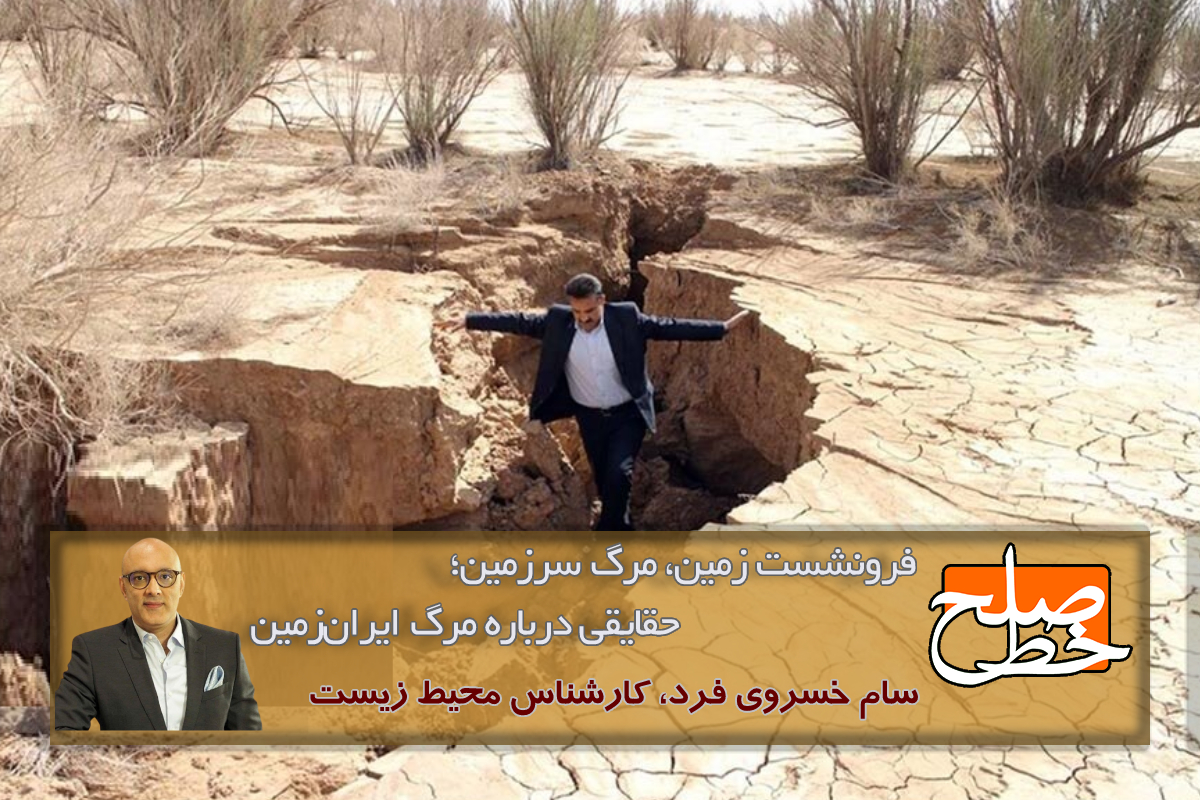
“Forgotten Earth, the death of the land; truths about the death of Iran’s land / Sam Khorshrooifar”
These days, when we talk about the environment in Iran, everyone immediately thinks of drought and water scarcity; an undeniable phenomenon resulting from corrupt management and exacerbated by climate change, which is taking away our ability to live in this land as Iranians. But there is another tragedy that is perhaps less talked about: the loss of soil, land subsidence, and the emergence of sinkholes. Even if we could provide water through technological tricks (such as desalination), no practical solution has been found for the lost soil and subsided land. If water scarcity turns a land into a desert, land subsidence leads to the death of the land.
Some government statistics show that annually, 125,000 hectares of forests and 800,000 hectares of pastures are destroyed (the total of these two numbers is more than the area of Qeshm Island). At the same time, with the loss of soil moisture and destruction of plants, the rate of erosion is increasing. It is estimated that at least two tons of soil in Iran is eroded and lost every year (meaning that 274,000 truckloads of soil are being taken out of Iran daily; understanding such a situation may be beyond our imagination. Unfortunately, this tragedy has been repeating in Iran for years). Iranian experts believe that our country has the highest rate of soil erosion. Now the question is, what is the importance of soil erosion? When moisture is lost, plants are destroyed. The destruction of plants means more soil erosion. Erosion and loss of soil (especially fertile soil) means the impossibility of plant growth and development. However, it should be noted
The situation of surface waters is also disappointing. Official reports show that 90% of wetlands are in critical conditions. Most of the country’s rivers have dried up: the depth of the Karun River has reached one meter in some areas and has completely dried up in some places, with sewage running rampant in it! Zayandeh Rud has completely dried up more than 20 times in the past 10 years. For the first time this year, news has come that the Chalus River has also experienced drying up. Springs and rivers in Lorestan and Isfahan have become waterless in the eyes of the astonished residents of that land. This situation is almost prevalent throughout Iran.
A quick glance at the situation of underground waters shows that Iran has lost more than 70% of these resources in the past four decades. The depletion of underground water resources leads to land subsidence, the occurrence of sinkholes, and ultimately the death of the land (for a better understanding of the increasing land subsidence in Iranian plains such as Qazvin and Tehran, and the rise in the number of sinkholes, refer to the news published in recent months). When the land subsides, it becomes impossible to revive it. More than 400 Iranian plains, which were once lush and a place for agriculture and life, have completely dried up.
With the loss of water and the death of the land, the process of migration, settlement on the margins, and its subsequent consequences are also increasing. According to official authorities, migration from Fars, Yazd, Sistan and Baluchestan, Khuzestan, South Khorasan, and Kerman has been going on for years. The villages of Korbal on the banks of the Kur River in Fars, which have been the habitat and settlement of Iranians since the time of the Achaemenids, are now almost empty. According to the statements of government officials, more than 20 million Iranians are living on the margins (sociologists can better explain the death of social life).
On the other hand, the fate of Iran, Iraq, Turkey, and Syria is more or less intertwined. The important rivers of the Tigris and Euphrates, with the Anatolian project (construction of 22 dams and 19 power plants on their branches), can lead to the death of the fertile crescent or the cradle of civilization; the destruction of this vast area is almost beyond imagination. The fertile crescent is a vast region similar to a rainbow or crescent moon that starts from the northern shores of the Persian Gulf, passes through Iraq, Syria, Lebanon, Jordan, and Israel, and reaches northern Egypt (the lack of constructive diplomacy in the region and the weakness of Iran are among the exacerbating factors of this irreversible event).
The name of Egypt came; remember that the state of the Nile is not good and the Renaissance Dam in Ethiopia will hit the Nile. The loss of soil moisture in this region (North Africa and the Middle East) means an increase in dust storms in Iran. Speaking of dust storms, a few officials announced a few days ago that 2,800 hectares of dust centers have been identified in Iran.
Therefore, Iran not only faces internal dust storms, but also receives a significant amount of this toxic dust, contaminated with radioactive, chemical, and disease-causing substances, from neighboring countries, which directly enters the lungs of its citizens.
The natural elements of Iran are deteriorating; from water and plants to soil and wildlife, from rivers and springs to forests and pastures, from wetlands and lakes to grasslands and orchards, from surface resources to underground mines and quarries. When these resources are lost, it means the land and homeland are dying. It means a large part of Iran will no longer be habitable.
Such a statement disturbs and troubles people. They have the right to be. It is difficult to believe. It remains like a mourning that wanders into the heart of man. But denying the truth and rejecting it does not solve any problems. The first step to solving the problem is to accept it. Let us accept that with the false hope and the illusion of normalcy, we cannot stop the current destruction of our Iran, and then maybe we can gather the courage to treat it, of course, maybe.
 Created By: Sam Khosravi Fard
 August 23, 2021
Tags
Dam Dam construction Dam construction and destruction of water resources Monthly Peace Line Magazine Number 124 peace line Sam Keshvari Fard The Earth's rotation Water ماهنامه خط صلح