


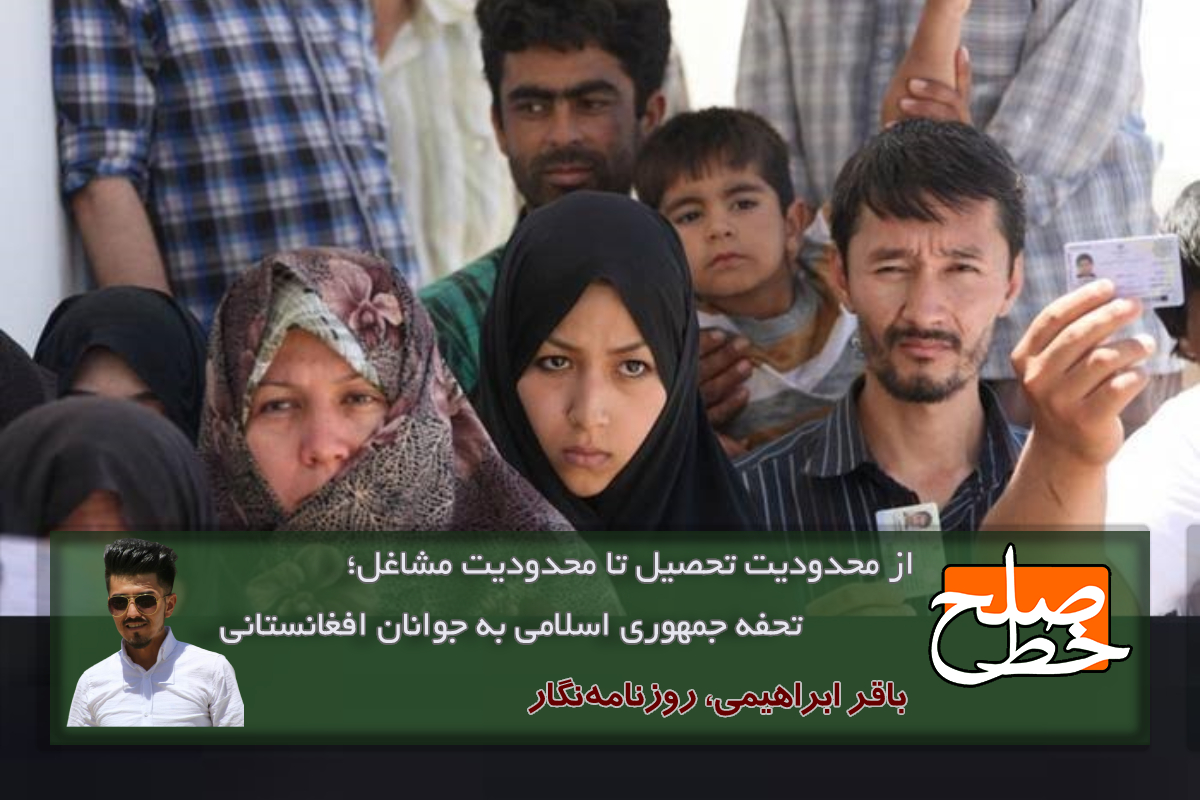
From limited education to limited job opportunities; the gift of the Islamic Republic to Afghan youth / Baqer Ebrahimi.
The decades-long war in Afghanistan has forced millions of its citizens to flee the country and seek refuge in neighboring countries. Iran is one of the countries where approximately three million Afghan immigrants live, mostly consisting of young people.
Young people who have sought refuge in Iran due to war, poverty, and hardship. Some of them have traveled to this neighboring country for work, and some are born in Iran and have been living there with their families for years, all working as laborers.
However, the Islamic Republic strictly enforces laws against Afghan immigrants, causing harm to their youth. These young people are even deprived of their basic rights such as obtaining a SIM card, having a bank account, and receiving education; some cities and occupations have also been declared off-limits for Afghan immigrants.
A large number of young Afghans living in Iran were born in Iran, young people who had no role in choosing this country and the force of circumstances has forced their families to leave their country; but the burden of this migration weighs heavily on the shoulders of young people. In childhood, they were not allowed to go to school and in their youth, they struggle with thousands of other problems.
“Nazanin” is a young Afghan immigrant girl, born in Iran, who after years of living in this country, says that the Islamic Republic has no plans for Afghan immigrants: “The Islamic Republic has not had any comprehensive and useful plans for immigrants. It could have used elite immigrants like other countries that grant the right to education to immigrants and then use their talents after graduation.”
He continues, “But the only thing that the Islamic Republic did with the young people of Afghanistan was to use their youth and strength in building buildings, streets, and promoting agricultural, cattle, and poultry projects. They always had and still have a condescending view towards immigrants.”
According to him, young Afghan immigrants are not even allowed to purchase SIM cards in their own name and they are forced to seek help from Iranian citizens for this task; in case their SIM card is blocked or lost, they cannot take any action to retrieve it.
According to the laws of the Islamic Republic of Iran, Afghan youth residing in Iran are not allowed to buy a house, car, or property. They must seek assistance from Iranian citizens for this matter. In case of purchasing a house or car, the ownership document will be registered under the name of an Iranian citizen, and that person can claim ownership at any time. This incident happened a few years ago to one of our dear relatives, and the Iranian person took the house from them.
While the economy forms the fundamental basis of life, young Afghan immigrants in Iran are not allowed to start economic activities such as establishing factories, engaging in construction and industrial work. They must always work as laborers for Iranian employers.
My beloved, with her own eyes, expresses it as follows: “If immigrants in Iran want to buy a house, property, or car, or have the intention of starting a business, they must have the permit in the name of an Iranian. There have been many cases where after they have transferred their house or car to an Iranian’s name, they have lost it because the documents were not in their own name and they did not have the right to ownership.”
Having a bank account, which is considered as one of the basic rights, is also a challenging and troublesome task for young Afghan immigrants; those who live legally in Iran cannot easily have a bank account. Perhaps after days of wandering, they may succeed in doing so, but their bank account can be blocked without any reason or notification; reopening it can even take months.
Nazanin remembers bitter memories of her bank account being blocked: “Once I went to a store to buy my daily necessities, I made a purchase and when I went to withdraw money to pay for it, I saw that my account was closed. It was a terrible feeling. The seller asked me why I was buying things if I didn’t have any money. I told her I had money in my card, but it seemed like my account was closed. The seller then said, ‘Masha’Allah, you Afghans have so much money.’ I left all the items I had purchased and walked away. The humiliation I felt in that moment and that day is indescribable. I will never forget being belittled for something that was not my fault and for which I had done nothing wrong.”
This young Afghan girl continues to add: “Educational problems for young immigrants are a widespread issue. In this regard, there are many difficulties for immigrants. Young people can only study in predetermined fields and majors; even if they complete their studies and graduate, they are still not successful in finding a job. Many young people who have completed university either return to their own country or migrate to European countries.”
Aside from the strict laws that the Islamic Republic imposes on immigrants, some citizens of this country also have a negative view towards Afghan youth. This attitude can be felt in different parts of the city, from drivers to shopkeepers and pedestrians who are passing by.
He concludes our conversation with these words: “His migration is all bitterness, just looking down on himself like that is very painful. I feel like I see myself as a young Afghan with neither a homeland nor a clear identity. In Iran, they don’t accept us, the ones who were born here, and Afghanistan sees us as mere migrants.”
A large number of young Afghan immigrants residing in Iran have traveled to Iran for work and to make a living. They also experience even worse problems; from hiding from security officers to being insulted and humiliated by employers and business owners, and being subjected to labor exploitation.
Most of these young people have smuggled themselves into Iran and do not have residency permits; they are known as illegal immigrants who usually live in hiding. These young people are mostly engaged in hard labor jobs such as stone mining, construction work, and factory work.
For these young people, reaching Iran is like passing through the treacherous and dangerous routes of smuggling, similar to passing through the Seven Labors of Rostam; but if they manage to arrive safely in Iran, they still face their own difficulties there.
“Reza” is one of the young Afghans living in Iran who illegally traveled to this country five years ago and is now working in construction in Tehran. He has many sad stories; from hiding under barrels to escape from security officials to not being paid by his Iranian employer.
In several modern buildings in Tehran, the signs of his hand are evident. Two years ago, when I was working on tiling in one of Tehran’s buildings, security forces stormed in due to the arrest of undocumented Afghan workers. One of the workers, upon noticing the officers, informed the others of their presence.
Some are captured and some are saved: “One of our fellow countrymen shouted that the authorities had come and we should escape. I was forced to hide under a barrel. I was there for almost half an hour, I was close to suffocating but thank God the authorities couldn’t find me. They caught seven or eight people, beat them and took them with them, and in the end they crossed the border.”
As he does not have a residency permit, he cannot freely move around the city or visit his relatives’ homes. Even when going out to buy things, he goes out with fear and worry, afraid of being arrested by security officials and deported to Afghanistan from the room he lives in.
Some cities and jobs are also declared forbidden for young Afghans in Iran, and they are not allowed to enter those cities or work there; therefore, they are forced to work in limited cities and even more limited jobs, which are all difficult tasks. In some recreational parks and even stores, entry for Afghan citizens is also prohibited.
According to himself, he has been insulted and humiliated multiple times by Iranian employers during work, and has heard vulgar insults from them that he cannot repeat. He has also felt discrimination based on his skin and bones while shopping in stores and moving around the city.
Once, the employer did not pay him: “I was working in a building, doing stonework on the facade with a few others. At first, it was good. The employer was paying us, but when the work was halfway done, his payment became very bad. He only gave us enough money to buy food. He would say, ‘When you finish the work, I will pay you in full.’ When the work was finished, he had taken about 20 million from us and said he had no money and we were free to go.”
Reza and other workers who were working there did not have residency permits; therefore, they were unable to go to the police and complain to the employer. As a result, they were unable to receive their money. Some other Iranian employers also did not fully pay their wages and after the completion of work, they made various excuses to deceive them.
This is just one example of the problems faced by young Afghans in Iran, but when we sit down and listen to their stories, the memories and experiences of each of them remain like an unwritten novel that can be written about in lines.
 Created By: Baqer Ebrahimi
 July 23, 2021
Tags
45 Number 12345 Afghan youth Baqer Ebrahimi Monthly Peace Line Magazine peace line The daily problems of today's youth. The problems of young people Young Afghans in Iran Youth