


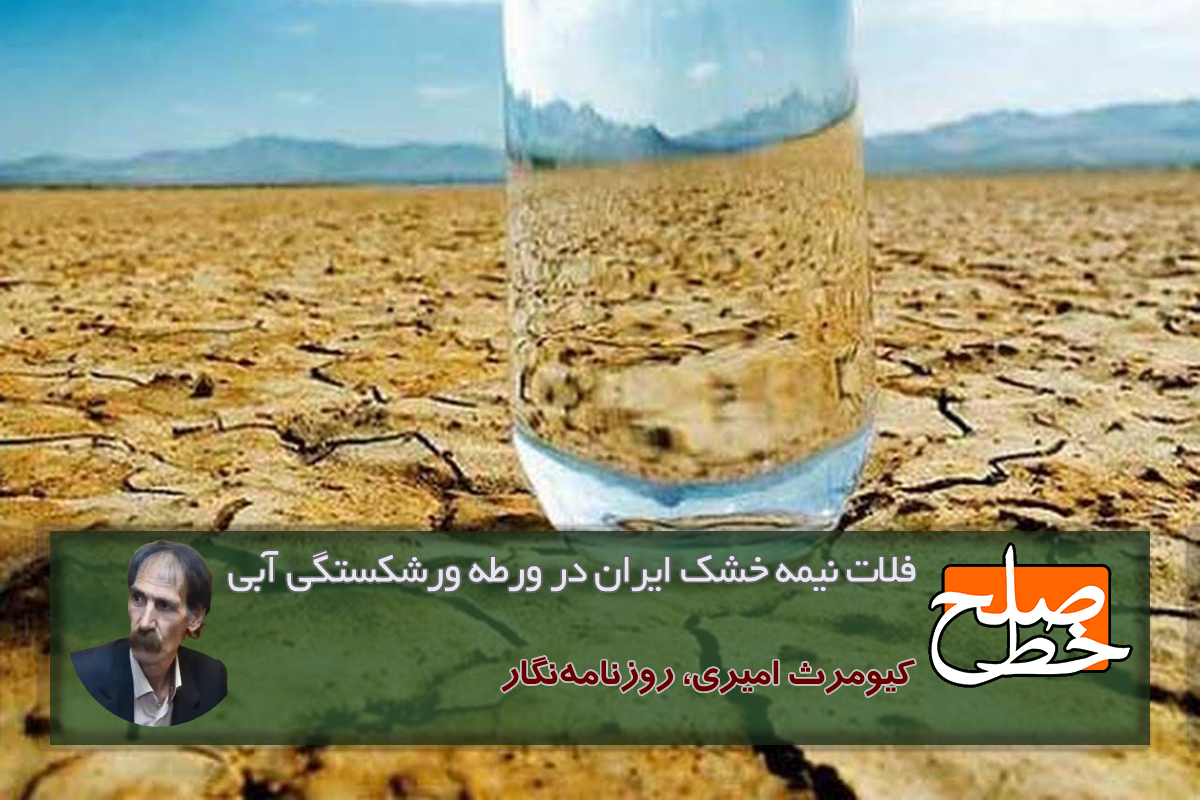
“Iran’s semi-dry lands are in danger of a water crisis/Kiumars Amiri”
The evident proof of this bitter reality is that from previous centuries until now, billions of hectares of the world’s vast forests have been lost and never recovered. This ongoing trend, in which human intervention is one of the major factors, continues to progress all over the globe, especially in the so-called Third World countries and in dry and semi-dry lands like Iran, in a terrifying manner.
No one is unaware that water is the source of life and without it, life would be impossible and unimaginable. However, to what extent has humanity taken this reality seriously and believed in its vital importance can be seen in their behavior towards this important element of water, which unfortunately will lead to bitter and concerning consequences.
Water, as one of the four main elements of life, has been a subject of attention for centuries and in this century, with concerns about water scarcity, it can be said that it has been given even more seriousness and attention. From time to time, it has been discussed and studied by scientists and biologists.
This fact cannot be forgotten that the existence of water depends on several factors, a large part of which is in the hands of humans. It must be said without exaggeration that the behavior of humans towards water has been rational and friendly over the centuries, especially during the industrialization of societies, which has multiplied water consumption. In its destruction, it has played a significant role in various dimensions.
The warming of the Earth, which is partly related to human activities on the planet, has had the greatest impact on the reduction and depletion of water and the occurrence of droughts on the Earth.
One of the other important factors in relation to water is the phenomenon of forests. Forests are one of the main natural factors for preserving and expanding water on the earth, while forests themselves rely on water for survival, growth, and expansion. Without water, forests and agriculture would not exist, and in a broader sense, life itself would not exist.
On the other hand, the loss of forests is just as effective in reducing water levels as the absence of water is in the destruction of forests. These two natural phenomena are complementary to each other in the mystery of existence and the continuation of life on Earth, and as a result, they enter into a phase of conflict and confrontation during human intervention, and in a way, they are in conflict and confrontation with each other. In another definition, forests and agriculture, which are two poles that maintain each other and are therefore water retainers, are in conflict with each other and have heavy effects on the quantity and quality of surface and underground water, as well as on the agricultural sector. The famous saying that has been expressed in recent years about water is that the next war between nations will be a water war.
In a general definition of water, it can be said that water is the source of life for all living beings on Earth, yet humans have undervalued and constantly put unnecessary pressures on it. This has put this source of life in danger of destruction and facing an uncertain and very concerning fate.
“Since the discovery of agriculture, unfortunately, humans have resorted to destroying their twin sibling, the forest, in order to expand it. They have not considered the forest as an important element in interaction with agriculture, but rather as a counter phenomenon in the matter of agriculture. In order to expand agriculture, they have been determined to destroy forests and deforestation. With the increase in human population on earth and the expansion of cities, the expansion of agriculture has become more and more prevalent, which inevitably has had a significant impact on the destruction of water resources.”
Forests, in their inherent nature, serve as a means of preservation and increase of water, while agriculture, on the contrary, has been and continues to be a destructive phenomenon for water in many ways.
“The evidence shows that as much as agriculture has grown and expanded, forests and water have suffered and fluctuated in the same proportion, leading to destruction and loss. Over the course of centuries, countless hectares of forests have disappeared in areas where agriculture has flourished, and the land has been allocated for cultivation. Similarly, countless cubic meters of water have been lost or are currently being lost in efforts to revive agriculture. This trend in agriculture and forestry practices in Iran, at least in the past half century, has resulted in Iran currently ranking fourth in terms of water stress in the world, losing more than 70% of its water resources. “
The expansion of cities, especially construction projects on fertile lands and road constructions throughout Iran, has also caused significant damage to forests and agricultural lands in the country.
In addition to all these factors, the political agendas of some governments and the profit-seeking of mafia groups also play a very important role in the destruction of forests and consequently the warming and drying of the land.
The Turkish government has destroyed thousands of hectares of Qandil forests and the Kurdistan border in the fight against the Kurdistan Workers’ Party (PKK) over the years. In Iran, thousands of tons of wood have been looted from the northern forests by mafia smuggling gangs, and devastating fires have also destroyed thousands of hectares of forests in various parts of Iran over the years.
Nowadays, seeing single trees in the vast deserts in the corners of Iran and the world is a sign that these empty plains were once lush forests that have been destroyed and turned into dry deserts and even deserts. On the other hand, the uncontrolled use of underground water resources has not only led to the depletion of the country’s water reserves on a large scale, but also caused the drying up of the country’s climate and the creation of land subsidence in many parts of the country.
Undoubtedly, if humans had known from the beginning that industrialization and population growth in the world would lead to environmental disasters, they would have taken action and tried to prevent it.
Something close to four-fifths of the Earth’s surface is covered by water, while only 3% of this water is fresh and usable. The vast oceans and seas that cover so much of the Earth are all too salty to be usable, and the cost of making them usable is not feasible. As a result, humans are forced to rely on the 3% of fresh water available, which is not enough to meet the current demand for water. Otherwise, we will be faced with irreparable disasters.
Therefore, in order to prevent the occurrence of a water crisis and drought worldwide, especially in water-scarce and semi-arid regions such as Iran, scientists and experts have come up with measures that, if not taken seriously and acted upon, will lead to the collective demise of humanity.
Iran is a prominent example of the issue of water scarcity in the world, especially in this century.
In the 1350s, a major project to revive forests and preserve surface and underground fresh water was put on the government’s agenda in Iran. After studying and implementing the project, several important dams were built in the country, and the plan for pasture management and reforestation with tree planting was carried out. The goal was to keep the country’s climate cool and moist through forests and preserve surface and underground water. If these plans had continued, today, after all these years, Iran would have been at the forefront of countries with moderate climate, abundant forests, vast pastures, and abundant water. The purpose of implementing these plans at a national and nationwide level was to preserve and protect the environment in all areas related to climate, but unfortunately, with the establishment of the Islamic Republic, all of these plans were destroyed. The tools and equipment used in these plans were stolen and the plan for pasture management was broken. The perspective on water and the environment completely changed and what should not have happened
The increase in population and uncontrolled consumption of water in agriculture, horticulture, industries, and household use are also major factors contributing to the destruction of forests and subsequently the depletion of water resources in the world.
Nostalgia for a grand plan to preserve, revive, and maintain forests, water, and agriculture in Iran that was destroyed.
In the approved law that was passed by the Senate in the Pahlavi regime in 1346 AH, protection and exploitation of forests and pastures were entrusted to the ministries of agriculture, assets, justice, economy, and the country.
This large project, which also covered the issue of water, was implemented in the same year and as a result, vast areas of the country’s pastures were fenced off and various types of trees were planted in the vicinity of natural forests, covering thousands of hectares across the country. As a result of this important action, it did not take long for protected forests and pastures to be completely secured and restored from any kind of unsustainable exploitation.
This project was designed to scientifically study and preserve forests and pastures, while also managing surface and underground water in a scientific and calculated manner. It aims to prevent any improper and uncontrolled use of water resources and has already shown significant results within three to four years of its implementation, with noticeable changes and growth in the overall appearance and development of forests and pastures.
Scientific and comprehensive study of the country’s ecosystem and its proper implementation, as well as its continuation under the supervision of at least four important ministries, has led to hope for the preservation and improvement of the future of vital arteries of the country such as water, forests, pastures, and agriculture, to become a reality.
The above plan was successfully being implemented in the best possible way, and if it continued, there would be no slightest concern about these issues in the country.
But with the establishment of the Islamic Republic, unfortunately all of its studies and achievements were labeled as tyrannical and destroyed in all fields, and in the long run, they were forgotten.
All the fences of the pastures and barbed wires were removed and stolen. The pastures were destroyed and plans for dam construction and others were all suspended.
The cessation and destruction of that law caused chaos and a disordered state in the entire ecosystem of the country, and all of these issues were ignored. Unregulated and unstudied water wells were dug for agriculture. Rivers became polluted and forests have been destroyed and devastated in various ways for years, and as a result of these problems and mismanagement, the vast land of Iran has been faced with water, forest, and agricultural crises. As a result, over the past four decades, according to experts, 73% of Iran’s water has been permanently lost, and this irreparable void remains.
Iran has entered a stage of water bankruptcy in the year 1409. And in the current year, the country has faced a 49% decrease in rainfall.
Land subsidence and the phenomenon of sinkholes are occurring due to unregulated use of underground water tables in various parts of the country.
The scope of these crises and problems is to the extent that many experts and opinion leaders believe that the land of Iran is on the verge of extinction and living in it will be impossible in the near future.
What is the solution to the depth of the blue disaster, agriculture and deforestation in the semi-arid plateau of Iran?!
After nearly half a century of anarchy, chaos, water and soil pollution, and deforestation in the vast and semi-arid plateau of Iran, which has occurred due to reasons such as unscientific and unprincipled approaches, inefficient and unprofessional management, etc., the Iranian plateau has now entered a dangerous stage of water bankruptcy in the year 1400. This bankruptcy has significant effects on the food security issue.
Neglecting the overall condition of water, soil, and forests in Iran for uncontrolled and unplanned agricultural development and imaginary self-sufficiency in agriculture, as well as reckless dam construction without scientific principles and even without proper research, and unfortunately, political and self-centered approaches and the use of wrong development patterns have caused the Iranian ecosystem to suffer a general decline, disturbance, and unprecedented and irreparable destruction over the past fourteen years. At this stage, the pollution of rivers and canals by urban sewage and industrial waste, and the disregard for traditional use of surface water for irrigation, and the pressure on groundwater, have resulted in the withdrawal of more than 73,000 cubic kilometers of groundwater in less than 15 years, which will be impossible to compensate for, according to experts.
In such conditions, where the country has passed the crisis border and entered the dangerous stage of water bankruptcy, and the war over water has begun and is expanding, and in the past forty years, more than 80% of the country’s forests and natural resources have been lost, and agriculture is on the verge of complete destruction, so that only in this year, due to drought and lack of rainfall, more than 67 trillion Tomans of damage has been inflicted on the agricultural sector of the country. Despite the fact that experts believe that returning to the past is impossible, expert suggestions and opinions are presented to prevent further destruction and to revive the vital veins of Iran, and above all, to completely change the development pattern and approach to agriculture and change management are emphasized.
It is said in this regard that in the long term, we must think about improving conditions in all related areas and put an end to this chaotic market quickly. We must take the environmental discourse very seriously and scientifically. Correcting management and familiarizing the public with the dangers of neglecting the environment should be seriously considered and by putting an end to society’s indifference, create a sense among people that everyone has an equal right to natural resources and eliminate the contradiction between government and people, and the separation of people from the government, and create a sincere spirit towards building trust between government and the nation.
Accepting the bitter reality that over the past four decades, many of the country’s resources have been permanently lost and cannot be compensated for, is essential in the most optimistic scenario. It is necessary for the government and the people to seriously and comprehensively work towards improving this situation in a long-term process, and to prioritize a rational and intelligent environmental discourse. Undoubtedly, none of these things will come easily unless there is a strong and comprehensive determination to take serious steps. Otherwise, as acknowledged by experts and commentators, we must wait for the disappearance of Iran’s plateau in the very near future, in less than half a century.
 Created By: Kiomars Amiri
 June 22, 2021
Tags
Agriculture Kiumars Amiri Monthly Peace Line Magazine Number 122 peace line Water