


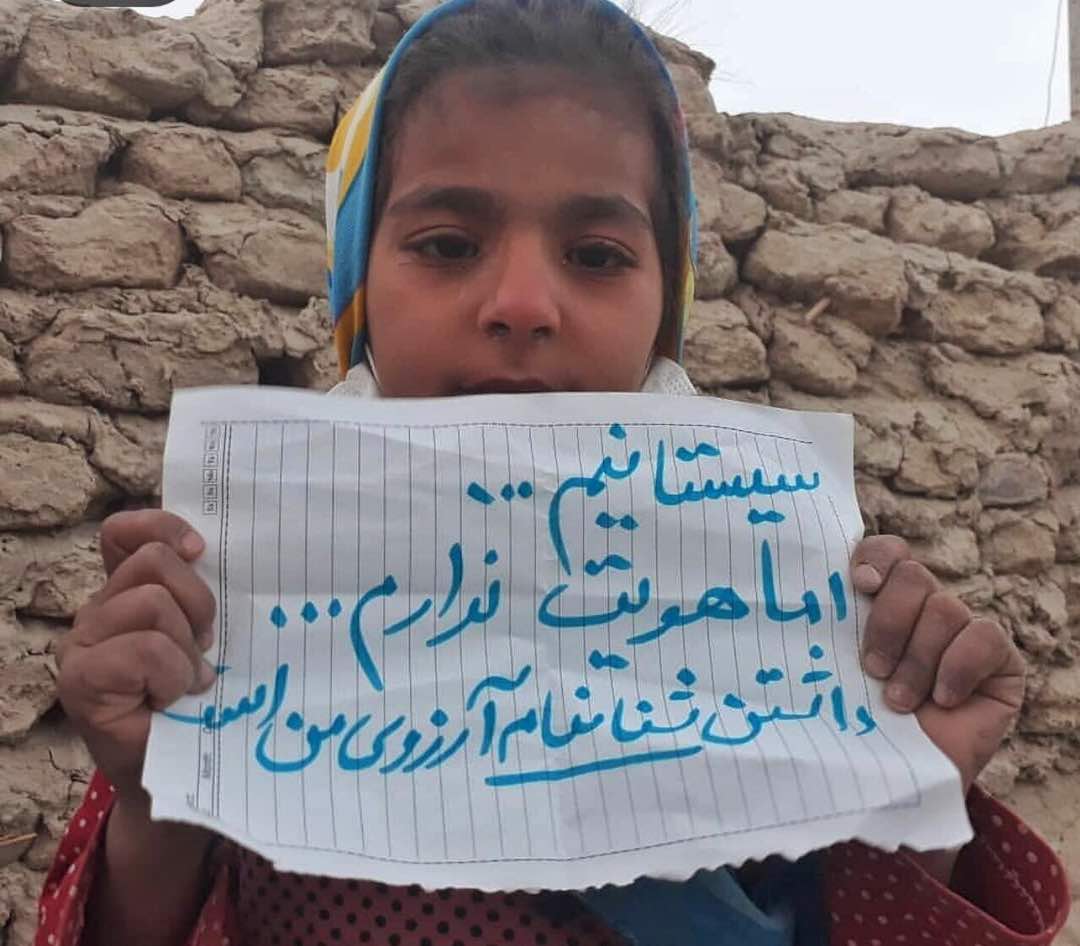
In my homeland, there are unknown identities in Sistan and Baluchestan/Miran Bahouti.
More than a hundred years have passed since the opening of birth certificates to the lives of Iranians, but after a century, there are still people who remain without birth certificates. These are people whose Iranian roots and heritage date back more than a century, but living in remote areas has deprived them of having a birth certificate. Without birth certificates, they are without identity. No one recognizes them officially and their deprivation is exacerbated during times of crisis. For years, officials have made promises that have fallen on deaf ears and there is no sign of action being taken.
No one knows exactly how many people in Sistan and Baluchestan are without birth certificates. Representatives of the province in parliament and some unofficial statistics estimate that there are one hundred thousand people without birth certificates. The majority of these are villagers whose fathers and grandfathers did not obtain birth certificates due to living far from the city and other difficulties. Some also have an Iranian mother and non-Iranian father. The people of Sistan and
Problems of anonymity
In today’s world, unlike a hundred years ago, being without a birth certificate is not a common occurrence that would not make a difference if it didn’t exist. These days, having a bank account, access to insurance services, and access to many basic necessities of life are all dependent on having a birth certificate, and being without one means not existing. In the devastating floods of last year in Sistan and Baluchestan, these deprivations were brought to light. Ali Yarmohammadi, a former representative of Zahedan in parliament, tells his fellow citizens that “most of the undocumented people live in hard-to-reach areas. They needed identity documents to receive tents and other facilities during the floods. This made it even harder for them to tolerate the situation.” He adds, “All officials claim to be working on this issue, but unfortunately it has not been resolved yet.” Yarmohammadi does not consider this situation to be a matter of the government or
Long way to destination
In recent years, there has been a lot of talk about efforts to solve the problem of stateless individuals, but all of these talks have not been as effective as they should have been. This claim is also made by officials themselves. Reza Rahat Dahmardeh, the director of the provincial civil registration office, says: “Since the beginning of 1398, 2,020 birth certificates have been issued. In 1397, 3,679 birth certificates were issued for stateless individuals.” He states that more than 2,000 cases are currently being processed. These statistics show the slow pace of officials’ performance in a province with about 100,000 stateless individuals, and if this slow pace continues and even 4,000 birth certificates are issued annually, it will take 25 years for all stateless individuals to obtain birth certificates.
One of the factors contributing to this slow pace is the DNA test, which is costly for villagers who have been living
 Created By: Miran Bahuti
 October 22, 2020
Tags
Birth certificates of Sistan and Baluchestan Companion Followers of the religion of assistance/support. Iranian African descent Khorasan's eastern regions Kooli (plural form of "kool" which means "porter" or "carrier") Miran Bahouti Monthly Peace Line Magazine Number 114 peace line Servitude Silent minorities Sistan and Baluchestan The Death Marrows