


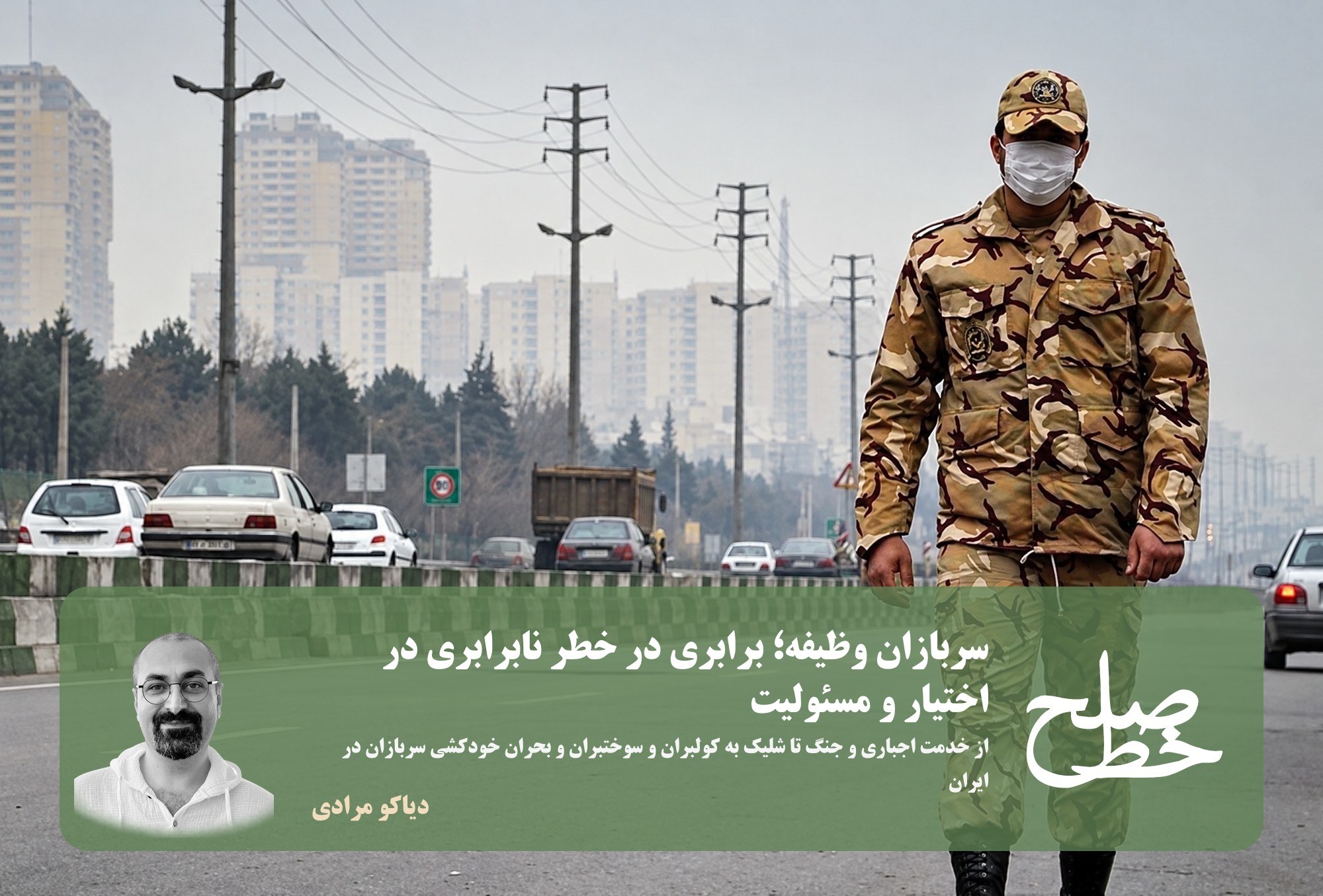
Conscript Soldiers: Equality in Danger, Inequality in Authority and Responsibility / Diako Moradi
Can a young man who has received only a few months of military training, has not freely chosen military service as a career, and lacks the remuneration, experience, and authority of a professional soldier, reasonably be expected to assume the same responsibilities and risks assigned to trained professionals? In wartime conditions, is a conscript merely manpower at the disposal of a military structure, or a human being endowed with fundamental rights for whose life, health, and imposed decisions the state bears responsibility? And when such a conscript is deployed to the border regions of Kurdistan and Sistan and Baluchestan to confront Kurdish cross-border couriers (kolbars) and fuel carriers, where does the boundary lie between obeying orders, personal responsibility, and commander accountability?
In a country such as Iran, where military service is mandatory for a large portion of the male population, these questions extend far beyond administrative or military debates. The issue touches upon the relationship between the citizen and the state, the limits of state power in utilizing human labor, the liability of military institutions for conscripts’ lives, and the balance between national security, human rights, and freedom of choice.
In wartime situations, this contradiction becomes even more pronounced. A conscript may be deployed to high-risk zones without sufficient opportunity to gain operational experience; similarly, during internal unrest or border patrol missions, he may find himself positioned against citizens who are themselves victims of poverty, discrimination, and restricted economic opportunities. On one side stands a young man summoned by law to serve; on the other, a kolbar or fuel carrier who has turned to dangerous labor simply to support his family. Yet the core decisions regarding security policy, operational missions, and rules of engagement are made at higher tiers of the power structure.
The updated UK Home Office report on military service in Iran, titled “Country Policy and Information Note: Military Service, Iran,” Version 4.0, dated August 2026 and updated on October 21 of that year, offers an opportunity to examine this issue in a documented manner. While reviewing the structure of mandatory service, disparities in training and service conditions, border deployments, risks during conflict and unrest, and psychological pressure within military environments, the report provides data that can be juxtaposed with findings from the United Nations, Human Rights Watch, and international law sources. However, this document was primarily prepared to assess asylum and international protection claims and should not be considered an exhaustive field study of all Iranian conscripts.
Compulsory Military Service: Military Obligation Without Free Choice
The fundamental difference between a conscript and a professional soldier begins with their entry into the military hierarchy. A professional service member, at least at the outset of the employment relationship, typically joins the military with an awareness of the nature of the profession, its prospective hazards, terms of service, and employment benefits. This choice does not, of course, grant complete autonomy in determining assignments or resigning at will, as professional personnel remain bound by military discipline, contractual obligations, and regulations. Nevertheless, a conscript enters this structure essentially on the basis of legal compulsion, with strictly limited ability to refuse service or choose the location and nature of his assignment.
The UK Home Office report explains in its executive summary that military service is mandatory for Iranian males within draft age, with its duration generally ranging between 14 and 24 months depending on the type and location of deployment. Section 4.3.3 also notes that specialized military training for most conscripts is limited to approximately two months, even though they may be assigned to operational, underprivileged, climatically severe, and border areas.
The significance of this disparity becomes clearer when comparing the training of conscripts with that of professional personnel. In section 12.1.6 of the same report, citing the ISNA news agency and statements by Hossein Zahedi, an official with the Conscription Organization (Vazifeh Omumi), it is noted that the training for officers graduating from military academies lasts at least four years, for certain other officers over two years, and for non-commissioned officers a minimum of nine months, whereas basic training for conscripts is cited as a maximum of two months. The same source explains that border guard conscripts receive three months of training to counter armed individuals and smugglers.
Consequently, this training difference is not merely a matter of duration; it can translate into disparities in risk identification skills, situational assessment, decision-making under duress, understanding rules of engagement, and coping with the psychological consequences of violence. Basic training, of course, does not represent the entirety of instruction a conscript might receive throughout his service. Nevertheless, the UK report reveals a substantial gap between the training pathways of professional personnel and conscripts.
This inequality in training is coupled with disparities in compensation and decision-making autonomy. In section 4.4.2, the UK report states that based on examined data, the monthly allowance for conscripts ranges roughly from £30 to £135. The report also mentions a prospective 20 percent pay increase in 2026, though it notes that it has not independently verified its implementation. These figures reflect the period in which the report’s data was gathered and should not be taken as the definitive present-day salary of all conscripts without further verification.
As a result, the state may require a conscript to carry out a mission involving life-threatening perils comparable to that of a professional soldier, despite disparities in training, experience, compensation, and bargaining power. The essential question is whether imposing comparable risks without providing commensurate preparation and protection is compatible with the state’s duty of care toward personnel under its command.
War: When Disparity in Authority Becomes Disparity in Security
Under wartime conditions, the distinction between a conscript and a professional soldier takes on even greater significance. Modern warfare is no longer limited to the capacity to handle a weapon and carry out basic instructions. Identifying military targets, detecting aerial and drone threats, countering electronic warfare, protecting civilians, administering emergency medical aid to the wounded, and making sound judgments in complex tactical situations all demand specialized training and experience.
The UK Home Office report in section 4.3.4, citing Iranian military service regulations, notes that in periods of war or general mobilization, conscripts are expected to serve a minimum of one year in operational zones. However, the report itself acknowledges that it did not obtain sufficient evidence to verify the practical enforcement of this requirement.
This distinction between statutory provisions and practical implementation is critical. One cannot conclude solely from the text of the law that all conscripts are deployed to operational combat zones in wartime. Nevertheless, the presence of such a legal provision demonstrates that the legal framework explicitly anticipates the extensive mobilization of conscript forces under conditions of war.
In such circumstances, the issue is not merely the risk of a soldier being killed. Inadequate training and lack of experience can also escalate the risk of operational errors, psychological trauma, flawed decisions regarding firearms use, and harm to third parties. Therefore, deploying a conscript to a conflict zone without adequate assessment of his physical, psychological, and specialized readiness is an issue that must be evaluated within the framework of command responsibility and the state’s duty of care.
Section 4.4.3 of the UK report also cites media accounts describing difficult conditions faced by certain frontline units during clashes in March 2026, including shortages of ammunition, food, and basic necessities, as well as limited medical access for wounded personnel. These accounts require independent verification and cannot be generalized across all military formations. However, where such conditions exist within an operational unit, questions regarding the liability of commanders and the institutions tasked with supplying equipment and medical services become even more urgent.
The salient point is that a conscript and a professional service member may face an identical military threat, yet their level of preparedness and capacity to navigate it differ substantially. Equal exposure to danger does not equate to equal conditions of service.
Kurdistan and Sistan and Baluchestan: Conscripts at the Intersection of Poverty, Security, and Lethal Force
The deployment of conscripts to the border regions of Kurdistan and Sistan and Baluchestan highlights additional dimensions of the relationship between military coercion and state responsibility. In these regions, border enforcement missions are inextricably linked with broader economic, social, and human rights issues. Cross-border hauling (kolbari) in Kurdistan and fuel carrying in Baluchestan serve as essential means of survival for segments of border communities. While these activities may contravene customs and statutory regulations, such infractions do not in themselves justify the use of lethal force against individuals.
In its report of July 8, 2024, titled “Iran: Security Forces Killing Kurdish Border Couriers,” Human Rights Watch investigated instances of lethal and excessive force used against kolbars based on interviews with 13 witnesses, survivors, and relatives of victims. The organization also reviewed medical and court records of several injured individuals, documenting that many victims and their families encounter severe barriers to obtaining justice and reparations.
The significance of this report lies not only in recording shooting incidents, but also in connecting poverty, unemployment, the border economy, and the use of force. According to gathered testimonies, many kolbars have turned to this dangerous labor due to the absence of sustainable employment opportunities and the pressing need to sustain their families. Human Rights Watch also noted that in several cases, complaints filed by victims against security personnel resulted in the dismissal of charges, or that court-ordered compensation was never fully paid.
In Baluchestan as well, independent UN human rights experts warned in a statement issued on September 23, 2026, against the use of lethal force against fuel carriers. According to the statement, at least 13 Baloch fuel carriers were killed between January and August 2026 in incidents involving shootings, vehicular chases, and other operations by military and security forces. The same statement cited the deaths of at least 12 Kurdish kolbars due to gunfire by border guards or Islamic Revolutionary Guard Corps (IRGC) personnel since the beginning of 2026. These numbers reflect cases formally reported to UN experts rather than an exhaustive tally of all victims.
UN experts emphasized that transporting goods in violation of customs laws does not inherently pose a threat to human life that would warrant the use of firearms. They urged independent investigations into deaths resulting from security force operations and called for the protection of families’ rights to truth and reparations.
Yet these documents raise an additional question: Who is tasked at the lowest operational tiers with executing these border policies? Are those opening fire conscripts, professional border patrol personnel, or members of other armed entities? And where conscripts are deployed, what degree of training, discretion, and capacity to challenge unlawful orders is available to them?
The UK report indicates that conscripts are utilized in border security deployments. The Human Rights Watch report also documents the involvement of Law Enforcement Command (Faraja) border guards and IRGC forces in specific shooting incidents. However, neither report independently establishes that the specific individuals who opened fire in documented cases were conscripts. Drawing such a conclusion requires independently verifying the employment status and organizational rank of the personnel involved in each incident.
This distinction is essential for assessing responsibility. One cannot assume that all armed personnel stationed at the border are conscripts, just as one cannot, without investigation, restrict accountability for a shooting strictly to the individual present on the scene.
The Soldier as Executor of Orders: Is Responsibility Shifted to the Lowest Rank?
One of the most critical legal questions in examining shootings involving kolbars and fuel carriers is the distribution of responsibility among the soldier, the commanding officer, and the decision-making institution. Within a military hierarchy, decisions concerning force deployment, mission parameters, rules of engagement, and issuing orders typically rest with commanding officers. A conscript, particularly at the lowest rungs of the chain of command, often exercises limited discretion to alter an assignment or contest superior orders.
Nevertheless, limited authority does not negate individual responsibility. If a soldier fires upon an unarmed person who presents no imminent threat to life, his conduct must be assessed under the legal principles governing the use of force. Conscription status alone does not absolve an individual of such actions.
Conversely, a commander’s liability must not be overlooked merely because he did not personally pull the trigger. In its legal study “Command Responsibility and Failure to Act,” published on May 21, 2021, the International Committee of the Red Cross (ICRC) distinguishes between two types of command responsibility: direct responsibility for issuing an unlawful order, and responsibility arising from a failure to prevent or suppress subordinates’ violations where requisite legal criteria are met. These principles are anchored within international humanitarian law and the context of armed conflict.
From a legal perspective, a clear distinction must also be maintained between combat operations and law enforcement missions. Border control shootings of kolbars and fuel carriers are governed, under ordinary circumstances, by international human rights law and law enforcement standards, rather than the law of armed conflict. Even the existence of war within a country does not automatically transform every border encounter into a military operation subject to combat targeting rules.
Here, an important hypothesis arises: Could deploying conscripts on armed missions, amid opaque operational orders and command hierarchies, serve to shift accountability from command structures down to low-ranking field personnel?
This hypothesis merits examination, yet available evidence remains insufficient to establish an intentional, institutionalized policy of using conscripts to evade accountability. Proving such a policy requires command records, personnel files of the shooters, eyewitness accounts from deployed personnel, and judicial investigation findings.
Nevertheless, the absence of public information on these cases constitutes a serious transparency deficit. When victims’ families are unable to ascertain who gave the order, who fired the weapon, and which entity is responsible for oversight, the path to justice is severely obstructed.
The Human Rights Watch report on kolbars documents concrete instances of this impediment. Through an analysis of court files, the organization reports that several complaints filed against border forces yielded no meaningful legal remedy, and in certain instances, victims were denied full payment of court-ordered compensation (diya).
Accountability, therefore, must not terminate with the individual who pulled the trigger; it must encompass the complete chain of decision-making, training, command, oversight, and judicial review.
Obedience to Orders or Defiance of Unlawful Commands?
One of the most agonizing predicaments for a conscript arises when a conflict emerges between obeying a commander’s order and upholding fundamental human rights. A soldier may fear disciplinary punishment for insubordination on one hand, while recognizing on the other that executing the order could result in the death of an unarmed civilian.
Article 33 of the Rome Statute of the International Criminal Court, addressing superior orders, establishes that executing a government or military order does not automatically relieve a person of criminal responsibility. The article outlines narrow conditions for accepting superior orders as a defense, including that the individual was under a legal obligation to obey, did not know the order was unlawful, and the order was not manifestly unlawful. The provision further specifies that orders to commit genocide or crimes against humanity are manifestly unlawful. Naturally, referencing the Rome Statute does not imply automatic ICC jurisdiction over incidents in Iran.
Within this framework, the extent of a soldier’s training and experience is of paramount importance. A conscript lacking adequate legal and operational instruction faces greater difficulty discerning the unlawfulness of an order or identifying avenues for dissent. This reality underscores the military institution’s obligation to provide transparent instruction on rules of engagement and establish safe reporting mechanisms for unlawful orders.
The UK Home Office report approaches this issue from another angle in sections 4.3.2 and 4.3.5. It observes that during periods of civil unrest or international conflict, state pressure on soldiers to execute orders and penalize insubordination may intensify. Citing secondary sources, the report also references a death sentence handed down to a conscript for refusing to shoot at protesters in January 2026, alongside reports of security personnel being detained in Kermanshah Province for refusing orders to fire.
Such accounts should be approached with caution, as the UK report does not provide an independent judicial investigation into all details of these cases. Nonetheless, the inclusion of such accounts indicates that the question of refusing orders to fire is far from a theoretical dilemma and represents a tangible factor in assessing the situation of Iranian military personnel.
In such circumstances, a conscript may face an acute dilemma: executing an order that violates the rights of others, or refusing to comply and facing the threat of severe punishment. The legal resolution to this conflict neither entails granting blanket immunity to conscripts nor ignoring institutional coercion; rather, it demands the creation of independent review mechanisms for unlawful orders, robust protection for whistleblowers, and due process guarantees for service members under command.
Conscript Suicide: The Hidden Facet of Violence and Pressure in Mandatory Service
Discussions surrounding the hazards of military service must not be confined solely to combat casualties or border skirmishes. Conscripts’ mental health, the pressures of barracks life, hierarchical power dynamics, separation from families, restricted leave, and access to lethal weapons are equally fundamental issues in evaluating state responsibility.
Sections 4.4.3 and 12.2 of the UK Home Office report address reported instances of suicide and violence within military barracks from 2023 onward. Citing media reports, the document also references an estimate suggesting that roughly 15 percent of conscripts have experienced suicidal ideation. However, existing data remains insufficient to determine the true incidence of suicide among all Iranian soldiers or to make valid comparisons with the general population. Furthermore, this figure reflects suicidal ideation rather than confirmed suicide mortality rates.
This statistical distinction is vital: suicide is a multifaceted phenomenon, and individual cases cannot be attributed automatically to conscription or commander abuse without independent investigation. Nevertheless, the presence of distinct risk factors within the military environment accentuates the necessity for comprehensive preventative policies.
Citing media accounts regarding conditions in military garrisons, the UK report highlights psychological stress, restricted communication with families, denial of leave, and poor sanitation. If sustained, such conditions can adversely affect conscripts’ mental health and quality of life.
In its suicide prevention guidance, “Limit Access to Means of Suicide,” the World Health Organization identifies restricting access to lethal means as an evidence-based intervention. The WHO explains that limiting immediate access to such instruments during crises provides a critical window of opportunity to defuse acute psychological distress and facilitate help-seeking.
This principle holds particular weight in a military environment, where firearm access is routine. The responsibilities of commanders and military establishments must encompass recognizing warning signs, providing confidential mental healthcare services, enabling personnel to seek help without fear of reprisal, and safely managing weapon access during personal crises.
Similarly, the US Department of Defense, in its 2025 guide on lethal means safety for military suicide prevention, emphasizes close collaboration between commanders and mental health professionals, stressing that protective measures should be temporary and non-punitive. While not addressing Iran directly, this framework illustrates how suicide prevention research can be integrated into institutional duties within the armed forces.
In the border regions of Kurdistan and Sistan and Baluchestan, the urgency of this concern is heightened by the rigors of service in isolated, high-stress environments. Nonetheless, asserting that conscript suicide rates are higher in these areas than elsewhere in Iran requires independent, disaggregated empirical data.
Here, the essential question is not simply why an individual conscript experienced a psychological crisis, but whether the military organization identified warning signs, ensured access to care, and implemented measures to mitigate risk.
State Responsibility Toward Soldiers and Civilians: Two Sides of the Same Issue
In evaluating the situation of conscripts, safeguarding their rights should not be framed in opposition to the rights of kolbars, fuel carriers, and other civilians. Both concerns stem from an identical underlying principle: the state’s power to deploy armed force must be restrained, lawful, and accountable.
On one hand, the state is responsible for the training, health, safety, and service conditions of the forces under its command; on the other, it is obligated to prevent the unlawful use of lethal force against citizens. These duties are interdependent. A conscript who receives inadequate training, is deprived of psychological support, or lacks clarity on the rules of engagement faces grave personal risk while simultaneously being placed in a position where his split-second decisions may imperil the lives of others.
However, the problem cannot be reduced solely to training quality. Even well-trained personnel operating under unlawful orders or within a structure devoid of meaningful oversight may commit human rights violations. Therefore, while training is indispensable, it cannot substitute for institutional accountability, independent oversight, and strict legal limits on the use of force.
From this perspective, the situation of conscripts in Iran must be evaluated on three distinct levels: the individual rights of the conscript, the responsibility of commanders, and the state’s obligations toward society. These levels are interrelated, but must not be conflated.
At the individual level, a conscript must be guaranteed fundamental rights, adequate training, healthcare support, and the ability to contest unlawful orders. At the command level, leadership must remain accountable for training quality, deployment practices, the issuance of orders, and preventing violations. At the state level, the government bears responsibility for enacting clear laws, providing external oversight over the armed forces, conducting independent inquiries into fatalities, and ensuring reparations for victims.
Conclusion: Equal Burden, Unequal Authority
In wartime, a conscript and a professional soldier may find themselves in the same trench, confronting the same adversary and exposed to identical risks of death or physical and psychological trauma. Both are equally bound to respect the fundamental rules of international humanitarian law. Yet this parity in danger and legal obligation does not signify parity in their actual standing.
Disparities in training, experience, remuneration, career choice, and position within the command structure create a tangible gap in authority and preparedness. A conscript enters this environment without free choice, where the decisions of others regarding his posting, missions, and the use of weapons dictate his fate as well as that of other citizens.
In conflict scenarios, this inequality exacerbates the vulnerability of inexperienced personnel. In the border provinces of Kurdistan and Sistan and Baluchestan, the deployment of conscripts within military and law enforcement frameworks underscores the vital necessity of scrutinizing the relationship between training, command hierarchy, and the use of lethal force. At the same time, reports of conscript suicides and severe psychological strain demonstrate that protecting the lives of service members must not be confined solely to mitigating battlefield casualties.
Nonetheless, compulsory service neither automatically extinguishes a soldier’s individual accountability nor serves as an excuse to ignore command liability. A fair evaluation requires simultaneous scrutiny of the nature of the order, the concrete circumstances of the mission, the individual’s degree of awareness, organizational coercion, and the institutional position of decision-makers.
The overarching issue is that decision-making power and accountability must remain proportional. A command structure that retains the power to define missions, issue orders, oversee training, and control weaponry cannot transfer accountability for the outcomes of its decisions solely to the lowest operational ranks.
From the perspective of peace and human rights, reforming this reality requires transparency regarding the composition of deployed units, independent oversight of border missions, disclosure of conscript fatality and suicide data, protection for personnel who refuse unlawful orders, and guaranteed access to justice and redress for victims and their families.
Ultimately, the issue is not merely how a conscript differs from a professional soldier in wartime; it is whether the state can legitimately demand that a citizen with severely circumscribed authority assume mortal hazards and liabilities for which it has failed to provide adequate training and protection.
No military establishment should disregard the limited autonomy of conscripts, just as no conscript should be made an instrument for depriving civilians of the right to life or shielding commanding officers from accountability.
Footnotes:
1. UK Home Office. (2026). Country Policy and Information Note: Military Service, Iran (Version 4.0). Official website of the UK Government.
2. Human Rights Watch. (2024, July 8). Iran: Security Forces Killing Kurdish Border Couriers.
3. UN Independent Human Rights Experts. (2026, September 23). Iran: UN Experts Demand End to Unlawful Killings of Kurdish Border Couriers and Baloch Fuel Carriers. Office of the United Nations High Commissioner for Human Rights.
4. International Committee of the Red Cross. (2021, May 21). Command Responsibility and Failure to Act.
5. International Criminal Court. (1998). Superior Orders and Prescription of Law (Article 33 of the Rome Statute). ICRC International Humanitarian Law Databases.
6. World Health Organization. (n.d.). Limit Access to Means of Suicide.
7. United States Department of Defense. (2025, January). Reducing Access to Firearms: A Suicide Prevention Guide for Line Leaders. Military Health System.(1)
 By: Diako Moradi
 November 22, 2026
Tags
Balochistan Compulsory military service Conscripts Diako Moradi Fuel tester Kulbars Kurdistan peace line Peace Line Monthly Peace Mark 187 Soldier's Suicide UK Home Office