


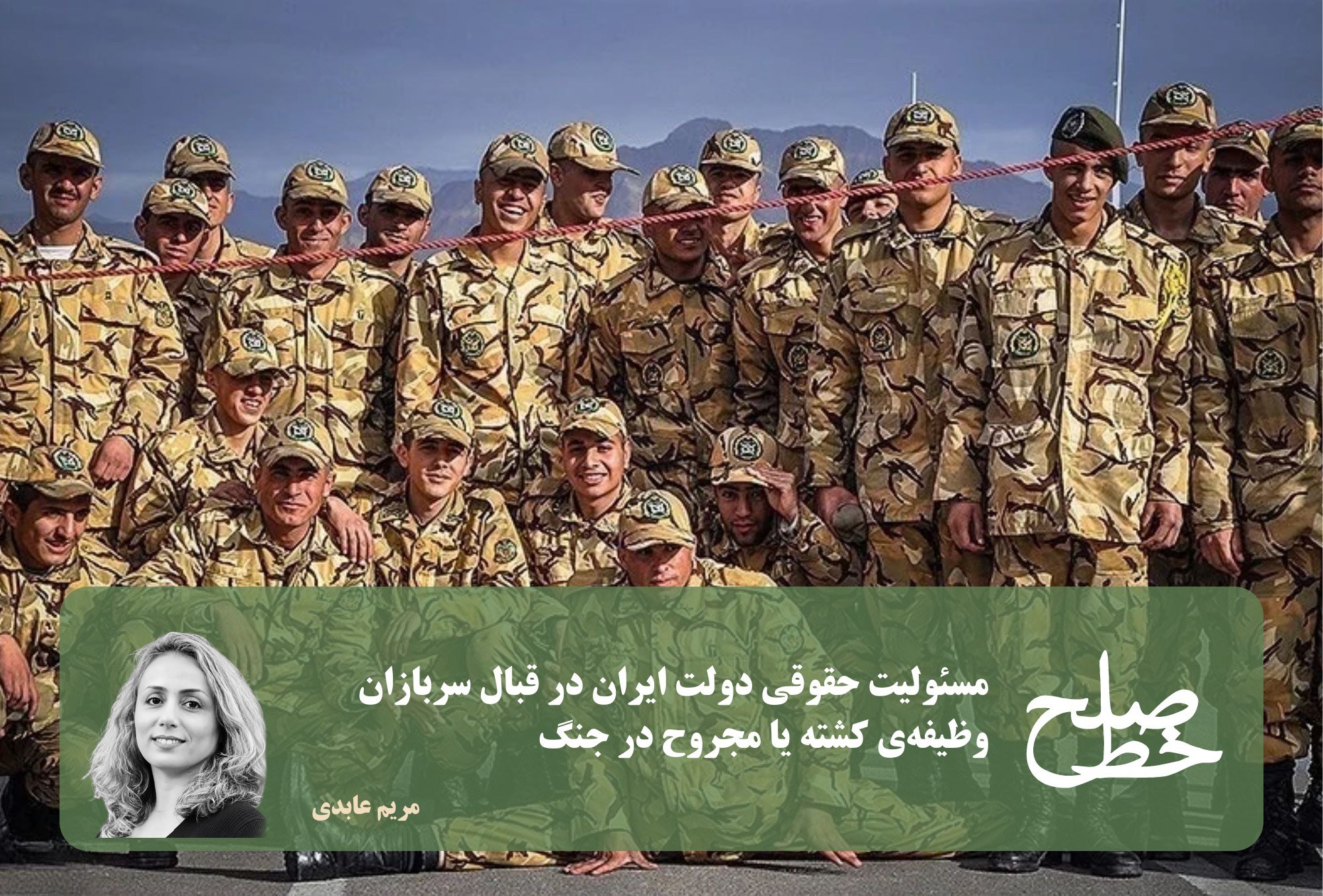
The Legal Liability of the Iranian Government Toward Conscripts Killed or Injured in War / Maryam Abedi
Mandatory military service is one of the oldest civic duties in public law; yet, unlike most other civic obligations, it can directly imperil a citizen’s life and physical integrity. When a nation becomes embroiled in war, this hazard transforms from a potential threat into a tangible reality, raising a critical legal question: What legal responsibility does a government that compels citizens into service bear toward those who are killed or wounded?
This question is vital for two reasons. First, unlike professional soldiers or volunteers, a conscript has not chosen to enter the military environment and, in practice, has no legal recourse to leave it. Second, existing statutory protections are scattered across disparate legislative instruments, and their enforcement has not always aligned with the expectations of conscripts and their families.
This article seeks to answer the central question: What is the legal liability of the Government of the Islamic Republic of Iran regarding conscripted soldiers killed or injured in war, and what are its foundations and limitations? Sub-questions include: What is the theoretical basis of this liability? What protections are afforded by the domestic legal framework, and what gaps exist? Furthermore, what role do the state’s international obligations play in strengthening this responsibility?
The hypothesis posits that state responsibility consists of two layers: a compensatory layer that operates on a no-fault basis due to the compulsory nature of conscription, and an accountability layer contingent upon adherence to duties of prevention and investigation; Iran’s domestic legal system is more developed in the former than in the latter. Applying a descriptive-analytical methodology, this paper addresses the theoretical foundations, followed by the domestic and international legal frameworks, and concludes with challenges, conclusions, and recommendations.
Theoretical Foundations: The State’s Special Duty of Care Arising from Compulsory Service
While the relationship between the state and ordinary citizens is governed by general public law, the relationship between the state and a conscript is fundamentally distinct. A conscript does not join the military apparatus of their own free will; rather, a legal mandate compels their presence within an environment under the total control of the state. In this scenario, the government is not merely the creator of the hazardous situation, but the sole entity capable of managing and mitigating it. This dynamic establishes a special duty of care that transcends the state’s general obligation to safeguard citizens’ lives. This analysis rests on three pillars.
A) The Doctrine of Positive State Obligations
The right to life under Article 6 of the International Covenant on Civil and Political Rights (ICCPR) does not merely prohibit arbitrary deprivation of life; it encompasses a duty to take reasonable operational measures to protect the lives of individuals under state authority. In the jurisprudence of international bodies, notably the European Court of Human Rights, this duty is applied with heightened scrutiny regarding conscripts. Although this jurisprudence is not binding on Iran, it provides valuable comparative legal arguments.
B) Risk Theory and Strict Liability
Whoever subjects individuals to extraordinary risk for the benefit of society must indemnify any harm arising from the realization of that risk. Consequently, state liability for killed or injured conscripts is legally justifiable even in the absence of personal fault by any military commander. This constitutes the philosophical foundation of duty-related pension and veteran benefit regimes.
C) The Principle of Equality and Distributive Justice
The burden of national defense must be distributed equitably among all citizens. If the primary weight falls upon a specific segment, such as military conscripts, the obligation to compensate them falls upon society and, by extension, the state. This rationale is equally relevant when critiquing disparities between conscripts and regular cadre personnel.
Accordingly, state responsibility has two dimensions: a compensatory dimension that exists independently of fault, and an accountability dimension predicated on adherence to standards of prevention and investigation. This distinction establishes the analytical framework for the subsequent sections.
Domestic Legal Framework
A) The Constitution
The Constitution does not explicitly articulate state liability toward conscripts; however, several principles provide a normative foundation. Article 22 guarantees the immunity of an individual’s life and dignity from violation, except as authorized by law. Article 29 establishes access to social security—including coverage for disability, loss of breadwinner, and accidental injury—as a universal right, obligating the government to provide financial support and services from public revenues for every citizen. Article 20 places all citizens under equal protection of the law, serving as the basis for demanding parity between conscripts and career military personnel.
B) The Civil Liability Law of 1960
Article 11 of this law distinguishes between two scenarios. If a government employee, in the course of performing their duties, causes harm to another party intentionally or due to negligence, they are personally liable for compensation. However, if the damage is not attributable to the employee’s act and arises from defects in the equipment or facilities of the administration or institution, the liability for compensation falls upon the administration or institution itself. In instances such as a lack of protective equipment or defective barracks facilities, this ruling places liability directly on the military institution. Conversely, part of legal doctrine excludes sovereign acts, such as strategic wartime decisions, from the scope of civil liability. The boundary between these two categories of actions remains one of the most critical points of contention in claiming compensation.
C) The Public Conscription Law and Armed Forces Regulations
The Public Conscription Law of 1984 (as amended) represents the legal source of compulsory service, thereby serving as the point where the state’s special duty of care originates. The statutory protection regime for conscripted personnel within the Armed Forces Regulations—including duty pensions and disability allowances—complements this framework.
D) The Comprehensive Law for Providing Services to Veterans (2012)
The primary legal instrument governing this matter is the Comprehensive Law for Providing Services to Veterans. Enacted pursuant to Article 123 of the Constitution and approved for a four-year experimental implementation following review by the Expediency Discernment Council, it was subsequently made permanent under Article 47 of the Law on Permanent Provisions of the National Development Plans. Article 1 defines a veteran as anyone who served to establish and protect the achievements of the Islamic Revolution, defend national sovereignty and territorial integrity, and confront internal and external threats, and who is officially recognized as a martyr, missing in action, disabled veteran (janbaz), prisoner of war, freed captive (azadeh), or combatant. In the event of the death of disabled veterans and freed captives, statutory benefits and privileges extend to their dependents.
Article 38 is of particular significance for conscripts. Under this article, the salaries and benefits of conscripts and unemployed volunteer forces deployed to the front lines by competent authorities who were martyred, went missing in action, or suffered total disability as veterans or freed captives—either due to their presence on the front lines or as a result of targeted attacks—are calculated in parity with permanent armed forces personnel and disbursed through the Foundation of Martyrs and Veterans Affairs. Its note stipulates that duty disability pensions for non-employed veterans are governed by armed forces statutes and calculated and paid according to their regulations. The executive directive for Article 38 was formally promulgated by the General Staff of the Armed Forces in 2017.
E) Summary
The Iranian legal system maintains a solid foundation for the compensatory tier: statutory salaries, parity with regular military personnel, and the transfer of pensions to surviving dependents. However, this framework remains predominantly compensatory, lacking clear mechanisms to evaluate fault or ensure institutional accountability in prevention. This limitation is examined in detail in the section on challenges below.
International Framework
A) Status of Iran’s Obligations
Prior to analysis, it is necessary to identify which instruments are legally binding upon Iran. Iran signed and ratified the four Geneva Conventions of 1949. Official statements by Iran at the United Nations affirm that while the country is a signatory to the 1977 Additional Protocols, it has not ratified them, and efforts to complete domestic ratification procedures remain ongoing. Consequently, the primary sources of Iran’s legal obligations consist of the Geneva Conventions, customary international humanitarian law, and the International Covenant on Civil and Political Rights, to which Iran is a state party.
B) Status of Conscripts Under International Humanitarian Law
The law of armed conflict draws no distinction between compulsory combatants and volunteers. A conscript serving in the armed forces is recognized as a combatant and is therefore a legitimate military target during lawful hostilities; their death in the course of an attack does not, per se, constitute a breach of humanitarian law. Conversely, if wounded or sick, they are entitled to the protections of the First Geneva Convention, and if captured, the Third Geneva Convention applies. Consequently, the source of state responsibility for the death or injury of a soldier derives not primarily from the law of war itself, but from domestic law and human rights law. This distinction must be articulated clearly to prevent conceptual ambiguity.
C) Protection of the Wounded and Sick
The First Geneva Convention requires parties to a conflict to respect and protect the wounded and sick without adverse distinction and, whenever circumstances permit, to take all possible measures to search for, collect, and care for them. This obligation applies equally to wounded conscripts and provides a legal basis for demanding timely, non-discriminatory medical treatment.
D) Human Rights in Times of Armed Conflict
In its 1996 Advisory Opinion on the Legality of the Threat or Use of Nuclear Weapons, the International Court of Justice affirmed that the right to life does not cease during armed conflict; rather, whether a deprivation of life is arbitrary is determined by the lex specialis of international humanitarian law. Article 6 of the ICCPR is non-derogable under Article 4(2), even in states of emergency. Consequently, a state’s obligation to protect the lives of persons under its authority, along with the duty to investigate their deaths, is not entirely extinguished in wartime.
For conscripts, the strongest legal arguments arise at the pre-engagement stage: adequate training, appropriate equipment, reasonable deployment decisions, and post-incident investigation. The jurisprudence of the European Court of Human Rights regarding the deaths of conscripts in service demonstrates the practical application of this obligation, although it is not binding on Iran. Here, a crucial distinction must be drawn: precautionary rules under international humanitarian law, including Article 58 of Additional Protocol I and analogous customary norms, are designed primarily to shield civilians from the effects of attacks and should not be construed directly as duties to protect one’s own armed forces. Such duties stem primarily from international human rights law and municipal law.
E) Responsibility of the Aggressor State
Pursuant to the rules on the Responsibility of States for Internationally Wrongful Acts formulated by the International Law Commission (2001), Article 31 provides that a state responsible for an internationally wrongful act is under an obligation to make full reparation for the injury caused thereby. Where a war results from unlawful aggression, bodily injuries and loss of life suffered by the armed forces of the victim state may be submitted as part of a claim for reparations. The precedent of the United Nations Compensation Commission (UNCC) for Iraq, established under Security Council Resolution 687 (1991), demonstrates that such mechanisms are feasible in practice, although their establishment remains politically contingent and exceptional.
Two observations warrant emphasis: first, this form of state responsibility operates on an interstate level and cannot be claimed directly by individual citizens; second, securing reparations from an aggressor state does not supplant the home state’s underlying legal duties toward its own soldiers.
F) Summary
Iran’s international commitments do not, on their own, establish a direct cause of action for individual financial compensation for killed or injured conscripts; nevertheless, they serve three key functions: providing a standard for prevention and investigation, a normative framework for treating the wounded, and a basis for interstate reparation claims against an aggressor state. Thus, the primary burden of redress continues to rest upon the domestic legal order.
Challenges and Critiques
A) The Restricted Scope of Protections
Article 38 of the Comprehensive Veterans Law applies strictly to individuals deployed to the front lines who sustain severe degrees of incapacitation—specifically martyrdom, disappearance in action, or total permanent disability. The statutory language explicitly conditions benefits on deployment and physical presence at the front or victimization through targeted assassinations. This leaves several categories in legal limbo: conscripts with lower disability ratings, deaths or injuries sustained within garrisons or rear areas caused by aerial or missile strikes, and psychological trauma such as Post-Traumatic Stress Disorder (PTSD). Using front-line deployment as a baseline in modern warfare, where boundaries between the vanguard and rear echelons are fluid, constitutes an inadequate standard.
B) Discrepancies in Interpretation and Enforcement
The divergence between statutory texts and their practical enforcement has been documented in public discourse. A 2022 commentary in Hamshahri newspaper criticized subjective interpretations and restrictive enforcement by administrative authorities, questioning the legal basis for addressing groups not explicitly enumerated in the statute. Furthermore, duty pensions for disabled veterans lacking formal employment ties are disbursed by the Martyrs Foundation under armed forces regulations; this bifurcated jurisdiction between two separate administrative bodies frequently leads to delays or procedural confusion.
C) Evidentiary and Verification Obstacles
Accessing statutory entitlements requires formal administrative recognition of veteran disability or martyr status. However, because contemporary conflict often renders military and medical record-keeping incomplete or unfeasible, this requirement imposes significant evidentiary burdens. Digital initiatives designed to process claims without paper correspondence or physical file submissions—such as the ‘Isaar-e Man’ portal, as officially announced by the Martyrs Foundation—represent an effort to address these bottlenecks; nonetheless, their real-world efficacy warrants independent empirical evaluation.
D) Disparities with Career Personnel
Although the statute ostensibly establishes parity through the phrase ‘on par with armed forces cadres,’ fundamental questions persist: What constitutes the baseline for calculating the duty pension of a conscript who has no prior employment history? Furthermore, are ancillary benefits, such as supplementary health coverage and preferential hiring quotas, extended to them in an identical manner? From the standpoint of equality under Article 20 of the Constitution, it can be argued that disparate modes of entry into service—compulsory conscription versus voluntary career employment—must not result in diminished institutional protection, given that the operational risks incurred are identical.
E) Lack of Independent Accountability Mechanisms
The existing regime is predominantly compensatory. In the second tier—namely assessing whether administrative or operational negligence occurred in preventing or managing an incident—there is no dedicated, independent forum. Several legal questions emerge: Can a soldier’s family lodge a claim before the Court of Administrative Justice or general civil courts, and under what procedural conditions? To what extent does the sovereign immunity of state acts preclude judicial claims? Is there an independent body tasked with investigating conscript fatalities? Answering these questions requires rigorous analysis of judicial precedent and legal doctrine; this article confines itself to identifying the issue.
F) Legislative and Budgetary Instability
The drafting of the Bill on the Organization of Duty Disability Pensions for Conscripted Personnel and Basij Veterans demonstrates that administrative voids have been recognized. However, the bill conditions financing on annual national budget appropriations, which effectively subordinates statutory entitlements to fluctuating budgetary decisions. A legal entitlement must be statutorily guaranteed and judicially enforceable, rather than contingent upon annual fiscal capacity.
G) Research Limitations
The analysis in this study relies upon statutory texts and publicly available sources; empirical data regarding practical administrative enforcement and judicial case law were not accessible. Consequently, certain assessments are analytical in nature and necessitate further empirical and field research.
Legal Recommendations
In view of the challenges identified in the preceding section—namely the narrow scope of protections, evidentiary hurdles, institutional fragmentation, and the absence of accountability mechanisms—this section outlines eight recommendations. These proposals are structured according to the two layers of state responsibility: items 1 through 4 and 7 address the compensatory layer, while items 5, 6, and 8 pertain to the accountability tier and international commitments. For each recommendation, the core defect, legal basis, and intended objective are summarized.
1. Expanding the Scope of Article 38: The criterion of ‘front-line deployment’ is inadequate in modern warfare, where distinctions between front lines and rear echelons are increasingly indistinct. It is recommended that this criterion be supplemented with standards such as ‘active assignment’ or ‘presence in an operational zone exposed to wartime hazards,’ thereby encompassing attacks on bases and rear facilities. The legal rationale is straightforward: operational hazard and state coercion are identical for the conscript, meaning their legal status should not depend on the exact geographic coordinates of the incident.
2. Extending Coverage to Lower Degrees of Incapacitation: Article 38 focuses primarily on martyrdom, disappearance in action, and total permanent disability. Conscripts who suffer less severe physical injuries or experience psychological trauma remain neglected. Medical care, rehabilitation services, and proportionate financial allowances must be codified for these individuals, with explicit inclusion of psychiatric injuries. This recommendation is grounded in Article 29 of the Constitution regarding state support for accidents and disability.
3. Establishing a Unified Administrative Authority: Benefits are currently split between the armed forces and the Martyrs Foundation, causing procedural delays and confusion. Conscripts or their families should deal with a single consolidated authority, with inter-agency coordination resting upon the state rather than individual claimants.
4. Formulating Transparent Evidentiary Regulations: In wartime contexts, administrative record-keeping can be fractured or lost. It is recommended that alternative forms of documentation, such as field commander certifications and statements from fellow servicemen, be explicitly recognized as admissible evidence so that substantive rights are not undermined by bureaucratic paperwork deficiencies.
5. Instituting an Independent Investigative Mechanism: The current framework is largely limited to monetary compensation and lacks an investigative body to examine institutional negligence in risk mitigation. For every death or serious injury involving a conscript, an independent inquiry regarding compliance with operational safety standards should be conducted, with findings disclosed to the family. This would foster accountability and align with the state’s positive obligation under the right to life to investigate deaths occurring under its custody or authority.
6. Clarifying Pathways for Judicial Redress: In instances involving defective equipment or institutional failure, Article 11 of the Civil Liability Law provides a substantive basis for action; however, the competent judicial forum and procedural thresholds remain ambiguous. The jurisdictional venue must be clearly delineated, and the scope of sovereign acts immunity should be narrowly defined and circumscribed.
7. Guaranteeing Permanent Budgetary Allocations: If statutory allowances depend on annual discretionary budget allocations, rights are degraded into conditional privileges. Funding mechanisms must be codified as statutory guarantees to ensure their enforceability.
8. Harmonizing Standards with International Obligations: While Iran has signed the 1977 Additional Protocols, it has yet to ratify them. Thorough legislative review regarding their ratification, coupled with the drafting of internal military directives on force protection and the formal review of service-related casualties, would bring domestic standards into alignment with international legal norms.
delayed
The legal liability of the state toward conscripts killed or wounded in war operates across two levels. The first is compensatory and, due to the mandatory nature of service, functions on a strict, no-fault basis. Its theoretical underpinning rests upon the state’s special duty of care, risk theory, and distributive justice, with domestic statutory support provided by the Comprehensive Veterans Law, particularly Article 38. The second level concerns institutional accountability, encompassing prevention, training, equipment, responsible deployment, and post-incident investigation. This tier remains underdeveloped in domestic law and is best reinforced through international obligations and human rights standards. International humanitarian law does not view the death of a combatant in lawful combat as an internationally wrongful act per se; hence, the primary responsibility for reparation lies with the municipal legal system, and potential claims against an aggressor state do not relieve the home government of its duties. The findings of this paper support the hypothesis that Iranian law maintains a far more coherent statutory basis for financial compensation than for institutional accountability. Nonetheless, because this assessment is based on legislative texts and accessible literature, definitive conclusions require empirical investigation into administrative practice and judicial case law.
 By: Maryam Abedi
 November 22, 2026
Tags
Conscripts European Court of Human Rights Mandatory Military Service Maryam Abedi peace line Peace Line Monthly Peace Mark 187 Right to life State responsibility Strict Liability War Casualties Wounded in Action