


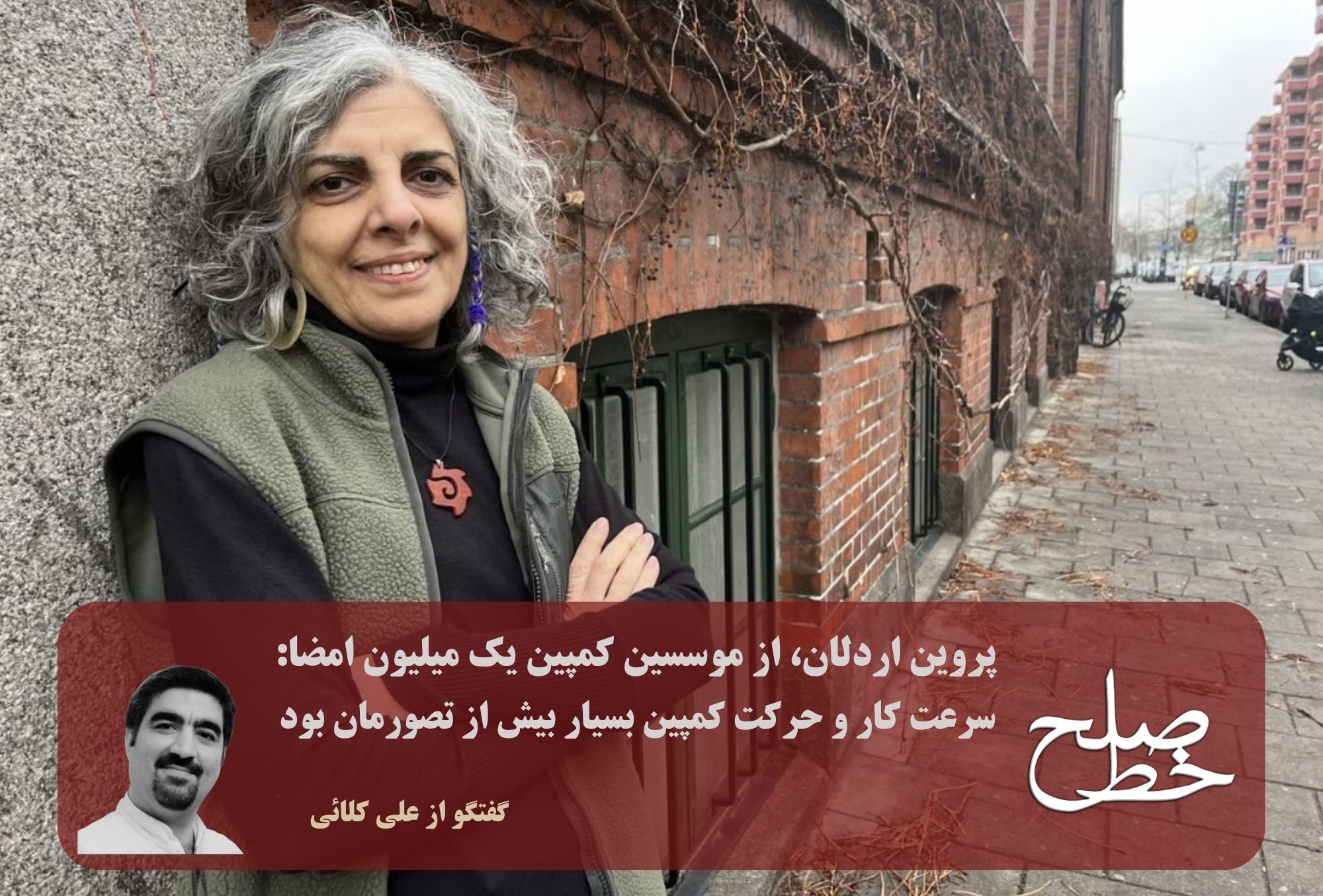
Parvin Ardalan: The Pace of the Campaign’s Work and Movement Was Far Beyond What We Had Imagined/ Ali Kalaei
This September, twenty years have passed since the launch of the “One Million Signatures Campaign to Change Discriminatory Laws,” a rare experience in Iran’s women’s movement that took shape in 2006 (1385), following years of collective discussion and joint activity among various women’s groups. The campaign sought to take the demand for changing unequal laws beyond limited circles of activists and, through face-to-face dialogue, education, and signature collection, turn it into an issue discussed among different groups in society. The goal was to collect one million signatures, but the experience that took shape along the way very quickly acquired a meaning that went far beyond the number of signatures.
This anniversary provided an opportunity to speak with Parvin Ardalan, a journalist, researcher, and veteran activist in Iran’s women’s movement. Parvin Ardalan was one of the founders of the Women’s Cultural Center NGO and one of the founding members of the One Million Signatures Campaign to Change Discriminatory Laws. In this interview, we look back with her, from a distance of twenty years, at that experience—from how the campaign took shape and how it was organized to face-to-face dialogue with people, power relations, internal disagreements, and security pressures. We also asked her what has remained from that experience for the women’s movement and what connections she sees between it and later movements, from the Girls of Enghelab Street to the “Woman, Life, Freedom” movement.
The full interview with Parvin Ardalan, journalist, researcher, and veteran activist in Iran’s women’s movement, follows:
If we go back to the days before the campaign was formed, how did the idea of collecting one million signatures come up? What led you from the initial discussions to the conclusion that it could actually be put into practice?
One of the discussions taking place within the women’s movement at that time, in the 2000s (1380s), was about how we could move from private circles into public spaces and places, and from there into the streets. The culmination of this movement came in 2005 (1384), when, through the Women’s Movement Hamandishi Coalition, which consisted of various individuals, groups, and networks, we managed to hold a large gathering in front of the University of Tehran to protest the “violation of women’s rights in the Constitution” of the Islamic Republic. This action was very influential. It made the movement visible and strengthened both solidarity within the movement and overlap among movements. The movement managed to take over street space and move beyond the issue of permits, because that gathering was held without a permit.
In 2006 (1385), despite Mahmoud Ahmadinejad’s coming to power, the women’s Hamandishi meetings continued under security pressure. As June 2006 (Khordad 1385) approached, we could not reach a consensus on holding another gathering to mark the anniversary of the 2005 (1384) gathering. The atmosphere was extremely policed, and rumors that orders had been given to shoot were constantly circulating. Concern about an excessively violent police response increased doubts and divisions. Some of us who wanted to hold the gathering issued a call and assembled at Haft-e Tir Square in Tehran for a “protest gathering against violations of women’s rights in Iranian laws.” There was no shooting, but the police response was extremely severe. Female police officers were also deployed in the square and, alongside male police officers, beat people severely. More than seventy people present at the gathering—including members of the public, women’s movement activists, children’s rights activists, labor activists, student activists, and journalists—were arrested and put on trial. We had planned to hold a one-hour gathering that day, but it did not even last fifteen minutes. I myself and many of my friends were targeted, and security forces raided our homes.
What I mean is that after this event, we found ourselves facing a closed environment in which we had to think of something else and find another way. The campaign emerged from this search for a solution. One of the movement’s activists, who was a member of the Women’s Cultural Center, introduced us to one of the signature-collection projects that had been carried out in Morocco—the One Million Signatures Campaign within the struggle to reform Morocco’s family law. That idea was refined and discussed, and it became a model from which we could draw inspiration and work within the context of Iranian society, taking into account its policing, social, cultural, and political conditions. It was from this idea and this environment that the One Million Signatures Campaign emerged, and many people came and participated.
From the first months of activity, what encounter or event has remained most vividly in your memory? Was there a moment when you felt that the campaign was beginning to find its place among the public?
The campaign was a new movement. It was very exciting for us as well, and it was another beginning. The setting for our activism was both the home, family, and circle of friends, and outside the home in public, professional, educational, academic, recreational, and other spaces. The way we made contact and initiated discussions was also important: directly, face-to-face, with someone you did not know. It involved both anxiety and excitement. This activity took place everywhere, from shops to courts and prisons. What was exciting was that the setting for our activism was broad and diverse, and in this process, the rapid increase in campaign activists was also encouraging.
You said that face-to-face dialogue was something new for you. These conversations with people were an important part of the campaign’s work. What did these conversations teach you personally? Was there a point when people’s reactions changed your perspective or the way you worked?
It was a kind of discovery of ways to engage in dialogue. Many people started with their own families. In public spaces, it was a little more difficult. You did not know how the people you approached would react. But it was a kind of preparation for communicating and engaging in dialogue with people who might disagree with you.
For example, when I went to my doctor’s office and tried to get his signature, he said, “I don’t engage in politics.” But as I explained the contents of the statement, he suddenly pulled the sheet out of my hand, signed it, and said, “I will never allow something like this to happen to my daughter.”
What I mean is that at some point, a social, class-based, gender-related, or legal issue has to become connected to and tangible within people’s everyday lives, particularly women’s lives. I remember that when we went to the Revolutionary Court for court hearings and interrogations, whether for ourselves or other campaign activists, we would take the campaign booklets with us and talk about them with the women working in the Revolutionary Court’s “Sisters” body-search section. One of them once said, “God willing, you will succeed and be able to do something for women.”
At some point, you reach a stage where the distance between you and society is reduced to a minimum. What I mean is that the face-to-face experience, in the process of raising our own awareness and that of the people with whom we were in contact, was like a booklet that was also being “written” in the course of action. In my view, this was one of the campaign’s greatest achievements: it managed to expand the discussion of legal equality and gender equality into a public discourse.
Anyone could be a campaign activist. There was no boundary saying that because you lacked education or experience, you had no right to speak about gender equality. This was something that helped us share knowledge and experience with one another and build narratives. That is why the narratives became intertwined, and this intertwining of narratives helped us understand one another and the circumstances more easily.
The campaign was intended to proceed in a participatory and horizontal manner. In practice, how were the main decisions made? To what extent did seniority, public recognition, or access to media and resources give some individuals greater power?
You know, wanting to work horizontally and participatively is one thing, and how far you are actually able to carry that out is another. It is after entering and acting within the process of a movement that you begin to see and test yourself, others, and the relationships more clearly. In this sphere, we were constantly grappling with this issue. Throughout the entire period, various discussions on these matters took place among us, and we discussed some of them collectively and sometimes in smaller groups.
For example, how should we define and transfer the movement experience of veteran members to campaign activists, many of whom were having their first experience of collective action through the campaign? Was this transfer of experience inspiring, or did it create a hegemony of power? Access to resources and media, and proximity to the center, were among the issues that were raised and were sometimes reflected in campaign reports as well.
The effort was to distribute power among committees, working groups, task groups, the website, and reports, so that both information and access to it would be available to everyone. But, of course, this did not always proceed easily. We wanted both to work in a participatory and horizontal way and to increase collective power. So we had to learn that if we were striving to achieve legal and gender equality, we ourselves also had to strive to create equal opportunities for one another and take this plurality and diversity into account.
We faced many challenges in this regard. These challenges were connected to many things, including knowledge and experience, age, geography and our distance from the center, the extent to which we were seen and heard, and so on. The volume of work was also increasing. The nature of the work in the campaign was not such that it could be controlled through an organizational model. Despite the many challenges and conflicts, this movement lasted four years, and in my view, what every individual involved in the campaign learned from it was immense.
It was the same outside Tehran. From the very beginning, the effort to keep the movement horizontal meant that other cities should not become branches of the Tehran campaign and should have their own independent identities. Even so, the challenge between the center and other cities, or the impact of what happened in Tehran on other cities, remained an issue.
For some young women, the campaign was one of their first experiences of collective activism in the 2000s (1380s). What helped newcomers take responsibility and pursue their own ideas? What do you remember about their collaboration with veteran activists?
The way work was structured within the campaign gave people opportunities to take responsibility. After joining the campaign and completing educational workshops, the forms of activity available were also diverse and varied. Different committees and workshops were formed, and people chose which committee or working group to join based on their interests, abilities, expertise, and experience. Some participated in several committees.
I myself was on the website committee. One of my most beautiful memories was reading the accounts written by new activists about their experiences collecting signatures, which reflected their ideas, ways of interacting with people, and abilities. This itself represented another transformation in documenting movement experience. In this process, many people who had never had experience writing before began writing narratives.
Some of those who began by collecting signatures would later attend workshops, and then themselves become people capable of holding workshops. Some campaign activists also connected their artistic knowledge and experience with the campaign. For example, people with experience in theater wanted to stage street theater. In other words, the campaign became a space in which each person could find their place and role through their own language and experience.
Apart from external pressure and repression, in your view, what developments within the campaign caused people to distance themselves or withdraw? Twenty years later, which of these do you think could have been prevented?
We had little opportunity to talk. When the campaign began—that is, after the June 12, 2006 (22 Khordad 1385) gathering—even gatherings of two or three people were not tolerated and were confronted. We had now found a method that both counted as a gathering and did not count as a gathering. This method helped us be everywhere in the city’s public spaces while, on the other hand, there was no reason for us to constantly chant slogans and expose ourselves to the risk of arrest.
That is why, in the early stages, the work was easier and there was much more energy, movement, cooperation, and solidarity. But gradually, as the work expanded, divisions and discussions about methods of work increased. How could we, when confronted with security issues, preserve ourselves as well as our documents, relationships, and work? In such circumstances, whose position was right? Who had the first say, and who was proceeding correctly?
The work had been divided among different committees, and the coordination committee consisted of representatives from those committees. Sometimes disagreements over the work spread from the committees to the coordination committee as well. What I mean is that questions of “what should we do?” and “how should we work?” became much more numerous.
Gradually, at one point, disagreements emerged over power relations, perspectives, and different forms and methods of work. Eventually, within Tehran, the campaign split into two groups, and one tendency separated from the main body and the campaign website. Discussing the details of this separation would require more time and opportunity. We were surrounded by security concerns, while our collective trust had also weakened.
What you described concerned external repression and pressure. But if we set repression aside, what was happening among the campaign activists themselves and among those who separated? Some were more religious and others less so. There were also different political tendencies. What caused people to distance themselves and withdraw?
All of these things were interconnected. A degree of distrust had developed within the group. Distrust causes people to form camps and divisions to increase.
Distrust of one another?
Yes. Distrust could have many different causes, from security concerns to personal reasons, to fragmentation and conflict within power relations, to forming factions and secrecy, to repression and the creation of fear. Looking back now, some of these things may seem insignificant to me. But even today, in Sweden and elsewhere, within relations among opposition and non-opposition groups, these issues still exist. Unfortunately, we are still afflicted by them. I once thought geography was decisive, but I no longer think so. All the factors work together.
You said that you had little opportunity to talk.
Yes, it was limited, and we did not have the opportunity.
Why? Was it solely because of security issues, or did political and religious differences also play a role?
When the campaign began, it had many opponents. Those currents opposed to the regime that regarded any activity within the Islamic Republic as reformist called our movement reformist and considered it to be operating within the framework of the regime. They particularly emphasized the issue of submitting the signatures to parliament. Some reformists, on the other hand, called us feminists and radicals. Government conservatives regarded us as Western feminists and morally unrestrained.
I do not think that having or not having religious beliefs was an issue for participating in the campaign. The campaign included religious Muslims, Baha’is, and secular people. Striving for legal and gender equality was something that concerned all of us.
When I say we had little opportunity to see one another and talk, it is because at the beginning we had many general meetings. People made their homes available to us. In any home, we could easily gather in groups of twenty, thirty, or forty people. We traveled from Tehran to other cities and from other cities to Tehran, and we were active. People would say, “I will make my home available to you.” In other words, we had many spaces inside homes that we could use as public spaces for the campaign. This helped us see one another, listen to one another, talk, and discuss.
But when the security atmosphere intensified, those who had made their homes available to us faced police and security action. We had to tell others not to come, because the host would be arrested and asked why they had turned their home into a gathering place for a bunch of counterrevolutionaries. All of these things were challenges and reduced our proximity to one another. This increasing distance meant that you had to pull yourself together and make yourself smaller. In my view, these kinds of contractions harmed the campaign, because we were forced to pass messages to one another, and this reduced opportunities for conversation and intellectual and collective participation.
Our communication decreased, and reduced communication increased the atmosphere of distrust. That atmosphere, in turn, increased concerns and deprived us of a space for open dialogue. I see all of these things as one package. You cannot separate the factors.
Disagreements would arise, and everyone would say that a certain thing had to be done. Then that same atmosphere would lead me to speak with people who agreed with me, while someone else would speak with those who agreed with them. Another person would come and say, “I’m in contact with another group, and they say this.” Then gradually you would see that even those of us who had experience in collective work were becoming divided.
In my view, these things happen frequently in collective work and can increase misunderstandings. The result was that many discussions moved into email spaces, and those became the only spaces in which we could talk. That was the only option available at the time; technology had not advanced to the level it has today.
Yes, there were email groups at the time.
There were blogs too. But bear in mind that even now, with all the facilities available outside Iran and in groups I have been part of, many disagreements arise because of misunderstandings created through online work. One side writes something online, and the other side does not understand what was meant and interprets it differently. Now add a security atmosphere to that and imagine the conditions it creates!
That is why I say that for the campaign to sustain itself for four years under the conditions of a country like Iran was a major and extraordinary achievement. I always think how fortunate it was that we managed to last four years under the Islamic Republic.
Twenty years have passed since the campaign began. Which of these disagreements do you think could have been anticipated or prevented? Could a mechanism have been created to prevent such developments?
The awareness we have today helps us a great deal. Reflection helps us understand one another better from a distance. I may have had a very serious criticism over something, but later I might think, why did anyone need to become so involved in such arguments? Yet when I look at them from a distance, I see that some of them were inevitable. Even if that experience were repeated today, we could not prevent them.
Part of it, of course, also goes back to the campaign’s network structure. At the beginning, we were small groups. These small groups themselves were only beginning to learn how to organize. For example, the Women’s Cultural Center, where I was active, had been operating for four or five years by the time the campaign began. Initially, there were only a few of us at the center, but with each activity our numbers gradually and slowly increased. We were a combination of different generations, and with those small numbers we steadily and continuously advanced organizing, mobilization, and the production of feminist knowledge.
When the campaign began, during those very days when we were at the height of our joy and the campaign was beginning to sprout, I repeatedly said that the campaign would swallow the center. With its network structure, the campaign reduced the center’s power. Not because it was a network, but because the project defined for it was not organization-centered. If it had endured and continued, it could have created various organizations within itself, rather than organizations creating it. Indeed, a movement for legal and gender equality emerged from that project.
This caused the activities of organizations that had previously operated under the Hamandishi Coalition, and even outside it, to become less prominent. But this is not a criticism of the campaign’s network structure.
I remember that when I was speaking about the campaign at a seminar outside Iran, another speaker at the seminar—an Iranian sociologist and researcher who also traveled to Iran—said angrily, “With this campaign of yours, you ruined things for us too.”
I think that if the campaign disrupted things for many people or diminished the organizational hegemony of many NGOs, it nevertheless represented a major leap against discrimination through a bottom-up movement in Iran. That is not a flaw. It was an everyday struggle moving at high speed. It was a new experience. Perhaps it can be said that the pace of our work and movement was far beyond what we had imagined, and in my view that was inevitable. Even now, when I look back at it, I see that we could not have done more than we did.
When you look at the campaign today, which of its actions or achievements has remained most enduring for you? What has remained from that experience that perhaps cannot be measured by the number of signatures or the extent to which laws were changed?
The campaign had two images. One was its surface image, and the other was its underlying image. The surface image was that we were collecting signatures to reach one million, and that was it. First, of course, the signatures did not reach one million. Second, we knew that even if they did and we submitted them to the Islamic Consultative Assembly, we would receive no answer. This movement was a way of posing a question, addressing the public, and holding the legislative institution accountable.
But our success was on another level: being able to work around an issue that concerned our lives, and learning how to organize, how to stand up to the police and the courts, and how to defend ourselves. These were among the outcomes and achievements of the movement.
Another point was that we spoke about legal equality. But at the same time, we were testing ourselves to see how much we valued equal positions for one another—not only in demanding rights, but in our lives and relationships with others.
Another point was that we began our conception of legal equality with discrimination and said that we were speaking against legal discrimination. But the campaign was a space that could take us from legal equality toward equality in many other areas.
Many people insist on asking why we did not raise the issue of compulsory hijab. The point is that there were many other things we could have raised and did not. For example, the right to one’s mother tongue, which was prominent in Kurdistan, or other issues of this kind—all the things we saw intersecting with one another during the Jina Revolution and “Woman, Life, Freedom.” In fact, through the campaign, we were moving toward that. In my view, this is one of the important points, because the campaign’s power lay in its movement. If it could have been taken to another hundred cities and kept moving, depending on who was moving it forward, it could have raised other issues.
Even now, as we speak, many of the people visible in rights-based, equality-seeking, feminist, and queer movements emerged from the campaign. Even though queer issues were not raised—we were not able to talk at all about the LGBT community—it was not because we did not want to. It was because we had not yet learned how to enter that discussion.
You mentioned compulsory hijab and the “Woman, Life, Freedom” movement. Compulsory hijab was not at the center of the campaign’s demands. We have traveled a path from the One Million Signatures Campaign to the “Woman, Life, Freedom” movement—from the One Million Signatures Campaign to the 2010s (1390s), the Girls of Enghelab Street and White Wednesdays, and then the Mahsa Movement in 2022 (1401), as the issue of compulsory hijab was raised increasingly, step by step. What specific connections do you see along this trajectory? Where did a rupture occur, and what did the campaign give the new generation for its later experiences?
I think these movements draw inspiration from one another, and this process of inspiration is extremely important. For example, the campaign itself inspired the Green Movement. Movements draw inspiration from one another, just as we drew inspiration from Morocco. Movements can have continuity. In other words, they shape and transform one another’s voices.
The issue of hijab was not something new either. From the beginning of the Constitutional Revolution until today, we have been grappling with it. We grappled with it under the Shah, and we have grappled with it since the Revolution. It was not that we did not know hijab should be included. The point is that you have to look at the conditions, atmosphere, and context of the movement.
After the Revolution and the flight of many revolutionary forces into exile, compulsory hijab rightly became one of their main issues. But inside Iran, raising this issue was difficult. The discourse of optional hijab under the Islamic Republic began through the actions of individual women, and it was stronger than the actions of movements, organizations, and groups. No group dared to step forward. But individuals, one by one, were flogged and reprimanded because of their hijab. We pursued it in our dreams, but we could not imagine that we might so easily be able to stand against it the next day.
You mentioned inheritance. Some campaign members had met with certain religious authorities in Qom, such as Yousef Sanei, and the issue of inheritance had also been raised. How were these contacts with religious authorities established? Part of the campaign’s membership was more secular and less religious.
When the campaign was formed, different groups were present within it. It was somewhat similar to Hamandishi, but the range of tendencies was also diverse. Many people, both outside and even inside Iran, criticized us for approaching religious scholars.
What mattered was that we all shared one common position: these laws were legally discriminatory and had to change. As a secular person, I said they had to be abolished. But for someone with religious beliefs, the opinion of a faqih was important.
If you were to pass something from the campaign’s experience on to a new generation of activists, what would you suggest they preserve, and what would you suggest they do differently?
Wanting something is important, but how and by what method you reach what you want is more important. If we want to act democratically, it was the campaign’s bottom-up method and its power of mobilization that made it a different experience, not its demands.
Thank you for the time you gave to Peace Mark Monthly Magazine.
 Created By: Ali Kalaei
 September 23, 2026
Tags
Compulsory hijab Peace Line 185 Woman Women's rights