


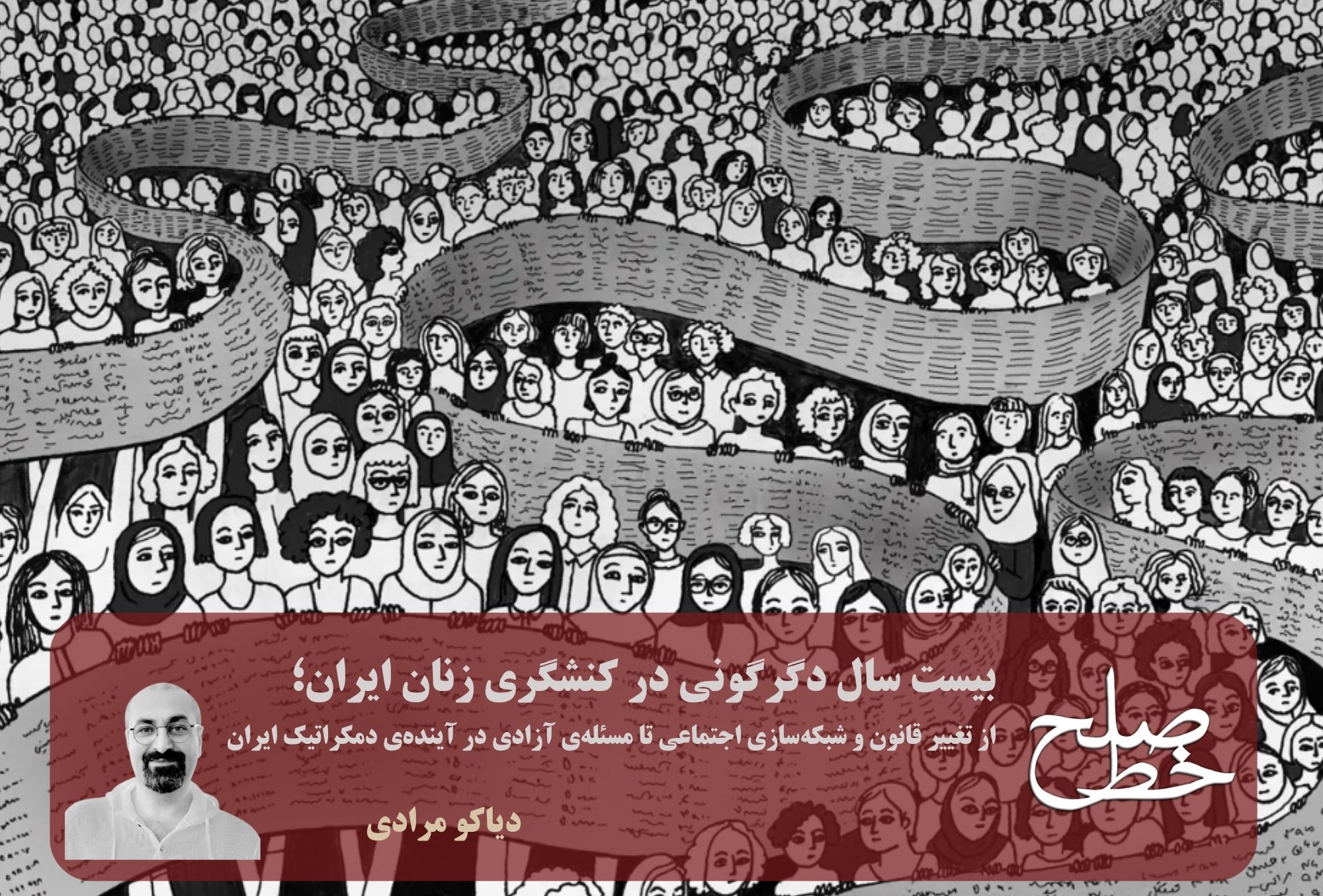
Twenty Years of Transformation in Iranian Women’s Activism/ Diako Moradi
Twenty years after the launch of the “One Million Signatures Campaign to Change Discriminatory Laws,” revisiting this experience becomes meaningful when we assess it not only by the number of signatures that were supposed to be collected or the laws that were supposed to be changed, but by the impact it had on forms of activism, networking, and the building of civil society in Iran. From this perspective, what can be seen between “One Million Signatures” and “Woman, Life, Freedom” (Jin, Jiyan, Azadi) is not a direct historical line, but rather a process of accumulating experience, resistance, and transformation in women’s agency—a process that has moved beyond the demand for equality before the law and today has arrived at a deeper question: What relationship will women’s freedom in the future of Iran have with democracy itself, the distribution of power, and the building of a democratic society?
Twenty years is not a short period for a social movement, particularly in a society such as Iran, which during this same interval has experienced several waves of protest, generational transformations, the rapid expansion of the internet and social media, intensified political and security pressures, changes in lifestyles, and ultimately the “Woman, Life, Freedom” uprising. Over such a period, many concepts that were once discussed only within limited circles of women activists or intellectuals gradually entered the everyday language of society, while the question of women itself expanded from an issue often defined within the boundaries of legal rights into one of the fundamental questions concerning power, life, and freedom.
For this reason, if revisiting the One Million Signatures Campaign is limited merely to commemorating an experience belonging to 2006 (1385), we may miss its most important dimension. The fundamental question is what happened in society over these two decades: how the demand to change discriminatory laws became connected to networking and building capacity within civil society; how women’s resistance took on new forms in subsequent years; and how, in 2022 (1401), with “Woman, Life, Freedom,” the issue moved beyond the boundaries of women’s rights and called into question the very relationship between the individual, society, and power.
Of course, a simple and linear relationship cannot and should not be drawn between the One Million Signatures Campaign and “Woman, Life, Freedom.” Such a narrative, in addition to oversimplifying the history of Iran’s women’s movement, would also disregard the specific origins of “Woman, Life, Freedom.” This slogan was not born in 2022 (1401), nor was it a direct product of earlier women’s movements in Iran. “Woman, Life, Freedom” is rooted in the experience of the Kurdish women’s freedom movement and in an intellectual and political tradition that understands women’s freedom not as a marginal issue, but in connection with the freedom of society, the critique of patriarchy, and the questioning of centralized structures of power.
What happened in 2022 (1401) was the expansion of this language from its specific historical and geographical context into a much broader space. Following the death of Mahsa (Jina) Amini, these three words were able to connect with the differing experiences of women and various sectors of society and become a common language for expressing something that had already existed across different layers of society but had not necessarily possessed a shared language.
Therefore, if there is a relationship between the One Million Signatures Campaign and “Woman, Life, Freedom,” it is better understood in terms of the “historical accumulation of women’s agency.” Social movements are not born from one another, but social experiences do not take shape in a vacuum either. Networks remain, languages are transmitted, new generations preserve some previous experiences and critique others, and a question raised in one period as a legal demand may, in another period, become a more fundamental question about power relations themselves.
In this sense, perhaps one of the most important trajectories of change over the past two decades can be understood as women’s gradual movement from being the “object of politics” to the “subject of politics”: from a woman who asks the power structure to recognize her equal rights to a woman who sees herself as one of the makers of law, politics, society, and the form of shared life.
From Signatures to Relationships: An Experience in Building Civil Society
The One Million Signatures Campaign was formed on August 27, 2006 (5 Shahrivar 1385), following years of activism by the women’s movement and after the peaceful protest of June 12 of that year (22 Khordad 1385). Its stated goal was to collect one million signatures demanding changes to discriminatory laws against women—laws covering areas such as marriage, divorce, polygamy, inheritance, testimony, diya, nationality, and the age of criminal responsibility, whose effects were directly visible in women’s everyday lives.
But the campaign’s historical importance did not lie solely in the substance of its legal demands. The method chosen to pursue those demands was equally important. Activists were not simply going to prepare a legal text, submit it to members of parliament or government officials, and wait for a response. A significant part of the campaign’s idea was based on direct dialogue with society: activists would go among the people, explain the laws, listen to women’s experiences, and demonstrate that legal inequality was not an abstract concept detached from everyday life.
This very choice brought law out of legal textbooks and into everyday life. When the right to divorce was discussed with a woman who had spent years trapped in a difficult marriage, the issue was no longer merely the interpretation of a legal provision. When the issue of custody was placed before a mother who had experienced it herself, the law became part of her lived reality. Discussions of inheritance, diya, or nationality likewise moved beyond articles and clauses and reached the question of how a legal structure can restrict a person’s ability to choose, as well as their security and independence.
This shift from the “text of the law” to the “experience of life” was fundamentally important. In many societies, discrimination acquires its greatest power precisely when it is no longer perceived as discrimination. When an unequal relationship is repeated over successive generations, it can gradually become normalized in the name of tradition, custom, family interests, or even the supposed nature of women and men. Under such circumstances, even the person facing discrimination may view what is happening to her as a personal problem unique to her own life.
Yet it is enough to place individual experiences alongside one another for the nature of the issue to change. A woman who realizes that the problem she faces regarding divorce, custody, or legal independence is an experience shared by thousands of other women is no longer dealing with a merely personal problem. What appeared private becomes a social and then a political issue. One of the campaign’s most important functions should be sought precisely in this transformation of individual experience into collective understanding.
From this perspective, even the number “one million” takes on a different meaning. One million was not merely the number of names that were supposed to appear beneath a petition. Behind that number lay the idea of an extensive range of social conversations. Each signature could be the result of a conversation—a conversation in which one person explained, another asked questions, disagreed, or recounted a personal experience. For this reason, in many cases, the process of dialogue itself became as important as the final signature.
In addition to affecting the campaign’s audience, this process also transformed the activists themselves. If social activism genuinely enters society, it cannot remain a one-way relationship between the “informed activist” and a “society that must be enlightened.” The activist, too, is compelled to listen and learn from the complexity of different experiences. A middle-class woman in Tehran does not necessarily face the same issues as a working-class woman. The experience of a Kurdish woman cannot be understood without considering gender, language, ethnicity, geography, and the securitization of the political environment. A Baluch or Arab woman may experience gender discrimination simultaneously with regional deprivation or other forms of structural inequality. Rural women, women belonging to religious minorities, migrant women, and women employed in different sectors of the economy likewise confront different combinations of restrictions.
These differences do not eliminate the shared issue of equality, but they complicate a homogeneous conception of the “Iranian woman.” Society is not a homogeneous mass but a collection of different experiences, and a social network remains alive when these experiences are not directed solely from the center toward the periphery, but are also able to move in the opposite direction—that is, when local and differing experiences can themselves influence the language, methods, and priorities of the movement.
From this perspective, perhaps the most important thing the campaign produced was not signatures, but relationships: relationships among activists, among generations, among different cities, and between women’s personal experiences and the legal and political structures affecting their lives. Social movements are not built solely from slogans and formal organizations; a large part of their power lies in these very relationships, which enable individuals to see themselves as part of a shared issue.
Civil society, in its deeper sense, also begins here. Civil society cannot be reduced merely to non-governmental organizations, offices, bylaws, or formal projects. Before all of these, civil society is the ability of people to establish relationships independently of state power—to define a public issue, discuss it, formulate demands, and engage in collective action for change.
At a time when much of Iran’s political experience was still understood through centralized organizations, recognizable leaderships, and vertical structures, this method of activism offered a different experience. Cooperation did not require everyone to agree on every issue; people with different political and intellectual orientations could work together around a specific demand without denying their differences.
This experience, of course, was not always free of disagreement and tension and should not be romanticized. Like any other collective experience, the campaign itself faced disagreements, organizational problems, and internal limitations. Yet this very experience demonstrated that plurality does not necessarily prevent cooperation. Civil society becomes meaningful when people can remain different while simultaneously acting toward a common goal.
From this perspective, the government’s security response to the campaign also takes on a meaning beyond its confrontation with a legal demand. Why should a political structure be concerned about collecting signatures to change a few laws? The answer may be found in the characteristics of authoritarian governments. Authoritarianism does not fear only rebellion or revolution; it is also concerned by a society capable of forming relationships independently of the state. Citizens who find one another without government permission, develop a shared language about their problems, and organize to resolve them gradually cease to be isolated individuals.
The issue was not merely one million signatures. It was a society practicing how to speak for itself.
From Civil Society to “Woman, Life, Freedom”: The Accumulation of Experience and a Change in the Level of the Question
Security pressures were able to restrict the campaign’s organized activities. Some activists were arrested, some faced summonses and pressure, some were forced to leave Iran, and the political atmosphere following the 2009 protests (1388) made many forms of public activity more difficult. Nevertheless, there is a major difference between weakening a structure and eliminating the social experience that structure has produced.
An organization can be shut down, but society cannot as easily be returned to the condition that existed before an experience took shape. People have acquired knowledge and skills, networks have formed, concepts have entered public language, and questions have been raised that can no longer easily be erased. An organization may weaken, but what has taken shape in people’s minds and social relationships can continue in other forms.
Iranian society also did not remain unchanged between 2006 and 2022 (1385–1401). The increased presence of women in universities and the public sphere, changing family patterns, the expansion of the internet and social media, economic crises, political and social protests, resistance to compulsory hijab, and changing attitudes among younger generations toward the body, family, religion, and lifestyle gradually transformed social relations.
Many of these changes may not initially have appeared political. A woman’s decision about how to dress, her resistance to a role assigned to her by her family or society, her efforts toward economic independence, or her redefinition of her relationship with marriage and family may outwardly appear to be individual choices. But when such behaviors are repeated on a broad scale, they alter the relationship between the individual and the social structure.
Society does not always change only in the streets. Sometimes, years before a political transformation becomes visible in the form of public protest, it is already taking shape in ways of living, aspirations, family relationships, and the expectations of new generations.
The expansion of social media accelerated this process. A personal experience could now become a public experience within hours, and an image or narrative could cross geographical boundaries. This transformation created an enormous opportunity for social movements, but it also had an important limitation: the speed of communication does not necessarily mean depth of relationship.
Millions of people may see a message or repost a hashtag without there being a lasting relationship, trust, or organizational capacity among them. A digital network can transmit a message with unprecedented speed, but a democratic society requires more than the transmission of messages. It requires relationships, shared experiences, institutions, trust, and the capacity to continue working after the moment of excitement has subsided.
Here, the experience of One Million Signatures once again becomes meaningful. That experience reminds us that a network is not merely connection; a network is relationship. Technology can create a connection in a matter of seconds, but relationships require time, dialogue, and trust.
In September 2022 (Shahrivar 1401), following the death of Mahsa (Jina) Amini after her detention by the Guidance Patrol, a large part of the changes that had accumulated within society became visible. Understanding that moment, however, requires taking two realities into account simultaneously. On the one hand, the 2022 uprising cannot be understood without the long history of women’s resistance in Iran, from the struggles of different generations and the One Million Signatures Campaign to resistance against compulsory hijab and various forms of civil disobedience. On the other hand, “Woman, Life, Freedom” cannot simply be subsumed into this history while disregarding its distinct origins.
“Woman, Life, Freedom” existed before 2022. The slogan emerged within the Kurdish women’s freedom movement and acquired a specific meaning in the political experience of women in Kurdistan. In this tradition, the connection between “woman, life, and freedom” is not merely a linguistic combination; it embodies a view of society that does not separate women’s freedom from freedom in general and regards patriarchy not as a private matter, but as one of the relations through which domination is produced and reproduced.
Following Mahsa’s death and during her funeral in Saqqez, this language entered a new phase and then spread to different parts of Iran. The significance of this transmission lay in the fact that a concept with a specific origin was able to connect with different experiences. Women and men from different backgrounds, without necessarily sharing identical experiences, were able to recognize some of their own demands and aspirations in these three words.
It is at this point that an important difference between the two periods becomes apparent. In the One Million Signatures Campaign, one of the central questions was why the law discriminated between women and men. In “Woman, Life, Freedom,” the scope of the question expanded to ask who fundamentally has the right to decide about a person’s body, life, and freedom.
This shift does not make legal equality unimportant; on the contrary, without equality before the law, freedom will remain vulnerable. But experience has shown that legal equality alone is not sufficient to build a free society. The law may speak of equality while the economic structure keeps women dependent; the right to vote may exist while the real centers of decision-making remain predominantly male; women may be present in formal institutions while lacking the ability to organize independently or exert genuine influence over the political agenda.
Thus, the issue expands from “having rights” to “the possibility of living freely.” Freedom moves beyond being a legal concept when it can be experienced in everyday life: in the body, clothing, work, love, family, language, public space, and the ability to participate in decisions that affect the lives of individuals and society.
In this sense, perhaps the transformation of the past two decades can be understood as a movement from law to life—not in the sense of moving beyond law or rendering it unimportant, but in the sense of placing law within the broader context of social relations and power.
Women’s Freedom: A Measure of How Democratic a Society Is
This transformation is of fundamental importance to discussions about Iran’s future. In many political programs, the issue of women is still presented as one topic among several others, alongside issues such as elections, the economy, the environment, ethnic rights, freedom of expression, and foreign policy. At first glance, this categorization appears natural, but it inadvertently reduces women to one “social group” alongside other groups.
Women, however, are not a separate segment of society. They are present across all classes, ethnicities, languages, religions, regions, and social groups. For this reason, women’s freedom cannot merely be regarded as one chapter in a democratic program; the status of women is itself one of the criteria by which the democratic character of a society can be assessed.
A society may hold free elections, but if women are deprived of economic independence, security, bodily autonomy, or genuine participation in power, a significant portion of authoritarian relations remains intact. If we understand democracy merely as a method of choosing a government, the existence of elections may appear sufficient to describe a system as democratic. But if democracy is also understood as a means of distributing and restraining power within society, the issue becomes much broader.
From this perspective, patriarchy is itself one form of the concentration of power. Power is not concentrated only in the central government or the capital; it can also be concentrated in a political party, an economic class, the family, gender relations, and the dominant culture. A country’s administrative structure may be decentralized while the family remains based on the unilateral authority of men. A political system may change while women’s bodies remain subject to decisions made by the state, religious institutions, or the family. Under such circumstances, part of the logic of domination has merely been transferred from one institution to another.
For this reason, the question concerning the future of women in Iran must also change. Instead of asking only, “What rights will be provided for women in the Iran of the future?” we must ask how women will participate in building the future Iran itself.
This difference is not merely linguistic. The first question still contains the assumption that a structure will be created somewhere and will then decide which rights to grant or guarantee to women. The second question moves women out of the position of recipients of rights and places them in the position of builders of the political order.
In that case, the issue is not merely women’s presence in parliament or the cabinet. Numerical representation is important, but it is not sufficient. We must ask what role women have in setting the agenda, how much access they have to political and economic resources, what position they will hold in drafting a constitution and designing the electoral system, and whether they will have the possibility of independent organization and genuine decision-making within political parties and civil structures.
There is a serious distance between “presence” and “power.” A woman may be a minister or a member of parliament while the fundamental rules of the game were determined before she entered. A political party may have many female members while leadership, resources, and major decisions remain in a predominantly male circle. Genuine participation therefore cannot be measured solely by the number of women within structures; we must examine the extent to which women participate in producing policy and shaping shared rules.
This is where women’s self-organization becomes important. Self-organization does not mean separating women from society or public politics; rather, it means that women must be able to enter the public sphere with an independent voice and their own social power. Political parties, men, and other social forces can be allies of women’s freedom, but they cannot take women’s place in defining problems and constructing solutions.
This issue is particularly important in discussions of political transition. One of the well-known dangers during revolutionary and transitional periods is that women are asked to postpone their demands until after the “main issue” has been resolved. The experience of the 1979 Revolution (1357) reminds Iran of the consequences of such logic. Women participated extensively in the revolutionary process, but soon after the change of government, their bodies, clothing, and rights became among the first arenas in which the new political order was imposed.
The conclusion to be drawn from this experience is that women’s freedom cannot be postponed until the day after a transition. The transition process itself must incorporate women’s equal participation. Decisions made during a transitional period concerning the constitution, electoral system, the relationship between religion and the state, the judicial structure, local government, and economic policy may determine the course of society for decades. If women are not in an equal position when these rules are being formed, reforming the resulting structures in the future will be far more difficult.
Democracy is not a skill whose practice can be postponed until the day after a change of government. The quality of the future is shaped to a large extent by the nature of relationships today. Forces that are currently incapable of creating genuine participation for women within their own structures cannot assume that the issue has been resolved merely by promising an equal future. Democracy must be practiced in organizational structures, in methods of decision-making, in tolerance of differences, and in the genuine distribution of power.
From Civil Society to a Democratic Society
At this point, the experience of the One Million Signatures Campaign leads to a broader question about the difference between a “democratic state” and a “democratic society.” Civil society creates a space in which society can breathe independently of the state. Unions, associations, women’s organizations, independent media, local groups, and informal networks of citizens are all part of this space. The existence of such institutions means that individuals do not stand alone before the state and can join others to define problems, formulate demands, and monitor power.
But a democratic society goes one step further. In a democratic society, a citizen is not merely someone who votes every few years or communicates demands to the government; citizens must also have the opportunity to participate in managing collective life between elections. In this understanding, democracy does not operate solely in parliament and government; it is also experienced in neighborhoods, cities, unions, associations, women’s organizations, and other institutions of society.
This distinction is highly significant for Iran’s future. If political change is limited merely to replacing one government with another without changing the relationship between the state and society, part of the logic of concentrated power may be reproduced. New institutions may be created while society remains in the position of receiving decisions made from above.
From this perspective, decentralization also acquires a broader meaning. Decentralization is not merely the transfer of administrative powers from Tehran to other regions. If the logic of decision-making remains vertical, smaller centers of the same type of power have merely been created. Genuine distribution of power must be both geographical and social: between the center and the regions, between the state and society, between formal institutions and civil institutions, and also between women and men.
Within this framework, women’s freedom shifts from being a purely gender-related issue to a question concerning the architecture of democracy. If policies concerning women continue to be designed in a political center while women in regions, cities, associations, and social networks remain merely their recipients, even a policy with progressive content can reproduce a top-down relationship. But when women at different levels of society are able to define the issues themselves, build independent organizations, and participate in designing and implementing policies, the relationship between society and power changes.
It is here that a conceptual bridge can be built between the experience of civil society in the One Million Signatures Campaign and the horizon of a democratic society. The campaign demonstrated that society should not merely wait for the state; it can itself engage in dialogue, build networks, and generate public issues. A democratic society extends this logic and asks how this same society can become not merely a demander, but one of the producers of public decisions.
For women, this shift has a particular meaning. At one stage, the issue was for the state to recognize women’s equal rights. At a broader stage, the question is how women themselves will participate in producing the laws intended to guarantee those rights and in designing the institutions intended to protect them. This is precisely the distance between receiving rights and possessing political agency. Yet such a horizon will be genuinely democratic only if the diversity among women themselves is also recognized. One criticism that must be taken seriously when revisiting the history of the women’s movement is the focus of some narratives on the experiences of Tehran and urban middle-class women. This criticism does not mean disregarding the important role of those women; the problem begins when one particular experience speaks in the name of all women’s experiences.
Iranian society is diverse in terms of language, ethnicity, class, geography, and religion, and gender is not experienced in a vacuum. A Baluch woman may experience gender discrimination simultaneously with poverty and regional deprivation. A Kurdish woman may confront the intersection of gender, language, identity, centralism, and a securitized environment. Arab women in Khuzestan, working women, rural women, migrant women, and women belonging to religious minorities likewise have experiences that cannot be reduced to a single narrative.
“Woman, Life, Freedom” was also an important moment in this respect. A movement that arose from Saqqez and Kurdistan following Mahsa’s death was able to resonate in Tehran, Baluchestan, Azerbaijan, and different parts of Iran without erasing the differences among the conditions in these regions. This very reality demonstrated that building a shared language does not necessarily require making experiences uniform.
A pluralistic society cannot be democratized by eliminating differences. Democracy, more than being a project of becoming alike, is the capacity to build a shared life amid differences. If the women’s movement is to play a fundamental role in Iran’s future, it must also be able to carry this multiplicity of voices within itself.
Twenty Years Later: From Demanding Equality to Participating in the Construction of Freedom
The twentieth anniversary of the One Million Signatures Campaign acquires its true value when it does not become an exercise in nostalgia or mythmaking. No genuine social movement is without limitations, disagreements, and mistakes. The campaign was no exception. Government pressure and repression played a decisive role in restricting it, but this should not prevent critical examination of its internal experiences, methods of organization, center-periphery relations, and the ways experience was transmitted between generations.
The memory of a social movement remains alive when it can both preserve its achievements and transform its failures and limitations into knowledge for the next generation.
From this perspective, one of the campaign’s most important lessons is the importance of social relationships. In the age of digital networks, it is easy to mistake numbers of followers, views, and reposts for social power. But society acquires power when connection becomes relationship—when trust is built, shared experience is created, and people can continue working together after a wave of media attention has subsided.
Another lesson is the importance of connecting broad demands with everyday life. Concepts such as freedom, equality, and democracy become meaningful to society when they can be seen in people’s actual experiences. The One Million Signatures Campaign connected equality to divorce, custody, inheritance, and family life. “Woman, Life, Freedom,” at another level, connected freedom to life itself—to the body, clothing, work, love, language, family, and the human right to participate in determining the conditions of life.
Placing these experiences alongside one another may offer another lesson: between the individual and the state, there is something called society. If society is not organized, even a democratic government can gradually concentrate power. Democracy is not merely the product of a suitable constitution; it requires a society capable of defending freedoms, monitoring power, and resisting the return of authoritarianism.
In such a society, independent women’s networks and organizations are not a marginal or sectoral issue; they are part of the infrastructure of democracy.
From this perspective, the distance between One Million Signatures and “Woman, Life, Freedom” can also be understood as the distance between two stages in the transformation of a question. In one period, the question was why the law did not recognize women as equal; in another, the question became: who has the right to decide about women, life, and freedom? The second question does not set aside the first; it deepens it. Equal laws are still necessary. Legal discrimination must be dismantled, and judicial, economic, and political institutions must be reconstructed on the basis of the principle of equality. But the experience of the past two decades has shown that equality remains fragile if it exists only in law. Freedom must be able to live within social relationships, and society must be able to defend it.
It is here that the question of women becomes inseparably intertwined with Iran’s democratic future.
Women’s freedom is not an outcome to be achieved at the end of a democratization process; it is one of the conditions that make democracy itself possible. A society in which a woman cannot decide about her own body, life, and future still retains part of the logic of domination within itself, even if it holds elections. A society that allows women into decision-making institutions while the fundamental rules continue to be constructed without their genuine participation has not yet achieved full political equality. And a society that postpones women’s freedom until “after change” may once again repeat a history for which Iranian women have already paid a heavy price.
Perhaps now, twenty years after the launch of the One Million Signatures Campaign, the meaning of that experience can be seen from a different perspective. One million names were supposed to be placed beneath a demand, but what remained from that experience was not merely the names; it was the conversations that took shape, the relationships that were built, the knowledge that moved beyond limited circles and was distributed throughout society, and a generation that learned that inequality is neither natural nor immutable. Sixteen years later, following the death of Mahsa (Jina) Amini, the question of freedom was condensed into three words: “Woman, Life, Freedom.”
If One Million Signatures asked why women were not equal before the law, “Woman, Life, Freedom” took the question to another level: How can a society in which women are not free consider itself free? And today, on the twentieth anniversary of that experience, perhaps another question must be added to this trajectory: Who will build the Iran of the future? If the answer is to be democratic, women cannot enter the new order after it has been built and demand their share. They must be among its builders from the very beginning—not as a group represented by others, but as actors who bring their own experience, knowledge, organization, and political imagination into the process of building society.
From this perspective, the path between “One Million Signatures,” networking and civil society, “Woman, Life, Freedom,” and the question of women’s freedom in Iran’s democratic future should not be understood as a direct historical line. It is a collection of experiences that have at times connected with one another, at times moved apart, and at times transformed one another’s language and horizons. What can be observed across them is the gradual growth of women’s agency and the expansion of the question from legal equality to the structure of power and the quality of life.
At one end of this history stood a woman with a pen in her hand, asking another person to sign for a change in the law. At the other, a generation of women took to the streets and declared that they had the right to decide about their own lives and freedom. These two images are not the same, and their historical differences should not be erased, but both are part of a longer history in which women have increasingly moved from the position of those about whom decisions are made to the position of those who themselves participate in making shared decisions.
Perhaps the deepest meaning of these twenty years lies precisely here: the movement from demanding equality to participating in the construction of freedom; from asking for inclusion to possessing agency; and from conceiving of “women’s rights” as one issue within politics to understanding that women’s freedom is intertwined with the quality of society itself and with democracy.
Iran’s democratic future may likewise be measured, more than anything else, by the answer to this very question: not what rights have been provided for women, but to what extent women, freely and equally and alongside other parts of society, are themselves among the builders of that future.
 Created By: Diako Moradi
 September 23, 2026
Tags
"Million Signature Campaign" Civil society Diako Moradi Freedom of speech Mahsa Amini Peace Line 185 Woman Women's rights