


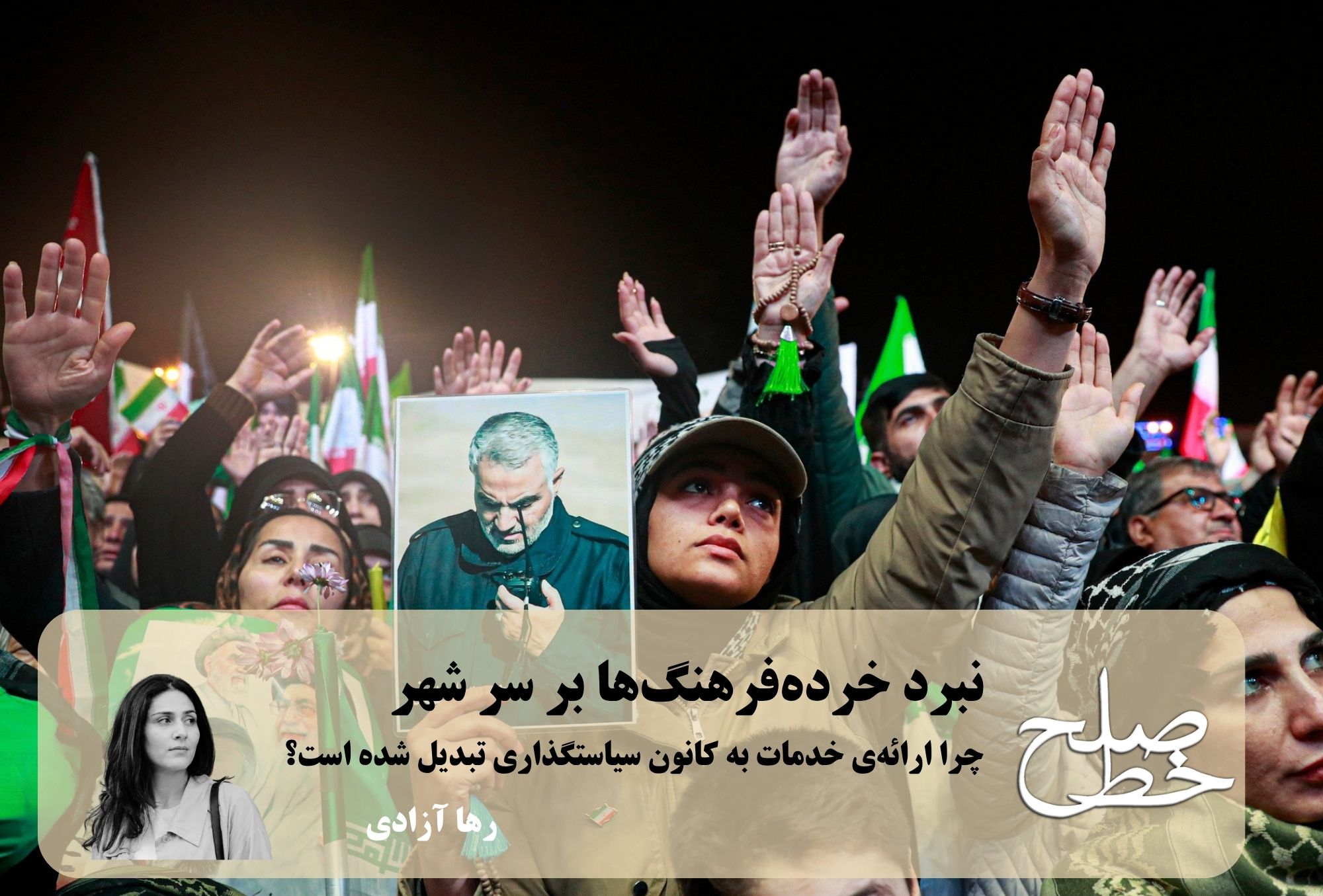
The Battle of Subcultures over the City/Raha Azadi
After the ceasefire in Iran, public policymaking, especially regarding public spaces and service occupations, underwent extensive changes. After 1401, with some twists and turns, the policy that Ali Motahari referred to as the “Sa’ah Sadr Nizam” was put on the agenda, and the previous strictures were somewhat relaxed. In these two or three years, it seemed that arrests and detentions had become more limited, and although a few Ershad patrol vans might occasionally be seen on a street or an attack on an individual or place might occur, it did not seem to be a dominant policy.
The year 1404 was a turning point in the history of Iran. First, the 12-day war and military aggression against Iran shocked the security policy-making institutions, and its product, along with actions that had a direction other than civil demands, such as the calls of January, promised double strictness. But in the end, the next military aggression that began in March was a harbinger of the future: “the title of a horror movie”!
January 1404 and the concern about the opposition conquering the streets, along with Israel’s inverted horseshoe, which targeted urban security forces such as police stations, Basij bases, and checkpoints, sending the message that it had a plan for the cities, led Iranian security officials to consider preemptively conquering the streets. Not long ago, Parliament Speaker Mohammad Baqer Qalibaf attributed this idea to himself and Ali Larijani.
The presence of a group of people – whom we will refer to as the pro-regime subculture in this article – was a propaganda tool and at the same time a barrier against the opposition taking over the streets. Perhaps the greatest achievement of this tactic was the Charshbane-e-Suri in late March, in the midst of the war, before which there was talk of opposition groups’ plans to use this night. Strange titles such as the Sent People – which did not clearly see people as bearers of the next revelation or the dead released from the resurrection – along with extensive television advertising and the installation of semi-permanent places in urban places for the presence of this subculture, continue to this day, in the late summer of 1405, indicating that the dominance of this subculture in society is set to be established. It seems that the hegemonic policies of the subculture go back to the sixties; When belonging to a subculture is the only way to get into college, find a job, and even get a bank loan.
By now you probably get the gist of the article: we’re going to find a battle between subcultures. What had seemed to be increasingly won over the years by the modern urban middle class was rapidly regressing. Although at first images of women wearing clothing other than what the pro-regime subculture liked were broadcast on television, and for a while national literature was sung in a prayerful tone in the form of hastily composed hymns—such as the slanderous To Rostam and others—at night gatherings, it was predictable that at some point the pro-regime subculture would revert to its previous settings, and the pro-regime people would take precedence over the Iranian nation. After some time of the ceasefire, the snake’s tail was visible from under the rock.
Groups of social and civil activists, many of whom coincidentally had been with the pro-regime subculture during the war against foreign aggression, were called to the security institutions. With arrests or SIM card blocking and other extra-legal restrictions (a common term for arbitrary illegal actions), this group realized that their importance to the regime’s propaganda apparatus was over and that if the country survived, they would not consider themselves part of it; the dominant subculture, using the excuse of martyrs and the continuation of the literature of the sixties, tried to drive others away and make them understand that the street does not recognize anyone except the people who were sent.
In order to prevent other subcultures – whether supporters of foreign military aggression to overthrow the government or its opponents – from considering themselves a part of the alleged victory, the confrontation had to start from the very moment. In addition to the activists, all the “other” subcultures had to be made aware of who the future of the country belonged to. Given the events of January and the bloodshed and promises of violence that groups of opponents of the regime were making, there was no room for risk.
This included groups, subcultures, and businesses that were essentially non-political.
Lifestyle can differentiate subcultures, and now a subculture that finds itself on the brink of a bitter or even fleeting victory cannot compare its alleged achievements with a group that has spent time in Iranshahr cafes or sports clubs or other different/alternative spaces; those nights when they supposedly engaged in jihad around a certain square with the slogan “You are a slanderous Rostam.”
Those who in previous years, as they say, were disgusted by the sight of women wearing optional veils, now have time to use the opportunity to restore their lost self-confidence. Security forces are also intimidating activists, lest they speak out, and are removing urban spaces from places where these people can gather, lest the voice of another subculture be heard in the city.
There are still those who speak of an opportunity that has been gained to unite the fragmented society and form a new Iran. Of course, they are criticized for the fact that the unity they seek is negative, not positive; that is, not around Iran, but around the war against Iran. But one flaw in their analysis is that they see the issue from the other side’s perspective as national, just like they do. National interests are important to these friends, and very, very good, but it should be noted that the subculture supporting our system does not see us as a nation, but rather has a view based entirely on the division of insiders and outsiders among the subcultures of society. As a result, it may be easier for them to lose Iran than to lose the competition over urban spaces, cafes versus mosques, and the like. The war gave this subculture the opportunity to recover and return to the settings of the sixties; When the dominant subculture forbade others from even attending university and school, and even on the street, one had to wear the clothes one wanted.
 Created By: Raha Azadi
 August 23, 2026
Tags
Iran-US war peace line Peace Line 184 Plumb Cafe Rustam Tahmatan Seal Subculture The war between Iran and Israel. Unveiling War You are a slanderer, Rostam. کنترل اجتماعی ماهنامه خط صلح