


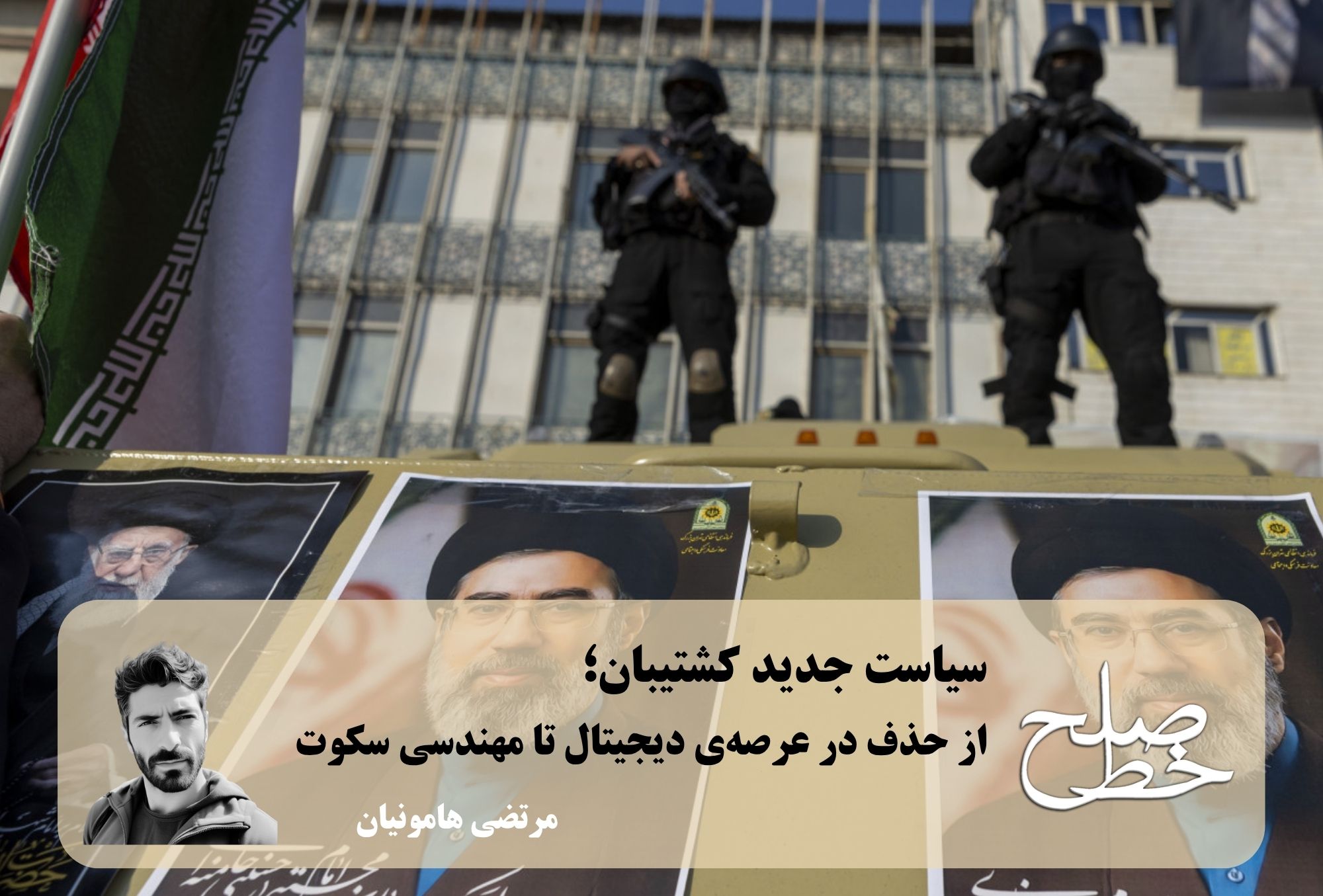
The Helmsman’s New Policy: From Elimination in the Digital Sphere to Engineering Silence/ Morteza Hamounian
Usually, after a calamity, clearing the rubble begins. For example, when a war occurs, after it ends, everyone seeks to clear away the rubble of war and tries, through a collective effort, to heal one another’s wounds. But in the Islamic Republic of Iran, it seems that everything is reversed. Once the war subsides, only then does the government remember that it must further constrict the public sphere—both physical and virtual—and expand the scope of its crackdowns; crackdowns that, in the recent postwar situation, have manifested themselves in almost every sphere—from social and cultural fields to economic activities. Once again, cafés and café-bookstores are being sealed, tourism tour organizers are being confronted, bloggers are being summoned, Instagram pages are being blocked, content is being removed, and pressure is being placed on businesses whose activities and income largely depend on the online sphere. In fact, in postwar Iran, the government has once again turned comprehensively to a policy of social control; a policy whose coincidence with the beginning of the system’s third leadership era and his efforts to consolidate himself and establish a new order deserves serious consideration.
In this context, what is happening in cyberspace is not merely a return to the same old policy of control; rather, we are facing a newer and more severe form of crackdown in a space that can be called the “digital public sphere.” A space that can potentially serve as a platform for dialogue, communication, and direct interaction among citizens, but which has been subjected to assault, restriction, and filtering almost from the very beginning of the internet’s arrival in Iran.
The author recalls that in the early years of the 1380s, government officials claimed that filtering was only intended to prevent access to pornographic and immoral websites. Yet during those same years, the website of a Shia marja such as the late Ayatollah Hossein-Ali Montazeri was also among the websites that experienced filtering. This very contradiction perhaps made matters clear from the outset. The main issue was never merely “pornographic content.” From its earliest years, the political order in Iran demonstrated through its actions that it had a problem with any platform that enabled the free circulation of information and public dialogue beyond government control, and that sooner or later it would do to the internet what it had previously done to the press and independent media.
This trend has continued from then until today, each time on a broader scale. One day websites were targeted, another day blogs and the crackdown on bloggers, and then came the turn of social networks, messaging services, and global platforms. Filtering expanded, and internet speed became a tool of pressure. Internet shutdowns during periods of protest became part of the government’s security toolbox, while crackdowns on users, journalists, and online activists also continued. But in the aftermath of the 40-day war, digital censorship has taken on another dimension. The form of repression may resemble the past, but its reason is something new. Consolidating the third leadership requires complete silence in the public sphere, both digital and non-digital. At the beginning of Khamenei’s first leadership era, it was the aftermath of the eight-year war and the post-1988 (1367) massacre atmosphere, and people held their breath. Today, the third leadership also needs an atmosphere similar to that period in order to consolidate itself; an atmosphere in which the public sphere, in all its dimensions, including the digital sphere, either moves in step with it or remains silent. In fact, with the changing power relations within the Islamic Republic, the public sphere can become a serious actor on the scene. This makes controlling that sphere a vital matter. The issue is the redrawing of boundaries: what behavior will be tolerated, what lifestyles will be allowed to be visible, what forms of gathering and communication will be permitted, and to what extent society will be allowed to create space for itself independently of the government’s will.
From this perspective, the wave of crackdowns on Instagram pages, bloggers, cafés, tourism tours, and online businesses must be viewed together. These are not a collection of scattered events concerning different subjects; rather, when placed alongside one another, they present a picture of an attempt to redefine the boundaries of the public sphere. After a period in which the war had placed parts of society, even if temporarily and cautiously, in a position closer to the government, instead of using that situation to repair divisions—which many optimists had expected—the government is once again speaking to society in the familiar language of restriction and repression.
HRANA’s report on the crackdowns carried out between July 11 and August 1, 2026 (20 Tir to 10 Mordad 1405) reveals part of the dimensions of this situation. According to the report, during this period alone, at least 72 popular and identifiable pages or accounts on social media were blocked, seized, or made inaccessible. The administrators of at least 21 pages were also forced to publish pledges or texts emphasizing compliance with regulations and refraining from repeating their previous conduct. At the same time, at least 23 business establishments were also sealed. HRANA, however, has clarified that some of these cases overlap and that their total should not be regarded as the number of entirely separate cases. (1)
These statistics contain a meaning within them, one that may be more important than the numbers themselves. In order to consolidate itself, the new order must make its boundaries known to society. Society must understand that a change at the top of the power structure does not necessarily mean a change in the way the government treats society. Quite the opposite may be true: the initial period of the new order may be a time when the apparatus of power feels a greater need than ever to display its authority and redraw the forbidden lines more boldly. One may recall Ahmad Qavam al-Saltaneh’s admonition and warning on July 18, 1952 (27 Tir 1331), when he threatened the Iranian people by declaring that “the helmsman has adopted a different policy.” Of course, it should be noted that the whole affair lasted only a few more days.
This time, in order to convey its message of authority, the government has gone directly to the grassroots of society. Sealing a café, closing a blogger’s page, removing thousands of pieces of Instagram content, or cracking down on a tourism tour each carries its own message: a simple and understandable message that the government still defines itself as the authority entitled to determine the boundaries of public life. Society should not imagine that what it has gained in the aftermath of the 2022 (1401) protest movement is definitive and that it can now rest assured.
Examples published from different provinces make this issue and message clearer. In Qazvin, the Public Places Supervision Police announced the identification and, in its own words, “cleansing” of 56 Instagram pages for publishing what it called “norm-breaking and culturally harmful advertising content.” The owners of the pages were summoned, the targeted content was removed, and judicial cases were also opened against a number of business establishments. (2) In Gilan, the police also announced action against 32 business establishments in Rasht and the removal of 3,258 pieces of content from their Instagram pages. (3)
The crackdowns may appear different. But they all converge at one point. The fundamental question is: who has the right to determine the form of presence in the public sphere? Society or the government?
Cyberspace, or the digital public sphere, is troublesome for the government precisely from this perspective. This space is not merely a place for publishing photos and videos. It is a place where society sees itself, presents itself to others, and compares itself with others. The outcome of all this in the digital sphere becomes an image that the government does not want society to have of itself, of others, and of the government. An image in which different lifestyles, forms of dress, social relationships, music, recreation, travel, businesses, and various ways of living are visible alongside one another.
An image of a café on Instagram can be an image of a different kind of life in one corner of society, where a model other than the official one is unfolding. The same is true of a tourism tour in which women and men are together and wear clothing other than that officially dictated by the government. The issue of censorship here is the issue of controlling the image of society; an image and images that convey another face of Iranian society to society itself and tell it that it no longer resembles what the government wants it to be. It tells society that its resistance has worked and that the government can no longer make it submissive and subdued in the physical and digital public spheres. These images of everyday life allow society to feel victorious; a sense of victory that creates hope for future changes, and this is a major danger for a newly enthroned ruler seeking consolidation.
Perhaps another example can explain this better. Consider the case of Nima Takido, a YouTuber born in the 1380s. In this case, following a large gathering of his fans at Iran Mall, his YouTube channel and then his Instagram page became inaccessible. Zoomit reported on July 27, 2026 (5 Mordad 1405), that his YouTube channel, with around one million followers, had been blocked with the message “pursuant to the order of the judicial authority by FARAJA.” (4) Nima Takido was not only non-political, but from time to time even acted in line with the system’s official policies. Yet he is someone who has hundreds of thousands of followers, and at his call, thousands of people gather at one location, far exceeding his expectations. In fact, he possesses an independent form of social power that, from the perspective of an authoritarian order, has become a threat. His power today may be used for entertainment or advertising, but the very existence of a network of social connections over which the government has no direct control can create sensitivities for the political structure. And so, it is targeted.
Another issue is that of pledges. Removing a post or even arresting the owner of a page is a form of crackdown and censorship imposed by the ruling order. But obtaining a pledge from a user is an attempt to determine their future behavior. The government no longer merely says, “You should not have done this,” but rather says, “From now on, you must not do this either.” It is here that repression moves beyond punishment and seeks to discipline society. A form of discipline intended to tell society that there are red lines it must not cross and to accustom it to observing those lines itself: censor yourself and abide by the red lines of me, the government. When a café owner, after seeing a colleague’s business sealed, changes the images on their own page; when a tour organizer asks travelers in advance to be careful about their clothing in front of the camera; when a blogger decides not to publish a video without having received any warning, the political order is reproducing itself without issuing a new command. It is here that self-censorship shifts from being a side effect to becoming part of the mechanism for consolidating the order. This is exactly what the government needs. This censorship is also carried out by turning words into tools. Terms such as “norm-breaking,” “culturally harmful content,” “contrary to public decency,” or “disrupting society’s psychological security” are used here. Words with unclear meanings that become tools of censorship and repression. The ambiguity of the meanings of these terms also causes users to censor themselves so that they do not face the government’s broad interpretation of them. The café owner deletes photos before receiving a warning. The tour organizer warns travelers in advance about their clothing. Before publishing a video, the blogger asks themselves whether it is worth the trouble. This pressure and attempt to compel users to self-censor through a method in which there appears to be no coercion is precisely the method of effective censorship. The government presents itself as the center of power and tells citizens either to comply with the framework it dictates or face crackdown and repression. This is the point at which direct pressure can turn into self-censorship. Research has also examined this phenomenon in the behavior of Instagram users and has shown that political, social, and legal factors can play a role in its formation and intensification. (5)
Pledges also acquire meaning precisely at this point. The individual is not merely punished for what they have done; they must also change their future behavior and sometimes publicly announce this retreat before their audience. The “blocked page,” the “sealed café,” and the “published pledge” each serve as a warning sign to others. The message is clear: “Stop yourselves before you reach this point.” This is something that cannot be counted. The number of pages closed and people arrested can be counted, but the number of times users have thought to themselves, “What will happen if I post this?” cannot be counted. It is impossible to know how many bloggers have set aside a video, how many cafés have deleted their photos, how many women have refrained from publishing their images, and how many business owners have decided to retreat on their own before the government comes after them.
The era following the 40-day war and the beginning of the third leadership, along with his efforts to consolidate it, is where the return of digital censorship and intense pressure on users finds its place. The policy also lies in the method that seeks to force users into self-censorship. In this way, the government no longer has to silence everyone. It is enough to create an atmosphere in which people calculate the cost before they speak. For a new order seeking to consolidate itself, such silence is valuable. A silence created not by consent, but by fear, caution, and calculation. And it is precisely here that the project of consolidating the new order and digital censorship converge: one needs silence in order to endure, and the other is the tool for producing that very silence. But the question is whether a society that has achieved a major victory over hijab on the ground, in which surveys such as the 2023 (1402) “National Survey of Iranian Values and Attitudes” also show serious changes, and which carries on its conscience the immense grief of the blood shed in January 2026 (Dey 1404), will submit to this censorship, silence, and self-censorship? Or will these pressures by the government themselves become the spark that ignites a powder keg? This is something that must be seen in the future. Although the author believes that Iran’s resilient civil society will overcome every barrier. Whatever policy the helmsman adopts, the waves of Iranian society’s sea will sink every ship of tyranny.
Footnotes:
1- From Blocking Pages to Sealing Cafés: A New Wave of Pressure on Cyberspace and the Public Sphere, HRANA News Agency, August 1, 2026 (10 Mordad 1405).
2- Qazvin Public Places Police Cleanses 56 Instagram Pages, Noghte Taslim News and Analysis Website, June 30, 2026 (9 Tir 1405).
3- Gilan Public Places Police Takes Decisive Action Against Cyberspace Violations and Seals Offending Restaurant; Thousands of Prohibited Posts Cleansed, Gilan Payam News and Analysis Website, July 29, 2026 (7 Mordad 1405).
4- “Nima Takido” YouTube Page Blocked by Judicial Order [Update: Instagram Also Shut Down], Zoomit, July 27, 2026 (5 Mordad 1405).
5- Salmasi, Marhamat; Nasiri, Bahareh; Shiri, Tahmoures; Soltanifar, Mohammad, An Analysis and Presentation of a Model of Self-Censorship in Cyberspace Using a Grounded Theory Approach in Iran, Iranian Political Sociology Journal, January 2023 (Dey 1401): Year Five, No. 10 (Consecutive No. 26).
 Created By: Morteza Hamounian
 August 23, 2026
Tags
Morteza Hamounian