


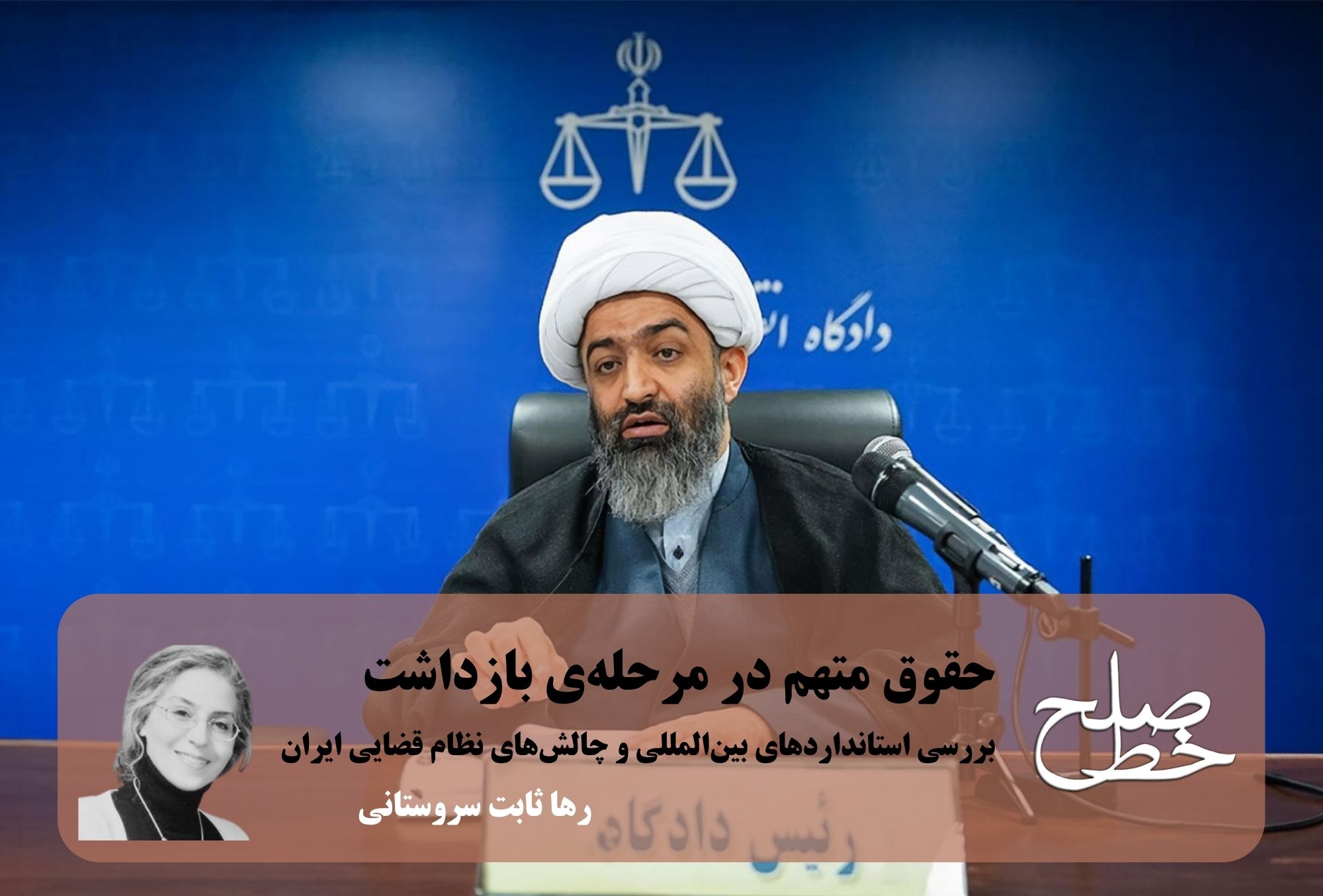
Rights of the accused during detention/Raha Sabet Sarvestani
The right to a fair trial is one of the most fundamental human rights and one of the most important guarantees for the protection of human dignity in contemporary legal systems. This right is not limited to the trial stage, but begins from the very first moments of deprivation of liberty. The experience of various legal systems has shown that many violations of the rights of defendants occur between arrest and trial; a stage when the individual is in a vulnerable position and may be subjected to arbitrary detention, pressure to extract a confession, or deprivation of basic defense guarantees. In response to these concerns, the international community has developed a set of legal standards for the protection of detained individuals, the most important of which are the International Covenant on Civil and Political Rights of 1966 and the Body of Principles for the Protection of All Persons under Any Form of Detention or Imprisonment of 1988. Since Iran acceded to the International Covenant on Civil and Political Rights in 1975, its provisions are binding on the Iranian government. This article examines the international standards governing the detention and preliminary investigation stages and assesses the extent to which Iranian judicial laws and procedures comply with these standards.
International standards of fair trial during detention
Article 9 of the International Covenant on Civil and Political Rights recognizes the right to liberty and security of person and provides that no one shall be subjected to arbitrary arrest or detention. The UN Human Rights Committee has emphasized that the concept of “arbitrary” does not only mean unlawful, but also includes detentions that are not necessary, proportionate or fair. According to article 9, paragraph 2, of the Covenant, everyone who is detained shall be informed at the time of his detention of the reasons for his detention and shall be informed promptly of the charges against him. This right is a prerequisite for an effective defence and for the review of the legality of the actions of public authorities. The Body of Principles for the Protection of Persons Under Arrest also emphasizes the need for clear information about the rights and legal status of the individual.
Another fundamental guarantee is the right to prompt and effective access to a lawyer. Article 14 of the International Covenant on Civil and Political Rights considers this right to be one of the pillars of a fair trial. The Fundamental Principles on the Role of Lawyers also stipulate that detained persons must be able to consult with a lawyer of their choice without undue delay or interference. In contemporary international law, prompt access to a lawyer is considered one of the most important means of preventing torture, inhuman treatment, and the extraction of forced confessions. The right to remain silent and not to be compelled to testify against oneself are also fundamental principles of a fair trial, as stipulated in Article 14 of the Covenant. This principle is closely related to the prohibition of torture and other forms of pressure on the accused and is one of the main guarantees of the integrity and validity of the criminal process.
Furthermore, any detained person must be able to challenge the lawfulness of their detention before an independent judicial authority. This guarantee, known in international law as the right to a judicial challenge to detention, is one of the most important tools for preventing arbitrary deprivation of liberty.
The status of the defendant’s rights in Iranian law
The Constitution of the Islamic Republic of Iran recognizes a number of the most important guarantees of a fair trial. Article 32 emphasizes the legality of arrest and the need for prompt announcement of charges, Article 35 guarantees the right to a lawyer, Article 37 recognizes the principle of innocence, and Article 38 prohibits any torture to extract a confession. The Criminal Procedure Code of 1392 also provides greater protection for the rights of the accused than previous laws and emphasizes the right to be informed of the charges, to communicate with family, and to have access to a lawyer. However, the existence of these guarantees in law alone is not sufficient to ensure a fair trial, and assessing compliance with international standards requires examining how they are implemented in practice.
Challenges in Adapting the Iranian Judicial System to International Standards
One of the most important challenges is related to the restriction of the right to choose a lawyer in some security cases. According to the note to Article 48 of the Criminal Procedure Code, defendants in these cases can only choose a lawyer from among lawyers approved by the head of the judiciary during the preliminary investigation stage. This restriction is not fully consistent with the principle of independence and freedom of choice of lawyer, which is emphasized in international documents. Another issue is the widespread use of temporary detention in some political and security cases. International standards emphasize that temporary detention should be an exceptional measure and that the defendant’s release until trial is considered the principle. However, reports published by international human rights institutions indicate cases of long-term pre-trial detention in Iran. International institutions have also repeatedly expressed their concern about the use of confessions obtained under pressure or broadcast on television. Although Iran’s constitution rejects the validity of coerced confessions, the lack of effective access to a lawyer during critical stages of investigations and the lack of sufficient independent oversight can make it difficult to assess the voluntariness of confessions.
Independence of judicial oversight
Independent judicial review of detention is a fundamental element of a fair trial. According to international standards, any detained person must be brought before an independent judicial authority as soon as possible to have the lawfulness of their detention reviewed. Although this principle is enshrined in Iranian law, various international reports have raised concerns about the independence and effectiveness of judicial review in some sensitive cases. Effective review requires that the judicial authority be able to decide whether to continue or end detention, independent of political or security considerations.
Finally
A review of international human rights standards shows that the right to a fair trial begins at the time of arrest and includes a set of fundamental guarantees, including the prohibition of arbitrary detention, the right to be informed of the charges, effective access to a lawyer, the right to remain silent, the prohibition of forced confessions, and the right to judicial challenge to detention. These rights are considered pillars of the rule of law and the protection of human dignity. Although many of these principles are recognized in Iranian law, reports in recent years of widespread detentions, restrictions on the rights of the accused to defend themselves, concerns about the preliminary investigation process, and the increase in the number of executions in many controversial cases have raised serious questions about the extent to which these guarantees are implemented in practice. Ultimately, respecting the rights of the accused from the time of arrest to trial is not simply an obligation under international law, but rather a yardstick for measuring the extent to which any legal system adheres to justice, the rule of law, and human dignity. Bringing Iranian judicial laws and procedures closer to international fair trial standards can play an important role in strengthening public trust, protecting human rights, and strengthening the criminal justice system.
 Created By: Raha Sabet Sarvestani
 July 23, 2026
Tags
Fair trial Human dignity Mandela's Rules peace line Peace Line 183 Revolutionary Court Right of access to a lawyer