


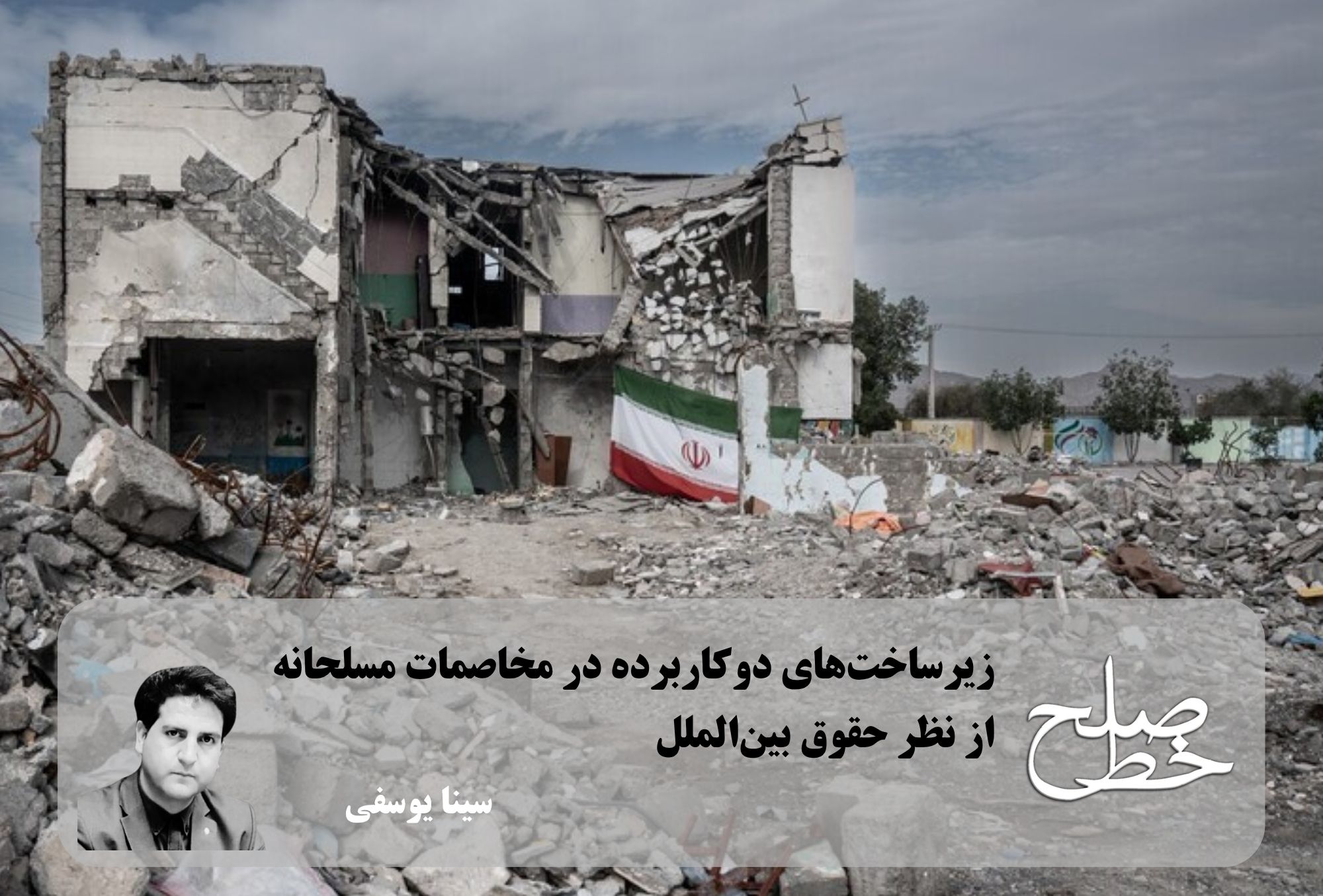
Dual-Use Infrastructure in Armed Conflicts from the Perspective of International Law/ Sina Yousefi
Before the recent war between Iran on one side and Israel and the United States on the other, the term “dual-use infrastructure” was mainly used in the specialized literature of the law of armed conflict and strategic studies. But with the expansion of the scope of military operations and attacks on facilities that appear civilian in nature, this concept became one of the most important subjects of discussion in public opinion and legal circles. In the recent war, attacks on energy facilities, communications centers, transportation infrastructure, and some facilities and research institutes linked to Iran’s nuclear program raised important questions about the limits of the legitimacy of such actions within the framework of international law. Does every infrastructure that can in some way serve a state’s defensive or military capability become a legitimate military objective? Is the mere existence of a potential military use sufficient to remove legal protection from civilian facilities? Answering these questions requires a precise understanding of the concept of dual-use infrastructure and its distinction from purely military objectives.
In international law, the term “dual-use infrastructure” has no explicit and independent definition, but it can be extracted from the rules relating to military objectives and the principle of distinction. Article 52 of Additional Protocol I of 1977 to the Geneva Conventions provides that military objectives are limited to objects which, by their nature, location, purpose, or use, make an effective contribution to military action, and whose total or partial destruction, in the circumstances existing at the time, offers a definite military advantage. Dual-use infrastructure falls precisely in the gray area between purely civilian objects and clear military objectives. Under normal circumstances, this category of facilities has a civilian function and is used to provide public services to society, but at the same time it may also serve military capacities. An electricity network that supplies both hospitals and military bases, an airport used both for passenger flights and for transporting military equipment, or telecommunications systems that, in addition to public use, play a role in the command and control of military operations, are examples of such infrastructure. Therefore, the main feature of this concept is not its inherent nature, but the overlap between civilian and military functions.
This very dual feature distinguishes dual-use infrastructure from purely military objectives. A military barracks, missile launch platform, or ammunition depot are, in principle, objectives that have a military function by their nature and do not enjoy protection arising from civilian status. But in the case of dual-use infrastructure, the situation is more complex. International law makes the legitimacy of attacking such targets dependent on the simultaneous fulfillment of several conditions. First, it must be proven that the current use of that infrastructure makes an effective contribution to military operations and that this contribution is not merely hypothetical or possible. Second, the attack must bring a specific and definite military advantage, not an unclear or long-term advantage. Third, even if the two previous conditions are established, the principle of proportionality requires that the expected harm to civilians and civilian objects not be excessive and disproportionate in comparison with the anticipated military advantage. Finally, the attacking party is obliged to take all possible precautions to reduce harm to the civilian population. As a result, the dual-use nature of an infrastructure does not mean the automatic removal of legal protection from it, and each case must be examined independently and based on a precise assessment of the objective circumstances.
In connection with the recent war, this very issue has acquired special importance. Some of the facilities targeted in Iran, according to the claims of the parties involved, had uses related to military programs or logistical support. However, even if this claim is accepted, the legal analysis does not stop at that point. For example, if energy facilities or communications infrastructure were attacked, it must be examined whether their role in military operations was sufficient to attach the status of military objective to them, and whether the foreseeable effects of the attack on civilian life were taken into account. Disruption of the electricity network can undermine hospitals’ access to vital services, damage to communications systems may affect relief operations and emergency services, and attacks on transportation infrastructure can disrupt the supply chain for basic goods. For this reason, many legal disputes concerning recent attacks have formed not over the existence or absence of military function, but around compliance with the principles of proportionality and precaution. This shows that, in the law of armed conflict, the legitimacy of an attack cannot be established merely by referring to the target’s “dual-use” nature.
An examination of contemporary wars also confirms this complexity. During NATO’s air operations in Kosovo, attacks on Serbia’s electricity network and some communications infrastructure were justified on the grounds that these facilities served military capabilities. In the Iraq war as well, the country’s vital infrastructure was subjected to extensive attacks that left long-term effects on the humanitarian situation. In recent years, the war in Ukraine has once again placed attacks on energy facilities at the center of attention, with both sides accusing each other of violating the fundamental principles of humanitarian law. In Gaza, too, the issue of attacks on infrastructure with multiple functions has been among the serious points of dispute in legal assessments. The study of these experiences shows that the concept of dual-use infrastructure, although originally developed to adapt legal rules to the complex realities of modern war, may in practice become a tool for expanding the range of targets that can be attacked. Therefore, sensitivity toward how this concept is interpreted becomes doubly important, because the broader the definition of military objectives becomes, the smaller the safety margin for civilians will be.
In fact, the law of armed conflict is a historical effort to create a balance between military necessities and humanitarian considerations, and the discussion of dual-use infrastructure lies exactly at the point where these two intersect. Contemporary wars have shown that the boundary between the military and civilian spheres has become more ambiguous than before, and that new technologies, the interdependence of infrastructure, and the complex nature of modern states have made identifying legitimate targets more difficult. Nevertheless, the difficulty of identification must not lead to the weakening of the fundamental principles of international law. The principle of distinction still requires that civilians and civilian objects be protected from the effects of conflict and that exceptions be interpreted narrowly. Dual-use infrastructure is a concept that must be approached with great legal caution: neither so narrowly that it ignores the practical realities of war, nor so broadly that it exposes almost every part of civilian life to attack. Ultimately, the credibility of the law of armed conflict lies not in its ability to justify war, but in its capacity to limit violence and preserve a minimum of humanity under conditions in which the logic of war always seeks to expand the scope of destruction.
 Created By: Sina Yousefi
 June 22, 2026
Tags
Armed forces Dual infrastructure Dual-use infrastructure Humanitarian law Infrastructure International rights Iran-US war Launcher Military base Sina Yousefi The war between Iran and Israel. War