


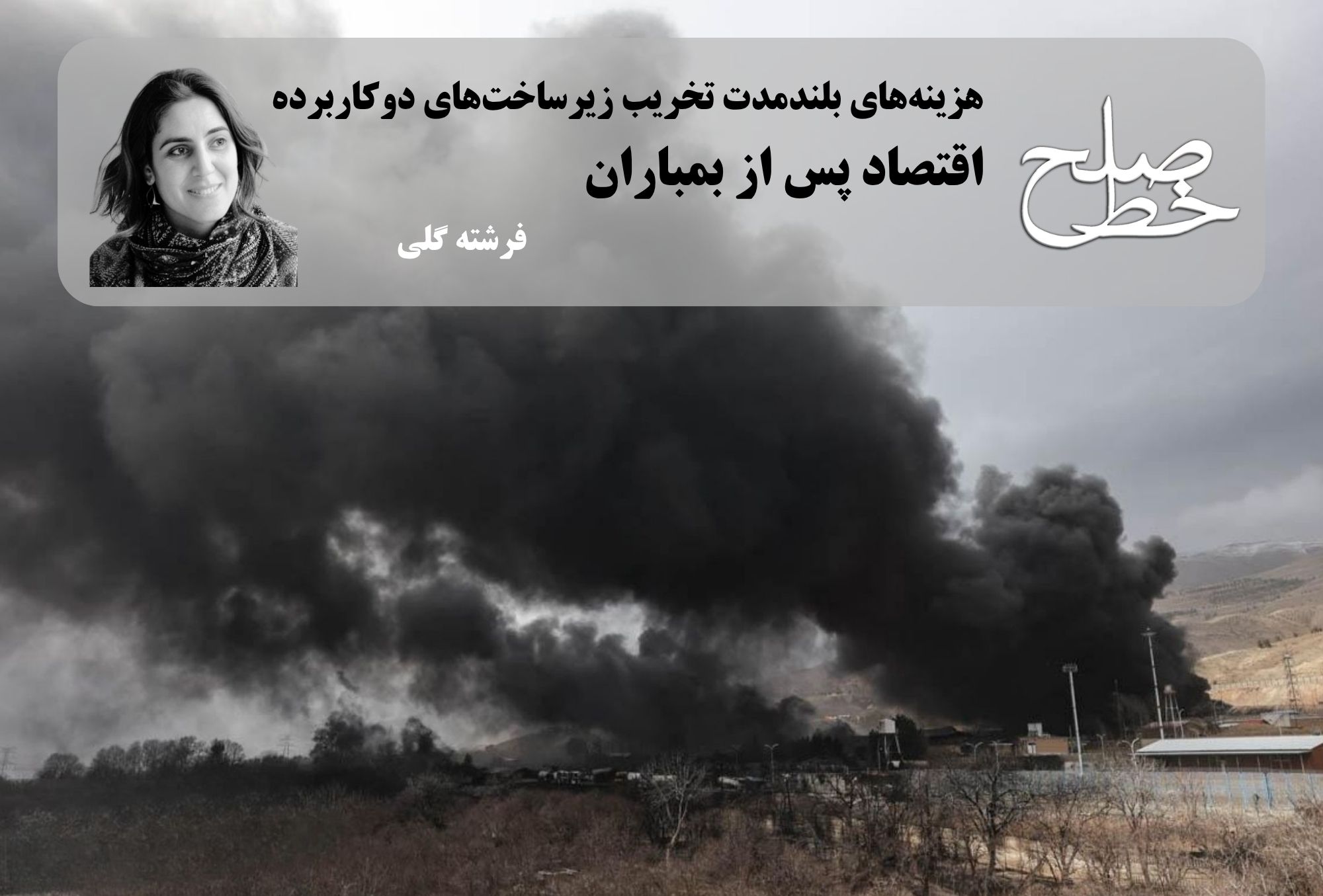
The long-term costs of destroying dual-use infrastructure/ Fereshteh Goli
Before addressing the main subject of this note, it is better to offer a definition of dual-use infrastructure. Although no clear and direct definition has been provided for “dual-use industries and infrastructure,” based on general concepts and the use of this term in texts related to security and economics, it can be said that dual-use industries and infrastructure refer to facilities, equipment, and systems that can be used both in normal times for civilian purposes—such as energy supply, industrial production, transportation, and urban services—and in times of crisis or war for military and strategic purposes, such as supplying fuel to the armed forces, producing military equipment, logistical movement, or defense. The most important examples of such infrastructure in Iran are:
- Energy facilities—power plants, refineries, and gas fields such as South Pars—which are known as the backbone of the civilian economy. They are vital for supplying electricity and fuel to factories, homes, and vehicles, and at the same time for supplying fuel to military equipment, defense systems, and maintaining the production cycle during wartime. The destruction of these facilities—referred to as “dual-use energy infrastructure”—damages the civilian economy and weakens the country’s military capability.
- Transportation and logistics networks—ports, bridges, roads, and railways—on which the movement of civilian goods and everyday trade depend. During wartime, this same network is used to transport forces, ammunition, and military equipment, as well as to maintain supply lines.
- Key industries—Mobarakeh Steel and petrochemicals—which produce civilian goods such as steel sheets for construction or raw materials for factories, but whose production lines can easily be repurposed during crises toward the manufacture of military items, such as armored vehicle bodies or missile components.
- Telecommunications and information technology facilities, which are used both for people’s everyday communications and for military command-and-control networks.
Now, in light of what has been said, it must be acknowledged that the destruction of dual-use infrastructure—especially in the energy sector—creates domestic crises, sends shocks through global markets, and imposes long-term strategic costs on the target country. In other words, damage to this infrastructure targets both the country’s “civilian future”—welfare, employment, inflation—and its “military power.”
According to reports published in various media outlets, the recent forty-day war between the United States and Israel with Iran inflicted extensive and crippling damage on military, nuclear, energy, and civilian infrastructure. Economic estimates of these damages vary depending on the source, but the reported figures range from $140 billion to more than $270 billion. Specifically, the spokesperson for the Iranian government announced a figure of about $270 billion, (1) and some principlist political activists—such as Mehdi Khanalizadeh—have also estimated the damage at more than $260 billion. (2) These figures, of course, have not yet been confirmed by independent international institutions. In the area of civilian infrastructure, more than 125,000 residential, commercial, and service units were damaged, of which around 100,000 residential units were fully or partially destroyed, (3) and nearly 330 medical centers, 857 schools, and 32 universities were also damaged. In the energy and industrial sectors, 85 percent of petrochemical export capacity was disrupted, 70 percent of steel production capacity was affected, and heavy damage was inflicted on refineries and gas fields such as South Pars. (4)
The long-term costs of destroying dual-use infrastructure in the post-bombing economy are extremely heavy and must be viewed across several sectors. These infrastructures were built over years with billions of dollars in investment, and their reconstruction is not only costly but also time-consuming. Moreover, rebuilding some facilities requires technology and equipment to which access is seriously restricted under sanctions. The experience of wars shows that the economic effects of infrastructure destruction are not limited to physical damage; rather, through reduced investment, declining trade, and weakened production capacity, they affect economic growth for years. The destruction of energy facilities, key industries, ports, transportation networks, and electricity systems has confronted the country with recession, disruption in supply chains, and reduced production. Some experts have estimated the direct and indirect cost of reconstruction at around $140 billion, while others, including lost opportunities, estimate the figure at as much as $500 billion. Rebuilding part of this damage may take years, and the indirect costs resulting from reduced economic growth, declining productivity, and intensified economic constraints may exceed the direct damages.
Global experience shows that physical reconstruction alone, without institutional reforms, improved governance, and reduced economic restrictions, is not sufficient to revive the economy. Therefore, successful reconstruction requires prioritizing critical infrastructure—especially in the energy and production sectors—alongside financing and stable policies. The destruction of power plants, refineries, gas facilities, export ports, and transmission networks has not only plunged the domestic economy into crisis, but its effects have also spilled over into regional and global energy markets.
At the global level, prices have also fluctuated sharply. Oil has even been sold at more than $120 per barrel, because 20 percent of the world’s supply passes through the Strait of Hormuz. The attack on Ras Laffan in Qatar, the world’s largest natural gas hub, destroyed 17 percent of that country’s liquefied natural gas export capacity, and repairs will take three to five years. Gas prices in Europe have jumped by up to 100 percent and have also caused concern in Asia. The halt in the daily passage of around 15 to 20 million barrels of oil and petroleum products through the Strait of Hormuz has disrupted the supply chain, and facilities in Saudi Arabia, Kuwait, and the United Arab Emirates have also been damaged. The global market has tried to adjust by activating strategic reserves and increasing production in the United States, Brazil, and Canada, but inventories are declining. In the long term, a permanently higher risk level in the Middle East energy market, the acceleration of the transition to alternative energy sources in Europe and Asia, and inflation and reduced global economic growth will be among the consequences of this catastrophe. If the worst-case scenario—continued disruption in Hormuz or further attacks—occurs, oil prices will exceed $150 and a global crisis will begin. In the baseline scenario—meaning a ceasefire, agreement, and gradual repairs—relative supply will return within six to 24 months, but with high costs and reduced capacity. In any case, the destruction of Iran’s energy infrastructure has been a strategic and economic blow that has dragged the domestic market into a crisis of shortage, inflation, and recession, while confronting the global market with a supply shock and price surge. The real cost goes beyond physical repair and includes lost growth, instability, and the transformation of global energy patterns. Successful reconstruction requires prioritizing energy, attracting foreign investment, and political stability; an extremely difficult task. Iran’s overall inflation has reached very high levels, especially in food and transportation. Bread and grains have become 140 percent more expensive, and oil 219 percent more expensive. Rural residents have experienced inflation of more than 86 percent.
On the other hand, the World Bank has predicted the largest increase in energy prices since the Ukraine war. A 10 percent increase in oil prices can raise consumer inflation by half a percentage point. In Europe and the United States, energy inflation has once again revived price pressures. The costs of transportation, raw materials, and food have gradually spread to non-energy goods and services as well, and energy-importing countries—especially in the developing world—have suffered the greatest harm. Repairing the facilities will take three to five years or more, and sanctions have also restricted access to technology and capital, intensifying inflation. The destruction of energy infrastructure has increased not only short-term inflation, but also the risk of structural inflation and stagflation for years. The impact of this destruction on social welfare is also deep and multidimensional. War and energy disruptions have added nearly four million people to the population below the poverty line and raised the poverty rate to around 41 percent. (5) In worse scenarios, millions more will be added to this population. Food inflation has threatened food security and increased malnutrition. Inequality has intensified, because low-income families spend the largest share of their expenses on energy and food. Here, it must be emphasized that informal workers, rural residents, and women have suffered the greatest harm.
In the area of employment, disruption in energy-intensive industries, transportation, and services has created widespread unemployment. Half of jobs have been at risk, and hundreds of thousands to millions of jobs have been lost directly and indirectly. Unemployment insurance registrations have sharply increased, and family incomes have fallen so much that many have turned to unstable jobs or migration.
In the health sector, blackouts and damage to water and electricity infrastructure have disrupted access to medical services. Respiratory diseases, psychological problems caused by trauma and anxiety, and indirect maternal and child mortality have increased sharply.
In education as well, blackouts, migration, and damage to schools and universities have led to closures or incomplete education, wasting the human capital of a generation. Iran’s Human Development Index, which was around 0.799 in 2023, could decline by several hundredths of a point; that is, a setback of one to one and a half years in human development. (6) Thousands upon thousands of people have been forced to migrate, and crime, social dissatisfaction, and the disintegration of social cohesion have also increased. Without rapid reconstruction and deep reforms, these effects will become chronic, and structural poverty, inequality, and reduced labor productivity will continue. International assistance, prioritizing the reconstruction of energy and social services, and targeted support policies can be mitigating factors, but sanctions and the budget deficit have made this path extremely difficult. In conclusion, the destruction of energy and dual-use infrastructure has not only pushed the economy into recession and inflation, but has wounded social welfare so deeply that it has reversed decades of progress.
The heavy responsibility of reconstruction rests first and foremost on the government. A government that must immediately identify priorities: first energy, then water and food, and then healthcare and education. Under these conditions, the government cannot rely on slogans alone. It must use all its capacity to organize the distribution of fuel and electricity, provide targeted support to vital industries such as steel and petrochemicals, and prevent capital flight and the destruction of production units. The government must provide smart and timely subsidies to the lower deciles so that people’s tables do not remain empty. Through active diplomacy, it must contain sanctions and open a path to attracting foreign capital and technology. It must use every opportunity to receive international assistance and not allow reconstruction to stall because of budget deficits and banking imbalances. Above all, the government must be transparent and accountable: where every rial of reconstruction is spent, why a certain refinery has still not resumed operations. If the government falters on this path, not only will today’s destruction not be repaired, but the roots of poverty and despair will remain firmly planted in the soil of this land for generations. Iran’s tomorrow is being built today through the government’s decisions; a process that resembles an impossible operation!
Footnotes
“Mohajerani: The War Has Inflicted $270 Billion in Damage on Iran,” Donya-e Eqtesad newspaper’s website review, April 14, 2026 (25 Farvardin 1405).
“A Principlist Activist’s Account of the Extent of War Damage to Iran’s Infrastructure,” Khabar Online, April 12, 2026 (23 Farvardin 1405).
“Red Crescent: 125,000 Residential Units Across Iran Were Damaged in the War,” Mehr News Agency, April 10, 2026 (21 Farvardin 1405).
“Israeli Defense Minister: 85 Percent of Iran’s Petrochemical Production Has Been Taken Offline,” Sedaye Miane, April 6, 2026 (17 Farvardin 1405).
“One Month of War Against Iran Has Cost Arab Countries Up to $194 Billion,” Al Jazeera, March 31, 2026 (11 Farvardin 1405).
“Escalating Military Conflict Threatens Iran’s Human and Economic Development Gains: Warning from UNDP Analysis,” United Nations Development Programme (UNDP), March 31, 2026 (11 Farvardin 1405).
 Created By: Fereshteh Goli
 June 22, 2026
Tags
Dual infrastructure Dual-use infrastructure Infrastructure Iran-US war Military installations Petrochemicals Power plant War