


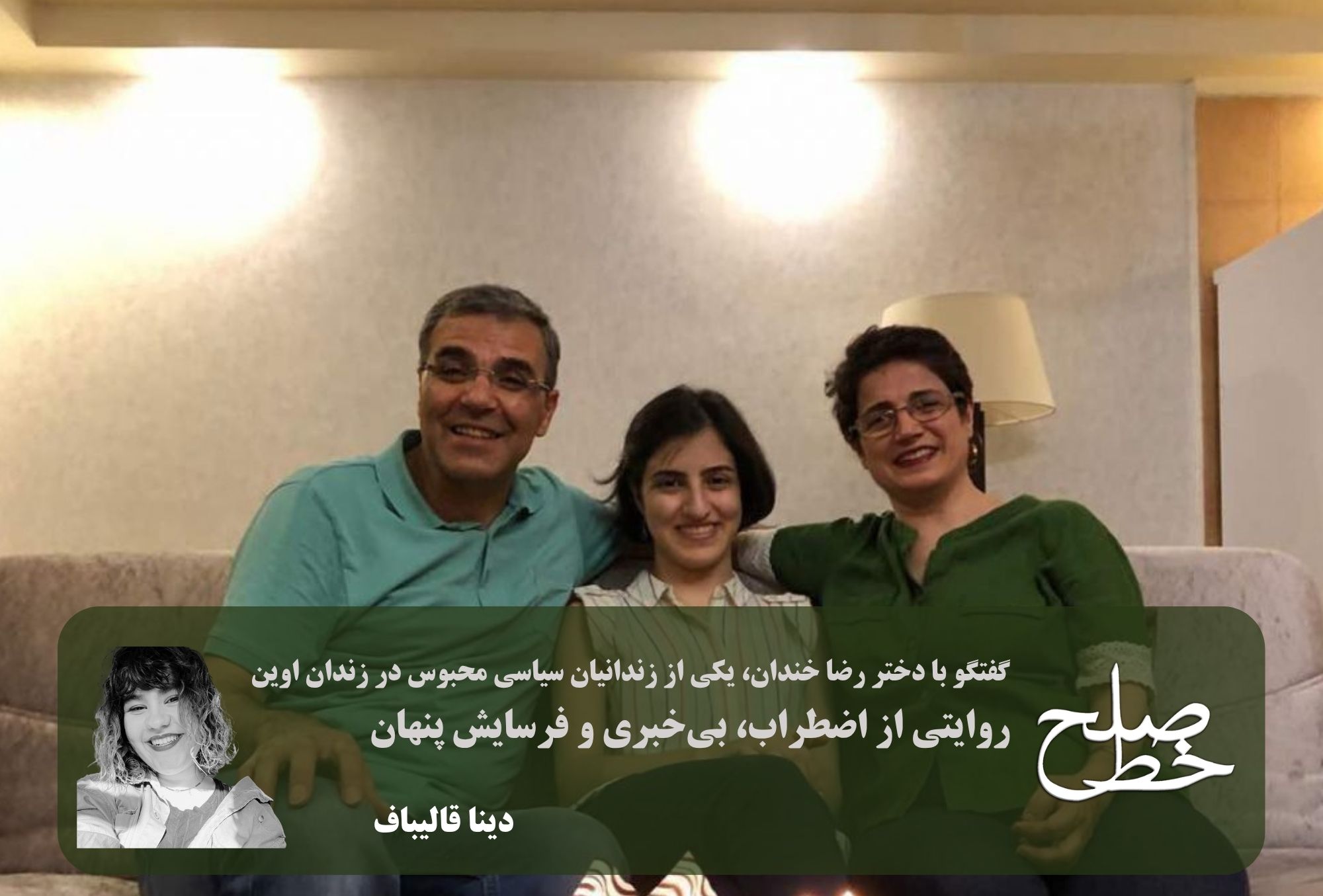
An Interview with the Daughter of Reza Khandan, a Political Prisoner Held in Evin Prison / Dina Ghalibaf
With the escalation of military tensions and the expansion of conflicts between Iran, Israel, and the United States, the situation of prisons—particularly political prisoners—has become increasingly shrouded in uncertainty. At a time when public opinion and media attention are largely focused on battlefield developments and the geopolitical consequences of war, the condition of prisoners and their families has been pushed to the margins. This is despite the fact that past experiences have shown that in times of crisis, marginalized groups—including prisoners—are more vulnerable than others. The following account, based on an interview with “Mehraveh Khandan,” daughter of Reza Khandan, a political prisoner held in Evin Prison, presents a picture of these recent days; a picture of anxiety, lack of information, and a kind of gradual erosion affecting both prisoners and their families.
Apparent Stability, Real Ambiguity in Prison Conditions
According to Mehraveh Khandan, no new detainees have recently been transferred to the ward where Reza Khandan is held—Ward 7 of Evin Prison. She states that many of those detained during recent protests have been transferred to Greater Tehran Prison or to security wards. Nevertheless, the lack of precise information and restrictions on communication remain defining features of these days. The closure of the prison store during the first week of the war is also among the signs indicating disruption in daily routines.
Daily Life as a Response to Anxiety
According to Mehraveh Khandan, the psychological pressure of this situation manifests most clearly in the lives of families. Since the beginning of the conflict, her mother has hardly left the house and has tried to create a sense of psychological stability through everyday tasks. She notes: “My mother tries not to transmit her worries, but this return to routine, more than being a sign of calm, is a response to a sense of helplessness and constant anxiety.”
In her account, the experience of war is not the same for all family members: “My younger brother, who had more direct exposure to the wartime atmosphere and emigrated to the Netherlands after the 12-day war, experiences fear in a more tangible and instinctive way. This anxiety has even manifested in situations such as the sound of fireworks during the New Year holidays.”
In contrast, she herself tries, alongside fear, to adopt a more analytical perspective on the consequences of war—a difference that in some ways reflects a generational gap in experiencing crisis.
Prisoners: The First Victims of Shortages
Referring to the economic conditions and the continuation of the conflict, Mehraveh Khandan expresses concern about the livelihood of prisoners: “If these conditions continue, the likelihood of restricted access to food and essential items for prisoners is very high. This concern is especially serious for prisoners who do not have financial support from their families.”
She adds: “Even before this, many detainees faced difficulties in meeting their basic needs, and the continuation of the crisis could make their situation significantly more difficult.”
Visits Shrouded in Uncertainty
Regarding visitation during wartime, Mehraveh Khandan says: “The status of visits is also uncertain. Due to restrictions related to hijab, my mother cannot attend the visitation hall in Evin, and my grandmother, who previously was able to visit, has not gone since the beginning of the war. At present, it is unclear whether visits are being conducted by the prison or have been completely suspended.”
Under such conditions, she emphasizes, the role of international human rights organizations in monitoring the situation of prisoners becomes even more important. Their اطلاعرسانی and oversight can help reduce pressures and prevent further deterioration of conditions—especially in an environment where the flow of information has become more limited.
A Double Loneliness in the Shadow of War
In conclusion, Mehraveh Khandan speaks of the experience of “double loneliness”—a feeling that arises from the simultaneity of war and having a family member in prison.
While emphasizing her opposition to war and her inability to understand its logic, she nevertheless considers the sense of desperation among some segments of society to be understandable. According to her, these days have been among the few times she has experienced such a deep sense of loneliness—a feeling she believes is shared by many families of political prisoners.
 Created By: Dina Ghalibaf
 March 21, 2026
Tags
Dina Ghaleibaf Evin Prison Iran-US war Mehraveh Khanden peace line Peace Line 179 Political prisoners Reza smiling ماهنامه خط صلح