


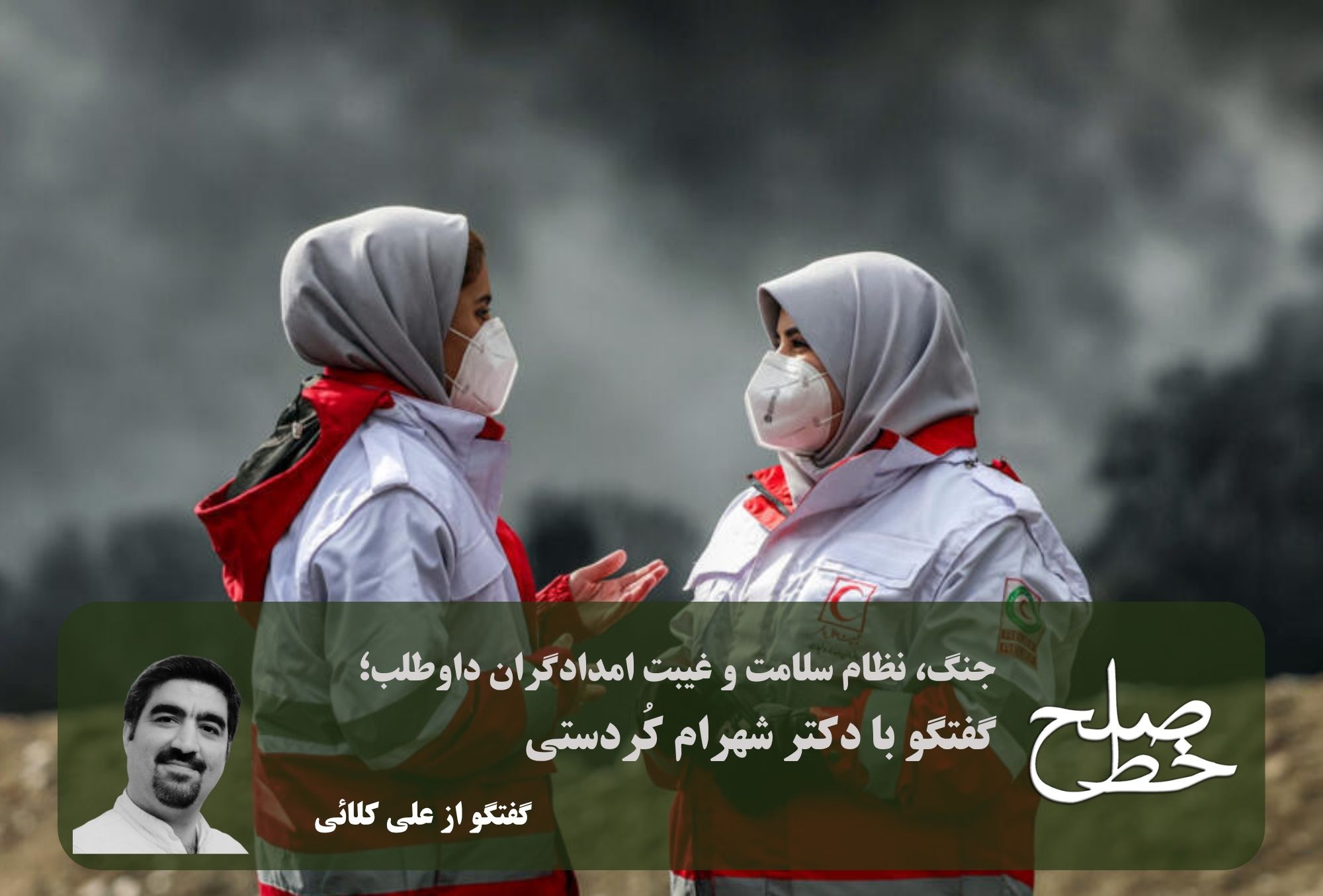
War, the Healthcare System, and the Absence of Volunteer Aid Workers; An Interview with Dr. Shahram Kordesti / Ali Kalai
Following the recent military attacks by the United States and Israel on Iran, the human and infrastructural consequences of war have once again come into focus. Although media attention has largely been directed toward the military dimensions and the direct casualties of these conflicts, the reality is that the deeper and more enduring effects of war reveal themselves in less visible layers—among them the healthcare system, access to medical services, and the condition of vulnerable patients. Under such circumstances, examining the state of the healthcare system and its capacity to respond to crisis becomes doubly important—especially in a country that has already been facing structural limitations, economic pressures, and managerial challenges. For this reason, Peace Mark Monthly Magazine spoke with Dr. Shahram Kordesti, a physician, hemato-oncology specialist, and Head of Cancer Immunology at King’s College London. As a researcher and university professor with years of experience in oncology and immunotherapy, as well as close familiarity with international healthcare systems, he offers in this interview an analytical perspective on the direct and indirect consequences of war for citizens and Iran’s healthcare system, seeking to present a clearer picture of the challenges ahead—particularly for the silent victims of war, namely chronic and vulnerable patients.
Below is the full text of Peace Mark Monthly Magazine’s interview with Dr. Shahram Kordesti, physician, hemato-oncology specialist, Head of Cancer Immunology, and professor at King’s College London:
Given reports of significant civilian casualties and large-scale population displacement, what is your assessment of the current humanitarian situation?
At present, obtaining information from Iran is extremely difficult. It is a situation where neither you can contact people there, nor can they contact you; there is no internet, and no sufficient reliable information has been published. Under such circumstances, I do not know to what extent the issue of population displacement is accurate. Nevertheless, certain issues are مطرح. One is the matter of war casualties. Another, as far as I have been able to speak with my colleagues, concerns military hospitals. We have no information about those who go to these hospitals, and no information about them is being disseminated. In other hospitals as well, the number of deaths and injuries is not comparable to what we witnessed earlier in Dey 1404. At that time, within two days, the number of injured and dead was so high that hospitals were truly paralyzed and unable to provide services. However, based on my latest contact with Tehran yesterday—this interview was conducted on March 17, 2026 (27 Esfand 1404)—there is not such a severe disruption in hospital services in Tehran. My information, of course, is from Tehran, as that is where I have been in contact. Another piece of good news is that for chronic illnesses such as cancer—which is also my own specialty—treatments are available to an acceptable extent, and the situation in hospitals has not turned into an acute wartime condition. That is, it has not reached a point where hospitals are unable to provide services. This assessment is based on the information I have. This does not mean everything is fine. Due to wartime conditions, a state of alert has been declared, and most hospitals are operating selectively. This means that patients requiring surgeries and treatments unrelated to the war—such as those with chronic illnesses, diabetes, hypertension, and similar conditions—cannot receive the same level of services they did before wartime conditions, which in itself can have many long-term consequences.
Different statistics about casualties are being published. How can these numbers be evaluated and trusted?
Unfortunately, we do not have a precise standard or reliable source. Statistics from the Ministry of Health have never been reliable in this regard—neither during the COVID-19 pandemic nor in the current situation. Either they do not provide specific statistics, or if they do, they are not trustworthy. Therefore, I doubt that a credible and reliable assessment can be made. This issue also highlights the absence of international charitable organizations, which in such cases can help provide more complete and impartial information. These institutions have either never been allowed to operate in Iran or have not been permitted in recent years, and now they are either not present in the country or their presence is extremely limited.
Which organizations do you mean?
Organizations such as Doctors Without Borders, the International Red Cross, and many charitable foundations that carry out voluntary medical activities in war zones. Unfortunately, none of these have access to Iran.
You mentioned that some of them previously had access but no longer do. What do you think is the reason?
The Islamic Republic, in general, is suspicious of any non-Iranian institution, and even Iranian institutions that are not under government control. In my view, the main issue is control over information. This is something the Islamic Republic is highly sensitive about, and it wants to be the sole channel of information. For this reason, it does not allow independent entities access to information. Under the pretext that “we do not need it,” they do not permit independent organizations to operate. They also do not want independent channels of information. This is why we have neither accurate statistics nor a clear understanding of what is actually happening. We do not have precise figures for the dead and injured, and even if we do, they are not reliable.
Reports indicate that some medical centers have been damaged or taken out of operation. In practice, what impact does this have on the country’s medical and treatment capacity?
This is a very dangerous issue. Hospital capacity in Iran has always been quite limited. This limitation is not only due to a lack of buildings—although the buildings are indeed worn out. The main backbone of Iran’s healthcare system is still what remained from before the Revolution. The issue is not just buildings; an empty building cannot provide medical care. You need other infrastructure as well—equipment and trained medical staff. The government has never allocated sufficient budget to modernize hospital beds and systems. Therefore, only a limited number of hospitals in Iran operate at global standards. When these are also damaged and taken out of service, the situation becomes more difficult. In wartime conditions, emergency situations arise that can somehow be managed. The issue is that in the long term, when these capacities are lost, healthcare support becomes problematic and care capacity decreases. This is something that can be dangerous in the long run.
When part of healthcare services is disrupted, what kinds of “indirect harm” are inflicted on people that are less visible in statistics?
These harms are among those that are not counted. The first question always asked is how many were injured or killed—which is, of course, very tragic and painful. But in every war, there are silent victims. These include people with chronic illnesses or conditions requiring special care, and their numbers are large. There are also those with blood disorders, various physical illnesses, cancer, kidney disease requiring dialysis, and similar conditions. These are people who suffer harm. First, their access to medical services becomes limited, and second, they may be forced to relocate to other cities. These problems can have long-term consequences that truly affect them. Someone whose dialysis is not properly carried out may die. Someone with cancer who does not receive chemotherapy may suffer long-term and irreversible complications. These are the silent victims of war.
Reports suggest that some damage has resulted from nearby explosions rather than direct hits. How does this type of damage differ in its human consequences?
When a medical center is damaged, the first thing that happens is that its non-emergency services are either shut down or rendered unusable. This reduces overall treatment capacity. Once this overall capacity decreases, the consequences I mentioned earlier become evident. That is, patients will not be able to receive the treatments they need. People do not even need to be ill—this also affects care for pregnant women and women’s health services. All of these can be impacted. Their consequences are not necessarily visible immediately; they may appear in the years to come.
You spoke about international charitable organizations. But the question is: if independent civil society networks and volunteer aid groups had been allowed to operate freely in Iran, what could they have done that is not being done now?
The same services that have been halted in medical centers due to war-related problems could have been carried out by these charities. Services such as care for cancer patients, kidney patients, or pregnant women. They could conduct home visits and go to patients’ homes. One of the most important aspects of care for chronic illnesses is mental health support. One example is group therapy. In European countries, these charities play a very important role in forming communication groups among patients—so that patients can gather, talk, and share their problems. This helps them psychologically. These groups can fulfill all these roles. But unfortunately, to my knowledge, either permission is not granted to establish such institutions, or if they are formed, they are not allowed to operate. As far as I know, some exist, but they cannot carry out much activity.
What specific gaps in relief efforts does the absence of these groups create?
Rescue operations are specialized work that charities usually do not perform; this is highly specialized and should be handled by organizations like the Red Crescent. However, these charitable groups could, for example, deliver medication to patients’ homes and provide wound care at home. The assistance they could provide in such areas is extensive, but they are unable to do so.
In wartime, volunteer forces usually step in. In the absence of civil society oversight and presence, what problems arise?
I have never been active as a physician in Iran during wartime. But the closest example I can give is Europe during the COVID-19 pandemic. In that crisis, medical treatment was carried out by doctors, but volunteer staff provided a range of services that were truly irreplaceable—transporting patients to hospitals, preparing medications, and supporting doctors. I remember during the pandemic, when we were working day and night in hospitals, volunteer groups brought food for us and the patients. They also helped wash and prepare the clothes we wore for the next day. They even took care of families. At that time, if someone contracted COVID-19, they had to quarantine. If parents were infected and had a child, these volunteers would take care of the child. Therefore, they can play a very important role. The issue is that they do not emerge overnight. These volunteer organizations and their members are people who have usually worked together for a long time, received training, gained experience working as a team, and built infrastructure. Now, using personal or donated resources, they help in a charitable manner. They are very important, and without them, the performance of medical staff can collapse under the burden of excessive additional tasks.
In the absence of civil society oversight and presence, what dangers arise for public health and lives—especially for groups such as prisoners, patients, people with disabilities, and marginalized areas?
Civil society plays a supervisory role. In democratic European societies, civil society fulfills this oversight function. For example, in hospital boards of trustees, they have supervisory seats to observe how hospitals are run, what their priorities are, and how budgets are spent. As representatives of society, they ensure that if public or government funds are being spent, they are used properly and that patients’ perspectives are considered. This is a general matter and not limited to wartime conditions. As far as I know, this has been initiated in Iran, but they are not given much role and cannot exert much influence. Even members of boards of trustees must pass qualification filters.
The role of civil society is precisely to identify where damage is occurring. If a hospital is damaged, they inform others and alert the global community. Because they are independent, their statements carry more credibility and are more readily accepted than those of the government. In their absence, the government becomes the sole source of information—and given the Iranian government’s track record in information dissemination, it is not widely trusted or accepted.
As a final question, in the conditions discussed, what do you see as the most significant harm the government has inflicted on people by restricting these networks?
I believe I have already explained the ultimate harm. In such a situation, there is insufficient oversight over the distribution of services and the proper use of resources. Are services being provided appropriately and fairly to patients? Is patient care equitable? Healthcare equity is very important—that no one receives better services due to money, social status, or other factors, and that services are properly distributed among all those in need. These are the aspects that are harmed, because there is no systematic oversight.
And your final words?
These are sorrowful days. I am deeply saddened by the conditions of war and the problems people are گرفتار in, and I hope this situation improves as soon as possible. Iran’s healthcare system has been severely damaged in recent years for many reasons that there is no time to discuss here. This system, already deeply damaged and inefficient, has worsened under wartime conditions, which is very concerning. I hope conditions emerge in which doctors, medical staff, and the public can work together to rebuild this system from the ground up. This will likely take a very long time, but I hope it happens.
With thanks for the time you gave to Peace Mark Monthly Magazine.
 Created By: Ali Kalaei
 March 21, 2026
Tags
Ali Kala'i Civil society peace line Peace Line 179 Red Crescent Red Cross Rescuers Shahram Kurdasti ماهنامه خط صلح