


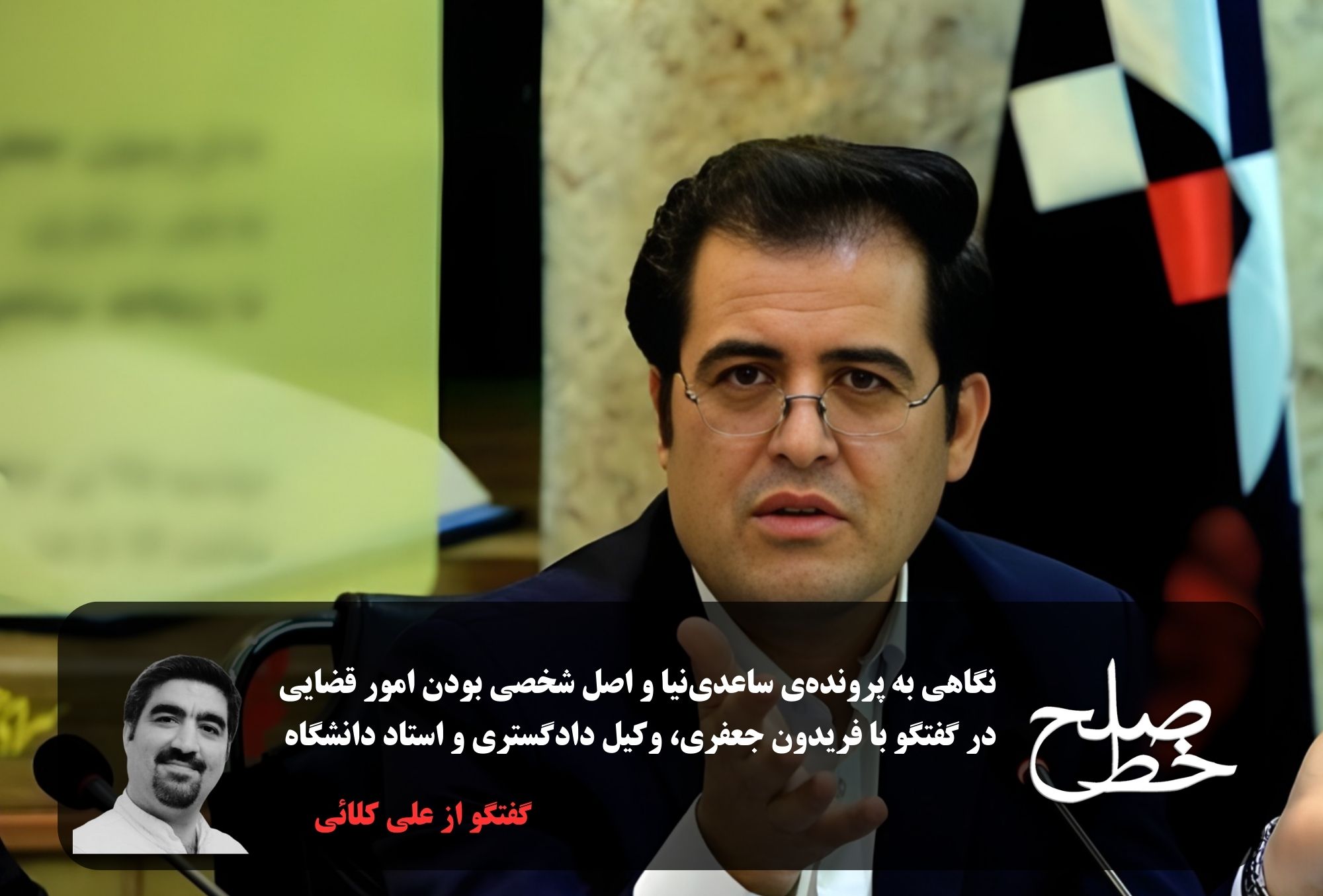
A look at the Saedinia case and the principle of the personal nature of judicial matters in a conversation with Fereydoun Jafari/Ali Kalai
The January 1404 protests were the bloodiest protests in Iran’s contemporary history, resulting in the deaths of thousands of people and leaving profound human, social, and legal consequences. In addition to its catastrophic human dimensions, this event also presented the country’s legal and judicial order with unprecedented challenges; challenges in which the boundary between “maintaining security,” “crisis management,” and “adherence to the law” became more contested than ever before.
In this context, the case of Mohammad Saedinia became one of the most controversial examples of the judicial response to the consequences of the protests. In this case, the issue of confiscating and attributing the property of an individual or economic group to the damages caused by the protests was raised by some official narratives. A narrative that immediately raised serious questions about the legal basis of these measures, the principle of the personal nature of crime and punishment, and the possibility of justifying extra-legal measures under the guise of “crisis circumstances.” In this regard, we went to Dr. Fereydoun Jafari, a lawyer and university professor, to explain in an analytical conversation, citing criminal laws and procedural rules, the distinction between confiscation, seizure, and confiscation of property, and the legal limitations of the judicial authority in this regard.
Below you can read the details of the monthly magazine “Hate of Peace” with Dr. Fereydoun Jafari, a lawyer and university professor.
In Iranian law, what exactly are the differences between “seizure of property”, “seizure”, and “confiscation”, and at what stage can each be applied?
Criminal law in Iran, like everywhere else in the world, has two parts: substantive and procedural. In substantive criminal law, we deal with the definition of a crime, the elements of a crime, criminal liability, and penalties or guarantees of criminal execution. But in formal matters, we deal solely with the process and procedure and the manner of handling this crime, the crimes or evidence, the defense rights of the accused or the plaintiff, or the duties of the investigator.
Confiscation is classified as a sub-category of substantive criminal law. This punishment can be applied when an accusation has been made against a natural or legal person, this accusation has been proven in court with evidence, and a preliminary verdict, an appeal verdict, and a final verdict have been issued. After that, in that verdict, within the framework of the principle of legality of crimes and punishments, the punishment of confiscation is mentioned. In this case, the verdict goes to execution and confiscation is carried out. This confiscation must also be based on international standards. For example, in the International Convention on Narcotic Drugs, the 1961 Convention states that confiscation should not be general. That is, even where confiscation is foreseen as a punishment, it should not have a general format and mean the general confiscation of property. In our law, the issue of the entire property was initially raised. However, after Iran joined this convention, our criminal regulations included the confiscation of property resulting from the crime. This means that confiscation is limited to property obtained from drug crimes. For legal entities, since 2015, the Penal Code of the Islamic Republic of Iran has stipulated punishment for them, and confiscation has been mentioned as one of the punishments for companies and legal entities.
The story of seizure and confiscation is different. These are a subset of criminal procedure and formal criminal law. According to formal criminal law, seizure and confiscation include tools, objects, or devices that were used as a means of committing a crime or were used in the course of a crime. Regardless of the decision about the offender, when the investigator or prosecutor encounters objects and properties that are related to the crime and the way in which the crime was committed, regardless of who they belong to and who their owner is, they must determine their disposition at the time of issuing the order and making the decision, whether to confiscate, destroy, or return them. These are the three words that we have for them in the law. If those objects have a specific owner and are legal objects, they must naturally be returned to their owner. Like a car that, for example, was smuggled and the owner was unaware of it. Naturally, once the car is seized, it must be returned to the owner after verifying the owner’s identity and proving that the owner had no role or participation in smuggling. Or it must be among the objects that must be destroyed. For example, in the Islamic Republic of Iran, when you encounter alcoholic beverages, because they do not have property in Islamic law and Iranian laws and regulations and cannot be valued, they are either given to pharmaceutical companies to be used in the form of medicine or they are destroyed. In some cases, such as illegal weapons, they are confiscated for the benefit of the government and military forces. In fact, seizure and confiscation are a subset of precautionary measures that the legislator has explicitly determined in the criminal procedure code.
According to the Criminal Procedure Code and related laws, under what circumstances can a judicial authority issue an order to seize property before issuing a final judgment?
In the part where I mentioned the investigator, the stage before issuing a sentence and prosecution and investigation, when the investigator is issuing an order in the prosecutor’s office, he can make a decision about these properties and objects that were obtained from the crime or used in the course of the crime. As I said, this has nothing to do with the criminal himself. Here, a decision is made about the object itself in an abstract manner, and not because it belongs to an owner.
But before the issuance of a verdict, confiscation is not possible. Because in our laws and regulations, confiscation is a punishment and until a final verdict is issued based on criminal regulations, confiscation is not possible. Of course, this is as far as I know and I am not saying that I am familiar with all the regulations and laws. I may be wrong. But as far as I know, it is not possible before a final verdict is issued. Moreover, in a final verdict, there must be a case where confiscation has previously been foreseen in the law as a punishment or guarantee of criminal execution of a specific crime or behavior.
In property seizure, what is the place of the principle of “proportionality” and “relationship of property to the crime” and what are its exact limits?
Proportionality is for punishment. That is, when you are determining punishment, based on the principle of individualization of punishments or Individualization of Punishment, it should be determined based on the severity of the crime, the type of crime, the degree of the crime, the amount of punishment, the effects that the crime leaves on society, the personality, position or family status of the offender, the gender of the offender, the health or illness of the offender, whether the offender is old or young, and things like that. These are for punishments.
But in the case of seizure and confiscation, this is not about the individual. It is about the objects or property that were used as a means of committing a crime by the criminal or criminals. The criminal may not even have been identified yet.
Let me give you an example. Imagine a murder scene. A gun or a knife is found. The culprit is still unknown and it is not clear who committed the murder. Here, the investigator must determine what to do with the knife or weapon that was found. Confiscate or destroy it. Or if the weapon was licensed and the license belonged to a specific person and the weapon was stolen or borrowed from him and in any case the owner of the weapon had no role in the murder, it must be returned to its owner. Proportionality is not an issue here, because no punishment is to be determined. There is no requirement and no coercive behavior is to be determined. Here, only a formal action is taken, which is seizure and confiscation. But I said that the story of confiscation is completely different. In confiscation, based on the Criminal Procedure Code and the Penal Code of Iran, all the laws and rules that you mentioned must be observed.
Can a judicial authority seize property on a large scale without final proof of a crime?
If it is proven that the tool, instrument, or object used was definitely one of the tools, instruments, or devices used in the commission of the crime, even without the identity of the perpetrator or the accused, they can be prosecuted. Regardless of whether we find someone as their owner or not. There is no need for final proof of the crime at all. What you have in mind is the issue of confiscation. Confiscation requires final proof of the crime and must be proven with evidence. Even if someone is acquitted, they cannot confiscate their property. Let me continue the example I gave. There is a body. A knife or a gun was found. No one has been convicted of murder yet. It is not clear whether it was murder or suicide, because it may have been suicide. The investigator has not yet been able to prove anything in this regard. But he must take action regarding that knife or gun and either seize them, destroy them, or return them to their owners. Even though no accused has been found yet. These regulations exist everywhere in the world and are not specific to Iran.
To what extent does the seizure of property before a final verdict conflict with the principle of innocence and Article 37 of the Constitution?
No. When we consider this discussion abstractly. That is, we say that we are dealing with an object, with an abstract subject and tool that is different from a human being, the discussion of innocence does not make sense. The discussion of innocence includes the human being. Suppose that in a robbery, an item is found that does not belong to the homeowner. Or it is an item that was used as a means of committing a crime. We do not know who the accused is. Can he not decide about that item? He can. Even if the accused is found, regardless of the final verdict of the accused, deciding about that item has nothing to do with the accused.
When we talk about a defendant, the discussion of acquittal, evidence, system of evidence, persuasive evidence, evidence, evidence, and other things that exist in Iranian law are used and discussed. But in this case that we are discussing, the law says that even if a restraining order is issued, which is a verdict of acquittal at the prosecutor’s stage, it must be determined whether the objects belong to the defendant and should be returned to him or not. If not, is it property such as drugs or alcohol that should be destroyed or given to pharmaceutical factories? Or if it is a case of smuggling that the owner cannot have, it should be given to the property management organization to be sold at auction. This is how our law looks at these properties and makes decisions.
In the case of Mr. Mohammad Saedinia, given the available information, what was the most likely legal basis for the seizure of assets and what scenarios are conceivable for it?
I am speaking as a lawyer and a lawyer. Commenting on this case requires knowledge and awareness of the main content of the case. Unfortunately, many of the data in this case are not clear due to a lack of transparency and lack of correct and appropriate presentation. Our judicial system is not like many judicial systems in which the evidence, citations, and reasons are transparent. So naturally, the information I have about this case may be less than the information you, as a media person, have about this case. There are two different narratives about this case. One is the official narrative of the government and the government of the Islamic Republic, and the other narrative that is presented from outside the framework of the government of the Islamic Republic. In other words, we are faced with two completely contradictory narratives.
In these circumstances, suppose that Mr. Saedinia is accused of committing a crime that is also in accordance with the laws and regulations of the Islamic Republic of Iran. This crime must be investigated in courts of justice, observing the principles of fair and just trial, and then the punishment and the legal article under which it is documented will be determined. Then let’s see whether the legal article under which he was accused provides for the possibility of confiscation of property or not, and if so, the judge must issue a ruling and then proceed to the stages of his appeal. After the investigation and finalization, it will be implemented. This is the stage of confiscation or seizure of property.
But at the investigation stage, suppose that he is accused of committing a crime or criminal behavior in accordance with the laws and regulations of the Islamic Penal Code of Iran. The type of crime is not such that its tools, instruments, and equipment are all his assets. If the crime that occurred was committed by means of the entire assets of the party, the discussions we have made so far also apply to this issue. If not, he can naturally determine the disposition of the assets of this defendant – a defendant is someone who was informed of the charges during interrogation, not at the police station or security agencies – who was issued a warrant, discovered, and was in the course of the crime or the criminal result or the commission of the crime. This case has not even reached the warrant stage yet, and therefore this literature and news that has been formed about him in the media do not have legal or judicial weight. These are media news and propaganda that here and there want to exploit politically. As a lawyer and expert who is merely giving a judicial opinion, I emphasize that under no circumstances within the framework of Iranian laws and regulations, such as the Criminal Procedure Code, can a person’s entire property be seized, confiscated, or confiscated, as if he or she is accused of committing a crime. I have never encountered such a thing in Iranian law, and such a thing is not foreseen.
One narrative from official government media is that the amount of detentions is roughly equal to the damage caused in Tehran during the protests; what does this type of narrative mean legally and politically?
I consider this just a media report. That is, I do not consider this news to have any legal weight at all. First, those who reported this news must prove its authenticity and say which judicial authority said such a thing. But assuming this news is true, what is the connection between the amount of Mr. Saedinia’s property and the amount of damages? We have the principle of personal nature of crime and punishment. In criminal law, we have principal, accomplice, and deputy. Everywhere in the world, someone who causes damage, whether criminal or legal, to another is not exempt from these three states. Either the person does it himself, which is considered a principal. Or he gives an order and someone else does it, in which case he becomes a deputy. Incitement, encouragement, and encouragement are all considered deputy in Iranian law, or he does it with another person, which is considered a partner. Suppose that in Tehran, Pars, Tehran, someone does something and damages somewhere. Then we come and say that a person living in Qom or Isfahan has committed an accessory to this crime. There is a famous poem that says: A blacksmith in Balkh committed a crime / A coppersmith was beheaded with a hammer. This precisely means that judicial matters cannot be contrary to the principle of personal responsibility. Basically, everyone is responsible for their own behavior, words, and deeds. The guarantee for the implementation of this responsibility is also determined within the framework of the law. Note that the law is only approved by the parliament. That is, according to the Constitution of the Islamic Republic of Iran, no other body other than the Islamic Consultative Assembly has the authority to legislate, especially criminal legislation, and they cannot determine a regulation that contains a crime and an executive guarantee in the name of punishment. Therefore, in this regard and this media news, my opinion is that it cannot be considered to be comparable to legal opinions and arguments based on the criminal laws and regulations of Iran.
An apology letter has been published by Mr. Saedinia. Part of the apology letter states: “Unfortunately, in recent days, due to problems in the market and financing the factory, my son mistakenly announced the closure of the shops in a short time, in line with the Tehran market. Both he and I have fully realized our mistake and apologize to the dear people, because if there was a problem, we must be vigilant so that the enemies of Iran and Islam do not exploit it, and we must tell the authorities and those who care.”
What is the legal status of such an apology? And can’t this apology itself become evidence against the defendant, namely Mr. Saedinia?
You asked a good question and I can give my legal perspective on this matter. In the Penal Code of Iran, we have Articles 37 and 38, which state the mitigating factors of punishment. They are called mitigating factors or mitigating factors of punishment. These articles have several clauses. One of these clauses is the expression of remorse by the accused or the criminal after committing the crime. Assuming the truth, authenticity, and reality of this writing, this text can be cited solely for the expression of remorse, which is considered as a mitigating factor in Article 38 of the Islamic Penal Code. What is its legal burden and what legal effect can it have?
I don’t know how familiar you are with the American legal system. The legal system of countries with Common Law is different from the legal system of countries with Civil Law that have written laws like ours. In America, when someone is accused of committing a crime, the police and prosecutors collect evidence and take the accused to the judge. The judge asks him, “Guilty or Not Guilty?” He says, “Do you consider yourself guilty or not guilty?” If the party says that he is guilty and it is proven that this confession is a truthful confession and that it is not intended to escape a greater punishment or to cheat, then no further proceedings are held and the court process does not proceed. The judge then enters into a plea bargain with him and determines a punishment for him within the framework of the law, which usually includes a reduction, and the case is closed. But if he says that he is not guilty, he says, “Go and I will set a court date and hearing for you, and come with your lawyer to defend you.” We don’t have such a thing in Iranian domestic law. We have the postponement or suspension of prosecution or the filing of the case. On the other hand, we have abbreviated aspects in the law, which is the same as an expression of remorse. If we consider this text as a form of expression of remorse and it is true and factual and was written in a normal manner, it can be one of the emirates of accepting the accusation and Iranian law has established a judicial burden for that. But not that someone can be convicted only for this reason. Yes, this is considered a type of confession, but this confession can prove the crime on the condition that it is true and was made under normal circumstances. Such a thing is foreseen in our laws. We need to see in what situation, under what circumstances and with what purpose and motivation what you said in this apology letter was written.
Given this case and similar cases, such as that of Mr. Varya Ghafouri, can we expect the judiciary to adhere to the law and avoid extralegal actions in cases related to protests?
As a lawyer and university teacher, my expectation from the judicial system of my country, as an Iranian, is that it should act within the framework of the law. It is not a question of crisis or anything like that. The law is not crisis-oriented, and a crisis does not authorize the violation of the law. The law is a general obligation that must be applied under all circumstances. This is also one of the citizenship rights of individuals. The most important ultimate goal of criminalizing certain behaviors is to benefit citizens, maintain public order, create security, and protect the lives, property, values, freedom, and reputation of citizens. The same five values that are the basis for criminalization everywhere in the world. Therefore, the expectation is that it should naturally be acted within the framework and based on the law. This is not only a rightful expectation from the legal community and me, a teacher, but it is also foreseen in our constitution that it should be acted on the basis of the principles of the constitution. We should never seek to violate, break, or reject the law.
The minimum expectation of a law teacher from the judiciary, which is defined within the framework of an independent constitution, is that even in these circumstances, the strict framework of legal standards and regulations and a fair and just trial, some of which are included in our Criminal Procedure Code, like the rest of the world, be observed so that, God forbid, no right is violated, even of a natural criminal. That is, even if someone is a natural criminal, no right is violated and he is tried according to the law and receives legal punishment or is acquitted.
Thank you for providing me with the Peace Line monthly magazine.
 Created By: Ali Kalaei
 February 20, 2026
Tags
Ali Kala'i Confiscation of property Criminal Criminal procedure Fair trial Fereydoun Jafari Massacre 1404 Mohammad Saedinia peace line Peace Line 178 Suppression The Di 1404 Uprising Uprising of 1404 ماهنامه خط صلح