


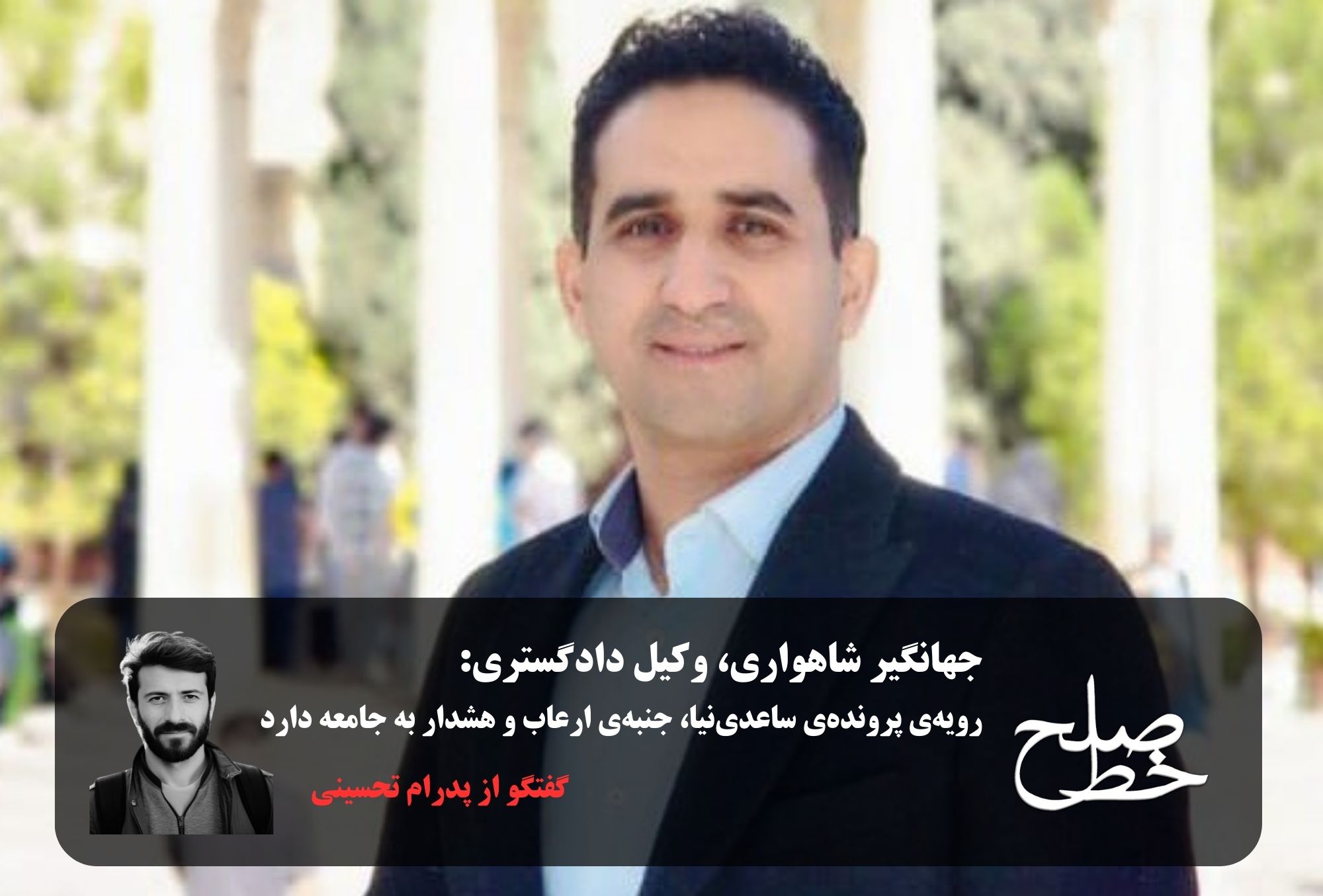
Jahangir Shahvari: The Saedinia case is intended to intimidate and warn society / Pedram Tahseni
The protests of January 1404, which resulted in the deaths of thousands of protesters and the widespread use of violence by security agencies, have been described by many as the bloodiest protests in the contemporary history of Iran and the world. The consequences of these protests were not limited to the streets and mass arrests, but quickly spread to the judicial and economic arenas, where the confrontations went beyond criminal prosecution to the seizure and threat of property and economic activities of individuals.
Meanwhile, the case of Mohammad Saedinia, as one of the prominent examples, attracted public attention. A case in which, along with the accusation of supporting the protests, an order was issued to seize assets and bank accounts, and judicial authorities spoke of the possibility of compensating for alleged damages from these assets.
In such a context, this conversation attempts to distance itself from security and media narratives and to examine the legality of this process. In this conversation, the Peace Line Monthly has spoken with “Jahangir Shahvari,” a lawyer at a courthouse and a member of the Center’s Bar Association, to examine, based on law, criminal procedure, and judicial practice, the legal aspects of seizure, confiscation, and confiscation of property in cases related to the January 1404 protests (especially the case of Mohammad Saedinia). The conversation was conducted with the motive of clarifying the boundary between law and the exercise of power and reexamining the position of citizen rights in one of the most sensitive junctures in Iran’s contemporary history.
Below you can read the details of the monthly magazine Khat Sohl’s interview with Jahangir Shahvari, a lawyer at a courthouse and a member of the Central Bar Association.
In Iranian law, what exactly are the differences between “seizure of property”, “seizure”, and “confiscation”, and at what stage can each be applied?
Seizure of property is a security measure. That is, it is a prohibition and prohibition on property until the matter is addressed. Usually, seizures can be made before proving the right or guilt. This, of course, has limitations. In criminal matters, the issue of seizing property resulting from a crime or money directly related to the crime is usually raised or to compensate for the damage caused by the crime. Seizure is also something similar to seizure and is carried out physically, but it is not in the capacity of executing a punishment. Such as the seizure of instruments of crime and smuggled goods that are obtained and seized, that is, they are kept in the possession of a person other than their owner. These issues are similar in some ways and different in others. These are related to the investigation period when they are seized, in order to prevent interference and possession leading to the inability to access. Seizure of property can also be a result of investigating crimes and violations and proving it. Seizure of property is a type of punishment that is foreseen in our classification of punishments.
According to the Criminal Procedure Code and related laws, under what circumstances can a judicial authority issue an order to seize property before issuing a final judgment?
We are faced with several situations. Sometimes there are obvious crimes and sometimes there are invisible crimes, or sometimes we have a private plaintiff and sometimes we do not. When we have a private plaintiff, he can request the payment of a criminal claim. This request for payment can be directly related to the money that was taken from him, or it can be from the property of the accused person to provide funds that, if he is convicted, he can withdraw from there to compensate for damages and losses. Of course, this is conditional on the fact that sufficient evidence has been obtained to consider the accusation against someone. I believe in the absence of a private plaintiff, there is a distinction between obvious and invisible crimes. In obvious crimes, only those that are directly related to the crime can be seized, confiscated, detained, and the like. The procedure is the same. Later, it is possible to lift the seizure and replace it, and the like in various cases. However, in my opinion, in invisible crimes, the initial seizure has no legal basis and such a thing is not foreseen.
Of course, the accusation that is made here is also important. We definitely do not have a basis for seizure in the case of an accusation that does not have a private plaintiff and whose punishment is not confiscation of property. If we accuse someone of an accusation that can be punished to some extent by confiscation of property, some believe that the prosecutor can seize this property from now on.
In property seizure, what is the place of the principle of “proportionality” and “relationship of property to the crime” and what are its exact limits?
The principle is that this property must have a direct connection with the crime, and confiscation is also possible to compensate for the damage caused by the crime. Proportionality is also related to the punishment and compensation, not to the crime. The explanation I gave was aimed at this issue. For example, if you accuse someone of a crime that does not require confiscation of property, you cannot confiscate his property because there is no way to secure it. This is also a weak idea that in crimes that require confiscation of property, property can be confiscated from the beginning, because where we are not clear, we must interpret everything in favor of the accused. In such a case, we cannot take security measures against someone’s property and limit their freedoms. This is against freedom, against the principles of the Constitution, and against the principle of the legality of crimes and punishments. This is only possible in security crimes, such as what they have recently done to some, with excess and direct orders from higher centers and the like, otherwise this is not the case. Let’s assume that someone is accused of a billion-dollar fraud. If convicted, this person is sentenced to forfeiture of property and a fine equivalent to the property taken. However, their property is not seized at the indictment stage and in the prosecution office unless at the request of the private plaintiff, taking into account proportionality, or unless a security order is issued for them and they come themselves and, for example, provide bail commensurate with the order. The fact that they want to seize someone’s property without issuing an order has no legal basis and, in my opinion, is contrary to the principles of customary criminal law and the Constitution.
Can a judicial authority seize property on a large scale without final proof of a crime?
At the accusation stage, if there is not enough evidence to consider the accusation, they cannot do anything. They are not even allowed to summon the person. The Criminal Procedure Code states that if there is enough evidence to consider the accusation against someone, the investigator is allowed to summon him. If this evidence is sufficient to prove it, the person is summoned as a defendant. Many times, the evidence is not sufficient and the person is summoned to give an explanation, so his property cannot be seized in the first place. It is not like they can seize a person’s property without there being any evidence or the accusation being proven. There is only one difference, and that is with a strict theory. In charges where confiscation of property is part of the punishment, a security measure is taken and a seizure order is issued, and here too evidence is required to consider the accusation. Such procedures have sometimes been seen in some economic crimes. They also usually have a private plaintiff. A private plaintiff comes forward and requests the payment of a criminal claim, and then the case proceeds or the property is identified as being the result of a crime. But normally, this is not a legal action.
To what extent does the seizure of property before a final verdict conflict with the principle of innocence and Article 37 of the Constitution?
I said that the principle is that the interpretation should be in favor of the accused. Basically, such a detention has no legal basis and is against the fundamental rights and freedoms of humans. Such an action is contrary to our Constitution and the Code of Criminal Procedure. Assuming that someone issues such an order, this is usually considered a disciplinary violation. Although such an action can have severe and adverse effects on a person’s life, the consequences of such an action for the issuer of the detention order are not great and ultimately it is a violation. That is why the system does such things without hesitation and ultimately you must refer to this system to achieve your rights, and this system also defends itself.
What effect does the seizure of assets in such cases have on the defendant’s right to defense and access to a lawyer and defense facilities?
Certainly, when someone’s property is seized, their ability to prepare a defense and have access to a lawyer is affected, and more importantly, it subjects the defendant to undue psychological pressure that can reduce the quality of their defense or even make them willing to accept lesser charges in order to escape death, as in the example of “They are taken to death to satisfy a fever.”
After the 2013 reforms, our criminal procedure code became very strong in terms of the rights of the accused. I can say that we have also surpassed French law in some places. Although it may not be implemented. For example, a person must be informed within the first 24 hours of their arrest. They can have the opportunity to meet with a lawyer in the first few hours, and many other matters. But these issues are not actually observed in many places, especially in security matters. In the case of crimes against security, they have also mentioned specific cases and have also excluded lawyers and said that we must consider special lawyers for them, all of which are violations of the rights of the accused. When we have violations of the rights of the accused to this extent, detention is another violation in the first place.
In crimes against security, characteristics such as being organized and being against security are considered for the accusation. They have said that in these charges, special lawyers who are authorized and approved by the judiciary can act to defend the accused of these charges. This is basically a violation of rights. That is, you cannot limit my right to have a lawyer to certain people. In the field of crimes related to the clergy, we also have a similar restriction in the Special Court for the Clergy. But this does not have much impact there. Because it is the clergy themselves who deal with themselves. But in the field of public rights, a truly gross violation is taking place. Fortunately, I remember that a few of our lawyer colleagues were on this list and withdrew and did not want to participate in this. Although it was a good employment opportunity.
In the case of Mr. Mohammad Saedinia, given the available information, what was the most likely legal basis for the seizure of assets and what scenarios are conceivable for it?
I don’t know much about the charges against Mr. Saedinia. But perhaps in this discussion, they will be charged with charges that the Revolutionary Court can order the confiscation of property. Charges that can broadly link them to Freemasons, international espionage, the former government, the Pahlavi government, SAVAK, Mossad, and Zionism, where the punishment is confiscation of property. Only in such charges is it possible to do so. But what was said in some media outlets that they should come and compensate for the damages caused, this has no legal basis. That is, if they want to act legally, there is no particular danger threatening Mr. Saedinia and his property because first a crime must be proven and then the damage caused by it, which must be direct, becomes relevant. Accepting an invitation to attend a protest gathering is not a crime that can be attributed to the extent of damage observed in recent events.
You mentioned attribution to the previous government. Shouldn’t the accusation be specific? Is such a broad accusation legally possible?
A crime consists of elements. The first issue is its material element. That is, a behavior must be committed by an individual. This behavior must be consistent with the legal element that criminalizes that behavior. Then, if necessary, a moral element must be established, malicious intent must be established, so that we can say that such a crime has been committed and must be punished. All of this begins with evidence. That is, there must be evidence and evidence for an accusation to be formed and an investigation to be conducted. The procedure that has been followed in the case of Mr. Saedinia is mostly aimed at intimidation and warning the community. The same rumor was true regarding part or all of Mr. Ali Daei’s property.
Government news agencies have written that the amount of detentions is almost equal to the damage caused in Tehran during the protests; what does this type of narrative mean legally and politically?
These are the words of the street, and unfortunately, our media is not much different from the words of the street. These words are popular with the audience and are attractive to a segment that has a specific line of thought. Since people in this country have become insiders and outsiders, these words have been the food of insiders and the source of intimidation for outsiders, otherwise the laws that raise the issue of responsibility and damages have their own special rules. It is not like us to come and say that because someone supported a movement, then the damage is with him. Here we must have the relationship of damage, responsibility, causality, and many other issues in different cases and weigh them with different theories and see which theory our law supports in such cases. Whether the occurrence of this damage can be attributed to this person, that we go and get compensation from him or not. Because there are so many elements between Saedinia and the damage that has been caused that sever the relationship, it is not at all conceivable that Mr. Saedinia could be approached regarding the damage.
The apology letter, which could perhaps be interpreted as a letter of repentance, was written by Mr. Saedinia.
Yes, I heard that they wrote a letter of repentance.
What is the legal status of these letters of repentance and apology?
If the letter of repentance is in the form of a confession and in the presence of a judge, it is evidence and has a probative effect against the individual as a criminal. If it is not in the presence of a judge and in the form of a confession, it is at least an indication. It is an indication to make a judge aware that he wants to bring an accusation against someone. This is one of the worst things that those accused of political activities or security crimes do, and everyone hopes that this repentance and apology will be accepted. The discussion of repentance in terms of limits and punishments has a process for acceptance and there is no requirement for its acceptance. But it has its probative effect. That is, I come and apologize and repent. This apology and repentance have a probative effect that I committed a criminal, heinous and immoral act, but it will not necessarily lead to an improvement in my situation or a punitive response to me.
Does this mean that an apology letter could end up to Mr. Saedinia’s own detriment?
One hundred percent. When you sign a confession, if it is a confession to an investigator or judge, it can serve as a confession and evidence, as well as evidence of your knowledge of committing a crime.
Mr. Saedinia wrote in this apology letter: “Unfortunately, in recent days, due to problems in the market and financing the factory, my son mistakenly announced the closure of the shops in a short time, in line with the Tehran market. Both he and I have fully realized our mistake and apologize to the dear people, because if there was a problem, we must be vigilant so that the enemies of Iran and Islam do not exploit it, and we must tell the authorities and those who care.”
The content of this is mostly about going on strike and participating in strike activities. But if I am not mistaken, the action they took was to announce that we would be closed on January 8 and 9 due to repairs. January 8 and 9 were also a call for people to protest and come out. Now he has written that we supported the strike. This writing can have that negative effect, at least to this extent. My initial response was not about Saedinia’s letter of repentance. I said in general that those who repent face such a danger.
Given this case and similar cases, such as that of Varya Ghafouri, can we expect the judiciary to adhere to the law and avoid extralegal actions in cases related to protests?
Your question basically states that they are not committed. I myself had cases against the police force and was successful in at least two cases and was able to convict the police force in a case involving a citizen and also received blood money for it. I am not disappointed with the judicial system. Our judicial system is made up of a group of people, most of whom believe in the law. Of course, the fact that in some cases unpleasant matters also have a legal form is a matter of debate because not everything that is legal is a moral and desirable necessity, and of course, the issue of security crimes and the security prosecutor’s office is separate. I cannot even speak in general about the Revolutionary Court itself. I was involved in cases where the Revolutionary Court, for example, ruled against the headquarters for implementing the Imam’s decree in confiscating property. That is, we cannot say that just because it is called the Revolutionary Court, it always protects the interests of the Islamic Republic. But we must accept that the government’s response to security crimes, especially regarding what we consider to be street protests that were forced onto the streets by blocking legal roads and, in their view, were destruction of property, war, and rioting, is in a way that they want to have a deterrent effect on perpetrators and potential perpetrators. That is, if they deem it necessary, they will react more severely and firmly than the law says, which may even be illegal, and this is more likely to be seen in cases where the perpetrator himself has extremist beliefs and ideological sensitivities. If you mean adherence to the law and the extra-legal, the Islamic Penal Code and the Criminal Procedure Code, this is a possibility, and actions contrary to these may also be seen.
But if we look at the issue in the system of Velayat-e-Faqih, it is possible that orders have been issued that are considered the source of law. Because in the system of Velayat-e-Faqih, our definition of law and decrees issued is not limited to the law itself. Therefore, it may be an act that we think is illegal, but in reality the person executing it is performing a legal act. For example, if an order is issued by the Supreme Leader, this order is above the law. He is both the head of the judiciary and at the top of the pyramid of the three branches of government. In the system of Velayat-e-Faqih, all powers receive their legitimacy and permission and authority from the Supreme Leader. What others know as a government decree has its place. But in terms of the theory of the absolute Velayat-e-Faqih, a decree issued by the leader is above the existing laws. From this perspective, all of this may be legal. If a decree is issued by the Supreme Leader or councils and headquarters that are created by the Supreme Leader’s orders and rulings – such as the Supreme National Security Council – they have authority. Many of their actions are apparently not in the law. They are authorized to issue orders or cancel orders and open and close institutions with the orders they have from the Leader, with the authority delegated to them by the Supreme Leader and by their successors in that matter.
Thank you for providing me with the Peace Line monthly magazine.
 Created By: Padram Tahsini
 February 20, 2026
Tags
Confiscation of property Criminal Criminal procedure Fair trial Jahangir Shahvari Massacre 1404 Mohammad Saedinia peace line Peace Line 178 Pedram Tahsini Strike Suppression The Di 1404 Uprising The right to strike Uprising of 1404 ماهنامه خط صلح