


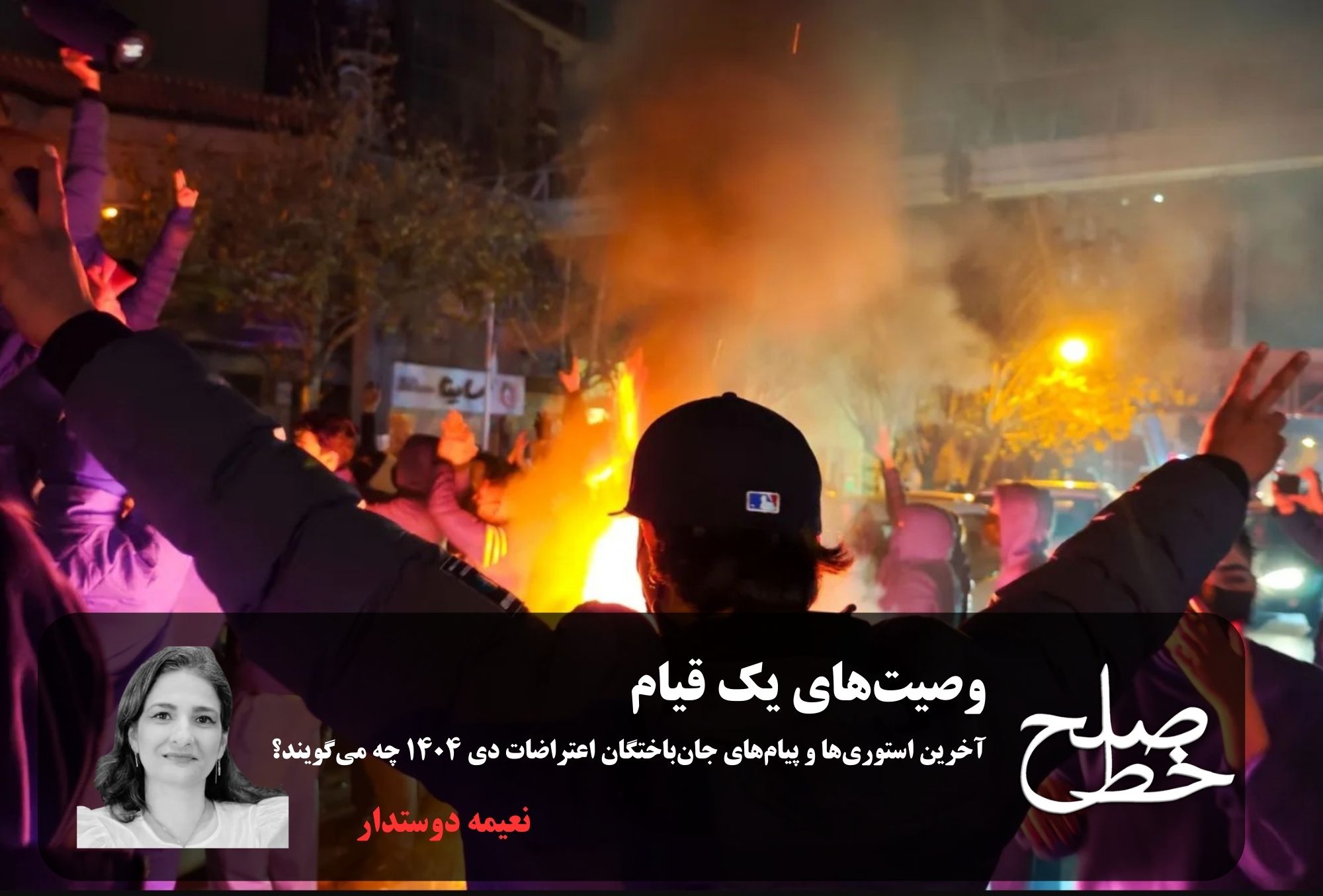
Testaments of an Uprising/Naimeh Doostdar
January 1404 was a time for a number of protesters to say their “last words”; a sentence recorded in a few lines on Instagram stories, or in a few-second video, sometimes in a brief call to family, and sometimes in a will that the survivors tried to carry out without fail. These messages, republished in the media and human rights reports, went beyond the level of scattered narratives and became documents; documents that speak not only of death, but also of the political consciousness of a generation that had already included death in the calculation of its actions. This article is written based on examples that have been published in the media and referable public sources; that is, either the text of the message/story was quoted in the reports, or the video/audio reached the media as the “last message” and its news was published. Naturally, this article is not “all examples”: many of the deceased have no recorded messages, or if they did, they were never made public. However, what has been published is extensive enough to allow a semantic map to be drawn from it.
“If I don’t get online …»: Death, Rituals, and the Rejection of Formal Ritual
In his last reposted story, 28-year-old Mehrzad Nazari wrote a sentence that quickly became one of the most frequently quoted testaments of this wave: “If anything happens and I’m no longer online, know that I didn’t lose easily,” and then a clear request: “Don’t pray or read the Quran at my grave; only music and happiness.”
Published accounts show that his family and those around him tried to fulfill the same request at the funeral; videos related to this issue were circulated on social media and in the form of media reports/reposts. In this will, the issue is not just “joy”; the issue is the delegitimization of the “official ritual of death.” Prayer and the Quran, in the general tradition, return death to the realm of religious authority and the symbolic order of the state; but “music and joy” pull death out of that order and return it to the realm of individual will, the lifeworld of the new generation, and political meaning-making. This point is one of the key features of the last messages of January 1404: death, not the beginning of silence, but the arena of struggle over the narrative. In another example, “Mojtaba (Shah Morad) Shahpari,” 32, from Izeh, according to a report published under the title “The Last Will,” requested to be buried “wrapped in a lion and sun flag,” and reports indicated that his body was wrapped in the flag in accordance with this request. Here too, the will is not just a “family request”; the choice of a symbol is the choice of a political position. The flag, instead of a formal shroud, is a testament that connects to the field of political identity and memory.
“You must die for freedom”; recorded messages for posterity
Another part of the messages is not addressed to “death” but to “continuation”: to family, to society, and to the future. For example, “Majid Farnia,” whose “last message” was published by the media before he was killed in the January 8 protests in Chalus, said a sentence in a video that reached the media after expressing his love for his family that became a headline: “You have to die for freedom.” Other reposts of the same message also emphasize the fact that leaving “for the future” and that freedom comes at a cost. The same pattern of recording a message before leaving is seen in several other narratives. One of these cases is the text related to “Raha Bahlolipour.” A few hours before her death, she had written the following sentence in a message on her personal Telegram channel: “Woman, life, freedom forever.” This short message is neither a detailed explanation nor a long political statement; Yet these three words, which form the central slogan of the movement “Woman, Life, Freedom,” clearly represent the direction and meaning she chose in her final moments in public. The message, due to its simplicity and symbolism, spread quickly and has been repeated in collective narratives about the dead as an example of individual political action and collective consciousness.
“Akbar Darzi Teymouri” is another survivor who says in a video message: “If something happens, we only went for the people, for Mujahid Korkur, for Mahsa Amini, for Nika Shakermi.” “Omid Norouzi” is another survivor whose last message was: “Anything can happen tonight. If he is released, be happy for me. Oh, I was angry.”
This form of “messaging” has an important difference from older waves: individuals consciously produce texts for the possibility of death; that is, they include death in advance in their political calculations and try not to allow the narrative to remain solely in the hands of the government or rumor mongers.
“Last Call” and “Last Sentence”: When Resistance is Summarized in Language
Sometimes the last message is neither a story nor a video; it is a short conversation. About “Behnam Darvish,” a 32-year-old from Hamedan, there were stories that described it as his “last conversation/last words” with his mother, and in them, phrases from well-known slogans were quoted. Addressing his mother, who was worried about him, he repeated this slogan in a humorous tone: “The cannon of the firecracker tank is no longer effective, tell my mother that she no longer has a son.” Regardless of the usual discrepancies of network reposts, the essence of the “last call narrative” is important: the most private form of human communication between mother and child at the moment of death becomes a public document. In its repression, the government targets the body; but by reposting the last sentence, society tries to reclaim meaning from the deleted body.
Stories that announce “going away”; from motivational quotes to bitter monologues
Media reports have cited numerous examples of “last stories” in which a person directly or implicitly mentions going out on the streets. There have been accounts of Ali Janani, a 20-year-old motorcycle courier in Islamshahr, posting a picture of himself on his motorcycle in his last story and writing a motivational quote: “To get the best days of your life, you have to fight on the worst days of your life.” Similarly, Amir Mohammad Kohkan, a futsal coach and referee, posted a dialogue in his last story about four hours before he was killed, saying: “I don’t know. I just want to go out and I have some thoughts in my head.” These types of sentences are exactly what is often seen in this wave: not long political statements, not pompous slogans; but everyday sentences, short and at the same time distant from “normal life.” It’s as if a generation is capturing a moment in which being ordinary is no longer possible.
“Death is here … I have paid my debt”; Story as a moral signature
In some cases, the latest stories are not reports of going to the street, but a kind of moral formulation of the end. Mehdi Qanbari, a 28-year-old from Malekshahi, Ilam, wrote this verse in his latest Instagram story: “Every moment, the old staff in my hand announces that death is here, or here, or here,” and then added: “I have paid my debt.” These two sentences create a complete worldview: death is not an accident, but a present possibility; and “paying my debt” does not mean a financial debt, but rather the fulfillment of a moral-collective duty. Such a phrase shows exactly why the “last messages” of January 1404 are not simply mournful; they are political-moral texts.
What patterns do these messages have?
When we put these examples together, a few key patterns emerge:
First: brevity and compactness. Instead of a long political explanation, many of these messages work with a key sentence; a sentence that can be quoted: “You have to die for freedom,” “I have paid my debt,” “Only music and joy.” This compactness is not a weakness, but rather an adaptation to a medium in which short stories and clips have become the carriers of collective memory.
Second: Direct confrontation with official ritual and appropriation of the meaning of death. Mehrzad Nazari’s will about “do not pray or read the Quran” is a clear example; Shahpari’s will about the flag is another. In these examples, mourning is not just mourning; “how to mourn” is itself politics: what to read? what not to read? what symbol to choose and what image of the deceased to leave behind? A work that the families of the deceased continued with dance, music, and the choice of white clothes.
Third: The connection between emotion and politics is without ideological mediation. Video messages like Majid Farnia’s are simultaneously “expressing love for the family” and “declaring a political choice.” This combination has an important feature: it tries to show that the struggle is not the product of hatred; it is the product of love for life, family, and the future that is considered the “right” of the protestor. This is why the phrase “for posterity” appears repeatedly.
Fourth: Wills and stories have become “testing grounds.” The government usually creates alternative narratives or puts pressure on families; in return, society tries to challenge the official narrative with these digital footprints. But the media and social networks show that the “last message” and the “last story” have become pieces of the fact-finding puzzle; such as reports that refer precisely to the “last story” of individuals to show that they consciously took to the streets. If we narrate January 1404 only by the number of deaths and the geography of repression, we will miss a large part of the truth. The “last messages” show us that for some of the deceased, death was not an imposed silence, but an opportunity to establish meaning: the meaning of freedom, the meaning of responsibility, the meaning of rejecting official ritual, and the meaning that the “narrative” must be written before it is confiscated. These last words, those few lines of the story or those few seconds of video, have achieved a historical function: becoming evidence of the lived experience of a generation at a moment when politics moved beyond the level of analysis and discussion and entered the level of body and soul; and this generation, before falling silent, tried to embrace its family and call out to the future with its last sentences.
 Created By: Naeimeh Doustar
 February 20, 2026
Tags
Arrow of Fire Criminal Internet outage Massacre 1404 mourning Naeimeh is a friend/lover. peace line Peace Line 178 Suppressing protesters Suppression The Di 1404 Uprising Uprising of 1404 Virtual space Will Will Woman, freedom of life ماهنامه خط صلح