


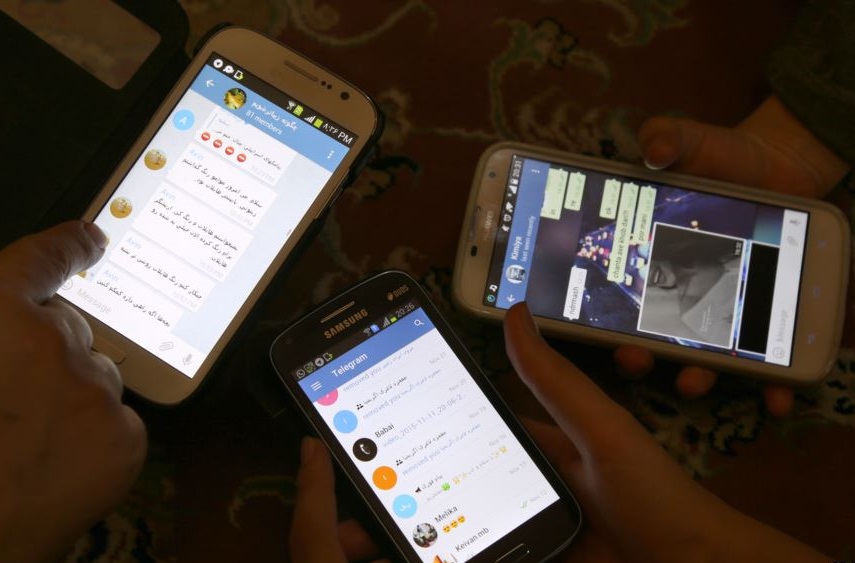
Telegram is like the internet for Iranians / Amir Rashidi.
This is a caption.
Amir Rashidi
From about four years ago, when the Telegram app became the most popular mobile application in the field of messaging in Iran, until today, three major changes have taken place in the conditions of users and the internet in Iran. The most significant change is the increase in speed and ease of access to information on the internet. These changes, which we will discuss in this article, are very important and have resulted in Telegram’s role in the lives of Iranians becoming more than just a mobile application.
Telegram, with its semi-media features, has practically become the internet for Iranian users; in a way that a large portion of their media needs are met through it, due to its lack of filtering.
Access to information in remote areas.
Thanks to the development of third and fourth generation mobile internet networks, today almost anyone in most cities of the country can connect to the internet with a relatively inexpensive SIM card and smartphone. Therefore, one of the problems of the internet in the past, which was access to the internet at a national level, has been significantly solved.
I remember in a not-so-distant time, when I was a student in Isfahan city, in many areas and roads, even the antenna coverage of mobile networks did not work properly and if you were a little far from the city center, your mobile practically had no functionality. But today, not only does your mobile still work when you are away from the center, but you also have access to the internet network on it.
According to statistics published by the “Comprehensive Information Society Gateway of the Islamic Republic of Iran” website, there is no point in Iran where access to the Internet is not available in the form of third and fourth generation. Therefore, the first fundamental problem in Iran, which is the issue of access to the Internet, has been almost solved. (1).
Becoming meaningless filtering.
The second problem in the field of internet in Iran is access to network content, which has been present since the early days of the internet in Iran and has become even stronger over time with the high wall of filtering.
In this field, Telegram plays a key and essential role with over 40 million active users inside Iran. Due to the fact that Telegram is not filtered in Iran, any website or application that is filtered can easily reach its audience inside the country by setting up a Telegram channel without even spending a dollar. The audience who do not need to use a VPN to access this information.
In simpler terms, on the Telegram network, due to the existence of a feature called “channels” for using as a media, and because Telegram is not filtered in Iran, all media or centers that produce information in any field can publish their produced content without any problems on a very wide scale using this feature, which is not filtered and also has an acceptable speed.
Telegram is like the internet.
The two main factors, which are providing access to the network and rendering filtering meaningless through the use of Telegram, have practically caused Telegram to function as the internet for Iranian users and have a much broader and widespread concept than just a messaging app or even a social network. In a way, the disruption of this network may seriously disrupt the flow of information in Iran.
This very feature, meaning the king of communication/information of the country, can play a very prominent role in political and social movements and as a medium, not a tool, for organizing activities.
This topic can be better understood and examined by looking at the level of usage of Telegram by users inside the country during the protests of December. According to information published by the “Ranking” website, during December and until December 4, 2017, the usage of the Telegram application was normal compared to Azar month. (2).
However, at the same time as the start of nationwide protests and the widespread spread of protests on the 5th and 6th of Dey month, the use of this application increased. On the 10th of Dey month – which could be considered the peak day of nationwide protests – the usage of this application reached from a few hundred thousand views per day to over 2 million and 367 thousand views per day. This resulted in the expansion of these demonstrations to many cities that were far from provincial centers.

This significant surge is a sign of the widespread use of this network by Iranian residents, not just those outside of Iran, to access the latest news or even participate in sharing news. Interestingly, exactly one day later, on the day that Telegram is filtered by the National Security Council, the usage of this network decreases to around 129,000 visits per day, almost reaching the same level as before the nationwide protests.
During the following days, Abdolsamad Khorramabad, the secretary of the committee for determining criminal content, claimed on January 22, 2018 that the blocking of Telegram has caused a 90% decrease in Iranian users of this application. If Mr. Khorramabad’s judgment is based on the latest information published on this website, it can be said that this claim is correct in terms of numbers. However, this decrease does not mean that users have lost access to Telegram, but rather that they were unable to use the application due to being stuck behind the high wall of filtering.
Notes:
For more information, you can refer to “.
The gateway to the comprehensive information society of the Islamic Republic of Iran.”
“Please visit..”
Ranking officer.”
Recently introduced by the Ministry of Communications and Information Technology, it announces the level of website and internet application traffic in Iran based on network analysis.
“Security and Internet Access Investigator in the Human Rights Campaign in Iran.”
 Created By: Amir Rashidi
 March 20, 2018
Tags
Amir Rashidi Filtering Nationwide protests in December peace line Telegram