


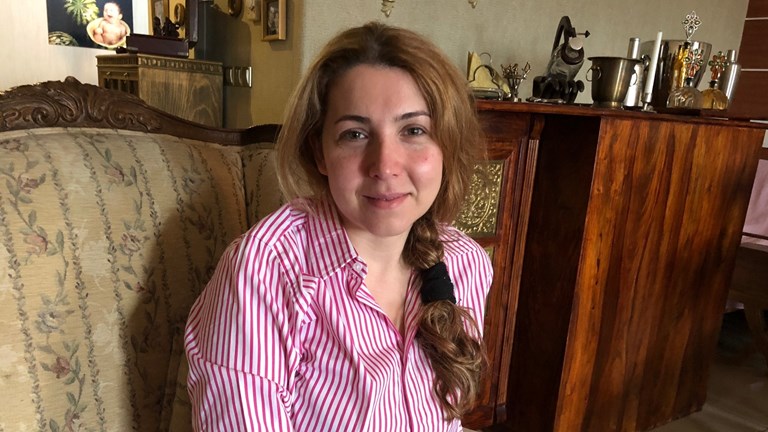
“Shaparak Shojai Zadeh: A beautiful day will come / Zahra Bagheri is happy.”
This is a caption.
Zahra Bagheri is happy.
Since the beginning of 2018, a limited number of Iranian women have protested against compulsory hijab. They stand on electrical boxes on the streets, place their headscarves on a stick, and shake it. This is their way of protesting.
Despite the fact that the number of these protests was not high, the reaction of Iranian government officials was severe; to the extent that two of these young women have been sentenced to prison after being arrested and interrogated. Women who participated in recent protests against compulsory hijab often have no desire to appear in the media or speak with them, but Radio Sweden reporter Cecilia Udden has conducted a unique interview with one of them. Shaparak Shajarizadeh, who is currently awaiting her sentence, tells Radio Sweden in Tehran, “This protest was not just about the headscarf, but about women’s rights, and after 40 years it was time for us to engage in civil disobedience.”
She, who is counted among the protesting girls of Enghelab Street, was arrested for raising her scarf on a stick in Qeitarieh Street and spent a week in solitary confinement. Shajari Zadeh is currently released on bail and is waiting to receive her court sentence. Among these young women, two others have been sentenced to one and two years in prison, respectively.
When Cecilia Oden, a reporter for Radio Sweden, goes to the Shaparak’s house to prepare a report, she sees her son sitting in the kitchen doing his schoolwork. Shaparak describes her son’s feelings to Radio Sweden, saying, “When I was released from prison, my son told me, ‘Mom, I told you not to go outside!’ I told him, ‘One day, you will make me proud.'”
Sparrows and other girls on Enghelab Street have no affiliation with any movement and only know each other through social media. Conservative analysts in Iran have considered these protesting women as a not-so-serious and marginal phenomenon and have evaluated them in one of these three ways. First, they have seen them as agents of foreign forces. Second, they have deemed them mentally and psychologically ill. And third, they have labeled them as Russian spies. But the interesting thing is that in dealing with this phenomenon, their reaction shows that they are taking this protest seriously. One sign of this can be seen in every corner of the city, where small triangular pieces are added to the height of electrical boxes to prevent the protesting women from standing on them.
The sparrow says to the Swedish radio: “I have read the history of women’s struggles and I thought now it’s my turn. I can’t sit and wait for others to suffer because of me.”
According to Radio Sweden, Shaparak states that it was difficult for him when he received a message from his 9-year-old son’s school on the eve of the Persian New Year, in which they told him it would be better for him not to attend the school’s New Year celebration due to his past struggles.

Explanation: The author of this article is in .
Radio Sweden.
Spread.“
Sicilia Oden.“
There is no text provided in Farsi to translate. Please provide the text to be translated.
 By: Admin
 April 20, 2018
Tags
Compulsory hijab Girls of Enghelab Street Hijab Monthly Peace Line Magazine peace line The sparrow is born from a tree. Zahra Bagheri is happy.