


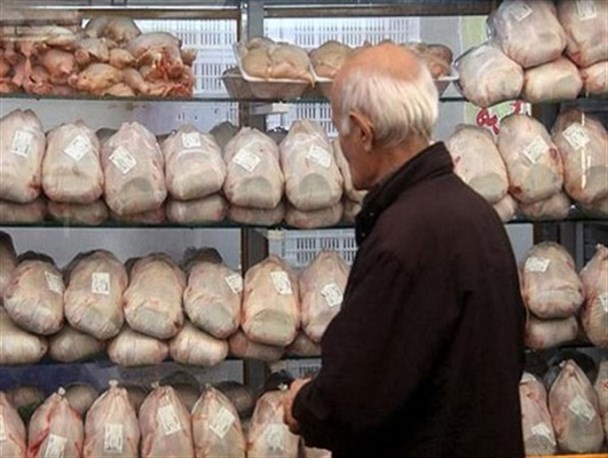
What group does inflation target in food items? / Ahmad Alavi
This is not a complete sentence, so it cannot be translated accurately. Please provide a complete sentence for translation. Ahmad Alavi
According to the latest published reports by the Statistical Center of Iran regarding inflation and the rising prices of goods, there has been a significant increase in the prices of food items, especially protein sources such as meat, compared to other categories. For example, according to the Statistical Center of Iran, the price index for the major category of “food, beverages, and tobacco” in the month of Bahman has increased by 4.5% compared to the previous month, while the major category of “non-food items and services” has seen a 1.1% increase. The price changes in Bahman of the current year compared to Bahman of 1396 (the previous year) for these two categories are 64.3% and 33.5%, respectively. In this regard, news about the rising prices of meat has been widely covered by the media in Iran. The government officials have responded to these price increases by taking measures such as importing goods or using tools such as the
The inflation of food items is higher than the overall inflation rate.
Food items are among the tradeable goods, their consumption is widespread, continuous and daily, and therefore the circulation of these goods and assets in the market is much higher compared to durable goods. For this reason, the price of these goods shows a higher reaction to economic, political and psychological shocks compared to other goods. The first point that should be noted in the current situation is that the inflation rate of food items in Iran is higher than the overall inflation rate of Iran and it seems to intensify in the future. The index below shows the trend of the inflation rate of food items compared to the overall inflation rate.
“من دوست دارم بهترین دوست تو باشم”
“I want to be your best friend”
The Central Bank, time series of annual average statistics from 1395 onwards are not available.
The chart above shows that since 2012, the inflation rate for food items has increased compared to the overall average inflation rate. In global comparison, the inflation rate for food items in Iran is much higher than the international average. Isa Kalantari, the deputy president and head of the Environmental Protection Organization, announced a few days ago that the price of food items in Iran is 50% higher than other countries in the world. The reason for this is the inefficient and non-competitive structure of production and distribution in Iran. However, this inefficiency and non-competitive structure is not only limited to the price of food items, but also includes many other goods and services. In addition to these factors, inappropriate business environment, widespread corruption, inappropriate policies, and the lack of an advanced production and distribution system are important reasons for this high cost and inflation. For this reason, many producers prefer to import food items rather than produce them domestically, as it is more profitable for them.
Inflation in food prices and various social classes
The Iranian society is a class-based society and is made up of various income and expense groups. Therefore, the consequences of any economic damage are not evenly distributed among the classes and relevant groups. For this reason, it is necessary to ask the question of which group is most affected by high inflation of food items in the current situation, and which group’s food security and safety will be most at risk?
According to the latest reports from the Iranian Statistical Center, the average share of food and grocery expenses in the month of Shahrivar is slightly over 27% of the average household expenses in the country. However, the distribution of expenses for food items is not the same among households in low budget groups (low income) and high budget groups (high income). The share of food and grocery expenses in low budget households (low income) is much higher than that of high income households. This is why low income households are more vulnerable to fluctuations in food prices. As the graph below shows, the share of food items in the household budget for low budget households is over 40%, while for high budget households it is close to 17%.
“این عکس یک منظره زیبا از کوهستان است.”
“This photo is a beautiful landscape of the mountains.”
Iran Statistics Center, September 2018 Report
It should not be forgotten that the quality of food consumption is not equal among these income groups and it is natural that not only the security but also the food safety of low-income households is less than that of high-income families and worsens with economic shocks.
The government primarily strives to preserve honor, credibility, and the continuation of power by attempting to hide or shift economic deficiencies, which are caused by structural economic and political factors, through importing food items or intervening in their distribution. However, until the production and distribution of essential goods in Iran becomes efficient, transparent, and competitive, the government’s actions only conceal the problems. The government does not have unlimited resources, therefore, although the market for food items may temporarily calm down through calming and persuasive actions, the problems will resurface from elsewhere. The experience of the past forty years has shown the futility of this cycle.
 Created By: Admin
 March 21, 2019
Tags
Ahmad Alavi expensive Expensive meat Monthly Peace Line Magazine peace line Right to compensation Spinal column Swelling ماهنامه خط صلح