


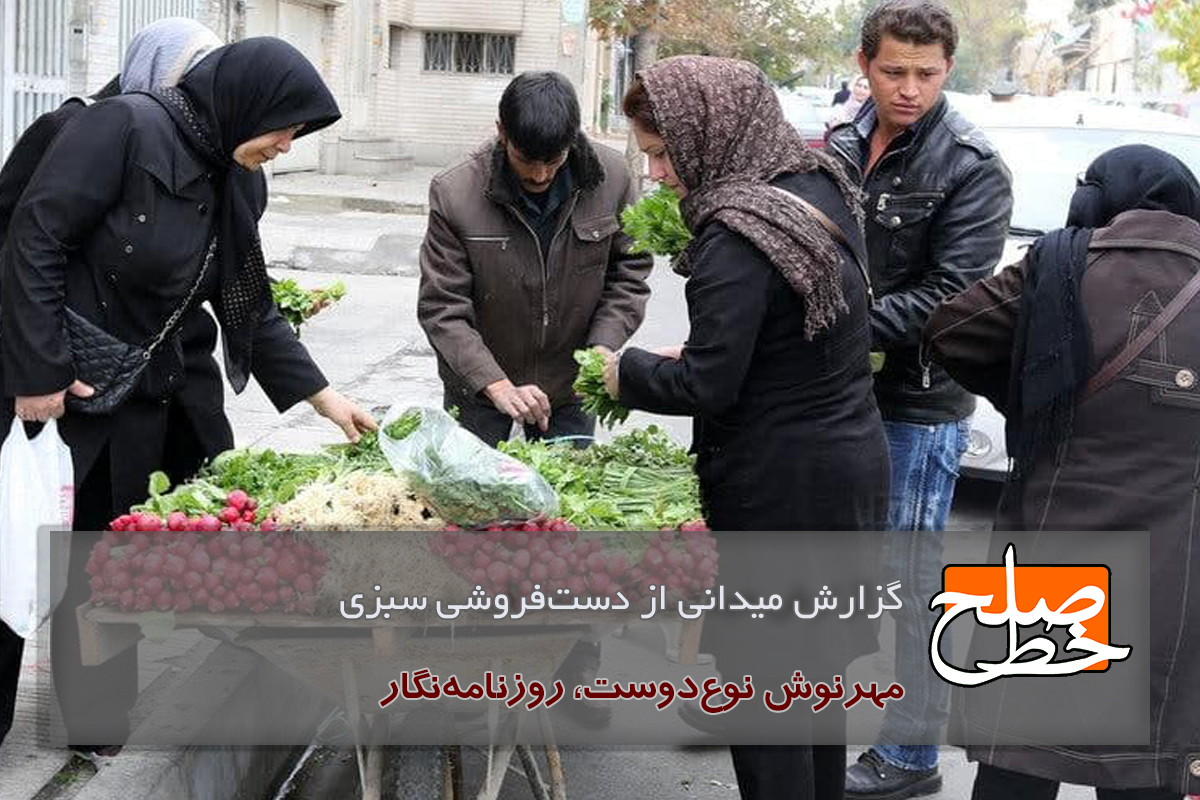
Field Report on Vegetable Street Vendors: Greasy Street Vendors and the Rule of Law/ Mehrnoush the Kind-hearted
“Informal” work is a form of paid work that is not recognized by economic laws. According to Marx, “wage labor” is work that has become a “commodity” and is bought and sold. Now, if this “commodified” work is defined as “informal,” it becomes a vicious cycle, as if the actor is only being exploited for the sake of a piece of bread. This report is an example of “informal” work, which is mostly done by Afghan immigrants.
A religious family expels their non-believing child. The expelled individual loses the desire to continue their relationship with their family. The material and spiritual ties between the individual and their family become weak or disappear. The non-believing child does not align with the rules and norms of their family and does not follow their desires; therefore, they are cast out and can no longer benefit from their support. On the other hand, the family is no longer able to monitor the actions of their child or benefit from them for the desires of the group (family). Both sides suffer losses from losing each other, but also gain some benefits; for example, the family preserves their religious core by casting out the non-believing child and the child is freed from the control of their family. This example is a type of separation and being pushed to the margins. The religious family no longer recognizes their child or they are no longer defined within the family’s moral boundaries; therefore, they are in contradiction with them and pushed
People in society are constantly experiencing these contradictions and separations. A open and accepting society embraces these contradictions and does not push its members to the margins or suppress them in any way. These relationships are not only defined by the interactions between individuals and groups in society, but also by their relationship with political authority and the economic system. Political authority also behaves towards its subjects in relation to its own contradictions; either accepting them or pushing them out of its circle of meaning and marginalizing them, or ultimately suppressing them. This same mechanism is also implemented in the economic system; individuals can either be assimilated and accepted in the current economic system, or they are pushed out and marginalized and enter the realm of the “informal”. In this way, every individual is constantly at risk of being classified as “formal” or “informal”.
The report and field interview examines one of the types of “informal” jobs; an activity that is only for income, and that too outside the “formal” economy in present-day Iran; an income that is not under government supervision, does not pay taxes, and is deprived of social services. This income is insignificant for some individuals, sufficient for some, and astronomical for others.
I will stay here; if you allow me.
Mohammad Ziba
He is 28 years old, from Afghanistan. He has a small cart and sells bunches of herbs and greens. He has been in Iran for six years and is waiting for his residence permit. He says, “My wife was born here; she has an Iranian birth certificate. Her mother was Iranian; she was finally able to get an Iranian birth certificate after 21 years. Now they are giving me my document too. I am very happy about this. I always thought one day I would have to go back to Afghanistan, but now I am staying here; if you allow me.”
Mohammad Ziba is a Persian-speaking Tajik from Afghanistan. He smiles slightly and says, “You must know where Panjshir is. I am from Panjshir. My brother and father used to fight with the Taliban; now they are fugitives. My mother and sister are from Khorasan. I have news from my brother and father’s whereabouts. They will be coming here soon; if you allow it.”
As he gets along well with the local ladies, he says: “We have a house in Islamshahr. We pick vegetables at five in the morning from the Shahriar, bring them home and wash and clean them with my wife. By the time I get here, it’s ten in the morning. I make as much money as a construction worker. My profit is two hundred thousand tomans per day. I also give a hundred thousand tomans to the municipality every week. The mayor doesn’t come; the officer comes once a week and takes the rent for the sidewalk. I don’t know if it’s for himself or for the municipality, but he always wears the municipality uniform.”
He calms his voice and continues, “I wish you wouldn’t write, they’ll take my place. They take money for everything. All Afghans have to pay to work with the carriages. I even pay ten thousand tomans for my carriage to be kept at night. There’s a warehouse down here where an Afghan worker has our carriages. All the vegetable sellers in this area are Afghan. I know them all. I’m satisfied. They treated me well here. If I get my papers, I’ll have a child. It’s better here than in Afghanistan. We’ll stay here, if you allow it.”
Traveling or selling food items such as vegetables, turnips, peas, etc. is not a new form of street vending in Iran. This type of vending has been prevalent in the traditional Iranian market, but today it has emerged as an “informal” occupation that is seemingly unregulated. Informal occupations in Iran, such as street vending, although they may not appear to pay taxes or be under government supervision, are still conducted on the fringes of the formal market and in many places are under government control. Many street vendors are required to pay rent for the space they occupy, often on footpaths, to the municipality or enforcement agency. Therefore, it can be said that they are deprived of social services and in a way, they pay a portion of their sales to the government.
Our enemy is one.
م
My dear
He is forty-two years old. He also sells a bundle of vegetables with his small cart. He has been in Iran for twelve years and has a residence card. He says, “I am Hazara. All of my relatives and colleagues are in Iran. I only have an uncle in Kandahar. I have four children and have been selling vegetables here for ten years. All the mothers here know me. My four children go to school.”
Aziz wants to send his children to America, he says: “The further we are from the students, the more comfortable we are. I buy vegetables early in the morning from the vegetable market. We prepare them with my family and then come here. I order vegetables every day. My expenses are covered. My wife helps. Other people work in houses. We work for our children. All of my brothers have come here, but none of them have residency papers. All Afghans are refugees. They come here and either sell vegetables like me, or collect garbage, or become construction workers. Many of us are educated, but this is our job. We are quiet. We don’t care about anyone, but anyone can give us work if they want. Now that the students have returned, we have no way back.”
He is impatient and, as he says, heartbroken. He continues: “We are not allowed to speak. If we protest, they force us to go back to Afghanistan. No matter what they do to us, we still won’t speak up. It’s for my own sake, but I give up my place for money. They come once a week and rent it; of course, they said not to tell anyone. Our enemy is one, but let me not say who it is.”
Somewhere outside the margins.
Margin in Iran was a distant place until two decades ago; an underground and “informal” society that existed for decades, but was less visible to the center. Now, the margin not only touches the center, but also exists in the heart of the center in various forms. If we can call the “informal” job the current economic margin of Iran, half of the economy is made up of the margin; “informal” jobs that also pay bribes to the government and are deprived of social services and legal supervision. Undoubtedly, a weak and shrinking economy creates a large space for the “informal” market. The “informal” market is where rent-seeking and profiteering thrive, transactions become illegal and untraceable, and cash flow for looting increases; but alongside a small group who can benefit from this “informal” market by being connected to the government, many people are pushed to the unsafe economic margin, where they not only lack stable and sufficient
 Created By: Admin
 January 21, 2022
Tags
False occupations Greengrocer Handicraft shop Mehrnoush is a type of friend. Monthly Peace Line Magazine Paragraph peace line Peace Line 129 Unemployment