


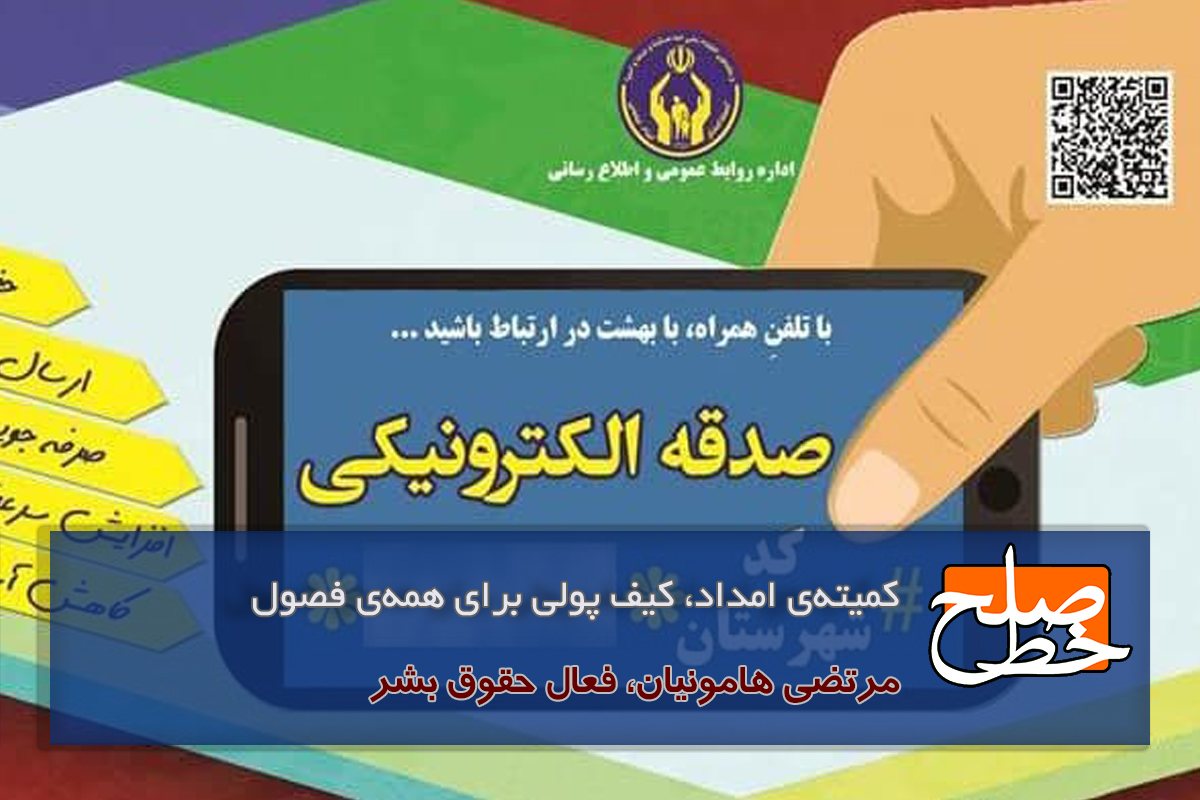
The Relief Committee, a wallet for all seasons / Morteza Hamounian
Charity boxes of the Relief Committee are everywhere. It is rare for someone to have spent a day in the streets of Iranian cities and not come across one of these boxes; boxes that are said to “remove seventy calamities”. This saying is based on narrations from the Prophet of Islam and also the Shia Imams, in which they say that charity, like water, extinguishes fire, removes calamities, or from Imam Baqir, the fifth Shia Imam, who is quoted as saying that charity causes the giver to be freed from a bad death. This topic is not limited to these charity boxes alone. In the time of coronavirus, with the advancement of technology, the act of giving charity in Iran has also changed. Now we are faced with electronic payment systems for charity in provinces and cities of Iran, and QR codes that can be used to make donations.
When we talk about giving charity, we are actually talking about one of the acts of worship and rituals of Islam. According to religious definitions, charity is something that a person gives out of their wealth and possessions with the intention of seeking closeness to God(1). It is also said that zakat (obligatory charity) and regular charity are recommended acts. Charity is essentially giving to someone who is in need; in addition, charity can be for the purpose of attaining rewards in the afterlife, reducing punishment in the afterlife, or because God loves to fulfill the needs of His servants and we give charity not for the sake of gaining rewards or reducing punishment, but solely for the satisfaction and love of God(2). The highest intention in giving charity is for the pleasure of God, but if someone gives charity with the intention of seeking rewards or reducing punishment in the afterlife, it is still a good deed; however, this giving of charity can also be in the form of
The mindset of forming this committee dates back to 1342 (1963-1964), when the families of political prisoners were in need of assistance due to the imprisonment of their breadwinners. Based on the necessity of giving charity and helping others, religious activists close to the clergy in that era also collected money and provided aid to needy families and families of political prisoners. This same mindset led to the establishment of a group called the Relief Committee by the founder of the Islamic Republic system in the early days of the revolution. The title of the Relief Committee was suggested by the then leader of the system, and in December 1978, less than a month after the victory of the revolution, Ayatollah Khomeini ordered Mehdi Karoubi to organize this group along with Habibollah Asghar Owlad, and Habibollah Shafiq. The founder of the Islamic Republic system wrote in his order that these three individuals, after the formation of relief committees in Tehran and
But who does the property of the Relief Committee belong to? Is it the Relief Committee itself? According to Article 7 of the approved charter of 2015, “The assets of Imam’s Relief are the net of all assets, including movable and immovable property and material and spiritual rights that have been or will be allocated to Imam’s Relief from financial resources or will be provided and registered in the Relief Committee’s books, which are considered as the total assets of the Supreme Leader” (4). In other words, whatever the Relief Committee has, belongs to the Supreme Leader of the Islamic Republic system. According to the belief of Shia Imami scholars, during the time of the infallible Imam, only he can manage the religious funds, and during his absence, just and pious scholars who are knowledgeable about the conditions have this permission; but according to the view of the Supreme Leader of the Islamic Republic, the management of the funds of the Muslims is in the hands of the leader himself
These legitimate funds during the time of the Prophet and the first and second Shia Imams, who ruled during certain periods, acted in a way (not completely) similar to the role of taxes in modern governments; meaning that zakat, khums, kharaj (land tax), and jizya (tax from the people of the book living in the Islamic government) were paid to the government during that time so that the government could manage itself with them and also with properties such as spoils of war and others. It is clear that since these governments were managed by an Imam or the Prophet of Islam, the ruler had complete control over all of these laws. However, some of the Shia scholars in later periods opposed taxation to the governments and stated that these cases and expenses were enough and it was not permissible for Muslims to pay additional taxes; but the wheel of modern governments (at least in democratic countries) turns with the taxes of the people. In the Islamic Republic, which considers itself
Let’s take another look at the issue. One of the main financial resources of the Relief Committee is zakat and alms. According to the bylaws of the Relief Committee, all the assets of this organization belong to the leader of the Islamic Republic and he has the right to receive and manage them. In fact, what has happened is that the people’s alms and religious payments have been turned into a financial support for the leadership of the Islamic Republic. In this situation, the Relief Committee is not willing to publish a detailed breakdown of its income and expenses and only provides general reports. For example, in September 2020, this committee published its annual report with less than 1,500 words. In fact, we are dealing with a committee that receives religious funds and alms from the people and only reports to the leadership of the system, who according to the bylaws of this committee, owns all the assets of the committee. With this situation, the Relief Committee, which receives
Notes:
1- Sadaqah, Wiki Shia.
2- Vows, charity and dealing with the Lord, Mohsen Kadivar’s official website, 17 December 2013.
3- Order to form the Relief Committee to Messrs: Karoubi, Askaroladi, Shafiq, Comprehensive Imam Khomeini Website.
4- Charter, Khomeini Relief Committee website.
5- Financial Management in Islamic Laws and Booty, Mohsen Kadivar’s Official Website, 29 Dey 1391 (January 19, 2013).
6- Collection of one trillion tomans of Zakat; Is the Relief Committee playing the role of Robin Hood?, Masoud Azar, BBC Persian, 18 Bahman 1399.
7- In honor of Government Week, the one-year performance report of the activities and actions of the Relief Committee and the Imam Khomeini Relief Committee was announced on September 6, 2020.
 By: Admin
 February 20, 2022
Tags
Charity 2 Charity and warding off misfortune Electronic donation payment Monthly Peace Line Magazine Morteza Hamounian peace line Peace Line 130 Relief Committee The Relief Committee