


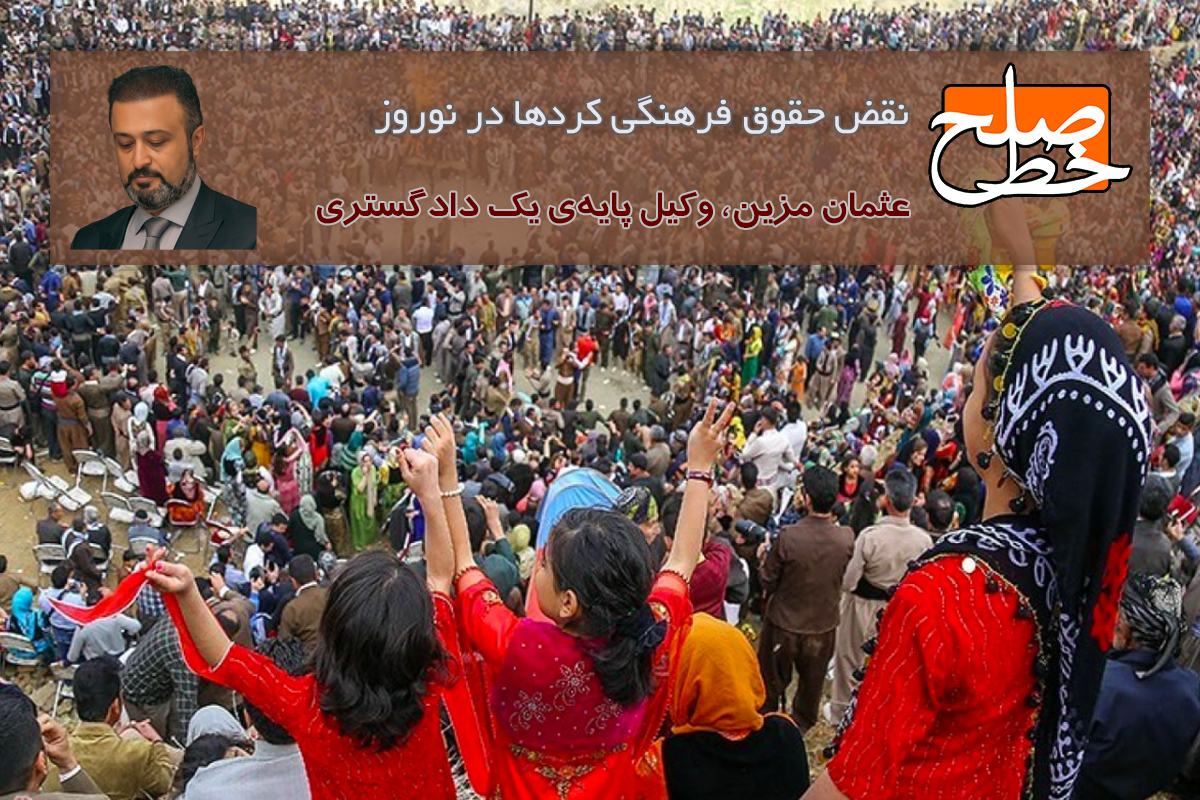
یThe violation of Kurdish cultural rights during Nowruz/ Osman Mozini
Each nation or people, according to their experience of passing through ups and downs and the darkness of historical events, considers certain days important and respects them, and as a result, has its own rituals and specific programs.
Seen in societies with multiple nations, ethnic groups, or ethnicities, all the sorrow of government is focused on the dominant ethnic, linguistic, and ruling group, which does not always have the majority. In the midst of this, the fundamental and basic rights of religious or ethnic minorities are forgotten and ignored, and while forgetting or neglecting the cultural rights of minorities, we witness interference and determination in order to deviate it, so that governments can impose their own interpretation of a cultural event on the minority.
The general goal of all societies in forming governments, paying taxes, and delegating some of their powers and freedoms to them is for governments to enforce the cultural rights of all social classes and groups; in other words, the existing authority of governments to take on cultural and educational affairs of society is derived from the theory of “representation and delegation”. In representation, as the representative is the deputy of the original, they cannot act beyond the will of the original and the framework of the representative’s authority is determined by the original. Whenever there is doubt about the representative’s authority or lack thereof regarding a matter, the principle is “lack of authority” and the representative who claims to have been delegated the authority to carry out a certain task must prove it with positive evidence.
Delegated powers to governments are also included in the framework of this theory, and governments and rulers should not consider themselves as the ultimate authority of society and people.
In modern societies, not only tasks such as maintaining order, foreign relations, education, and cultural affairs are entrusted to governments, but also they are expected to be carried out in the best and most complete manner by the people, and any incomplete or neglectful performance of these tasks will result in the representative being held accountable for not fulfilling their duty or disregarding the public interest and genuine will.
Let’s assume that in a society there are three linguistic groups: Persian, Turkish, and Arabic, and the Arabs are the majority. The government is responsible for the education and culture of these three linguistic groups. In this case, where the government represents the above-mentioned three linguistic groups, should it act according to the will of all three ethnicities (Arab, Persian, and Turkish) that have delegated authority to it, or is it sufficient to act according to the will and declaration of the linguistic group that is the majority? How can it be accepted that acting against the will of the principal is correct? Surely the Persian and Turkish linguistic groups, who are in the minority in this hypothetical society, have entrusted the government with the authority to educate their mother tongue, and it will never be desirable for them to be taught or imposed the language and cultural characteristics of another ethnic group, even if it is the majority.
With these characteristics, governments must follow the will and desire of minorities in implementing cultural policies and language education. They should behave according to their will.
In addition, every government is responsible for preserving and safeguarding the language, customs, culture, historical artifacts, and traditions of society, which must be diligently protected and we should not witness any discrimination in fulfilling this duty. Allocating attention and financial resources to certain accepted customs and cultural traditions is not acceptable.
The Constitution of the Islamic Republic of Iran begins with this sentence: “The Islamic Republic of Iran is based on the principle of the comprehensive nature of the cultural, social, political, and economic institutions of Iranian society,” which emphasizes the importance of cultural institutions in this system. Its third principle, in 16 articles, outlines the responsibilities of the government in achieving the goals stated in the second principle. In articles 6, 7, 8, 9, and 14, it is stated that:
Elimination of any form of tyranny, autocracy, and monopolization. Ensuring political and social freedoms within the bounds of the law. Public participation in determining their own political, economic, social, and cultural destiny. Elimination of unjust discrimination and creation of fair opportunities for all in all material and spiritual aspects. Ensuring comprehensive rights for all individuals, regardless of gender, and establishing fair judicial security for all, with equality for all under the law. This statement includes obligations such as the elimination of any form of tyranny and autocracy in all aspects of individual and social life, and in the same way that one should not allow an individual to be under the control of another individual or group, a linguistic group should not be under the control and monopolization of another group. Local ceremonies and programs are among the social freedoms of individuals, and achieving equality by creating equal opportunities for all and eliminating discrimination. After eliminating discrimination, it can be claimed that everyone is equal under the law.
This principle is in the context of expressing the duties of the government in a general sense, which should be discussed and in addition to mentioning negative issues such as eliminating discrimination among individuals and groups, it also lists its duties; meaning that simply eliminating discrimination is not enough and by stating a matter and using the phrase “should”, it talks about the necessity of achieving equality and uniformity in all personal and group matters and rights.
In the forefront of the third season of the same law, that is, in principles 19 and 20, it has such verses:
Article 19: The people of Iran, regardless of their ethnicity or tribe, are entitled to equal rights and their race, ethnicity, language, and the like shall not be a cause for discrimination.
Article 20: All members of the nation, regardless of gender, are equal in their support of the law and are entitled to all human, political, economic, social, and cultural rights in accordance with Islamic standards.
Article 19 declares and emphasizes the equality of all individuals from every race and ethnicity, stating that color, language, and race should not be the cause of deprivation of rights and privileges. According to this principle, all ethnic and linguistic groups should be able to progress through managerial and academic levels without discrimination and have access to positions and responsibilities. However, in practice, this is not the case and the majority of government positions and educational opportunities are dominated by one race and language, hindering the advancement of individuals from other ethnic and linguistic groups. This results in ignoring the abilities, scientific qualifications, and competence of individuals based on their affiliation with a certain group.
The 20th principle, although it is about equality between men and women, is inferred from the equality among all women, that women of every nation should have the rights of other women.
Not supporting the cultural and linguistic rights of all ethnic groups in a country results in nothing but the destruction of minority cultures and the dominance of the cultural characteristics of another group over minorities. When criticizing a policy or approach, its effects should be taken into consideration and ignoring the culture and language of minorities only leads to their destruction, which is a well-known historical experience in many societies where reviving a destroyed culture or language is no longer possible.
In cultural and linguistic matters, governments have no right to interfere and should only provide the necessary space and facilities and play the role of facilitator. However, in recent years, we have witnessed obstruction of cultural and historical ceremonies of Nowruz in Kurdistan, which goes against the basic cultural rights of individuals and is in conflict with the principles of the constitution; especially principles such as the rejection of discrimination. In other words, on one hand, the government has not fulfilled its duty to allocate budget and resources for such programs, and on the other hand, it has prevented people from holding them. Now, we must ask the question of how and where the cultural budget of Kurds is being spent and for what purposes. Governments do not have the right to do so, and Kurds, as grantors of representation, do not allow their budget to be allocated to other cultures.
Minorities are always facing destruction due to the prevalence and support of the dominant language and culture, and we are witnessing a decrease in the speakers of minority languages and the interference and commands of governments only intensify this process, as the minority groups themselves are not able to preserve and support their language and culture, and this matter should be carried out by governments.
 By: Osman Mozayan
 April 21, 2022
Tags
Kurdistan Minorities Monthly Peace Line Magazine New Year celebration peace line Peace Line 132 Usman Muzin