


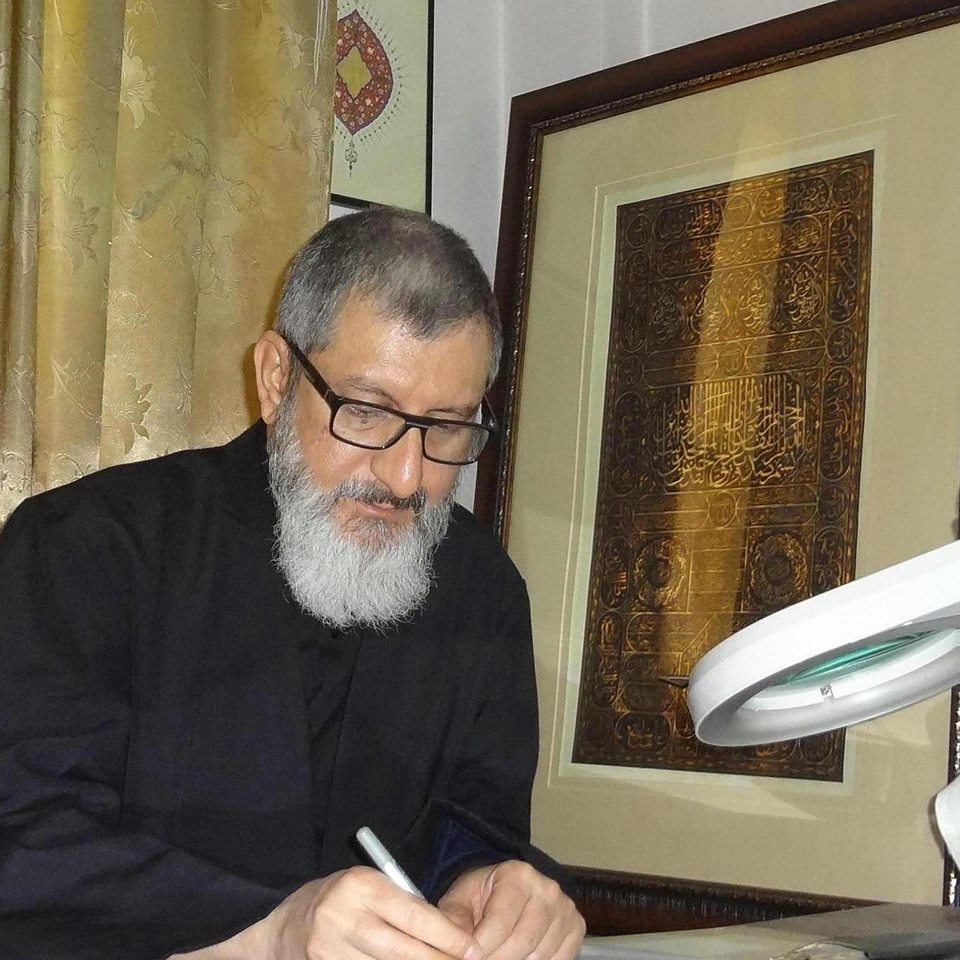
Ayatollah Abdulhamid Masoumi Tehrani: If we have a constitution, fatwas have no meaning / Morteza Hamounian
Ayatollah Abdolhamid Masoumi Tehrani, a well-known cleric, resides in Tehran. In the past three decades, due to his activities and unique religious views, he has experienced imprisonment, torture, and security confrontations in the Islamic Republic. He has always strived to emphasize coexistence among religions and denominations in all parts of the world. This calligrapher, painter, and illuminator has dedicated many of his works to believers of other religions and denominations.
Abdolhamid Masoumi Tehrani has also repeatedly expressed his reactions to issues related to religious discussions in his interviews with the media or in his articles. In these interviews, he has brought up various discussions and debates. In response to questions about the peace line in relation to the issue of women cycling, he mentions that recent fatwas on this matter have turned into a gender and historical debate. He says, “The opinions of jurists in this area are based on multiple narrations, while today’s jurists do not rely on the Quran.”
Mr. Masoumi also speaks about the principle of issuing fatwas in the field of such issues, saying: “There was a time when the country did not have proper laws, and they would solve problems by issuing fatwas. In a country with a constitution and a parliament, issuing fatwas no longer has any meaning.”
A conversation with Ayatollah Abdolhamid Masoumi Tehrani in the monthly magazine of Khat-e-Solh regarding recent fatwas, specifically the fatwa of the Supreme Leader of the Islamic Republic regarding women’s cycling and related issues.
What is your opinion on Ayatollah Khamenei’s recent fatwa regarding women cycling in public? What do other scholars think about this matter?
In my opinion, their fatwa was not so far from expectation and traditional scholars also have a similar view. According to the opinion among the jurists, the discussion on this matter is about gender. In fact, although this gender discussion does not have an Islamic origin and foundation, it has a historical background that needs to be examined. The issue is mostly related to the patriarchal thinking that believes men have a special gender and women are generally seductive and must be careful! This is not limited to Islam; it also exists in Christianity and Judaism.
As I mentioned, the result of this fatwa was not entirely unexpected, but it does not align with modern perspectives and, in fact, it must be said that these statements do not correspond with the understanding and perception that humanity has now gained about its society.
What was the main purpose of this fatwa? Can it be related to the prohibition of women riding horses by the Shia Ahlul Bayt and the quotes from the Prophet of Islam and Imam Sadiq on this matter?
Yes, this issue exactly comes from these narrations related to horseback riding. At that time, there was no bicycle. The uses we have from these narrations are in the same way. Personally, I do not believe in these narrations very much and I think our problem is essentially these narrations. We do not have such discussions in the Quran. Of course, some words and discussions have been mentioned in the Quran, but it has been said according to the time when the Quran was revealed, that we should also look at the Quran according to the view of the Prophet’s era. Narrations have been formed based on differences in societies and conditions in different periods; otherwise, Imam Sadiq or any other Imam who did not give so many fatwas.
If possible, give some examples of these narrations for our readers.
As an example, there is a narration from Imam Sadiq in volume 20 of Wasa’il al-Shi’a and volume 5 of Usul al-Kafi, which has been narrated from the Prophet of Islam that he forbade women from riding on a saddle. Or in another narration mentioned in Wasa’il al-Shi’a volume 11, it is stated that the saddle is cursed for women. Additionally, in some narrations, this issue is related to the signs of the end times. For instance, in Mustadrak al-Wasa’il volume 14, it is mentioned that “women will ride on saddles in the end of times.” Such narrations and traditions can be found in hadith books.
The problem is that currently, the scholars do not have any work with the Quran and only refer to the narrations. Finding a narration for any issue is not a difficult task. In fact, with these books, one can find a narration for and against any issue. Deduction and inference means that you come to a fixed opinion (at least for yourself) among these contradictions. However, the dominant view of Islamic scholars is based on the same gender contradiction that has been passed down from ancient times. Unfortunately, our scholars have not been able to adapt to the times and still have a form that is suitable for seven or a thousand years ago, and they try to fit anything new into this form by any means possible; but it does not fit and these problems arise. All these problems and corruptions that have arisen are because that container and content do not match, and they are trying to force them to match. At least a scholar should understand the conditions of their time, but unfortunately, our
Of course, you also mentioned being a lord.
Yes. The issue of male dominance has existed in all societies for centuries. Perhaps it is only in the past hundred years that the issue of equality has been raised. Christianity does not advocate for any special rights or privileges for women, but at least the Catholic Church has been able to align itself and its views with the current situation and conditions. Of course, this is not a comparison between Christianity and Islam, as they have fundamental differences in their beliefs, but the root of this issue goes back to the culture of male dominance that has existed in all eras and societies. The reason for this is that, generally, men were physically stronger and would impose their dominance over others, while women were physically weaker and could not confront this issue.
Basically, you might be wondering why such a fatwa has been issued by the leader of the Islamic Republic at this time.
In my opinion, the issuance of such a fatwa has two reasons. One is that after 38 years of converting to Islam, we have only heard the name of Islam and in society, people have somehow taken on a confrontational attitude. They do not come to discuss the issue and see why such events did not happen during the time of the Shah. At that time, for example, if a religious scholar issued a fatwa, everyone would pay attention to it, but now it is not the case. This issue requires social psychology and experts must determine why and for what reason people act contrary to these fatwas. Why do women act contrary when the issue of hijab is raised?
This issue shows that the government is using religion as a tool, but their actions do not align with their words. People have put these issues under the umbrella of religion and Islam, but they do the opposite of what they preach. However, some men are still under the illusion that they are like Mirza Shirazi, who could issue a fatwa and, for example, declare riding bicycles as forbidden, and people would break and throw away their bicycles. Those days are gone! People’s understanding has changed and there must be a law in place. There was a time when the country did not have proper laws and they would solve issues by issuing fatwas, but in a country with a constitution and parliament, issuing fatwas no longer holds any meaning. It is possible to issue fatwas in personal and private matters, but it is not appropriate to issue them in governmental and social issues. For example, they issued a fatwa against eating chicken, what was the result!?
But my opinion and in relation to the second aspect of the issue and the sensitivity that they have towards certain issues such as hijab, music concerts and cycling, is that considering the fact that every day a new corruption emerges from the government system, in order to divert people’s minds from that issue and put them under the spotlight of such issues, they issue such fatwas; that there should be no football on the night of Ashura, or concerts in Mashhad or other cities so that it does not disrespect Imam Hussein and Imam Reza. These issues have happened before, but why was no one’s dignity broken!?
Do you think why, despite the fact that according to you, issuing a fatwa no longer serves its purpose, there is insistence on continuing it?
The misconception is that people believe if they speak up, it will be the end of the world. Not all people who sit around and criticize others are actually qualified to do so. The exact misconception is that those who do not listen to them are in the minority. If they were to step out of their bubble and take a walk on the street, they would realize their mistake. There was a time when men would sit with the people and listen to their complaints and concerns without fear, but that is not the case anymore. The challenges and social problems must be addressed by experts. The religious scholars are the experts who should give their opinions on these matters.
Do you think they can use this fatwa for motorcycling as well?
See, during the time of the Prophet, women used to ride horses and camels and were also present in battles, and no one had any issue with it. This shows that as we have progressed further from that era, this mindset has become more closed and restricted. Therefore, if tomorrow a fatwa is issued declaring it forbidden for women to sit on motorcycles, don’t be surprised. If they haven’t issued it yet, they will one day. They started with the hijab and now they have reached smaller matters such as boots and bicycles. You should even expect a fatwa prohibiting women from driving and leaving their homes. In fact, the more corruption there is in our institutions, the more they will be forced to restrict society. They started with women, but they will also reach men.
Mr. Torkashvand’s research in the book “The Islamic Veil in the Time of the Prophet” is very important and it should definitely be read; although many men have criticized it (although they have not been able to convince Mr. Torkashvand so far). One of the criticisms of the people is that they do not follow up on such issues. People should be told to at least increase their knowledge; just because it does not make sense to me and we do not do it does not mean it cannot be done.
The Quran specifically addresses this issue, for example, it criticizes Jewish rabbis and says, “You say this is permissible and this is forbidden” (Surah An-Nahl, verse 116). They issue rulings from God for themselves, while this is not the case. The ruling comes from the individual, and it may be correct or incorrect. Ultimately, society, culture, and people’s understanding are progressing. We live in a global village and cannot move forward with the thinking and ideas of the 18th century. Unfortunately, these things are still happening in that era.
According to Article 2 of the Islamic Penal Code, any act or omission for which a punishment has been specified is considered a crime. Currently, to what extent is this fatwa capable of being implemented in society and considered a crime?
It should be noted that in a country where the law is the ruler and not personal opinions, such a fatwa cannot be implemented. However, in a country where personal opinions take precedence over the law, such a thing can be implemented; they come and say that Ayatollah has issued such a fatwa and make decisions based on it. Sometimes, judges, when they lack a legal provision in court, refer to the writing of the Imam! That is, on one hand we have criminal law and on the other hand we have explanations of issues and writing of the Imam. One of these must be set aside. Because they do not go well together. There is a history of such a thing and this inconsistency has been proven.
In this country, different religions and beliefs coexist, and even the majority of Shia do not believe in Shia political thought, and many Shia have no connection to the dominant ideology. Should everyone follow the ruling fatwa in such conditions? The point is that if someone holds an executive position in the country, they should not have a religious position because they must consider the whole society. This idea of putting everyone under the rule of Islamic law was for the time of the Abbasid caliphate. If such behavior is applied to Muslims in Europe and America, there will be protests. Therefore, someone who holds a government position cannot have a religious opinion unless they exclude all other sects, including Shia, Sunni, Baha’i, Jewish, and Christian, and make all members of society followers of the ruling Shia. Yes, in such conditions, one can govern as a religious person, and this is exactly the same method used in the Vatican, where the Pope gives orders and fatwas to priests
Thank you for the opportunity you have given us.
 Created By: Admin
 October 25, 2016
Tags
Abdulhamid Masoumi Tehran Ayatollah Abdolhamid Masoumi Tehrani Ayatollah Khamenei Bicycle riding decree Bicycling is prohibited in the park. Bicycling or cycling Fatwa Leader's fatwa Monthly Peace Line Magazine peace line Seyed Ali Khamenei Women's cycling Women's sports پیمان صلح ماهنامه خط صلح ماهنامه خط صلح