


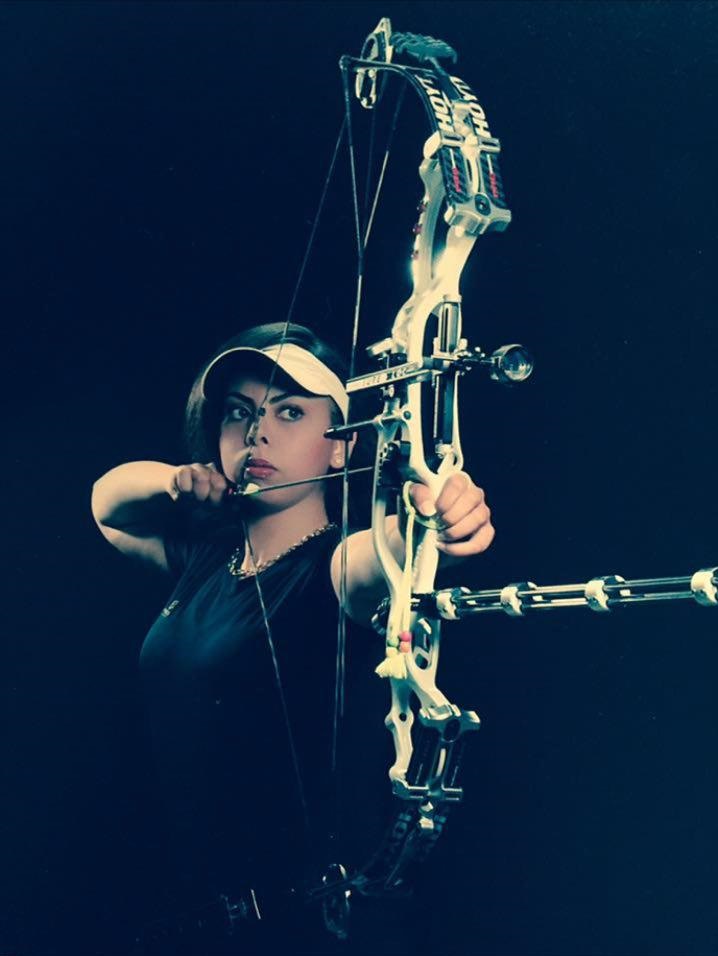
From world champion to the pain of being unloved and leaving the homeland; a conversation with Mahtab Parsamehr, the champion of shooting in Iran.
Mehdi Parsamehr, is the record holder of Iran in the sport of archery. This young athlete, besides winning the gold medal for the Iranian national team in the 2011 World Archery Championships, has many other achievements and medals in his sports career. However, he has recently left Iran and moved to the United States due to the lack of support from officials and his pursuit of further education.
Mehrab Parsamehr, in an interview with the magazine “Khat-e-Solh”, explains in detail the reasons for his separation from the national team and leaving his homeland. He says, “Mr. Karim Safaei, the head of the Archery Federation, had promised me various prizes, such as a gold coin, a car, and a complete set of archery equipment, but none of their promises were fulfilled.”
This successful athlete, who continues to pursue professional archery, was not allowed to enter freedom sites for practice in Iran for a long time and was repeatedly pressured by authorities because of his attire.
Mrs. Parsamehr, considering that many people believe that shooting and archery are sports that are usually of interest to men, please tell us how you became interested in and entered the field of archery?
I started archery at the age of eighteen by coincidence. I had no mental background or experience in archery; although I had shot a gun before, I had never used a bow. I had always been interested in pursuing sports professionally, but I was focused on golf. When my aunt and I contacted the Azadi Sports Complex, it was funny that besides us, there was only one other person who was a fan or follower of this sport at the time. That’s why they didn’t form a class for just three people, and that’s why I couldn’t pursue this field professionally.
In July 2007, a television program was broadcast on the news network about youth competitions in archery with recurve and compound bows. After watching the program, I thought this sport could be good for me. I contacted the federation and they introduced me to a club, and that’s how I started this sport in July 2007. I actually stumbled upon archery by chance, but I took it very seriously and after five months, I bought my own bow and equipment. Of course, I didn’t win any medals in my first competitions, but in my first national competition in 2010, I won gold and after that, I became addicted to winning medals.
Please tell us a little more about your professional background. Tell us about the path you took to join the national team and achieve a world record in archery.
As I mentioned before, in the year 88, in the first national competition that I participated in (indoors, 18 meters), I was able to win a gold medal. At that time, I was not yet a member of the national team. After that competition, the federation organized the Ramadan Cup – which was a kind of selection for the Asian Indoor Games in Vietnam (2009) -. Because I had good results, I was selected for the national team training camp. However, the national team coaches were not familiar with me and did not want me to participate in this competition. But because I had won many medals and had a high rank, there was no room for them to change my name.
The Vietnam competition was my first international competition; I was able to win silver in the individual event and our team also won gold. As I had also become a member of the national team at the same time, we immediately went to the 2009 Indonesia competition in Bali. As the competition had four distances and my training was in the 18-meter distance, I was not in the main team; but we still managed to win bronze and I also received a medal. After the Indonesia competition and the end of the training camp, the coaches’ opinion was that the compound did not need training and it was better to only hold a camp for recurve, which is an Olympic discipline. For this reason, we did not have a place to train throughout the winter. The conditions were very difficult because I had to find a club myself and pay for it to be able to train; but in the end, all of these difficulties had good results for me.
In the 2010 World Stage Championships, in the second stage in Antalya, Turkey, our team (meaning myself, Vida Halimian, and Anisheh Hajianzehi) managed to win the first silver medal for Iranian women in the team compound. After that, the World University Championships were held in China where I also won a silver medal in mixed competitions with Mr. Hamzeh Nikoui and our team came in second place.
The year 2010 has ended and as usual, we did not have a winter camp. In the 2011 competitions, in the first stage in Croatia, I achieved fifth place and in the second stage held in Turkey, I was able to win the individual gold medal and Iran’s ranking in the world rose to third place thanks to this medal. My own ranking also became third in the world in the individual category. The record for Iran is still in my hands.
Our next competition was the World Championship in Italy, which is held every two years and can be considered as our Olympic event. There, I placed fourth in the individual compound category. In the mixed category, Mr. Amir Kazempour and I also placed fourth, and as a team, we were able to bring home the silver medal once again.
You were a successful athlete in Iran, holding a world record, captaining the national team, and becoming the flag bearer for Iran in the 26th World University Games in 1990. What led you to decide to immigrate? In fact, during your professional career in Iran, what obstacles and difficulties did you face that ultimately led you to consider leaving the country?
After 2011, when I succeeded in winning the gold medal at the World Championships and it was the best year of my professional career, there were many controversies. At that time, I was 22 years old and imagine that without any support from the federation or having a sponsor, I had achieved all these successes with only the support of my family. The only facilities that the federation provided for us were just a set of arrows. Apart from not having any facilities such as a training hall or dormitory, they didn’t even give us bows. We lived in the east of Tehran and for competitions like the Ramadan Cup, which was held after breaking the fast, we had to go to the west of Tehran and the outskirts of Karaj at night by personal means or by metro and bus. Mr. Karim Safaei, the head of the Archery Federation, had promised me various prizes such as the Azadi Gold Coin, a car, and a complete set of archery equipment

After 2011, Mr. Safaei’s presidency in the federation ended. Although they were very unfair to us in terms of the results we achieved, it must be said that they had good management. After their departure, some political issues arose. The president of the World Archery Federation got involved in this matter and said that your government interferes in the selection of presidents for various sports federations and we cannot accept politics in sports. As a result, Iran was sanctioned and we were unable to participate in any international competitions for two years. I cannot accept Mr. Mohammad Ali Shojai as the new president of the Archery Federation, neither then nor ever, and I have told him this. They may think they achieved good results, but we will never have a team like we used to. The various competitions held in the country lacked the coordination and grandeur they had before, and the athletes did not have the motivation to participate. In any case, during those two years of
When and why was the Iranian team sanctioned lifted?
In 2013, the sanctions on Iran (for reasons I am not aware of) were lifted, but I distanced myself from the team for a while because we didn’t have a good coach. At that time, Mr. Kordi, who was only a shooter and had no coaching experience, was the head coach of the national compound team. After that, even though I was invited to the national team training again, there were some controversies. For example, I would protest against the team’s lack of facilities and coordination, and these protests, to my disbelief, led to a breakdown of trust between the coach and the athlete. This issue escalated to the point where I wasn’t even allowed to enter the Azadi Stadium for training. It had gotten to the point where I was practicing on the rooftop of my own house. At that time, I would post pictures of my training on social media to show that I was being disrespected and that the world champion was not given
However, a few months later, I was invited to join the national team for the 3D archery competition in Antalya, where I also won a silver medal. This was under the circumstances that I had not been in training and had no experience in 3D competitions. In fact, I was informed of my flight to Turkey on the same night that I had to go with the team.
Following the same issues and controversies that I mentioned to you, I decided to sell all my equipment in Iran and leave the country to continue my profession and education. That’s how I came to America in 2015.
“When it comes to women’s sports in a country like Iran, the first limitation that comes to mind is the dress code for athletes. Has the dress code and hijab that was imposed on you been a factor in hindering your progress or activity? Has this dress code ever deprived you of an opportunity?”
Yes, we were definitely dealing with these problems. You see, having a dress code in Iran is a law and no one can argue with that; but the issue is that when you enter a sports environment, the looks towards female athletes turn into a kind of added pressure. For example, the color or material of the clothes were in a way that I always felt embarrassed and it caused my self-confidence to decrease. These are issues that many female athletes in Iran may never find the opportunity to speak about.
At that time, the head of female athletes was a woman named Akbarabadi who had a very strict and tough approach towards the issue of clothing. Of course, Islamic clothing for our sports had been resolved in a way; however, considering that archery involves the face, cheeks, neck, and hands of the athlete and these parts should not have any type of clothing, the face of the athletes became a problem. During the time when Mr. Safaei was the head of our federation, due to the power he had – or for any other reason – he did not allow Ms. Akbarabadi to have any involvement in women’s issues. We could wear a loose headscarf or use a hat and because of this (apart from the psychological pressures we faced in various competitions), we could work comfortably. But unfortunately, after Mr. Safaei left, Mr. Shojai gave Ms. Akbarabadi a high price and it became such that this
An athlete should be able to comfortably perform their activity and have peace and focus, not be distracted by unnecessary controversies. Of course, hijab has not been an obstacle for us, but if myself or other female athletes have been able to achieve success, it has not been an easy task. I doubt that men who sit and plan for Iranian women’s hijab can even spend an hour in the summer heat with such a hijab on the sports field or even on the street.
Why do male athletes in Iran still find it easier to speak about their problems compared to female athletes? Do you think this issue is more related to existing sensitivities around women’s sports or the lack of proper attention from the media towards female athletes?
“Undoubtedly, media and the existing atmosphere are the main reasons. For example, you will never see a female athlete’s photo on the front page of newspapers and magazines, or the news about women that is broadcasted on TV has no clear images. All the successes of women in the country are temporary; when they win a gold medal, their news is spread on Facebook, Instagram, and some media outlets, and that’s it. But imagine a male athlete; when he wins a gold medal, he becomes a celebrity, his name appears in sports advertisements and billboards, and not only his photo is on the cover of newspapers and magazines, but also articles are written about him for a long time. Unfortunately, female athletes do not receive such support, and I really don’t understand why the image of a female athlete who competes with a full hijab (which is not a problem in our sport, as they say, because of lack of movement) should not be broadcasted on
These are all issues that demonstrate the media’s neglect towards women’s sports. Of course, the media’s treatment also depends on the management of individuals. In regards to my field, when Mr. Safaei was the head of the federation, league matches were fully broadcasted on television. In fact, he insisted that our matches should also be broadcasted and did not make any distinction between women and men. That’s why I say that during his presidency, our field was much more successful.
Can cultural barriers, lack of awareness, and public acceptance towards women’s sports (compared to men’s sports) be considered as one of the obstacles to the development of women’s sports in Iran?
I believe that Iranian society is still a society with traditional thinking. When I was coaching the youth and junior team in Tehran, I noticed a lot of talent, but at the same time I saw that families were imposing many restrictions on them. For example, they would say, why does my daughter have to be at the sports club every night until 8 pm? This was despite me explaining multiple times that the club (the Navy club where I worked) had set the time from 4 pm. And that archery is a sport that requires at least 3 hours of training every day, and one hour is not enough. But it was useless and they wouldn’t allow their daughters to come to the club at that time. This was just one example that I witnessed myself; other sports were the same. This traditional mindset does not allow for much progress in women’s sports.
Currently, as a resident of America, what challenges do you face and what are your goals and plans for the future?
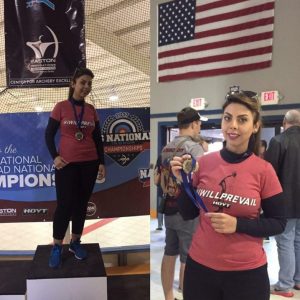
Well, anyway, life here is very difficult; especially since I live alone and at the same time study and work. However, I also pursue sports professionally and even participated in the Georgia Championship and won gold. I also placed fifth in the National Indoor Championships USA in 2017. It means a lot to me to be able to continue my sport here and my goal is to join the American national team. Currently, most of my time is spent working, so I am trying to find a sponsor. If I can have a sponsor’s support, I will be able to focus more and follow my training more regularly. To achieve my goal, I have to shoot for 4-5 hours every day.
If there is a specific point that you have in mind, please let me know.
I hope the hardships I have endured will not befall the new girls who have recently joined the archery field in Iran, and that they and my other friends will always be a source of pride for us.
Thank you for the opportunity you have given us to use the peace line.
 Created By: Admin
 May 25, 2017
Tags
Archery Archery Federation Bow and arrow Mehrab Parsa Mehr (This does not have a direct translation, but it could possibly mean "beloved moon" or "loved one from Parsa") peace line Women's sports پیمان صلح