


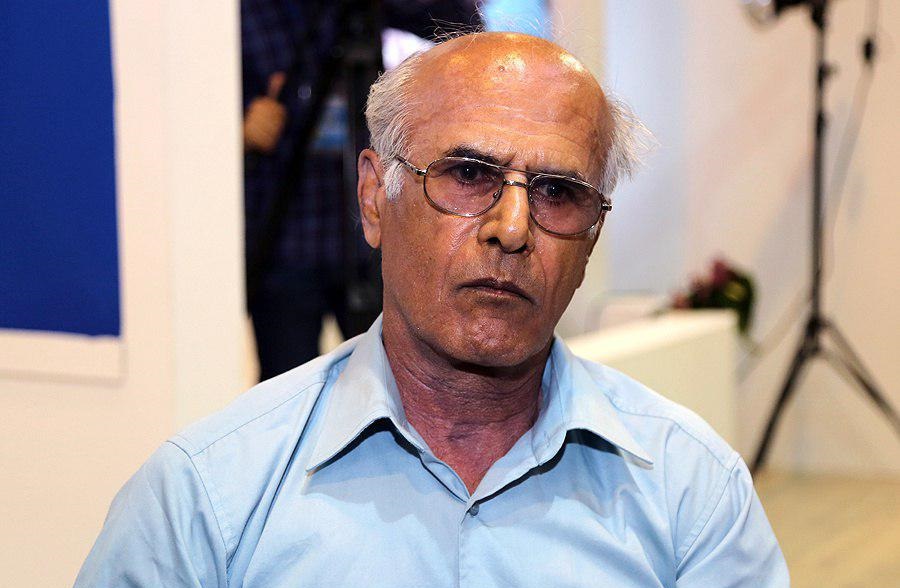
Naser Aghajari: Capitalism and profiteering have created a disaster in Iran / Ali Kalai
This is a picture of a beautiful flower.[/caption]
این یک تصویر از یک گل زیبا است.
Conversation with Ali Kalai
News about workers’ protests over their unpaid wages has turned into a daily occurrence, with reports of the situation slowly returning to normal. Workers who have been working for months without receiving their wages. Families whose breadwinners are unpaid workers, struggling to meet their basic needs even after several months.
To investigate this issue and inquire about its reasons and methods, we have spoken with Naser Aghajari, a seasoned labor activist and representative of the workers’ union in the southern project. We asked him about the issue of delayed wages, the type and structure of contracts, and the Ministry of Labor’s response to it. Aghajari also discussed with us the “exploitation” of existing capital in Iran, and how it violates the fundamental and substantive laws in all areas of Iran, including the labor sector. He said that what is happening is a violation of the existing laws in the country and the removal of all workers from the realm of labor law. This removal has led to the complete control of employers and contractors, and the lives and property of all workers are in their hands. These workers, according to Aghajari, are being brutally exploited. Their everything is being plundered and they have nothing left to lose but their lives.
You can read the detailed conversation with Naser Aghajari below.
“سلام دوست عزیز، امیدوارم حالت خوب باشه”
“Hello dear friend, I hope you are doing well.”
In recent years, especially in the eleventh and twelfth governments, we have witnessed an increase in the amount of unpaid wages for workers. In your opinion, what is the root cause of this issue becoming more widespread?
This is a natural occurrence because the economic relationships have shifted towards structural adjustment and privatization – or what is known as neoliberalism in Iran – which has undermined the power of the law, especially in relation to temporary workers – who make up the majority of technical workers in Iran. In fact, workers are no longer protected by labor laws. Even for disputes that arise in the workplace, instead of resolving them through negotiations between the labor representative, employer, and worker, the issue is handed over to religious courts. These courts have no knowledge of the details of labor issues. The contractor goes and talks to them, and they defend the contractor’s interests against the worker. A worker who hasn’t received their wages for six months, has no other source of income, and their family has nothing to eat, is forced to go on strike. It should be noted that the workers’ strike is not for an increase in wages, but to receive their rightful wages. The worker says, “Give me what we
With great regret, these neoliberal economic policies that post-war governments, without exception, insist on continuing, have caused a serious crisis in the country that is getting worse day by day and manifests itself in various forms in society. All of this is a result of the fact that there is no longer any labor law in the country, and contractors do whatever they want and do not pay workers their wages for five to six months, and even up to two to three years in some places. For example, some courts in Asaluyeh and Kangan have ruled that these workers’ wages must be paid, but the contractor refuses to pay. There is no other legal authority to defend the rights of workers.
You mentioned a five to six month delay in wages and even the continuation of this issue for two to three years. Is there a more accurate statistic on the amount of unpaid wages for workers?
The amount of months that workers have not received their wages is usually different in various places; but even the statistics published by the ILNA website show that they have mostly not received their wages for five to six months. I have been unemployed for a year now. When I went to the Persian Gulf Star – which is a large and under construction refinery – and talked to the contractor about employment, he said that you don’t have the right to demand wages for a year! If the employer gives me money, I will give you your wages, but if not, I won’t give you anything! Do you want to stay, or do you want to leave? It’s that easy! There is no contract for me to sign. What I sign is a blank piece of paper that is only a copy and is in the possession of the employer. They fill out the paper however they want and write whatever they want on it. That’s why not only do they delay wages to this extent, but
What structure does this type of contract that you mentioned – the one where you come and work, if I give money, I will give it, if I don’t, I won’t – fall under?
It is oral. It is not written. It doesn’t even have a legal form. If they wanted to act according to the law – even if it was oral – they would say that since the worker has gone to work, the contractor is obligated to pay their wages. The dispute resolution courts, which were between the worker, the employer, and the labor office, usually supported the worker’s rights. But now, because they are excluded from the labor law, there is no authority to defend the worker’s rights. All governments are aware of this issue. These news, for example, that the miners in the north are owed a certain amount, are constantly written in newspapers. But who comes and asks why the situation is like this? Why do these employers – or as they call themselves “entrepreneurs” – not pay the people’s rights, what they have agreed upon? The reason is that due to structural adjustment and privatization, which Mr. Hashemi Rafsanjani started
Do you know if the Ministry of Labor and the Ministry of Industry and Mines have planned or come up with a solution for this large amount of unpaid wages for workers?
See, the Ministry of Labor, which is the Ministry of Capitalists, is definitely not doing anything. They are aware of this issue but they take no action. They don’t even come out and protest or demand that the rights of these poor people be given to them, not even as a slogan! They don’t even bring it up themselves in their media. Keep in mind that these workers have no income or capital other than the work they don’t get paid for, but no one talks about this issue at all.
Gentlemen, the only thing they have done in the face of such excessive abuses by contractors is remain silent. In fact, by their silence, they are strengthening the business relationships in Iran. Even a person with a postgraduate degree and full mastery of English, when they go to one of the airline agencies in Tehran for work, they are hired for a salary of two hundred or two hundred and fifty thousand tomans, and sometimes even less than the minimum wage of a laborer. The reason for this is that airline agencies are exempt from the labor law and are considered as workshops with less than 10 employees. Because they are exempt from the labor law, the contractor has full authority and says, “I will pay you this amount; take it or leave it!” It’s absolute lawlessness. Laws have been removed from society and contractors are exploiting people with impunity.
You raised the issue of removing laws and also referred to Article 44. Do you think privatization of workshops and factories has exacerbated this problem? Has it led to a decrease in government responsibilities and the government shirking its duties?
The government claims to have delegated responsibilities to the people, but in reality, they are calling the capitalists the people. This is not the case and this issue is not true. The government and the ruling powers want to deny the existence of class-based life.
On the other hand, the government has not only become smaller, but it has also become much larger compared to before structural adjustments and privatization. The goal was supposedly to make the government smaller, have less responsibility, and fewer employees with lower salaries. However, the reality is not like this at all. Thousands of institutions with thousands of employees have been created to silence people and control them. This is why they have not achieved any of the goals they wanted and that neoliberalism claims to have. They have only caused destruction. I refer to the Islamic Republic’s radio and television. Iranian television reported that in each of the streets of the industrial city of Shahrekord, only one or two active workshops remain, while before there were dozens of active production workshops on each street. The workshops that used to employ 50 or 60 workers are now only working with two or three workers. They have all been shut down and gone bankrupt. This means that even privatization has not been carried out.
At the beginning of your conversation, you mentioned the discussion of whipping, prison, and dealing with workers. One of the managers of Hapco recently referred to protesters of their work environment as “terrorists.” What is the purpose of such security measures against workers who are simply seeking to fulfill their professional demands, such as receiving fair wages, and what does it signify?

The capital market that exists in Iran is actually full of intermediaries and brokers. I intentionally use the term “brokers” instead of “financial capital” because the quality of financial capital in Iran is not up to par with that of brokers. They must do these things in order to protect their own interests.
The religious ruler, whose knowledge is only religious and knows nothing about economic issues, workplace environment, or employment contracts, easily accuses workers of issues related to jeopardizing national security and similar matters, just because of a few slogans, and sentences them to long-term imprisonment. The imprisoned worker is sick and dying, but he does not release him.
With great regret, I emphasize that the most harmful type of capital in Iran, which is speculative capital, is thriving and its consequences for the country do not matter to them. I know second-tier companies whose owners all have green cards and their families live in America, Canada, or Europe. In fact, whatever they earn in Iran, they take it there. No one monitors why they take their money out of the country when they create income here. They only empty the pockets of the people, acquire resources, and leave, without caring about the potential harm to the country.
Structural adjustment and privatization after the war in Iran has created a swarm of parasites; parasites that not only lack the conscience of coexistence with their victims – the Iranian people – but are also sucking the blood of these people until their last breath.
Trade activists pursue their trade demands. Why are attitudes towards these trade activists political and politicians are afraid of them?
When you live in a society where you can’t even form a trade union to defend your rights; an organization that can say that a worker is a human being working and their right is to receive their salary at the end of the month, and when they don’t receive it, their wife and children suffer from lack of food, education, and healthcare; then the issue is no longer just a labor issue. Whether you like it or not, you are forced to stand against the system. This standing is a political movement.
In addition, when economic calculations are moving in a direction that only supports the interests of a minority in society – namely, capitalist profiteering – it inevitably leads to issues of class and political dimensions. This type of economy puts heavy pressure on human life, which can only be described as a form of extremely savage exploitation. In Europe, even if they were exploiting, they would at least pay a minimum wage; but here, even that minimum poverty line is not given. The worker’s rights end up in the pocket of the capitalist. Instead of receiving their rights, the worker is imprisoned for several months. And when they are fired, they are not entitled to any of the benefits stated in the laws, such as severance pay and retirement. The labor regulations in free trade and industrial zones, which include temporary contracts, state that the contractor is not obligated to provide insurance. Even in this law, it is written that if a court orders the fired worker to return to work, the contractor can
In your opinion, what impact has the issue of the Iran nuclear deal had on the lives of Iranian workers, or will have in the future?
The JCPOA has not only had no impact on the lives of workers, but it has also not affected society. During the Obama administration, a significant amount of financial resources were made available to the government, but the president himself easily stated that we want to spend this money on rebuilding the shrines of the Imams. He took pride in this issue. This is how those financial resources were spent and used outside of Iran.
See, when we talk about project workers, we are talking about those who produce the mother industries. We are the ones who even our helpers must know some trigonometric equations. When a refinery is being built, they give us a map and say, for example, this pipe goes there at this angle; I have to take the pipe at an angle and work in a way that I don’t encounter any problems in the rest of the path. At that time, the technical workers who build the mother industries in this country have been excluded from the labor law and are not paid their rights. They put the worst pressures on them. Most of them are currently unemployed; they are either sitting at home or doing taxi and selling cigarettes…
As you mentioned the issue of technical workers, what is your view on the issue of apprenticeship programs? When the Ministry of Labor says that university graduates are supposed to enter the workforce through this method.
These issues and plans are all deceitful. Internship is a deceit that only seeks to intensify exploitation. The purpose of this plan is to put an engineer at the disposal of a contractor who will pay him a meager salary for months and then it is uncertain whether he will be employed or not. You see, I was employed by law in 1348. I had also been working in oil company projects since 1343. I even became educated at one point, but then returned to project work. In fact, I have been working for over 45 years. However, that young engineer who has just graduated from university is so strong in theory and after three to four months, he becomes so proficient at work that I, who have been in that project for years and am experienced, cannot compete with him. A student who graduates from university and enters a project does not need an apprenticeship at all.
If there is a point you have in mind at the end, please let me know.
The goal of this government is to destroy the law in all areas and they have no value for the workforce. They look at a technical worker or an engineer as if they were a cow that only needs to be milked! They only want to use them for their own benefit. There is no human perspective from the government. If they had a human perspective, they wouldn’t ignore even the basic laws that they themselves approve and which give them legitimacy. Unfortunately, they have also disregarded all of their own laws.
Thank you for the time you have dedicated to the peace process.
 By: Ali Kalaei
 December 29, 2017
Tags
Ali Kala'i Monthly Peace Line Magazine Naser Aghajari Obstacles/Barriers/Circumstances/Challenges Ahead peace line Workers پیمان صلح ماهنامه خط صلح ماهنامه خط صلح