


Merciful Love; A Study of the Situation of Children Who Have Dropped Out of School in an Interview with Asifeh Kamrani.
This is a picture of a flower.
The conversation is with Samin Saberi.
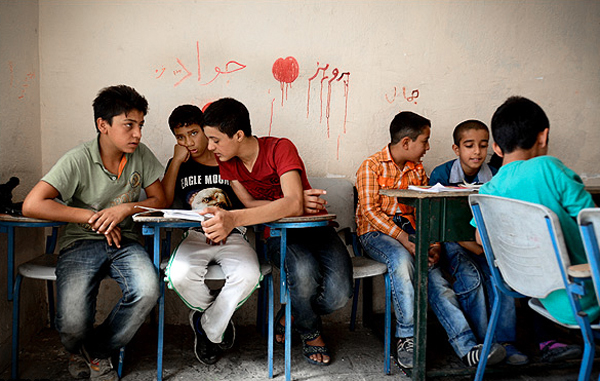
On the first day of Mehr (the seventh month of the Persian calendar), there are many poems describing the kindness and joy of Mehr, which are whispered. But there are countless children who have not experienced or received kindness from Mehr. The first day of Mehr is just like any other day for them; full of monotony, hard work, and being ignored, full of scolding and suppression. In schools and statistics, they have no place; it’s as if they are invisible and not important to anyone. But there are activists in the field of children’s rights who stand tall for them and fight to reclaim their childhood. Asefeh Kamrani is one of them.
The following interview is the result of my conversation with him on the eve of October.
As someone who has been working in the field of child labor law in recent years, in your opinion, what are the reasons that usually cause children to drop out of school? How important do you consider the role and responsibility of the government in this regard?
In recent years, the issue of children who are left behind from education or expelled from school has become very prominent, thanks to the efforts of civil and social activists. In fact, through their activities, this issue has turned into a social demand. The Ministry of Education and the government as a whole are trying to say that no child will be left behind in school anymore, or that all children can enroll in schools. But the reality is that all of this has a promotional aspect and in fact, has a wrong perspective. This perspective is that they want to create credibility and trust for themselves in the eyes of the people. Unfortunately, many people are not aware of the reality and most of the civil or social activists who are involved in this work and are themselves following up on the registration of children in schools, realize that despite the plans and orders that have been given, we are still seeing children who are left behind from education. Children who are left behind in school.
One of the reasons we can mention for children dropping out of school is the biased attitudes of families towards girl children. Girls are victims of this issue and are more likely to drop out of the formal education cycle than boys. In this situation, they either have to get married or take care of household chores. This can also be another reason. But what we see in children who drop out of school is that when they are not going to school, they will usually be looking for work.
Financial inability and lack of identity documents are among the reasons that prevent children from attending school. What everyone thinks and expects is that enrollment in public schools should be free; but the reality is different. Public schools also charge registration fees from children at the time of enrollment. Now consider a working-class family whose father is struggling to provide for the family and has many difficulties, with at least two or three children who need to be enrolled in school and are in different grades. For enrolling just one of his children in elementary school, he has to pay around 130 to 150 thousand tomans, and in some schools – which now have a taste for it – up to 170 thousand tomans. In addition, he has to pay a fee to purchase textbooks, which costs around 80 to 85 thousand tomans. They also have to pay another fee to obtain the school form.
Good, really this is not within the means of a working-class family. Even if we say that the cost of books and school forms has no relation to the school, but the registration fee that the school collects is directly related to the performance of the government and education system. The question that arises is why should free education for residents be eliminated and such exorbitant fees be charged for registering their children, especially for those from low-income families who cannot afford it? They themselves know that these families do not have the ability to pay such expenses.
Another issue is that in some areas, such as district 12 in Tehran, there is simply not enough educational space. Currently, we all know that the economic situation of society is in crisis. Considering that agriculture is not thriving in rural areas, many families are forced to migrate to big cities in order to have some income, either through false jobs or manual labor. Most of these families are marginalized and live in the outskirts of big cities, such as Tehran. As a result, the population density in these areas has increased significantly. Therefore, in many cases, we see that schools have only been able to register children to the extent that they had space and capacity to provide educational services. These schools themselves are facing challenges and cannot be blamed. They simply do not have the space and capacity to provide more services.
Classes that have around 37 to 38 students and one teacher, their conditions are really difficult. In such a class, we cannot expect to have a very good quality of education. The teacher has to deal with all these children and usually the children are at risk or have been harmed. On the other hand, because they have reduced the number of staff, there is no counselor or social worker in many schools. They have come to the conclusion that they do not need these staff and the teacher can handle counseling issues for the children. But how can a teacher handle both counseling and educational issues for such a large number of students?
Therefore, another reason is the lack of sufficient educational space in densely populated areas. As we can see, for example in a big city like Tehran, schools in affluent areas are becoming empty and the number of students is decreasing. However, we are faced with the same proportion of density in the southern areas of Tehran.
This is a picture of a beautiful sunset over the ocean.
Asghar Kamrani, children’s rights activist.
Usually, what activities are children engaged in instead of studying?
Most working children who are not enrolled in school or have not reached school age are constantly working. Children who are working in workshops are not seen in the community and unfortunately, these children are often exploited by employers and work for about 10 to 12 hours a day. They practically have no time to go to school. We also see some working children on the streets and intersections, with whom we can have more communication. This group of children are at least visible and can be connected with. There are also garbage collecting children whose situation is much worse than other working children. They visit NGOs and support homes less frequently and are exposed to more harm. To communicate with them, one usually has to go to garbage dumps and provide basic health and harm reduction services on site.
What are the financial conditions of families with surviving children usually like?
These families usually do not have favorable financial conditions; therefore, they prefer their children not to attend public schools and work instead. However, there are NGOs operating at the national level, but what I think they should consider is that they should not take on the government’s responsibilities, but rather force the government to fulfill its duties. When families see that they do not receive any money from support centers and NGOs, they prefer to enroll their children in these centers. On the other hand, they say that their child is studying and has more free time to work. It is true that NGOs have educational activities, but the reality is that a child has the right to study in the formal education system of the country and not be left out of it. That’s why NGOs should all work together (not separately and fragmented) to make the government fulfill its duties and force it to do its job. Although the government is aware that it is not fulfilling its duties and at the same time the laws have no executive
من می خواهم به دانشگاه بروم
I want to go to university.
What difficulties do you usually face when registering children in school?
The most important problem is the lack of identity documents, which is usually the case for immigrant children and nationals. However, there are also Iranian children who do not have birth certificates. But what we are mostly faced with in Tehran is that children of nationals usually do not have any identity documents and are issued a blue card, which is essentially a permit for them to enter the country’s formal education system. These blue cards are issued on the condition that they must go and enroll in schools. If they do not enroll and do not follow up on this matter, this blue card and permit will not be issued for them in the following year.
Families are all striving and struggling to enroll their children in public schools. However, these schools do not have enough space and sometimes there is also a subjective treatment towards these children.

What is your perspective on these subjective interactions? In fact, within the framework of the law, what potential conflicts of interest may you encounter?
See, for example, school administrators say we still have Iranian children who are not registered and they are given priority over Afghan children; when Iranians are left behind, why should we register them? We, as social activists, follow up on their case and go to the local education department, but they clearly say that we cannot be present there due to the registration of citizens. In fact, they do not allow us to enter. Of course, we do our own follow-ups and efforts and we do not become hopeless, but sometimes we will also face these confrontations.
In schools, there is a lot of discrimination towards immigrant children. Often, they get caught up in ideological and religious issues. Most of these children are Sunni Muslims, but when enrolling in school, they are required to pledge not to behave in a way that goes against the Shia religion. I have personally witnessed a first-grade student being asked to make this pledge upon entering school. These commitments can have negative effects on the child’s mental well-being. The child does not even understand these concepts, let alone make a commitment to not do something that goes against the Shia religion in school.
As a final question, the educational method used for teaching children who have dropped out of school is usually quite different from the methods used in formal schools. Please also explain a little about these differences.
The method we use for children who have dropped out of school, which is very effective, is a method founded by Mr. Ali Sadeghatei Khayat. This method is known as the “Modern Art of Reading and Writing” in Iran. In this method, the Persian alphabet is taught using a series of “code elements” and by telling stories to the children, which creates a fun and enjoyable learning environment for them. This method is much easier and faster than the traditional method of education, and the likelihood of forgetting is also very low. Children who have dropped out of school due to not being in the appropriate grade level need to catch up quickly. We strive to use this efficient literacy method to help children reach their appropriate grade level as soon as possible.
Thank you for accepting to participate in this conversation.
 Created By: Admin
 September 23, 2018
Tags
Asifeh Kamrani Child labor Deprivation Monthly Peace Line Magazine Paragraph peace line Reopening of schools The right to free education. پیمان صلح ماهنامه خط صلح ماهنامه خط صلح