


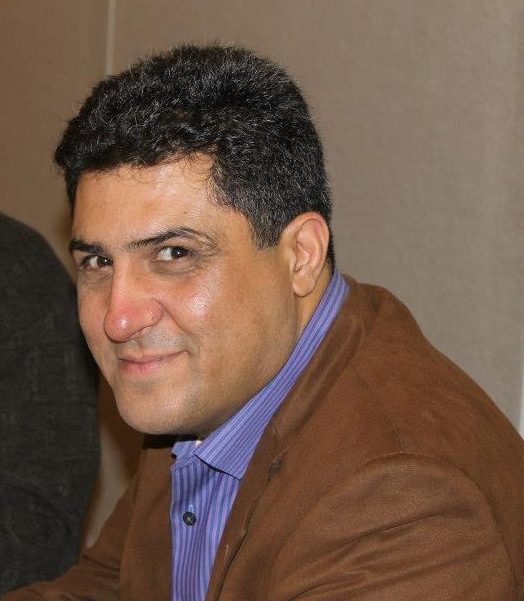
Independent labor movement from party and government in the international arena; in conversation with Mehdi Kuhestani Nejad/ Ali Kalaii.
This is a caption
این یک عنوان است
This is a caption.
Conversation with Ali Kalai
Mehdi Kuhestani Nezhad is an active worker residing in Canada who has been involved in the labor field both inside and outside of Iran for many years. We sat down with Mr. Kuhestani Nezhad to discuss the situation of the labor movement in Iran on an international level, and our conversation also delved into the realm of theoretical labor issues.
He, who is the national representative of the Canadian Workers’ Union, in a conversation with the peace line, talked about what activists outside of Iran can do to help the labor movement in Iran. He emphasized that the labor movement must be independent from the political movement and if there is a relationship, it is the labor movement that should have an impact on the political movement, not the other way around. He strongly stated that he does not believe “any government” can help the workers in Iran, but stressed the importance of linking the labor movement in Iran with similar labor movements that have gone through stages such as Korea, Palestine, Ireland, Colombia, and similar countries.
Mr. Koohsani Nezhad also spoke in this conversation about what he called the achievements of Haft Tapeh and Ahvaz Steel and explained his reasons for his perspective and opinion.
The explanation of the peace talks with this labor activist is passing below from your perspective.
In your opinion, why are labor protests in Iran not reflected much in international media?
This issue can be looked at from several angles. Firstly, there is a lack of necessary coordination between defenders of workers’ rights, and secondly, the political issues in our society and country do not align with the international conditions. This means that if you compare workers’ protests in Iran with those in Arab and African countries, the number may be higher in Iran, but they have not received the same attention. There are different reasons for this. One is the competition and weakness of social forces outside of the country. Another is the dispersion and division that exists among ourselves. The third reason is related to our weak foreign relations. And most importantly, we prioritize our internal issues over the existing situation. Between the late 1990s and the mid-1970s, we see that the majority of our workers’ protests were covered by the People’s Mujahedin of Iran organization. The reason for this is that this organization had broader foreign relations and had worked on these issues. After this period
In fact, the labor movement in the international arena has become oppressed due to the “political” role and function of the government and opposition. The political perspective, which has been more monologue than dialogue, has hindered the improvement of the working class situation. In some countries such as Korea, the Philippines, Mexico, and Colombia, the labor movement has an impact on the political movement, but in our country, the opposite is true.
The reality is that there are many stars within our country, but these stars do not align in a system and are separated from each other. The government can easily identify them and eliminate them through various methods.
If we want to mention the peak of our labor movement on the international stage, it is related to the years 1381 to 1388 SH and then gradually declines until we reach a new period; after the nationwide protests of December 2017. During this period, both Persian and non-Persian newspapers focused more on labor issues in Iran, but we have not been able to accurately reflect the reality of our labor society. The reason is that they have not been able to separate political issues from labor issues and these weaknesses have been dominant.
This trend is even evident in terms of international support. In fact, international unions are less likely to show solidarity with striking workers. For example, in the case of the truck drivers’ strike in Iran, which was widespread and unprecedented, we saw less international support. Do you know the reason for this?
Of course, I think they treated the truck drivers well. The Transport Confederation at its congress in October practically passed a resolution in defense of truck drivers and truck drivers in Iran, and this was a golden leaf for us, but it is not enough. The reason for this was that the issue of truck driver workers was raised, but due to suppression, only through the virtual world should be followed and even the possibility of investigating whether all the detainees have been released? What happened to the so-called death sentences? Mr. Jafaridolatabadi (Tehran’s public and revolutionary prosecutor) announced that he wants to punish or execute 17 of them, which was a big shock for the international movement. If you compare it with 1383 and the famous Saghez case, at that time a lot of effort was made to show how our courts treat workers. At that time, unions were actually present in that field and in a specialized manner. There was a time when
These confederations also try not to interfere in each other’s work. The issue of how the relevant labor institutions in each field can come together in Iran is also a problem. We see that even these independent organizations within the country, if they had joint programs for the first of May and issued joint resolutions, today they have become less active. This is a group that needs to be considered and seen what the solution is.
We have often seen that many newspapers from different countries contact us and say that we want to report on such and such person. That’s when we see them working very actively. Even in labor unions, especially the Confederation of Trade Unions in England, they have their own representative in Amnesty International who works with other unions and has their own annual reports.
Keep in mind that Iran is among the top 10 countries in the past 20 years with the most severe treatment of workers, as reported by annual reports from organizations such as the International Confederation of Free Trade Unions. Despite this, we have been able to effectively address more labor issues. We have been witnessing for years that there are individuals interested in labor issues, but those who are able to translate from English to Farsi or vice versa are very few. As a result, our own weakness in this regard also affects us.
You said that labor confederations do not interfere in work. What is the reason for this? Do they have a fear of politicizing the issue?
The reason for their lack of involvement is that they have become more specialized. This means that when you talk about the workers of Haft Tapeh, the Food Confederation knows from what angle to carry out its activities and must employ a policy that fulfills the demands of the workers.
Iranian workers in several areas are seeking help from labor unions; issues such as the freedom of detained workers, return to work, fighting against economic mafia, the right to union recognition, the right to strike, abolishment of discrimination, and abolishment of child labor.
Confederations also need to organize their own members. Of course, they have also paid for the Iranian workers. For example, in 1386, when several calls were made to arrest the head of the single company’s union – who was in prison at the time – Hong Kong confederation workers poured into the Iranian embassy, were arrested, and went back and forth to court for years.
You mentioned in the midst of your conversations that recently, even cooperation among labor organizations has decreased, even for events like the first of the month. What do you think is the reason for this and what has happened within the labor movement in Iran?
The issue revolves around different tendencies and desires of labor that are not related to today and yesterday. When we talk about different tendencies, it is related to both inside and outside the country, as well as between domestic and foreign forces.
The labor movement inside the country in the 1980s was mostly seeking independent organization and we saw that this issue was met with severe suppression. Well, when they see that they are being suppressed, they are forced to change tactics. We need to see how the institutional tactics that come from within the work environment but do not have the right to work within that environment can move forward. We have also made differences since 1388 and under the influence of the conditions of that period. Our social movement has also changed. Conditions have also changed compared to 1383 and 1384. At that time, labor unions had their own forces and also faced many blows. For example, in the strike of a single company on January 24, 1384, 700 people were arrested and paid the price. 60 of these individuals were active until the end of the 1980s. Some continued until the 1990s to be able to return to work. Some retired and
The point here is that our society is in a crisis, but it is not in a revolutionary state and some people take this into consideration. However, unfortunately, the foreign forces that want to help our labor movement assume the conditions to be revolutionary. Revolutionary conditions require its own forces. This labor movement must solve this issue within itself, that is, in what conditions are we progressing. Tactics must be based on this and move forward accordingly. However, these tactics have not been able to create a balance between internal and external factors. Because when we have specific conditions outside the country, we are forced to act based on our own history and activities, and when we see that our desires and interests do not align with reality, we act in the opposite direction.
Inside the country, there is also a difference of opinion as to whether the conditions we are in are fundamental changes or if we must fight for our achievements, or more importantly, if our fight is towards fundamental change. For example, those outside of Iran say that these achievements are defensive, for the rights of the oppressed and not for the progress of the working class. They do not consider that the government’s tactic is to send forces to fight against erosion and defensive conditions, not attack. What we see outside is a reflection of external conditions and is not separate from it. These organizations also know from within what angle they can move their work forward. On the other hand, we are dealing with a government that accuses protesting workers of disturbing public opinion and having connections with foreigners, and has raised the cost of the struggle significantly.
Do Iranian workers have access to tools at an international level that they can use?
In my opinion, we have had powerful tools for years, but we need more help in terms of how to use them. Being alongside other social movements in other countries and using international laws are important issues. For example, the biggest labor case, which is the 2525 case, has been ongoing since August 2005. We have these capabilities, but we have only made limited use of them and naturally, this is not enough. We need to enhance these tools and not be content with what we have. For instance, why couldn’t we bring the International Bar Association with us? We should not just think that the World Trade Organization or the International Confederation of Trade Unions or its affiliated confederations are the only helpful tools. We need to compensate for our own weaknesses.
I emphasize that no government can help the workers of Iran. However, there are many international social institutions that we can seek help from and cooperate with. For example, we see that the biggest supporter of the workers’ movement in Iran is the Palestinian workers’ movement. This means that wherever they want to push a resolution, they must first consult with the Palestinians. The reason for this is that when we tell the Palestinians, we have brought the Arab countries with us. In any case, they also have their own internal issues. When we want to pass a resolution for truck drivers, the Korean unions are among the first supporters and are closer to our workers. In Europe, the Irish provide the most help due to similar conditions. The Colombian unions also help in the same way. What I understand and read as a labor activist is the solidarity of the workers’ movement at the international level, especially in countries that have had similar conditions to ours. We must strengthen these connections and see how the social movements
You believe that in Iran, the political movement has an impact on the labor movement, not the other way around. What do you think is the reason for that?
The historical structure of our country is as follows. In the 1320s, our labor unions formed the Mass Party. In the 1950s, political parties also played a fundamental role in our labor activities. However, the reason why we have not been able to separate these two is related to political and social issues. But the recent focus of the labor movement has been more on working independently from class. In the past fifteen years, the idea of an independent labor organization separate from political parties and the government has been raised, as it has been realized that when a political party forms labor organizations, they become dependent on that party. Instead, it should be the other way around, with the political party being dependent on the labor organizations. If you look at advanced countries like Canada, you will see that, for example, in 1956, the same congress that I am active in was actually the founder of the Socialist Party of Canada. But even today, I have not participated in
The difference between us is from this angle. Our civil society has not yet formed. We may imagine Iran as a country based on capitalism, but we are plagued by a structure of political despotism and this political despotism has had its own effects, which are evident in labor struggles. However, today in the labor movement, there is an independent organization separate from parties and the government, and the reason for this is that they do not want to be dependent on parties or issues like these. The working class of Iran demands public ownership and promotes the rejection of privatization. We are somewhat caught in the gap of this process and we must ask why we have not been able to separate these two – labor issues from political issues. This is the weakness of our labor movement and it has actually had an indirect impact. In the meeting of the workers in Burma and in the presence of 38 organizations sitting behind the table, we see that not even one person speaks against the others. But if
In advanced countries, they bring up the term “political inclination” in labor issues and call it labor organization, asking from which angle I can work and help. But in Iran, it is not like this.
Does the Iranian government have membership in any international organizations related to labor issues? If it does, what responsibilities does it have?
The government of Iran is a member. We have two global confederations. One is the International Trade Union Confederation (ITUC) and the other is the World Federation of Trade Unions (WFTU), also known as the former Eastern Bloc. In this second confederation, Iran’s representative, Alireza Mahjoub, serves as deputy and vice president. One of our main problems is that the confederation that comes from a leftist position and should be more sensitive to the issues of Iranian workers, but because Iran is involved in “anti-imperialist” movements in international relations, it has acted in this way. The Workers’ House provides financial assistance to the institution, and that confederation also supports Iran more than others.
Mr. Koohistani, why do recent labor protests in Iran, including the protests of the Seven Hills sugar workers, end without achieving any of the workers’ demands?
See, we have a complex economic structure. In the past three years, the private sector responsible for the seven hills has been working. The seven hills are lands with very good irrigation and many people have their eyes on these lands. Two years ago, they started digging to build a refinery because these lands have gas and oil. In my opinion, this was part of the process of destroying the seven hills. Many people don’t like to admit that this part of Iran’s economy is weak and cannot be profitable, so they want to destroy it. The seven hills are an institution that had the highest economic profit in 85 and 86, but suddenly started to decline in 86. Then in the 90s, they gave it to the private sector and later brought up the issue of using gas. In my opinion, there are institutions behind this that want to destroy it, and I say that this institution is the Revolutionary Guards.
The Sepah is an economic institution that is not willing to work for anything in the country. Look at any part of the country and you will see the Sepah playing a role. They have ports, airports, and can import goods from anywhere they want. They pay no taxes, report to no one, and are not accountable. They not only want to destroy the Haft Tapeh Steel Plant, but also Ahvaz Steel Plant which was profitable with a 30% profit until a few years ago. The reason for this approach by the Sepah is that as an economic institution, it doesn’t matter to them what gets destroyed. They say we will go and import. This is the same corrupt economy that has been operating in the country for 40 years.
Even we have witnessed that in recent years, most of the arrests are carried out by the intelligence of the Revolutionary Guards. The Revolutionary Guards arrest because they know how to destroy them; they destroy one with bribery, another with suppression, and another with other methods so that no one speaks up about these matters.
But regarding Haft Tappeh and Ahvaz Steel, my opinion is not that the workers have returned to work without any achievements. In my opinion, the workers are in the process of regaining their strength and organizing themselves to continue their struggles. You see, there is a season for reaping the reed, and if you don’t reap it in that season, the reed will be lost. When the Haft Tappeh workers saw that the reeds were disappearing, considering that the worker is passionate about their work and the land they work on is their sanctuary and they are committed to it, this worker was forced to not let these reeds disappear. Those who wanted these reeds to disappear caused trouble. One side was the Karkeh newspaper and the other side was the Sepah newspapers. Government institutions were looking for the strike to continue and were not doing anything. Because they wanted to destroy this complex. The worker who returned to work was not looking to return to
What is your solution for workers in Iran who will protest and strike in the future to achieve their labor rights? What do you think supervisors can do in regards to the existing capacities?
I am not in a position to offer suggestions to Iranian workers. We have 6 to 7 thousand worker protests in Iran. These protests are very creative, they choose their own slogans, and they know how to advance their struggles. If we assume that each of these 6 to 7 thousand protests is organized by 5 people, we now have about 40 thousand serious organizers of worker protests in the country. We need to see how we can help them and what angle they need our help from. In my opinion, we have a good labor movement that no one wants to talk about. I think if this labor movement grows and can stand on its own, it can bring about great changes in the region. That’s why I believe there is no other solution for our workforce. Perhaps the government can suppress it, retreat and arrest its leaders, but it cannot silence the public spirit of the society. The public spirit of our society follows its own path. It has its ups and downs
Thank you for the time you have dedicated to the peace process.
 By: Ali Kalaei
 December 22, 2018
Tags
Ahvaz Steel Ali Kala'i Mehdi Kuhestani Nezhad Monthly Peace Line Magazine peace line Privatization Sugar Seven Hills پیمان صلح خصوصیسازی ماهنامه خط صلح ماهنامه خط صلح