


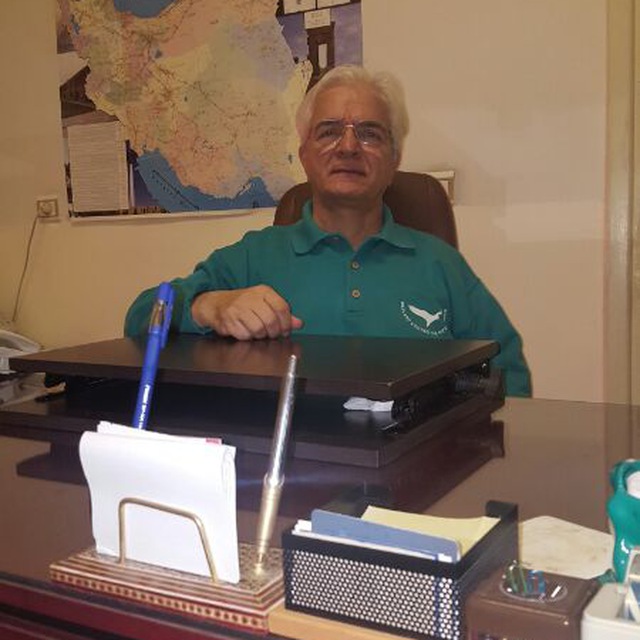
Dr. Behran Riazi: Destruction of nature is harmful/ Ali Kalai
“این عکس یک جوان زیبا را نشان می دهد”
This picture shows a beautiful young person.
Conversation with Ali Kalai
Recent floods have taken many victims in various parts of the country. Both from the land and from fellow citizens. Both their lives and their belongings. The flood, as usual, shocked crisis management centers and they struggled to handle and manage the crisis, but it seems that the flood managed them.
But what happened that this flood with such dimensions occurred and affected several provinces of the country? What were the scientific and theoretical reasons for it? What has happened to the soil and vegetation cover in Iran that provides the basis for such a flood? There are many questions in this regard, but in a space where speculation is rampant, finding scientific and knowledge-based answers is not easy. However, our efforts have paid off and we were able to reach an agreement to have a conversation with Dr. Behrouz Riyazi, a PhD in environmental management, a university professor, researcher, and environmental expert, about the flood and the environmental situation of the country.
Dr. Riazi, however, does not consider the rainfall as the sole reason for this flood and says that “the excessive rainfall has exacerbated the situation.” He counts the destruction of vegetation as the main cause. We also raised this question with the university professor, why are we not only facing water? Why so much mud? And he told us about the destruction of soil in Iran. That, for example, all that used to exist as first-class pasture in Iran, no longer exists and today there is no trace of it in Iran.
This retired professor of the Environmental Organization also spoke about managing the current situation in terms of peace, saying, “At least 20 years of proper management in nature should be done and we must refrain from destruction, so that if we have such a disaster in 20 years, we will be safe. We have been constantly destroying for years; nature will take revenge in this way.”
According to Dr. Riyazi, who has a background in CEO, chairmanship of the board, and founding board of several environmental institutions: “We live in a dry and semi-arid region, where unpredictability in precipitation is a norm. This means that there may be a period of drought for several years (3 to 4 years) and suddenly, in a period of, for example, 2 years, we may experience heavy and consecutive rainfall. These are the characteristics of our land and we are aware of them; however, a management system based on this reality does not exist in our country.”
The following is a description of the conversation with Dr. Behrouz Riazi from your perspective:
In your opinion, what was the main reason for the recent floods in Iran?
The main cause of the excessive and unusual rainfall has been the lack of necessary precautions, especially if the destruction of vegetation cover had not occurred and the forests were not only in name, but truly forests, such damage would not have occurred. In other words, we would have had floods regardless, but they would have been brief and not caused such high levels of destruction.
In fact, the excessive rainfall has been exacerbated by our actions. When we completely destroyed the vegetation cover on the ground by grazing, dry farming of grains, and other forms of destruction in the Zagros region, we caused the flood to occur. In addition, both the inside and the banks of the rivers have been encroached upon. The main rivers have a 150-meter buffer zone on both sides. According to the law, this buffer zone is considered as the home and the river’s territory, and nothing should be built in this area. However, all of these buffer zones have been closed and built upon. Well, when we destroyed the forests, removed the vegetation cover on the ground, exposed the soil, and dry farmed on low-yield deltas – which are plowed along the slope – it is clear that with such heavy rainfall and downpours, the soil will be washed away. If there was only water instead of soil, there wouldn’t be so much damage.
Mr. Doctor, how much has the geographical situation of the region, such as the existence of moon hills (for example, in Lorestan province), affected the formation of this clay, and to what extent have human destructive activities, such as deforestation, played a role?
The average annual rainfall in all of these regions – meaning western Iran – is over 400 millimeters; from Azerbaijan to Kurdistan, Lorestan, and Kohgiluyeh and Boyer-Ahmad. This amount of rainfall causes even in places where there are no forests, there is still first-class pasture (where the soil has 100% plant coverage). In recent years, there has been more serious destruction. All lands, even those that were once rocky or hilly, have been plowed and used for dry farming. It can be said that this dry farming, from a national and country-wide perspective – and not from the perspective of someone who sees nature as ownerless – has no added value and no economic justification. In order to grow wheat or barley, we may not even harvest one ton per hectare. But this has led to the exposure of the soil in past decades and the easy washing away of the soil by rain. Now we no longer have any first-class pasture in
To what extent can we reduce the consequences of natural disasters by avoiding changes in the ecosystem, such as destruction of vegetation or preventive measures?
This is not something that can be done today or tomorrow. We cannot prevent or have immediate treatment for these incidents. At least 20 years of proper management in nature must be done and we must stop destruction, so that if we have such a downpour in 20 years, we will be safe. We have been constantly destroying for years; nature will take revenge in this way.
Where should strategic management be in the hands of an institution or organization?
When floods and earthquakes occur, the risk of people being harmed and becoming unfortunate is high; therefore, crisis management is needed. However, in my opinion, this disaster is not purely natural and a large portion of it is due to the destruction caused by human activities over the years. In a scientific approach to such a disaster, we are dealing with a multi-disciplinary issue. In my opinion, in the occurrence of this disaster, the responsible parties include the Forests and Rangelands Organization, the Environmental Protection Organization, the Ministry of Energy, and all other organizations that may not seem to have a role in the current situation; because for years, they have not properly managed nature and have been negligent.
What reforms need to be made in the construction system, crisis management, or aid protocols to reduce vulnerability to such incidents in the country?
From my perspective, what is hidden and unfortunately not paid enough attention to is the issue of environmental destruction. If we want to prevent such incidents, we must stop the factors behind them. We are losing our forests, pastures, and everything is becoming bare and uncovered. The protection of rivers has not been considered. For example, there should be no structures within 150 meters of major rivers such as Karkeh, Zayandeh, Karun, etc.; but construction has taken place. Therefore, we have not respected anything and in fact, we have destroyed the home of the river. In regards to such a tragedy, we must investigate to what extent it is natural. I believe that a large portion of this disaster is “anthropogenic” and “human-made” rather than “natural.”
It means that you believe a large part of this tragedy in the country is unnatural and caused by violations of existing protocols in the country.
Exactly. We have not followed any of the regulations and rules that we have. Why is the uncontrolled grazing of livestock an issue? When the carrying capacity of the environment for sheep and goats is 4 or 5 times higher, when it is assumed that grazing should only be done for a maximum of 100 days, why is it done every day of the year? When, due to natural factors, the forests have become dry and infested, we are essentially destroying all vegetation cover and leaving the land defenseless. This leads to soil erosion and disasters. It is obvious that building around rivers will have such consequences.
In 96, we had an earthquake in Kermanshah, and now we have floods in the country. However, there are some crisis management protocols in place; how much could the precise implementation of these protocols reduce the damages of these events?
We must have a contingency plan for every situation, such as floods and earthquakes. We do not have such a plan in place. It is true that these events are not entirely natural and human intervention plays a role, but the discussion of crisis management is still relevant.
A key point that is often overlooked about the recent flood is the extent to which it is caused by human factors. How much of it is due to environmental destruction? We live in a dry and semi-dry region, where irregularity in rainfall is a norm. This means that there may be periods of drought (3 to 4 years) followed by sudden heavy rainfall in a short period of time (e.g. 2 years). These are characteristics of our land that we are aware of, but there is no management based on this reality in our country.
For example, regarding what happened in Shiraz, the issue was that they had built a parking lot inside the river. This is a very ridiculous issue and a simple mistake. Furthermore, in other places, we have destroyed nature and eliminated the vegetation cover, which actually acts as a barrier for heavy rains and flash floods, and helps water to seep into the ground and nourish underground water sources. We have destroyed it. We have had similar rains or storms before, it is the nature of our land, but such events have not occurred on this scale. This tells us that destructive interventions have been the cause of these floods.
What is the role of public awareness in relation to environmental issues? If people are more knowledgeable in these areas, what differences will we see?
It is clear that informing people about all environmental and natural issues is very important, but ultimately it is the responsibility of the government. When they do not control the reasons for livestock and farming, in these circumstances, a villager or nomad sees that if he does not destroy, someone else will come and destroy, he does not care anymore. When they pass laws that anyone who plows a land can get a deed for it, they are rewarding the destroyer. In such circumstances, what can we expect from people? In fact, raising awareness among the general public requires that officials be aware and not engage in destructive actions; which they are doing. We have regulations that even say go plow in the forest and plant wheat and expose the land! These clearly destroy biodiversity and vegetation cover and cause great environmental damage.
The question that is being raised a lot these days is about drought and fear. Can we say that we have entered a state of fear?
The characteristic of dry land is irregularity in rainfall. The drier the land, the more irregular the rainfall, and vice versa. For example, in the tropical forests of Brazil, the rainfall is so orderly that even the difference in rainfall between different years is only one or two percent. There, we even have a daily climate pattern, meaning it is predictable when it will rain and when it won’t. But as we move towards dry regions, we see a decrease in this orderliness and witness irregularity. Therefore, it is impossible to predict scientifically whether we will have a wet year or a sudden severe drought in the next few years. The inherent characteristic of dry regions is irregularity in rainfall, and the occurrence of wet or dry years cannot be predicted. This has been the case since ancient times, and there are references to it in stories and old tales, such as in the story of Joseph in the Quran where he mentions seven years of drought and seven years of abundance. This is
The year in Damascus was so dry.
“That friends have forgotten love.”
The sky became stingy towards the earth.
“They did not wet their lips for planting crops and palm trees.”
“Enjoy the ancient springs”
Nothing remains, except the tears of an orphan.
I am nothing but a widow’s sigh.
If you open the window, smoke will come out.
Or it is a fact that in the history, in Isfahan, Yazd and Kerman, many people died due to drought and after that there have been several years of famine. Our problem is that we do not follow these patterns. Management should be based on dry regions. Our current management, which is implemented in the country, operates in the same way in Yazd, Kerman and Isfahan as it does in Gilan and Mazandaran. We must behave scientifically and think about the necessary measures based on the fact that our land is dry and unpredictable. And again, I emphasize that we should refrain from destroying nature.
According to your reference, this amount of precipitation is natural and has little to do with climate change and global warming?
If it has even a little, it means it doesn’t even reach 10% and more than 90% is attributed to the nature of this region.
Do you confirm the exposure of public media, especially radio and television, to recent floods or similar phenomena? How should we deal with this issue (raising public awareness, disseminating news, etc.)?
In any case, it could have been done much better. My emphasis and point is that this crisis could have been avoided, or if it did happen, it wouldn’t have had such dimensions.
I also agree that there should have been more awareness; especially in the first few days, this was not done enough. Of course, now they are exaggerating a bit; for example, they have issued severe warnings to all southern provinces. While the situation may not be the same in some provinces. In fact, instead of being realistic, fear is involved in this issue. In any case, we must be able to look at the land with a scientific perspective, but unfortunately, the main issue for us has become greed, exploitation, and indifference towards nature, and we have the least importance and respect for ecological and natural laws.
Thank you for the time you have given to the peace line.
 Created By: Ali Kalaei
 April 21, 2019
Tags
Ali Kala'i Crisis management Drought Flood Mathematical proof Monthly Peace Line Magazine peace line پیمان صلح ماهنامه خط صلح ماهنامه خط صلح