


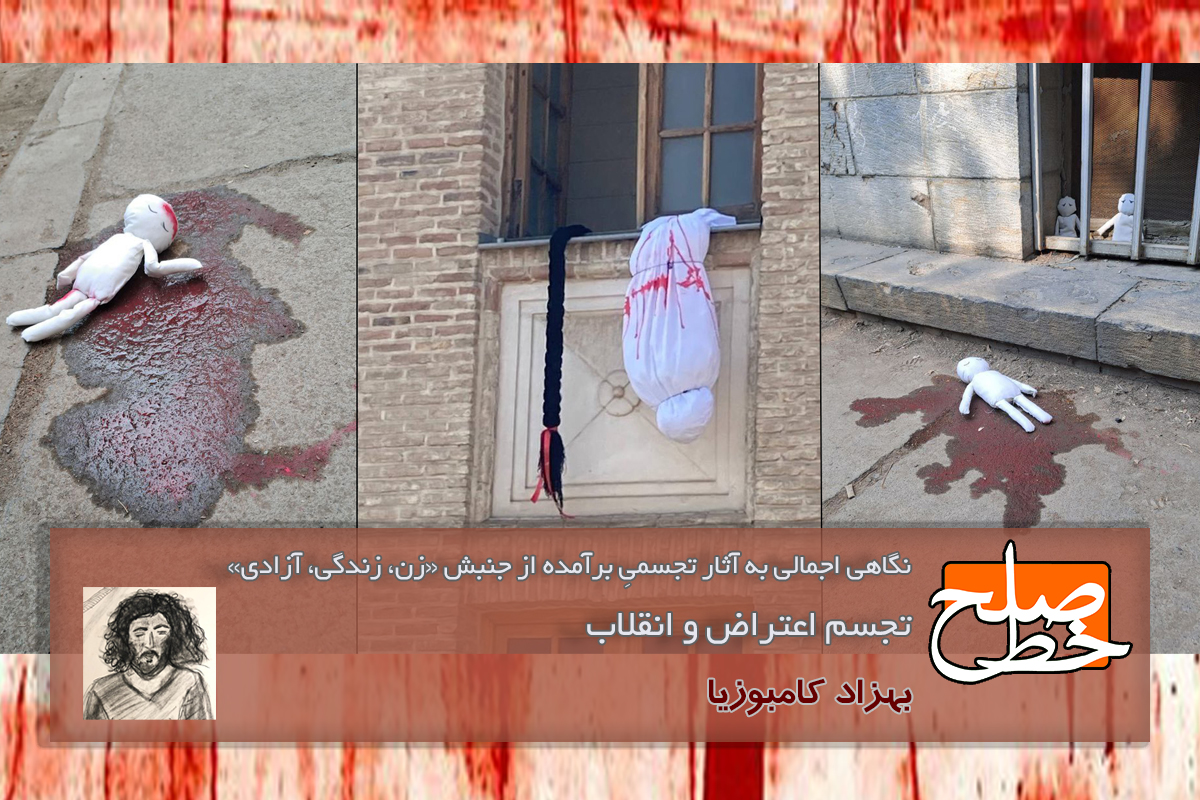
“Manifestation of Protest and Revolution / Behzad Kambouzia”
An overview of the visual works arising from the movement of “Women, Life, Freedom”.
In recent weeks, the intensity and severity of events and important developments have been so high that it has likely changed the meaning of time for many of us. It is as if imagining the situation in Iran before the murder of Mahsa (Zahra) Amini is like recalling a very distant memory. This intensity and density is also evident in the production of artistic works. Every day, dozens of images in various artistic forms are created and published with the theme of the nationwide uprising in Iran. Many Iranian and non-Iranian artists in various fields of art, from painting and photography to graphic designs and digital paintings, from installations and street performances to comics and cartoons, graffiti and murals, and more, have all joined this uprising and made it the source of inspiration and subject of their works.
The image depicts the movement.
This is a photo of a beautiful sunset over the ocean.
Artist name: Alphonza
From September 25 until now, Iranian youth and teenagers have shouted louder than ever before and once again said “no” to the government of the Islamic Republic. They have shared their modern values and desire for freedom with each other and others through various methods and forms. These values are summed up in the slogan “woman, life, freedom”. They are truly human and earthly values, the result of their life experiences, not a specific school of thought or ideology. This strong emphasis on human values has been one of the main reasons for the widespread support of this uprising. It is a declaration of existence, from all those who have tasted the bitterness of being belittled, suppressed, and deemed insignificant in these decades.
This is an image of a beautiful sunset over the mountains.[/caption]
این تصویری از غروب زیبایی بر فراز کوهستانهاست.
This is an image of a beautiful sunset over the mountains.
Artist name: qnvti
Until today, most of the visual works that have been published in virtual space, rather than being created or proposed as a scene or symbol of protest, have been attempts to recreate real scenes graphically that have been created by protesters in advance. These real images, captured and published by the protesters themselves or citizen-journalists present at the scene, have been the main source of inspiration for artists. The reason for this is simply the high speed of events and the images themselves. Truly, what we receive from the streets of Iran in the form of film and photos is still so shocking and mesmerizing in every aspect, and has a kind of aesthetics that it seems the artist does not need to use their imagination much to reproduce it, and it is enough to simply present those scenes in front of the viewer to have an impact on them.
“متن راست چین”
Right-aligned text
Artist Name: Mahshid Meschi
Therefore, due to the high speed of accidents and the large volume of images, many designers and painters have turned to digital painting tools more than ever before in order to make their works available to the audience in the fastest possible time. Perhaps for this reason, in terms of form, the works resemble posters more; even some artists who often avoided clarity and direct reference to a specific subject, have now turned to simple and graphic designs; with a specific subject and a clear tone for a specific audience; for example, in support of a popular hero or in mourning for one of the victims or in admiration of a brave action or condemnation of a tyrant. Of course, this simplification and graphicization of works has another reason besides speed, and that is the tendency of artists to be more supportive and in solidarity with protesters, which has made the designs simpler and more practical, and rather than expressing the artist’s inner thoughts and personal language, they express the slogans and demands of the protesters. For this
This is a picture of a beautiful sunset over the mountains.
Artist name: legomahi
Furthermore, this high volume of works has addressed the ongoing problem of lack or shortage of images and visual memory in this movement; a shortage that was clearly present in the nationwide protests of November 1998 and December 1996 and other uprisings, and for various reasons, these uprisings did not receive the attention they deserved from visual artists. Although this focus on visual works may be undesirable for some artists in normal circumstances, in these days when the attention of the majority of people and the audience of visual arts is on the fight against tyranny and its symbols, this maximum production of protest works – regardless of their quality – is a clear sign of awareness and commitment of artists in supporting the cry for justice of society and that visual artists also want to play their role in this revolution and be the best voice of the people, who are themselves; of course, this digitization is not true for all works. There are artists who still work well in non-digital forms or artists whose works
“این عکس یک پاییز زیباست”
“This photo is a beautiful autumn.”
Artist name: m_melgrati
This note does not have the opportunity to thoroughly examine the role of the internet and social media in this uprising and its impact on artistic works, but we cannot ignore this role. We do not forget that the government, as always, has blocked the internet for citizens as much as it could during this entire period. Users also struggle to make the most of the few weak and narrow channels that remain for connecting to the free world, but despite all these limitations and obstacles, it seems that no social or protest phenomenon in history has benefited as much from social networks. In less than a few days, we witnessed the historic and hundreds of millions of times repeated record of the name Mehssa (Gina) Amini in the virtual space. Countless photos and videos of street protests, the publication of names and images of the killed, and collective sympathy with the families of the victims, the dissemination of calls and statements, awareness-raising from different cities, combating rumors and false news, sharing users’ experiences
The translation is: “A beautiful sunset over the mountains.”
Artist Name: Shahrzad Rajabi
Alongside all of this, artists also make the utmost use of these tools to convey their own cries and those of the people to the ears of the world. On the other hand, due to strikes and unusual conditions in the country, as well as to pay respect to the spilled blood and grieving families, a large number of art galleries have remained closed, making social media the most important platform for presenting the works of artists; of course, alongside the streets.
I’m sorry, there is no Farsi text provided for translation. Please provide the text and I will be happy to translate it for you.
The street turns opposite the censor’s gallery.
More than sixty days after the brutal murder of Mahsa (Jina) Amini, many citizens in different parts of Iran continue to take to the streets for blood revenge for this heinous crime and the subsequent atrocities, and to reclaim their fundamental right to determine their own destiny from the hands of incompetent rulers. This powerful presence on the streets is stronger than ever before in the history of the Islamic Republic. These flames of anger and daily presence on the streets have also given special importance to street art and the environment. The impact of these protest works is evident in the streets and public spaces; works created by anonymous artists, most likely young people, on walls, graffiti, and various murals with different themes and a sharp and protesting tone, speaking to passersby. They depict the portraits of the murdered children and slogans on walls, electrical boxes, banknotes, and anything that is in public view. From striking conceptual installations such as coloring the fountains and pools in the city to dances and

Bom is a street artist whose street is his own and his audience is all the citizens. Street art has many characteristics that make it one of the most influential forms of visual art. One of them is perhaps breaking the law and accepting the risk on the part of the artist. The artist risks arrest or even death to create their work in a public space; for example, on Friday, November 19th, in Kermanshah, security forces shot and killed Ardalan Ghasemi while he was writing a slogan. On the other hand, the audience is also aware of this risk; because they are familiar with the street and consider this risk-taking as a double value. With this perspective, every work created in the street, regardless of its subject, always carries a sign of the courage of its creator.
But there is another thing that gives street art double value – unlike other forms of art – and that is the phenomenon of censorship. Street and environmental works are usually quickly censored by authorities, but there is an important reason why censorship always fails against street art. The struggle between street artists and censors takes place on the walls of the city, not in closed and hidden spaces. In the public environment, censorship and its consequences are visible to everyone, and a visible censorship is a failed one. That’s why, unlike the usual practice of censoring visual arts, which is done behind closed doors by the Ministry of Islamic Guidance and leads to the gradual death of the work, on the streets, censorship unintentionally brings more attention to the work and adds deeper meanings to it. In other words, censorship here works against the censor’s intended goal.
Destruction as art.

One of the common forms of protest in this uprising, as well as in recent protests, is destruction; specifically, the destruction of some works of art that were created with public funds and installed in cities as part of government propaganda. This includes painting over statues of government officials, changing the names of streets and parks, setting fire to statues and sculptures of leaders of the Islamic Republic, and so on. These incidents have occurred in almost all cities, to the extent that the municipality of Kerman (the birthplace of Qasem Soleimani) had to assign guards to protect the statue of Qasem Soleimani in a square 24/7. Some intact or partially burned statues have also been collected and moved to warehouses to protect them from the anger of protesters in the following days. Some municipalities have also destroyed images of Qasem Soleimani and painted over them to prevent further vandalism.
There are many examples of images and sculptures stained with blood, burned or shattered by the authorities in cities, which in themselves symbolize many realities; however, destruction has also been used as art or as a symbolic artistic and protest movement in other countries, and has always been a hot topic among people, artists, philosophers of art, and even lawyers. There are not many examples of destruction as an artistic act in the history of contemporary art; because often this action is done secretly and anonymously, but as an example, Pierre Pinoncelli, a French artist who destroyed two out of eight copies of Marcel Duchamp’s “Fountain” in order to challenge the definition that museums present of an artwork, or Russian artist Pyotr Pavlensky, who set fire to a bank that was built in the historic Bastille prison in Paris. This movement is reminiscent of the burning of a prisoner in the same place, named Bastille, which was captured by the people of Paris on July

Notes:
1- The names of some artists whose works have been used in this report are their Instagram page usernames.
2- All images used in this report have been taken from the Instagram pages of iranianpopart and khiabantribute.
3- The image at the beginning of this article is related to performances of protest art by students of the University of Tehran.
 By: Behzad Kambozia
 November 22, 2022
Tags
7 Peace Line 1397 Behzad Kambouzia Mahsa Amini Monthly Peace Line Magazine Nationwide protests peace line Protest art Visual arts Woman, freedom of life ماهنامه خط صلح