


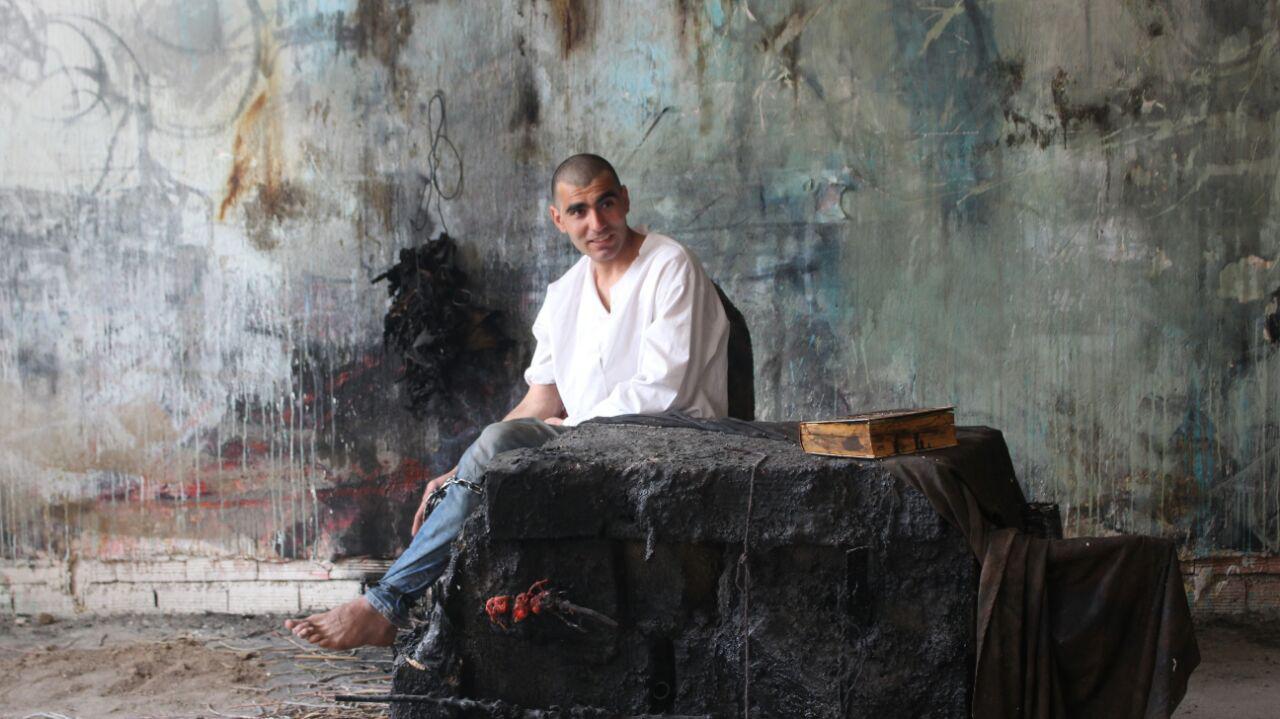
Our nightmare is real; in conversation with Mostafa Parvin, artist from Ardabil/Siavash Khoramgah
This is a caption
“This is a caption”
Siavash Khoramgah
In the month of Ordibehesht of this year, a protest performance titled “Our Nightmare is Ongoing” was carried out in Ardabil, drawing the attention of the audience, especially artists and civil activists. This performance took place in a space that had been transformed into the artist’s home.
Mustafa Parvin, a young artist from Ardabil, reconstructs the layers of violence and domination in his performances. He tries to reveal the hidden layers of violence present in society. Parvin sees art as a means of expressing social issues and believes that artists have a subjective role within society; someone who creates art like an event and does not wait for the flood of events to pass; in other words, they have an impact and are not just passive recipients. In fact, art is not just a concept, but it is itself a driving force in society and if it is on the right path, it can help with the understanding of the public and ultimately contribute to the development of freedom.
It should be noted that despite the cancellation of the permit for his art exhibition by security forces in previous years, in December of last year, he also held an exhibition titled “Evin” at his personal residence in support of political prisoners.
Mustafa Parvin, an artist and civil activist, talks about his art, activities, and motivations in a conversation with the Peace Line.
When and how did you start your artistic activity?
I have been familiar with art since childhood; my brother and I used to design together. At the age of 18, I discovered my passion for design and painting and started working professionally. In this field of art, I have gained a lot of experience and have learned many useful techniques and methods. Most of my works are textile-based; I work experimentally, improvisationally, and freely without any restrictions. According to my audience, my works are emotional, inspiring, impactful, and highly expressive. I am a busy artist and have explored various subjects in styles such as abstract expressionism, expressionism, and more. I always use the visual field as a vast area for my works.
As an artist, do you believe that art has a social mission or not?
Yes, I did not want to stay alone in painting and I wanted to use my whole body and get into the game. It can be said that performance art is the loneliest contemporary medium that has maintained its political nature and its main strain is its political nature. I got involved in this field by knowing it. I also became interested in valuable works of artists who worked in these areas by studying the history of contemporary art, including Futurists, Dadaists, Surrealists, and especially the events of the 1960s (hippies, student movement, black movement, etc.).

With these explanations, what is your definition of a work of art?
Art is the loss of orbit (this is what psychologists have studied), always at its peak and failure. An artist only creates a work of art when they reach a state of loss. The artist is always influenced by their surroundings and environment. I am a part of my own geography. It is this society and its conditions that have shaped me in this way. My own thematic has also helped me in creating my work. Even large parts of my work are dedicated to my surroundings (the city of Yerevan, the Shirvan Valley, the Qaradagh and Hirkan forests, Lake Urmia, etc.). In my opinion, every work of art is a failure and it is in explaining this failure that it takes shape, finds form, and comes to life. The social injustices and injustices that you see, remain in a state of suffocation and emptiness, and this is how you create your work. When I see injustice, my hands and feet tremble and
Can you tell us about the motivation behind your exhibition “Evin” that took place in Azar 97?
I am signing this agreement, not for the sake of an event happening to me, but because it is the duty of a contemporary artist to not only depict human problems and understand them through their art, but also to convey and reflect them accurately. It was a great honor for me to hold an exhibition titled “Evin” at my personal residence on December 9, 2018, in support of political prisoners. The opening ceremony was conducted by Mr. Abbas Lesani, a well-known civil activist from Azerbaijan, who also gave a speech at the event. He is currently on a hunger strike and I am aware that he is suffering from liver disease, stomach ulcers, and a herniated disc. People are worried and anxious about his condition. I urge you to make extra efforts and reflect their voices. I want to say that Mr. Lesani is a role model of courage and bravery for me and others like me. Despite his age, he continues to be on the frontlines
One of your other projects is the performance of “Our Nightmare is Real” in April of this year. What was this performance protesting against?
I have titled my objection against any wrong and violent social phenomenon, especially the overall violation of human rights in Iran. You know that the violation of human rights in Iran has various aspects, including increasing political pressures on ethnic groups, lack of obligation to respect women’s rights, denial of education in mother tongue, issues such as livelihood and economic problems, limitation of equality and freedom, and many other cases.

This performance was prominently characterized by various displays of violence; why?
In its essence, in its entirety, it abstains from violence and is against it, and tries to make the relationship between the individual and the brutality of society apparent. Performance reflects the prevalent and common violence in society and protests against it. As Bertolt Brecht says, art is the reconstruction of reality and this reconstruction is not possible without the use of violence in artistic performance; because society is filled with violence. Due to the dominant culture or authority, this society has been and is subject to violence. That is the exact reality. As I mentioned, I have my own special position because I have different social conditions; you cannot compare this place to Switzerland, France or anywhere else.
The ideology of authoritarianism brings disaster upon civic activists, in order to discourage them from repeating their actions. Despite knowing that I will face consequences for this, it was a very impactful experience for me, and I believe that this act will only gain its true value when I am arrested and accept the cost, whether it be prison or any other punishment. This is pure art and an act of civil disobedience.
Who were your audience members during this performance?
I want to talk about this performance and say that it speaks for itself; from age and race to acts and norms. The majority of the work is explicit and transparent, yet full of metaphor and allusion. I see these acts of violence as a result of the extreme hardship and suffering present in society. Touching reality, my mental images were transformed into artistic experiences. In my opinion, an artist must address the problems of society. This approach shows the artist’s awareness and understanding of the pain of the people and society. Note that my mother, despite her reluctance, agreed to be present among my audience at my insistence, so that even she could understand the severity of the situation in society. An artist should not even alienate a single audience member, especially when the relationship between a mother and child is of increased importance in critical moments. Like a part of the performance where, as I was actually on fire, she ran towards me in fear; although unfortunately this part of the film has been

If there is a point that you would like to mention, please do so.
One of the other advantages that it had, is its silence. There is no speech in the performance; except for the last part where I unintentionally shouted a sentence and that unexpected act happened. The point is that in the end, this performance surprised both the audience and myself. It was a new experience, even in my personal life, and taught me the audacity and artistic role-playing.
A while ago, when I was talking to my audience, they were upset about my burning. Of course, the problem of burning was resolved, but I stayed at home for almost a month. Due to the many restrictions in societies like our country, we cannot perform our shows in public and different places – from streets to special locations. That’s why I am forced to do my work at home. As you know, the permits issued for my work have been revoked several times by security officials.
Thank you for the time you have given to the peace line.
 Created By: Siavash Khoramgah
 June 22, 2019
Tags
Monthly Peace Line Magazine Mustafa Parvin Our nightmare is real. peace line Siavash Khoramgah پیمان صلح ماهنامه خط صلح