


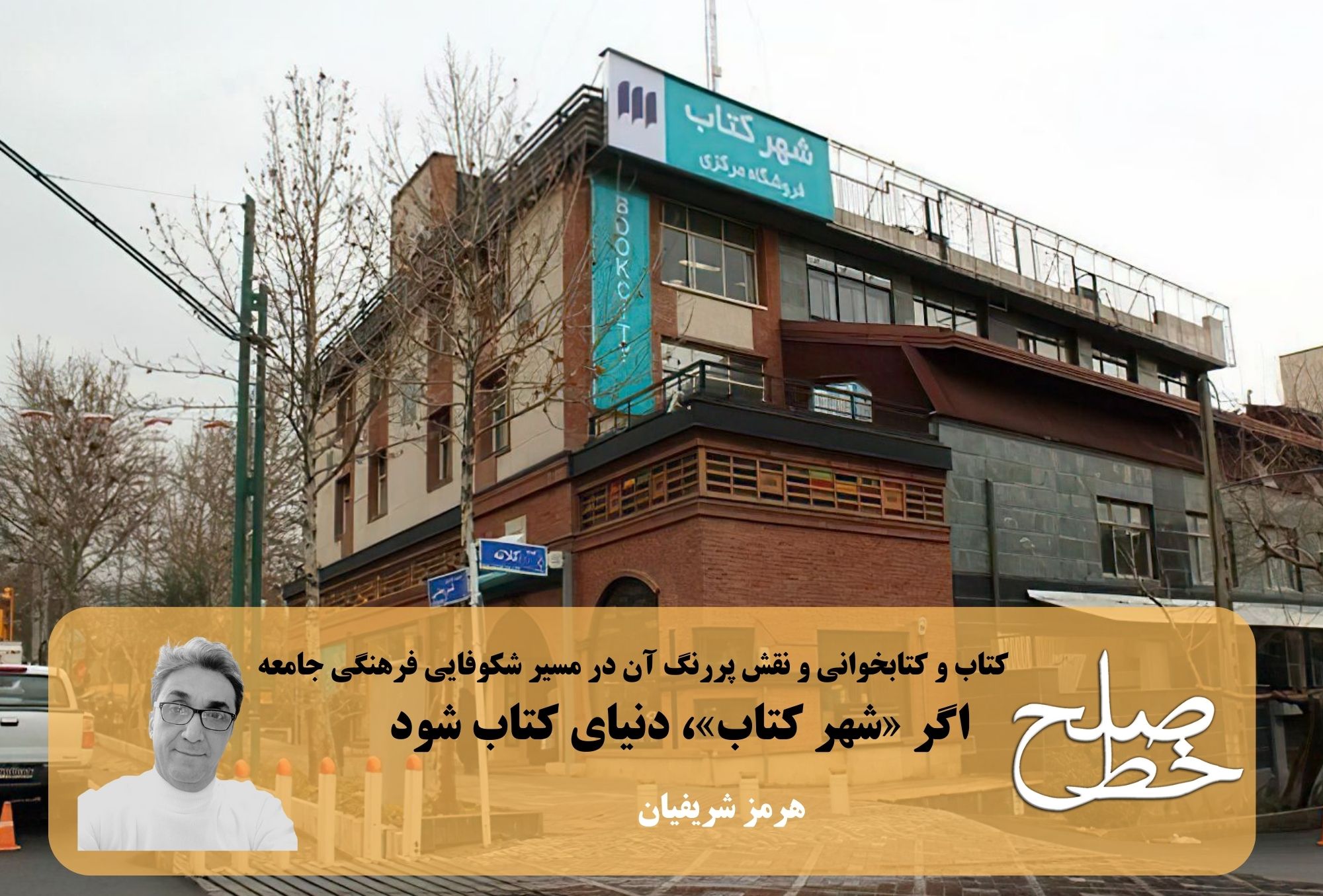
If “City of Books” becomes the world of books/ Hermoz Sharifian
The position and culture of reading books in Iran is so esteemed and respected that parents and teachers in schools, from the very first years of education, introduce books as humans’ best friend and encourage children to read, and of course, they still do so.
Of course, verbal encouragement alone is not enough to establish this desired culture, and other incentives and motivators are necessary for its sustainability.
One of the positive actions that the municipalities of the country, especially Tehran, have taken since the era of the Reform government to strengthen this constructive culture is the establishment of cultural places called “City of Books”. After a while, it spread to other parts of the country and was met with widespread enthusiasm from book lovers and the culture of reading.
Although over time these cultural units have been transformed into economic enterprises and their primary goal of cultural investment has changed to economic benefit, nonetheless, their establishment has greatly aided the promotion of book-loving and reading among citizens.
The community’s bookstores can be a place for families to visit and purchase their favorite books in various fields and age groups. In fact, the city of books has turned into a cultural “supermarket” where families can provide their cultural nourishment by visiting it.
But if we ask the question whether the city of books has been able to play its role in providing cultural nourishment for society – for all segments – the answer is negative.
Naturally, the city of books has had and continues to have a very positive impact on the spread of the culture of reading in the country. However, it is not enough and more financial and cultural support and resources are needed for this already weakened culture to gain more strength and become more effective.
Excessive weakness in the culture of reading books, with a look at its per capita in a country where it is not more than two minutes a day, is a sign of a cultural disaster; a disaster that is manifested in the unfortunate state of publishers and cultural institutions that are involved in book production, and every day we hear news of bankruptcy or job changes for some of them.
The shocking rise in the price of paper and the subsequent significant increase in the price of books is one of the major obstacles for book readers in Iran. The book reading community in Iran, who are mostly from the middle and educated classes, have become poor in terms of culture as much as they have joined the poor class in terms of economic and living conditions. This is because they are forced to remove books from their cultural basket in order to be able to fill their tables with essential necessities.
In addition to the high cost of paper and distribution expenses, “censorship and inspection” is another blade of this scissors that has pushed reading to the margins of people’s daily lives. The lack of permits for some books, both by domestic and foreign authors, is another important factor that has put the printing industry and the profession of publishers at risk and has caused the number of book titles to decrease to a minimum, leaving publishers in a difficult position.
The city of books, however, can still regain its positive and lost role, just like in the past, if the cultural authorities of the country support them and take measures to prevent books from becoming unaffordable. This way, the middle and lower classes of society, who are more inclined towards books and reading, can purchase this cultural product and enrich their intellectual and cultural horizons.
The significant increase in printing and publishing costs has resulted in books becoming a “luxury” commodity in Iran; a product that many readers can only admire by visiting the book city and sadly leaving empty-handed. This bitter occurrence is a common experience for middle and lower class members of society such as journalists, students, teachers, employees, and workers, who leave the book city with regret and empty hands because they cannot afford to purchase their desired books.
Unfavorable economic and living conditions have caused the growth of places like book cities in Iran to slow down or come to a halt, as investors naturally choose to invest in more profitable areas when they see that they can earn more profit.
This is where the government should step in and, with the knowledge that this investment will lead to long-term profitability, take the hands of those who are still standing and help establish such places to not only prevent the progress of this very constructive culture from stopping, but also to accelerate its pace.
Cultural authorities of the country and those related to the field of publishing and books should keep in mind that Iranian society is a diverse community with different tastes and orientations, and book readers should not be expected to think like the managers of this field. Policy makers and managers in this field should be aware that they cannot impose their own opinions on society and expect the tastes of book readers to be the same as those of managers and the government.
Limiting books and reading in the digital age is a futile and pointless policy because enthusiasts of any field can obtain their favorite book in the digital space if they do not have access to it.
More importantly, managers in this field must have realized that many books that have not been granted permission for publication are being printed and easily sold on the streets within the country. This is just a sign that in such a world (the digital world), no thought or idea is out of reach, and by not allowing certain books to be published, the only thing that changes is the way they reach their interested audience.
The city of books, as mentioned earlier, is the best possible place for expanding the space of reading; provided that the problems in this field are solved by adopting correct, realistic and logical policies, and the path for book-loving citizens becomes smoother.
 Created By: Hormoz Sharifian
 October 23, 2023
Tags
Authors Book Censorship City of books Cultural goods Freedom of speech Hormoz Sharifian Intellectuals Monthly Peace Line Magazine peace line Peace line 150 Publishers Reading Reading rate The price of paper ماهنامه خط صلح