


In search of the historical roots of health and economic corruption / by Tous Tahmasebi
This is a caption
This is a caption
Tous Tahmasebi
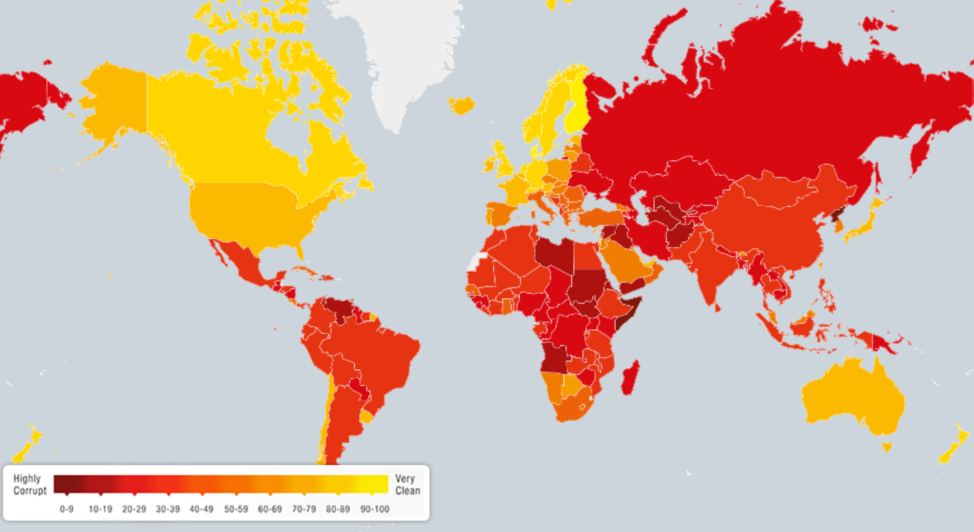
When you look at the global map of corruption, you are faced with important facts and wonders. In this map, which is annually published by the non-governmental organization Transparency International and uses criteria such as embezzlement, bribery, buying and selling of government positions, corruption in the judiciary system, and financial corruption among politicians and government officials as a basis, countries of the world are marked with a spectrum of the healthiest ones in bright yellow to the most corrupt ones in dark red. It only takes a few seconds for the story to become clear to you. The most corrupt are the current and former communist countries, as well as some countries in the Middle East and Africa that share the common feature of nationalist, populist, or Islamic fundamentalist governments. This list is completed by some developing countries in Asia, Africa, and Latin America that have not been able to provide the necessary institutions and structures for the rapid changes in population and urbanization in recent decades. On the other hand, the chart
Corruption in administrative and economic systems has a history as long as civilization. Plato believed that anyone who receives an extra gift for performing their duty should be executed. The historian Ammianus Marcellinus wrote in the 4th century AD that in ancient Rome, judges even demanded money for drawing a bow, and if the accused pays a good amount, even murder can be overlooked. In East Asia, rulers would turn to priests to learn about the future and the will of the gods, by observing the paths of stars or interpreting the entrails of sacrificed animals in temples. These priests, with their influential positions and their ability to manipulate their predictions for their own gain or loss, would accept large bribes to align their prophecies with the desires of the authorities or classes.
The main focus of intellectuals and philosophers on the issue of corruption until the 18th century AD was not on a structural or systemic level, but rather on an individual, existential, and moral level. For example, Dante, in his Divine Comedy in the 14th century, refers to the issue of “corruption” and sees its root in the moral weakness and decline of virtue and piety in people’s souls. Even a century later, Machiavelli, who is one of the founders of the new perspective and worldview on politics, although to some extent deviated from the classical perspective of the ancients, still did not reach a systemic understanding of corruption. Machiavelli believed that because most people are weak and lack piety and self-restraint, the ground for corruption always exists in them unless they are under the guidance and control of a great leader. When we reach the era of thinkers like Montesquieu and Rousseau, a change in perspective begins. Mont
The strong political movement that, parallel to Protestantism, changed the coordinates of the ancient world and established a new political-administrative formation in a part of the world, was limited by the traditional political tradition and the mutual commitment of the Anglo-Saxons. Dissatisfaction of English barons and farmers with the expensive wars and foreign policies imposed on them by Richard the Lionheart and his successor, led to a historic transformation known as the Magna Carta. John, in order to finance his wars, would periodically increase taxes and also try to reduce his expenses by cutting back on government services. This also caused great disruption and harm to the lives of his subjects. One of the services he cut off was the appointment of judges by the king to settle disputes. Without these judges, there was no one to resolve the conflicts and disputes of the people. The opposing nobility, citing a decree issued by John’s brother, King Henry I in 1100 AD, which recognized certain freedoms for the
When looking at the political map of the world one century later – in the late 19th or early 20th century – democracy is only present in the Protestant-Anglo-Saxon areas plus France. Once again, look at the map of corruption and economic health in 2015: the same yellow areas!
 Tous Tahmasebi
 September 25, 2016