


Sorry, this is not a valid Farsi text. It appears to be a series of repeated letters and does not have a meaning. Can you please provide the correct text?
Year: 2013
Why did the Arab Spring pass by the Emirates?
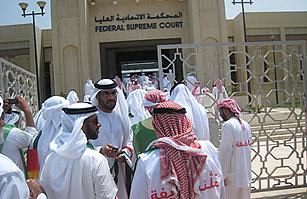
“To better understand the reason for the continuous crossing of the Arab Spring from the Emirates, pay attention to the words of Nasser Al-Hamadi, a 30-year-old electronics engineer: “What else do we want? Everything is taken care of here; education, health insurance, and free housing.”
On Monday, 150 people stood in front of the Supreme Court of the Emirates in a rare protest in this country, repeating this viewpoint. Supporters of the government chanted slogans in support of the ruler of the Emirates, Sheikh Khalifa bin Zayed Al Nahyan, in the park across from the court in 45-degree heat.
Among the people, national flags and scarves with the image of Crown Prince Sheikh Mohammed bin Zayed Al Nahyan were being distributed. Inside the court, five Emirati intellectuals, who have been in prison since April, are spending their second day of trial. They are charged with threatening national security, disrupting public order, opposing the government system, and insulting the rulers of the United Arab Emirates. Khalid Al-Husseini, another protester, says, “We Emiratis rarely speak to the media, but today we have come here to be heard. They can’t speak for us.”
The wealth of the United Arab Emirates protects this country from the economic pressures that led to unrest in Egypt and Tunisia, and the wealthy elite make every effort to meet the needs of citizens, such as free housing, public insurance, education, and subsidized energy. At the same time, the relatively small population of citizens, who are mostly related to the ruling families, have also been effective in preventing
Nameless and unknown prisons
In continuation of the series of conversations that took place in the “Face to Face” section of the monthly magazine “Peace Line” with torture victims, especially victims of white torture, in prisons; this month, we went to “Farahnaz Fardousi”, a Baha’i citizen who spent some time in prison in the 1960s.
Farān Ferdowsi was born in Esfand month of 1331 in a Bahá’í family in Tehran. He has one sister and three brothers. In 1352, he went to the United States to continue his studies and returned to Iran in Bahman 57, one year before the revolution, after graduating in management and accounting. Mr. Ferdowsi was arrested by security forces less than three years after the revolution, in Aban month of 1360, and spent some time in temporary detention.

Farān Ferdowsi, whose father, Fathullah Ferdowsi, was executed during that time in Evin Prison, says that all that time, like scenes from a movie, have remained in his mind.
He speaks about his arrest as follows: “My father was a member of the Tehran spiritual assembly and was arrested in November 1982 during a meeting. At that time, any Baha’i citizen who was identified would be arrested and in many cases, some would go missing and no one knew where they were. In order to at least know where my father and other friends were, after hearing about the arrest, I started to follow up and went to different police stations, committees and prisons. While I was searching for them, in a committee that was right in front of the house where they were arrested, during questioning, one of the officers asked me, ‘Are you a Baha’i?’ and as soon as I confirmed, I was arrested and taken to the same place where my father and other members of the assembly were imprisoned.”
Mr. Ferdowsi, in response to the question of which prison he was transferred to, says: “This was not a prison; it was an old and large garden on the old Shemiran road, near the Russian embassy – an old private villa that I do not know who it belonged to – that they had turned into a prison. At the end of the garden, they had built small cells and used the residential part as the prison office and interrogation room. This place was apparently created for drug addicts, whose numbers reached 300-400 and had been there for a long time. Apart from them, there were also 10-15 members or supporters of the Mujahedin organization and the ten of us, including the caretaker of the house and his wife and child who had been arrested, making a total of thirteen, were also imprisoned there. We never understood why this small number of Mujahedin and us were taken there; perhaps they wanted to humiliate us.”
He continues: “There were eleven men in one room (cell) where we would sleep with one door in the middle and we would sleep on our sides, unable to move or turn over. On the other side, they had only given us a thin military blanket to put under us and on the cement floor, and if we had a coat, we would put it over our heads. This was in a situation where the cell windows were also without glass, and imagine that with the cold northern air of Tehran, in that season of the year, we were practically sleeping outside and on the ground. Additionally, our cell did not have a toilet and they would only open the door once in the morning at 6 and once in the afternoon for us to use the toilet, and for example, one of our friends who had to go to the toilet more often due to illness, they would not open the door for him no matter how much he begged.”
Faran Ferdowsi describes the behaviors of security officials during their interrogations as follows: “On the second or third day of our interrogations, all day long, they would close our eyes and take us out to the courtyard or the veranda – which was sometimes wet due to rain. During this time, with our eyes closed, anyone who passed by would kick and curse at us. The interrogation process was also such that they would come every hour, open our eyes, give us a piece of paper and say, ‘Write your name.’ After we wrote our names, they would close our eyes again and come back an hour later, this time asking for our address. As we wrote our address, we would sit on the ground for an hour and be kicked, cursed at, and hit. An hour later, they would come back and ask, for example, ‘Where do you work?’ and this process would continue until we were taken back to our cells at night… Meaning,
Mr. Ferdowsi continues: “One day, two guards came and made a bet on whether we would insult our religion or not. The guard who had made the bet forced us to do so, and after the bet, he brought a blue pipe and started hitting us. Everyone’s eyes were closed and he hit all parts of our bodies, even our heads and faces. For example, he hit me in a way that the bruises remained for six months even after our release.”
I ask him what his accusation was: “One day, as they were reading names one by one and placing each person’s file in front of them, a person named “Haji Talooei” who was in charge there and was one of those we later heard were strongly against the Baha’is, when he reached my file which had “Farhan” written on it, he realized that there was no accusation in that file; he asked one of the officers, “Why did you take this one!?” The officer replied, “He had come looking for his father!” and ordered them to write on the file: “Logistics officer”! Meaning that I, who had only gone to the committee to inquire about my father’s situation, had become a logistics officer! This was the crime they mentioned for me…”.

This Baha’i citizen talks about the mental abuse he experienced during his detention: “They would insult and humiliate me. But one day, they came and told us to start writing our wills because the Attorney General has issued a death sentence for all of us… There was also a shop where prisoners could buy basic things like plates, spoons, forks, or soap, but they wouldn’t let us go to the shop. Meanwhile, they only gave us one spoon and one bowl for our meals in the entire cell. For example, one day at lunch when they brought us watery meat and poured it into the same bowl, 10 people had to eat that meal with the same spoon!”
He adds, “Although our cell was small and we had limited space, we were still there. They took us to the cell for drug prisoners for two or three days; a place where about 200-250 people were in one hall and we couldn’t even sit down. We stood on our feet from morning until night, waiting for someone to be called so we could sit for a few minutes. The conditions there were extremely bad. You may not believe it, but one day an elderly man, around 70-80 years old and addicted, collapsed from extreme exhaustion on the ground. Due to the overcrowding and lack of space, four people fell on top of him and no one could do anything. That old man died from the pressure. The guards came in the morning and took his body away. When we went to that hall, it was packed with people. Well, these people couldn’t control themselves and since there was no toilet in the cell, they sometimes did their business
When I ask Mr. Ferdowsi if the mental tortures he endured during his detention have had any long-term or short-term effects on him, he laughs and says, “Of course it had an impact. Even though it has been thirty-some years since that time, there hasn’t been a day when those memories don’t play like scenes from a movie in my mind; meaning that those days are always with me. My wife has often said that you are a different person before and after going to prison. At her request, I even went to a psychologist for help.”
“I completely understand the soldiers of the Vietnam War who cry when even the smallest mention of the war or their lost friends is brought up, even after forty years.”
In response to whether they were insulted for their religion in prison, he said: “The painful issue that had become normal for us due to its repetition was exactly this. For example, when we wanted to go to the bathroom, they would take all the prisoners from the yard to their rooms and say that they are impure, do not talk to them and do not get close to them. Or for example, during the time they took us to the crowded cell of drug addicts, they assigned one prisoner to be responsible for us and keep us in a corner, so we wouldn’t have contact with other prisoners. And in the mornings when they took us out of the cell blindfolded for interrogation, they would tell us to put our hands on each other’s shoulders (form a line) and the guards would give the first person a stick or a piece of cloth so they wouldn’t hold our hands and they would lead us to the hall where the interrogation took place; so that their

“When we were beaten in front of each other, it was very impactful. The drug prisoners who were whipped 80-90 times every day at around 12 o’clock, and we saw it. Another very painful thing we witnessed was when after 4-5 days, they realized that the husband, wife, and their 12-year-old son – who I said were the Baha’i caretakers and were taken with the rest – were the only ones left and even didn’t participate in the sessions and were actually useless, they decided to release them; without any trial, they said they had to receive 50 lashes each before their release. The head of the women’s section also warned that this woman was in her menstrual period and shouldn’t be whipped, but they changed the sentence right then and there to 10 lashes for the woman and 40 for her husband! And then they made the three of them lie on the ground in front of us and started whipping them. That was
This former political prisoner, after a while, was transferred to Evin prison by his father and the remaining Baha’is who were imprisoned there (9 people). He was temporarily released on bail and several guarantees, including a property deed and a signed blank check.
I ask Mr. Faran Ferdowsi when his father was executed: “Well, we were together and two months after they released me and took the rest to Evin, my father was executed in Evin prison. In fact, one day they contacted our house from Evin and only said, “We have understood these things” and hung up the phone. We followed up on the matter and talked to the others, and we realized that others had also received such messages. Then gradually they came to seize and confiscate our house, and it took one or two days for us to find out through friends and acquaintances that they had buried those 9 people in a place called Kafarabad (Khavaran) at that time, and they did not give us any bodies or signs.”
Iranian Health Insurance System
Previous experiences, current challenges, and future strategies
The healthcare system in Iran is mainly based on an established insurance system, which has a significant impact on the Iranian healthcare system.
In 1947, the Iranian Tobacco Company insured its employees for health expenses and medical services. The first social insurance law was passed in 1952, when the Social Insurance Organization (Social Security) became an official part of the Ministry of Labor and Social Services. In 1974, the Ministry of Welfare was established to coordinate various previous activities in the field of social welfare. The Social Security Act expanded the support services provided by insurance companies and in 1975, it made it mandatory for all workers to be insured by the Social Security Organization.

In 1979, the Iranian parliament merged the Ministry of Social Welfare with the Ministry of Health and renamed it the Ministry of Health and Welfare. The Social Security Organization was placed under the management of this new ministry. In 1980, the organization was renamed as the Social Security Insurance Organization to emphasize the importance of insurance for medical services. Currently, this organization provides coverage for over 27 million people (36% of Iran’s population) across the country. Almost all of its customers are private sector workers and employees, for whom insurance coverage is mandatory. There are two distinct features that set this organization apart from other insurance organizations. First, its financial system is heavily dependent on the government, which allows for more freedom in resources and services. Second, the organization has two branches that work together. The health branch acts as both a provider and a consumer of medical services. As a provider, it offers services in health centers and hospitals that are free for those covered by social security insurance. As a
The Health Insurance Committee of the Relief Committee is a charitable health insurance program that was established shortly after the 1979 Revolution to provide basic insurance coverage for citizens who cannot afford the membership fees of any insurance. Approximately 20% of the organization’s income comes from charity, and the rest is paid by the government. Currently, this organization covers around 5.4 million impoverished individuals.
The Universal Health Insurance Law in 1994 aimed to cover approximately 60% of the uninsured population in Iran. The Medical Services Insurance Organization was established in October 1994 based on this law to provide coverage for a wide range of individuals over a period of 5 years. These individuals included government employees and all members of society with varying social and economic levels who were not eligible for insurance through other organizations. Since the establishment of this organization, the proportion of the population covered by health insurance has increased from 40% in 1991 to approximately 90% in 2010. This was when the country’s population had reached 7.57 million to 7.74 million. This increase mainly occurred in rural areas, where there is a lower likelihood of being able to afford insurance compared to urban areas. However, the goal of providing complete coverage for the population has not yet been achieved. Today, the Medical Services Insurance Organization is the largest health insurance organization in Iran, covering approximately

The Armed Forces Medical Services Insurance Organization covers approximately four million members of the armed forces and their families. Its services and policies are very similar to those of the Medical Services Insurance Organization, but it is directly established by the Ministry of Defense.
The current situation of the health insurance system in Iran is facing two types of challenges; one is internal challenges directly caused by policies and regulations of the health insurance system in Iran, and the other is problems arising from external factors.
The first problem is the rise in medical expenses. The reasons for this increase are new and expensive medical techniques and tools that have become prevalent in treatment procedures. Medical expenses in Iran have greatly increased in the past decade. This rapid increase in expenses has put immense pressure on insurance systems and healthcare providers.
The second problem is the lack of systematic evaluation of health technology. Although new technologies have continuously entered Iran in recent years, there is no systematic method for evaluating and guiding the optimal use of these expensive and innovative technologies.
The third issue is limited financial resources. It seems that there is an obvious imbalance between the expenses and income of health insurance organizations, indicating a serious financial shortage that prevents these organizations from meeting the expectations of patients in terms of financial capabilities. One of the reasons for this financial shortage is the increase in medical expenses. Another factor is that the per capita health care costs are higher than what the government approves. The per capita costs for health insurance organizations have grown significantly in recent years. These factors have made it difficult for health insurance organizations to timely pay the necessary funds to healthcare providers. This transfers the problem to healthcare providers such as hospitals, to the point where they sometimes cannot pay their bills.
The fourth problem is a problem in management and decision-making. Each of the health insurance organizations in Iran has its own structure and board of directors. This method has caused key problems such as providing coverage for only a portion of the country’s population.
The difficulty of data collection and the duration of the decision-making process have had a significant impact on health insurance activities.
The fifth problem is the uninsured population. Uninsured population is a prominent concern in Iran. This concern is especially for those who are unable to be covered by any insurance. Currently, there is no accurate statistics on the number of people covered by health insurance services. It is estimated that between 10-15% of the Iranian population is not covered by any health insurance, while it was planned for all of the Iranian population to be covered by health insurance organizations by 1999.
From Kant to the United Nations
1. Steps towards peacebuilding
The 18th century is widely known as the end of Europe’s decline. In line with the Industrial Revolution, there was significant growth in industry, agriculture, production, and transportation. At the same time, we witnessed the beginning of a widespread “peace movement” on this continent, with the starting point being Immanuel Kant’s essay “Perpetual Peace.” In this essay, Kant discussed the foundations for creating a framework for unity among nations and establishing an organization for world peace.
However, it took 150 years for the formation of the United Nations and this organization’s goal of achieving world peace to come to fruition, far beyond the “Perpetual Peace” essay. The concept of peace research, which aims to understand and provide the necessary conditions for peace, has never been foreign to Europe. The tradition of holding conferences and gatherings on the topic of peace and for the purpose of achieving more peace in the world – as mentioned in a part of Alfred Nobel’s will regarding the Peace Prize
2. Internal Struggles and Sustainable Peace in the Continent
Contrary to the peaceful proposals of Kant and Hugo for the unity of nations, Europe began a new decline with the First and Second World Wars and numerous invasions and crimes. However, this destruction and periodic wars in Europe came to an end with the formation of the “European Economic Community” between six countries and the signing of the Rome Treaty. The strong legal framework of the economic community, later known as the “European Union”, promoted development and democracy with remarkable growth.
The common currency under the supervision of the central bank, common agricultural policies, common trade policies, common fisheries policies, common foreign and security policies, and the turning point of all these achievements, the “Schengen Agreement” and the removal of border checkpoints, brought peace, tranquility, and development to Europe after centuries of turmoil.
The European Economic Community, which first emerged after World War II with a clear vision and correct understanding of the integration of economy and politics, successfully achieved its goals. These goals were not only about peace in the region, preventing another possible war, and rebuilding Europe.
The political struggles within the European Union between the “statist” and “multinationalist” factions were balanced, and this union paved the way for peace on the continent.
From the devastation of world wars to becoming the world’s largest economy in 2007 with 1/3 of the world’s gross domestic product, it was a long journey. However, common economic policies, a strong
Internal Consequences and External Performance
The modern world is waiting for an era that begins with a return to an ideal. An ideal called freedom that brought together a nation over 2 centuries ago, and laid the foundation for a new world based on respect for human beings, reason, and their freedom.
During these two centuries, a magnificent struggle for the defense of humanity began, and great enemies such as European absolute governments, fascism, and communism were brought to their knees.
But today, once again, we witness a bipolar world. A world where on one side, defenders of freedom and human values stand, and on the other side, violators of human rights are placed.
When the wars of Europe ended with the formation of the European Economic Community, and the motivation to join the European Union for the sake of common economic policies and wider trade communities led to the establishment of democracy in countries like Portugal, Greece, and Spain, when nationalism did not become a threat to national sovereignty and democracy, meaning the desire for freedom and defense of
-Aid of 46 million euros to Morocco for improving “gender equality”
-Aid to increase Tajikistan’s budget towards “human resource development”
-Aid of 3 million euros to improve “health, livelihood, and education” for Afghan refugees in Iran
-Aid of 40 million euros for host countries of “Syrian refugees”
-Aid to Egypt for “developing water supply network for over 15 million Egyptian citizens”
-Aid of 82 million euros to Somalia to increase 17,000 “peacekeepers for stability and development”
-Aid of 100 million euros for “improving water quality and waste management” in the Gaza Strip.
These were only a few of the European Union’s efforts outside of its borders. An attempt to respect human rights and defend freedom and peace, which demonstrate the Union’s responsibility and fight against human rights violators and enemies of freedom.
Peace and politics
In the critics’ view, awarding the Nobel Peace Prize to the European Union highlights the war-mongering policies of this union. These policies include occupying the Middle East, waging war against Gaddafi, and imposing severe sanctions against the Islamic Republic.
2 Questions:
1. Is an abstract interpretation of “peace” enough to justify peaceful policies?
2. Is an abstract interpretation of “policy” enough to justify war-mongering policies?
Peace, respect for humanity, and defense of its values are intertwined and their separation will only result in false interpretations. As the process of redefining political borders is linked to rethinking cultural borders.
What the concept of human rights refers to is claims related to universal and global values that may contradict local cultural values. It is not possible to make a comprehensive and accurate judgment about political boundaries and policies based on cultural values alone.
According to the writer, looking at current policies and describing them politically is a major and widespread weakness in the discourse of many critics. Looking at social and political sciences should not be a descriptive approach and examining the static situation without considering the dynamic and future potential will not be helpful.
We cannot talk about these sciences and ignore the concerns, problems, crises, and deficiencies of societies and be indifferent to these issues. In the discourse of these critics, adopting an analytical and at the same time prescriptive approach is necessary for political problems.
Of course, using rational methods to achieve a personal and irrational or non-public goal does not make it rational. Rationalization in this definition requires a reasoned defense of that goal based on public criteria, and of course, such a defense takes place in
5. Dreams and Reality of Peace
In the eyes of the writer, the world is waiting for an era in which Europe sees it. A society that has made defending humanity, reason, and freedom its goal, both within and beyond its borders.
A society that began its efforts with the peace-loving Emmanuel Kant and Victor Hugo, and received the first Nobel Peace Prize through the initiative of Dunant in founding the Red Cross and the Geneva Convention. And through the efforts of dozens of individuals, such as Harti Ahthysari, it has worked towards resolving international conflicts. And today, the European Union receives the Nobel Peace Prize on behalf of the continent.
A prize that, as Barroso says, belongs to 500 million citizens.
Who is telling the truth?
Why is it so difficult to achieve collective success in Iran? Why is it rare to find productive discussions among Iranian intellectuals that do not result in verbal conflict? Why are we like this? How can we find an answer to such a question? Should we compare ourselves to other nations or should we critique ourselves regardless of how others are? In critiquing this situation, there are points that can be raised, which I will address based on my personal concerns.
How can we determine what is right and what is wrong? First, we must establish our own criteria for judgment. Should we evaluate the truth and falsehood of a statement based on absolute and fixed rules, or should we consider the norms of our time and era as the standard for judgment? Both perspectives have many supporters, but regardless of the validity of each statement and for whatever reason, we cannot overlook the practical consequences of these ideas. It is difficult to find a system of thought that has persisted throughout human history and has not relied on an undeniable truth. In the debate between economic and philosophical ideologies of the left and right, each has focused on real and objective interpretations of individual and collective human behavior and has addressed its theories and interpretations of life and its rights and wrongs.
Perhaps no one is wrong if a person gradually discovers his position, authority, and limitations in life, and with the passage of time and relying on the rapid trial and error of the modern era, he will be able to clear the field of fruitless experiments and perhaps he will not be able to do so, but what is not doubtful in this matter is that how can we determine the accuracy of a statement without testing it? Perhaps the blind knot of Iranians in collective work can be found here, an environment that has been empty of the possibility of testing different and conflicting beliefs and is heavily controlled by limited beliefs, how can it observe the practical results of implementing ideas? Maybe we are all wrong and maybe we are all right!
“Put on your own shirt!” Although importing ideas may not be entirely futile and pointless and cannot be easily rejected, it should not be confused with importing fruits or cars. Thinking has very delicate considerations; what and why do we think? Can we import thinking like a Mercedes Benz from the West, and ride it without knowing how it is made and what differences it has with our own Samand? Without exaggeration, thinking should be considered a luxury item with many customers, a precious vase that captivates and delights the eyes, but its existence or non-existence does not make much difference, a luxury item that has come from abroad and its value is simply because it has been imported from abroad! But how should we introduce this product to Iranians? Why, after more than a hundred years since the Constitutional Revolution, can we not find the slightest trace of conscious effort to test thinking in students in the Iranian education system? Thinking is teachable, it stems from doubt and choice, and when its
Politics is not just about thinking. It is not that no politician can think, but the requirements of politics are not necessarily the same as thinking, just as politics is not necessarily the same as political participation in social changes. A person does not necessarily think to gain power, but they may enter political parties to gain power. When politicians (and of course not political actors) become the mouthpiece for introducing ideas, what can be expected other than a war of ideas, which is essentially a war of power? And in such a situation, how can one hope for cooperation of ideas? When simply having a preference for a system or belief in a philosophical proposition can be seen as an accusation by others, how can one assess their own actions and their consequences? How can one be humble in the face of criticism? Perhaps the solution lies in hope. Collective work requires practice, one cannot be ignorant alone, but one cannot overcome ignorance. It is better to not be disappointed by thinking, listening, or practicing
Nobel Peace Prize and sanctions
The motivation for writing these lines is the awarding of the Nobel Peace Prize to the European Union in October, an event that may have been one of the most challenging decisions of the award committee; with widespread critical feedback, sometimes humorous and even sarcastic. But before delving into this action, let us become more familiar with the identity of this award and not be unaware of Alfred Nobel himself. Then we will critique the underlying concepts and finally compare the sanctions against Iran with this award.

Alfred Nobel, a prominent chemist, became very wealthy and famous in the late 19th century with inventions and discoveries such as dynamite. He had created the most powerful explosives of his time and, with the help of his family’s background in weapons manufacturing, he focused on producing large quantities of explosive materials for both military and non-military purposes. He continued on this path until 1888, when a French newspaper falsely reported his death with the following statement: “The Angel of Death is dead, Dr. Alfred Nobel, the man who became rich by finding a way to kill more people in less time; he died yesterday.” He gradually became disillusioned with his fame and wealth and in his last will and testament in 1894, he expressed his wishes for the Nobel Peace Prize to be awarded to those who have “done the most or the best work for fraternity between nations, for the abolition or reduction of standing armies and for the holding and promotion of peace congresses”.
On the date of awarding this prize, there have been many ups and downs that have been controversial. From names like Winston Churchill and Simon Perez to the absence of awarding this prize to people like Gandhi… Criticisms have generally been about the past actions or ideologies of the winners, and the organizing committee has been accused of being political and serving the agendas of certain governments. Now, let’s focus on this year’s winner, the European Union.
The reason for the success of the European Union has been declared as follows: “More than six decades of efforts for progress in peace and reconciliation, democracy and human rights in Europe.” The Union, which was formed after the end of World War II and through a famous treaty known as the “European Coal and Steel Community”, gradually evolved into its current form with twenty-seven members. Although we have not witnessed any wars between powerful countries on this continent since World War II, their names are always seen among the countries involved in regional conflicts.
The claim of the Nobel Peace Committee can be criticized from perspectives such as: the concept of peace and reconciliation, the existence of democracy and human rights, limiting these issues to the borders of the European Union, dual standards, etc.
A- Peace and Reconciliation: Since these words can be analyzed with numerous definitions and exceptions, we base our interpretation on the will of Alfred Nobel; countries that have been involved in the occupation of many countries in the world and still have their military forces spread out in many parts of the world, in the past six decades, have not only made no comprehensive efforts towards international friendship, but have also sown the seeds of enmity by invading the lands of nations and massacring them. “Efforts towards disarmament or reduction of military forces” also does not seem to be very relevant to the union that has twenty-four members in the NATO alliance and its military budget in 2010 was one hundred and ninety-four billion and three hundred and fifty-seven million euros. This is equivalent to one-sixth of the total gross domestic product of the European Union.

In this regard, looking at the economic situation of Greece, Italy, Portugal, and Spain, and the strict economic policies of more powerful countries towards exploiting the people of these countries, as well as the violent actions of the police towards the people, there is no such thing as friendship or peace in the relationships between governments and nations. The streets of Greece and Spain have witnessed the most violent protests and clashes with security forces this year, which is a testimony to the European Union’s inability to establish even minimal peace within its borders.
B- Democracy and Human Rights: Without a doubt, the European Union has made commendable progress in this area and its experiences should be utilized in many countries. However, human rights cannot be limited by borders; when the reason for awarding a prize is limited, humans are classified. It would have been better if those responsible for awarding prizes had divided the phrase “in Europe” a little and presented it against the spirit of peace and the Nobel legacy. Spreading the table of peace for “ourselves” and shooting peace missiles for “others” will not have a friendly appearance, nor will it in the future.
Dual Standard: Few analysts know that the rule of Saddam or the Islamic Republic is self-destructive and adventurous, but at the same time, it is rare to find an ordinary person who does not know that heavy financial sanctions do not diminish the self-interest of the rulers. The government spends the income from oil sales on maintaining its military power and the middle class is pushed towards economic and moral collapse. The foundations of small-minded social movements, civil institutions and cultural studies are shattered and replaced by hunger, insecurity, corruption and “bread riots”. So how can this union believe in peace by trying to break the pride and protest power of the people and eliminating the opportunities for the progress of a nation? How can it respect human dignity when the sound of a nation’s destruction is interpreted as the downfall of a government? If human rights are respected, why are they devalued among allies such as Saudi Arabia and Israel, and sometimes even on their own streets? If there is a danger of atomic bombs and
This article is not about ignoring the progress and achievements of the European Union, but rather about keeping a clear view of the few human concepts that are still being promoted by media outlets.
Women and freedom-seeking movements

With dedication to all freedom-seeking women, especially the free women of Iran.
“Movements without the presence of women ultimately lead to the rise of fascism, Nazism, or at best, a fanatical Islamic regime. Women, as the majority of society in terms of numbers and as a key factor in the contradiction of survival, such as being a mother and their essential role in the economy and politics, cannot be removed or rendered ineffective by any reasonable theory from the realm of social movements. Throughout history, it has been women who have played the most and best roles in the process of societal evolution. Therefore, no social movement can be complete or truly beneficial for a better society and humanity without the presence and role of women.”
Sometimes, a person enters a political, social, ethical, or religious discussion with a certain position and begins to present the subject and its theme from that same position. Ideologies, individuals, and specific movements have their own beliefs and can transform into different movements within themselves, such as left, right, center, and so on.

The perspective on women and gender is also subject to these regulations, sometimes examining women in the role of motherhood, caretaker and protector of the family, and procreation. However, the reality is that the issue of women has always been with us throughout history, especially in recent centuries. In all intellectual movements, the issue of women, gender, and women’s rights has been a serious matter. The effort that this present writing seeks to present to the public is to examine how the perspective on women’s rights and gender has been in different movements, and the main purpose of this writing is to investigate various positions on women’s rights after the Constitutional Revolution and until now. Of course, this perspective will be more general in order to critically examine the recent period and the impact of the emergence of an extremely anti-women regime such as the Islamic Republic and its effects on the women’s movement.
During the Constitutional Revolution, there was a significant difference in thinking among constitutionalist intellectuals regarding the issue of women and gender. The spectrum led by Sheikh Fazlollah Nouri was opposed to any rights for women and believed that women should be considered a small part of a man’s property, responsible for fulfilling his desires and taking care of his children and possessions. A good woman was an obedient woman, even if it meant seeking another husband for the man’s pleasure. According to this spectrum, freedom for women meant immorality and corruption in society. Whenever the issue of women’s rights was brought up among this spectrum, they would quickly turn to the Quran and extract women’s rights from its 1300-year-old laws, which was a fundamental principle for them. In the view of this backward and traditionalist movement, any kind of modernism and modernization was seen as a threat to their beliefs and a cause for the decline of society. They were afraid of any kind of progress in society
Self-defense and carrying weapons

In the past years, there have been few cases, but a tragic attack by an armed individual on a group of unarmed and non-military individuals has been at the top of the news for days, leading to numerous discussions on how to prevent such atrocities from happening again. Only in 2012, in the United States, 43 people were killed in such shootings. According to statistics gathered from reports by the Federal Police of America, in the past 30 years, 62 mass shootings have occurred in this country, 30 of which were in schools. These statistics are shocking and raise criminal questions such as: What drives a person to massacre children? Is there a lack of control or regulation on the possession of weapons by individuals? What is the role of the government in preventing such incidents? Now, we will delve into a few fundamental questions and also look at some statistics for assistance.
من می خواهم به دانشگاه بروم
I want to go to university.
من به دنبال یافتن راهی برای بهبود زندگی خود هستم
I am looking for a way to improve my life.
Who is being discriminated against by banning the sale of weapons to everyone?
Criminals who are after easier conditions for committing crimes or victims who need to defend themselves? Most advocates of gun freedom insist on the “right to self-defense” and one of the best examples of this can be quoted from Cesare Beccaria: “Laws that prohibit carrying weapons… disarm only those who neither desire nor are inclined to commit crimes… Such laws make things worse for the assaulted and better for the assailants; they serve rather to encourage than to prevent homicides, for an unarmed man may be attacked with greater confidence than an armed man.”
But we know that violence is the product of fear. Fear of losing something; whether it be property, life, honor, power, etc. So someone who becomes afraid can easily resort to violence. We recently heard in the news that an American shopkeeper suspected a black teenager and, in order to protect the neighborhood and prevent another theft, he interrogated Trayvon Martin, a 17-year-old, himself because the police had not arrived at the scene. And because he did this with verbal violence and illegally, the boy defended himself legitimately and, in the end, the shopkeeper, in defense of himself and his loved ones against the hypothetical thief, used a gun and brought down the teenager.
Apart from the issue of fear, being in a position of power is dangerous for humans. By being in a position of greater power, humans are more likely to experience severe psychological disorders. A prominent example of this is political power, and at its highest level, dictatorship and its relationship with the illness of political leaders. Most leaders of democratic countries suffer from depression or severe stress, and in extreme cases, such as Winston Churchill, this can lead to paranoia. In dictatorships, the emergence of schizophrenia in figures like Hitler and Gaddafi was not unexpected. We know that a handgun is not equal to a can of pepper spray. With a firearm, one can target individuals from a distance and with a large number; this means more power compared to unarmed individuals. Therefore, having a weapon is equivalent to having more power, and having more power means the emergence of various delusions and increased psychological pressures for us.
Can the role of weapons in keeping life safe from invaders be denied with these arguments? No! Certainly, one cannot achieve victory against a 9mm bullet with hand strikes; but what statistics show us is nothing less than denial. According to a statistic in the “Journal of Public Health in America”, people who carry weapons with them are four and a half times more likely to be targeted by a bullet than unarmed individuals. Or according to a study conducted by Arthur Kellerman, keeping a gun at home increases the risk of suicide among household members.
So by arming the people, we are essentially serving two groups: those who remain defenseless against other aggressive groups, and those who are targeted by organized criminals who engage in theft, murder, and other crimes for their livelihood. These groups are more easily able to obtain weapons under such laws. The second group suffers from illnesses and mental disorders, and in moments of madness or emotional, economic, or other crises, they are easily confronted with a greater power resulting from possessing a weapon and become more agitated, ultimately leading to massacres such as the Connecticut shooting or the Virginia Tech incident in 2007. However, some individuals who have resorted to arming themselves for self-defense and are relatively mentally stable, in many cases become victims of the greater power of the attackers and their own lack of ability to use the weapon and shoot back.
According to statistics over the past thirty years, in large and media-driven massacres in America, the number of people who have legally obtained their weapons is about five times higher than those who have acquired them illegally. Additionally, the use of semi-automatic weapons has been almost equal to all other types of firearms. These weapons are specifically designed for street and irregular warfare, rather than defense. Interestingly, a report published by the World Health Organization in 2003 showed that the number of gun-related homicides in America is about 20 times higher than similar countries with similar annual incomes. Despite a 20% decrease in recent years, this statistic still highlights the difference in levels of armed crimes in America compared to other countries with stricter gun sale laws.
There remains one question, and that is what can defend unarmed individuals against violent attackers? From the writer’s perspective, there is a simple answer to this question, and that is the taxes collected from the people to equip the police and army forces, as well as the expenses for research in various scientific fields, are enough for governments to not only ensure public safety, but also eliminate the human and psychological roots of crime. However, the will of governments and large weapon-producing companies seem to have different goals in mind. Of course, one should not overlook the potential psychological disorders of these government officials.
The necessity of examining the hijab.

Iranians must open many knots with their hands or teeth to achieve sustainable and fair development, but perhaps opening any of these knots, such as the issue of hijab, freedom of sexual relationships, and acceptance of women’s social freedoms, may not be as difficult and complicated as it seems in people’s minds. This is while important parts of society are not in favor of the necessity of creating change in this area. In the following speech, I will try to explain the difficulties of changing attitudes in this area and the reasons for it.

1. Religion, as one of the fundamental aspects of human social life, carries principles that are formed during its creation; sacred principles that any reconsideration of them can be interpreted as disbelief and apostasy from religion and can have serious social consequences. The geographical insecurity of Iran and the importance of establishing security, the tradition of political despotism, and the prominent role of religion in preserving the foundations of political sovereignty, without a clear presence in power, have been a safe haven for criticizing religious principles. From this perspective, the issue of women and all related issues, which are considered insignificant and unimportant in the view of religions, are not open to discussion and criticism; an issue that in the present time, especially with the occurrence of the 1957 revolution and the placement of religion in the path of political power as one of the main obstacles to creating change in the social sphere, is being challenged.
2. In the collective unconscious of Iranians, no issue is as important as morality in the realm of red lines. The concept of chastity and purity is a privilege for a woman that she does not have the right to be violated, even if she is not the cause of it; for example, if a woman is sexually harassed or even assaulted, she does not receive any form of moral support from society and the victim is so ashamed that in many cases, they do not have the courage to speak out. This is while in civil and criminal laws, which are a reflection of public opinion, the absolute ownership of a human over their body and thoughts is not protected by law. A woman is seen as an object that must be covered to remain pure, and if she is harassed or tortured, she is seen as the one who provoked it. To understand the reason behind this issue, we must take a step back; the issue of women’s rights as a human being, like the rule of
3. The issue of women in Iran is also largely class-based, with a strong emphasis on religion in the marginalized segments of society and the insistence of these classes on preserving social traditions adding complexity to the matter. These thoughts are influenced by the limited access to modern educational and living facilities, and while dissatisfaction among women in the middle and upper classes with the current situation is evident, women in marginalized classes do not think about changing their legal rights. Early marriage, less inclination towards continuing education, and high rates of suicide (especially self-immolation) are all signs and consequences of the compounded oppression imposed on women in marginalized classes.
Four. Furthermore, the issue of women is not only limited to themselves, but it is a human issue. Women’s rights activists face severe restrictions and suppression in raising awareness in society, but perhaps the biggest blow to the women’s rights movement is the lack of effort to create intersectional solidarity in the struggle for change. The women’s movement cannot hope for success in the not-so-distant future without establishing effective connections with other powerful movements, a connection that has not been sufficient so far.