


ماهنامه خط صلح
Political Sociology of Trust/ Ahmad Faal
In geographical divisions, Iran is considered a large and expansive land and, in terms of geopolitical significance, it has a strategic role and importance in the region, as it is located at the crossroads of the West and East, North and South. Iran is connected to Western Europe from the West, to the Middle East […]...
Read More Created By:
Ahmad Fa’al
Created By:
Ahmad Fa’al March 20, 2024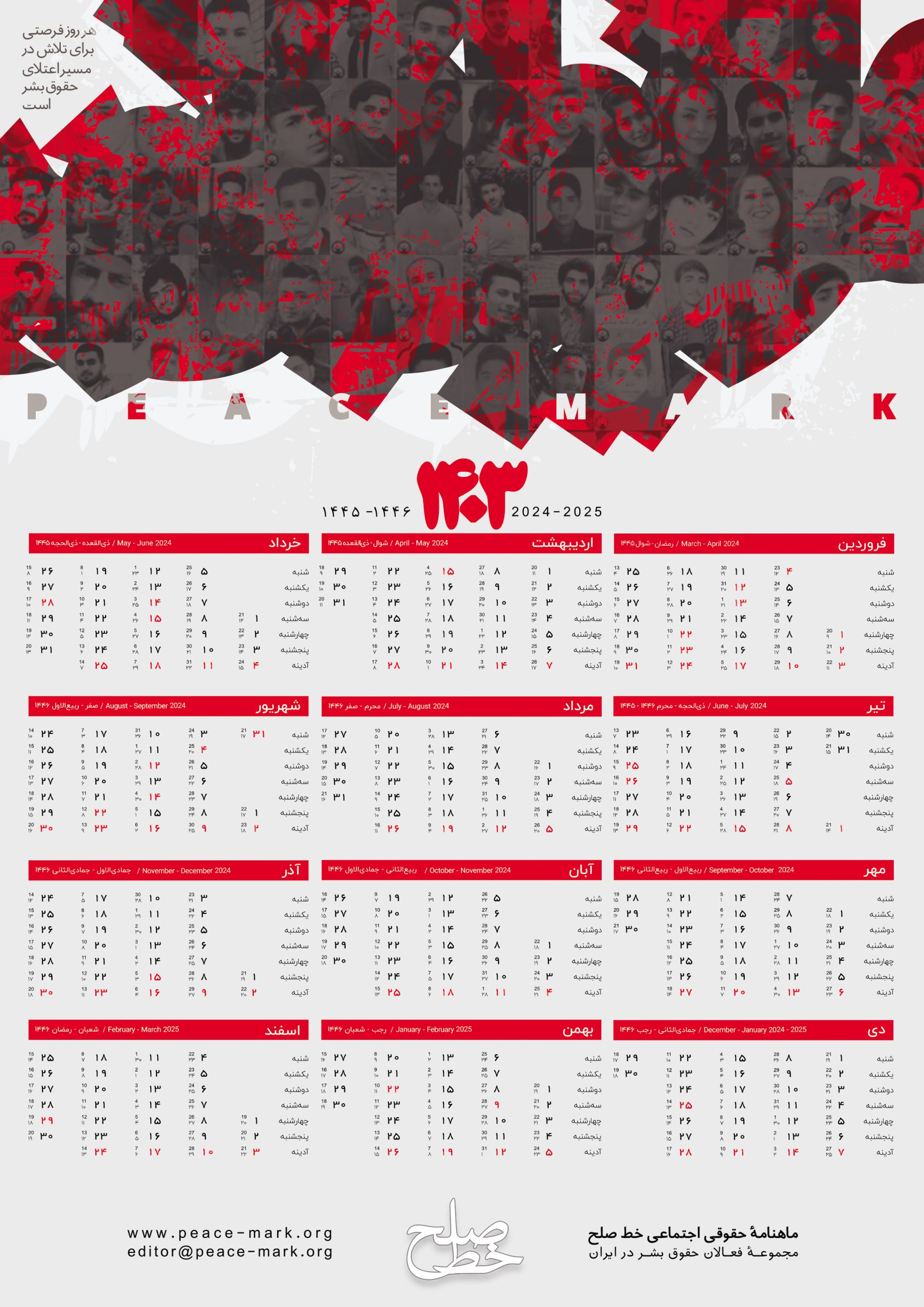
The 1403 Hijri Shamsi calendar dedicated to the audience of the peace line.
1403 Solar Hijri Calendar Dedicated to the Audience of the Peace Line...
Read More
Created By:
مدیر سایت March 20, 2024
Mohsen Haji Saeed: It is not possible to accuse every tourist of being a spy/ Dina Ghalehbaaf
Perhaps you have heard about the arrests of dual citizens or foreign tourists who have traveled to Iran for leisure. These arrests are often justified by security institutions claiming that these individuals are spies and have traveled to the country for espionage purposes. The question that arises in this situation is how valid this justification […]...
Read More
Created By:
Dina Ghalibaf February 20, 2024
Javad Ghasemi: The first condition for tourism development is security/ Ali Kalaei
A few days ago, a video went viral on social media. Lionel Messi, the Argentinian football star who is currently playing in the Saudi Arabian league, kicked a ball in a video promoting tourism for Saudi Arabia. After the release of this video, discussions about tourism in Iran resurfaced and became a hot topic. Under […]...
Read More
Created By:
Ali Kalaei February 20, 2024
Violation of Women’s Rights and Its Impact on the Tourism Industry in Iran/ Sina Yousefi
According to official statistics, despite the presence of natural, historical and cultural attractions in Iran, the implementation of social and recreational restrictions and restrictions imposed by the specific laws of the Islamic political system has led to a lack of development in the tourism industry in Iran. These laws, especially in the field of women’s […]...
Read More
Created By:
Sina Yousefi February 20, 2024
The issue of mandatory hijab and prohibition of alcohol; what is the problem?/ Alireza Goodarzi
Can we have hope for the growth of tourism industry in Iran despite strict Islamic laws such as restrictions on clothing choices (for both men and women) and prohibition of alcohol? I answer the above question with one word: Yes! In the following article, I will discuss the reasons for this answer and address the […]...
Read More
Created By:
Alireza Goodarzi February 20, 2024
The tourism industry; a caravan that we have remained from / Saghar Rahimi.
One of the interesting topics for all of us who use websites and social networks is the content related to tourism and travel, which is produced and published by influencers and travel bloggers. In some cases, this content is produced with such high quality and accuracy that it keeps people informed about the details and […]...
Read More
Created By:
Soghra Rahimi February 20, 2024
The Great Battle of Our Time over Personal Boundaries; In Conversation with Ehsan Shahghasemi/ Matin Mostafaei
The discussion of “citizenship rights” has had many ups and downs throughout history, starting with political rights in ancient Greece and later evolving into cultural, social, and civil rights. Recently, with the expansion of digital technologies and virtual space, the topic of citizenship rights in the digital and virtual realm has gained attention. For years, […]...
Read More
Created By:
Matin Mostafaei January 21, 2024
Hossein Ansari Rad, representative of the parliament’s eras: Mandatory hijab is forbidden for Muslims / Ali Kalaii
CCTV cameras and their use for monitoring individuals who do not wear mandatory hijab have become a challenging issue. Some consider it as a replacement for the morality police, while others have spoken out against its legality. Hossein Ansari Rad, representative of the first and sixth sessions of the Islamic Consultative Assembly, tells Khat-e-Solh magazine […]...
Read More
Created By:
Ali Kalaei January 21, 2024
“Commuting in a secure city/ Dina Ghaleibaf”
The metro is considered one of the public transportation vehicles that is used by students, workers, and employees for commuting within the city. It can be said that this means of public transportation, which has become a staple in Iran due to the presence of street vendors, has often been the subject of various news […]...
Read More
Created By:
Dina Ghalibaf January 21, 2024
Human Rights in the Era of Digital Authoritarianism/ Amin Qazaei
Does emerging technology strengthen individual freedoms or make authoritarian governments more capable of controlling and monitoring citizens? In response to this issue, there has always been a simple analytical framework: on one hand, information technology, with the emergence of the internet and later social networks, facilitates and accelerates the free flow of information and increases […]...
Read More
Created By:
Amin Ghazaie January 21, 2024
The Naked Life of Unregistered Baloch Children/ Marzieh Mohabbey
I cannot let go of the enchantment of those glances, and I cannot understand the bright light in the eyes of the children who were forever bound in the attack of Pakistan’s missiles on a village in Saravan, located in Sistan and Baluchestan, Iran. I cannot understand which race, nationality, or ethnicity the flow of […]...
Read More
Created By:
Marziye Mohebbi January 21, 2024
