


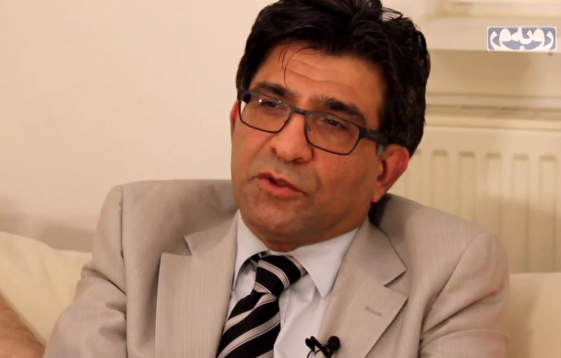
Mehrdad Darvishpour: The living conditions of Afghans in Iran are subject to modern slavery/ Ali Kalaii

Conversation with Ali Kalaii
Mehrdad Darvishpour, born in September 1339 in Tehran, has completed his PhD in Sociology at Stockholm University in Sweden and is currently a university professor and deputy professor at Mälardalen University. Mr. Darvishpour, who has been working on developing political theories since the age of 20, has published numerous articles on human rights, women’s rights, anti-racism, and peace.
As part of the special issue on peace, we have had a conversation with a sociologist and discussed the latest report from the Walk Free Foundation on modern slavery, as well as comparing traditional and modern definitions of this social phenomenon. We have also delved into the history of slavery in Iran and critiqued Iranian society’s denial of this part of history.
Dear Mr. Darvishpour, in recent years we have been faced with a concept known as modern slavery in the world. This concept, for example according to the latest report by the Walk Free Foundation, is supposed to represent the living conditions of more than 45.8 million people in the world. What is your definition of modern slavery?
Slavery in the classical sense refers to the state of being owned or belonging to someone else and a form of extreme subjugation. It means that a slave is someone who does not have anything – not their body, life, or labor – in their possession and is considered as an object, a tool, or like an animal in the ownership of their master. Therefore, the classical concept of slavery is the most inhumane and brutal form of relationships between two humans or two social groups. In addition to subjugation and the transformation of slaves into property and forced labor, classical slavery also includes forced marriages as a form of slavery.
After the collapse of the slavery system, in today’s society, we are less likely to see this traditional form of slavery where humans do not have control over their labor, body, and life. Out of the 45 million slaves in the world, only over 18 million are in India. One of the rare examples of classic slavery is perhaps the sale of Yazidi women by ISIS in Iraq and Syria; but in general, slavery is still prevalent in a significant part of the world. However, defining slavery only as the lack of ownership or control over one’s labor, body, and life may be oversimplifying the issue. What defined slavery as a social system and slavery as a condition or a group situation of humans was not just the fact that slaves did not have control over a part of their existence, but also other characteristics of the slavery system, such as its brutality, inhumanity, and indescribable injustice towards slaves. Slavery is not simply about being in possession
But if we look at the situation of millions of people in every corner of this earthly sphere, we see that they are facing conditions that can be called a form of modern slavery. Modern slavery is used in various meanings. One very common example of it, in addition to forced marriages, is prostitution, the sex industry, and the buying and selling of women and sexual exploitation, which is sometimes referred to as sexual slavery of women and girls, and sometimes young boys. In fact, these individuals are facing the most difficult conditions and the least rights, and for this reason, the field of sexual slavery is considered one of the widest fields of modern slavery.
In my academic research and in my latest book (Migration and Ethnicity: A Look at Sweden’s Multicultural Society), I have also used the concept of modern slavery in dealing with the immigrant community. However, more than just mentioning modern slavery, I have also mentioned the concept of internal colonialism, which has created a form of modern slavery.
Specifically, what do you mean by internal colonization and how does this issue relate to the modern understanding of slavery?
Internal colonization means that in the past, colonizing countries would take over third world countries with military force and missionaries, enslave the people and exploit their cheap labor. Today, with the decline of classic colonization, it is rare to find a country that is actively engaged in this practice (although in recent decades, we have been faced with examples of what Antonio Negri calls the new imperialism, where military occupation is a part of it). Nowadays, instead of sending forces to another country and plundering its natural resources and labor, many citizens of those countries come to Western countries as migrants and refugees, working in the black market and under extremely difficult conditions, without any rights and with the lowest wages. Therefore, in my opinion, a part of modern slavery includes a large group of migrants and refugees.
In this way, modern slavery is not limited to non-Western countries; rather, here too, through the brutal sex industry (whose market is much larger than that of luxury brothels), the cheap labor of immigrants and refugees, or the methods of companies like H&M that buy cheap child labor from poor countries and create their own companies and markets there, have a significant role in modern slavery.
As you mentioned, modern slavery is definitely a product of the modern world and the traditional concept has disappeared with the changing world. Do you think that Iranian society has fully entered the modern world, and is this issue traceable in Iran (according to reports)?
When we talk about the modern world, we refer to a general concept and a historical era or the present age. However, the world today is not a world of slavery and feudalism, but has become the era of capitalism, which also includes Iran. But I can add two points about the statistics you mentioned: one is that in countries like Iran, statistical measurements are very difficult and cannot be easily traced due to censorship; therefore, the actual figures for such statistics may be much higher. In this regard, we can mention cases such as cheap child labor, brutal sexual exploitation of young girls, and many women in servitude, which also applies to these individuals. The level of welfare, employment, and standard of living in many parts of Iran, especially in more deprived areas such as Sistan and Baluchestan, is very low and the intensity of exploitation is high. It is also necessary to mention urban marginalization, where a part of modern slavery or brutal exploitation of labor can be
I don’t know exactly, but according to the Wak Free Foundation report, it seems that those who are involved in buying and selling or child labor have been the main focus, or perhaps a broader concept has been considered. Otherwise, if the economic hardship and lack of freedom of choice in employment, place of residence, etc. were to be evaluated, the numbers could have been higher than what has been mentioned; of course, it is not clear to me what exactly their criteria and method of gathering statistics have been.
To what extent is modernity in a society like Iran caused by Iranian traditions and culture, and on the other hand, the industry of the modern world and its necessities?
Undoubtedly, in the most deprived areas where people have a lower standard of living, education, and culture, there is more widespread injustice and a lower level of social and class awareness, and even a lack of awareness of citizenship rights. Therefore, the grounds for legitimizing such relationships (modern slavery) can be more prevalent in these areas. This means that traditions play a very strong role in preserving modern slavery, and the remnants of the past, including relationships between landlords and peasants in many deprived areas of the country, still exist and cannot be ignored. At the same time, the issue of widespread migration is a problem of the modern era. The world has never seen such a high level of migration and refuge in recent decades. Considering that many Afghan migrants are facing living conditions that subject them to modern slavery, it can be emphasized that part of modern slavery is a product of the conditions and situation of the modern era. Of course, this does not mean that modern slavery is an inevitable product of modern
On the other hand, as I mentioned before, a significant part of buying and selling involves sexual transactions and obscenities, which have been considered the oldest profession in human history, can be categorized as sexual slavery of women.
Regarding “obscenities”, some emphasize the use of the term “sex worker”; this term may reflect the situation of some workers in this industry and luxurious obscenities in developed countries or other parts of the world, but a large portion of women and girls face much more severe conditions that should be referred to as sexual slavery rather than just work.
You mentioned a good point about the relationship between the master and servant system. However, many in Iran do not recognize the history of slavery and only refer to concepts such as slavery and the slave system in cases like racial systems and discrimination against black people in America. Why do you think this denial takes place?
Iran has faced a form of slavery during the Achaemenid era and the reign of kings such as Cyrus and Darius, as well as during the Sassanid era. Like most civilizations with slavery, wars were one of the main sources of obtaining slaves. It is said that countries that have faced the Asian production method have had a longer or somewhat different duration of slavery. The classic forms of slavery are more noticeable in ancient Greek and Roman civilizations, but ancient civilizations such as Egypt, Babylon, Assyria, China, and India in the East have also faced different forms of slavery. In ancient Iran, it is said that slavery was mostly associated with monarchy and kinship. References to slavery and slaves can also be found in the literature of Abrahamic religions. In the Persian language, the words “kaniz” (female slave) and “ghulam” (male slave) are evidence of the prevalence of this type of slavery in Iran, even during the Qajar period.
But regarding the denial of the existence of slavery in Iran, it must be said that in societies where there is no democratic culture, there is generally a weak critical view of oneself, the ruling structure, and even the past. Also, in societies where there is not much future-oriented thinking or progress, idealizing the past helps with the identity of individuals. It is not without reason that often, countries that are more advanced are less nostalgic and act in the opposite way. In the case of Iranians, especially after the revolution, we were faced with the phenomenon of the Islamic Republic, which is seen as a historical setback for many as it is perceived as an Islamic-oriented regime, and today, in facing it, there is not much perspective for change. Therefore, instead of hoping for a better future, idealizing the pre-Islamic past is both a way of confronting the government and a way of healing the wounds that have been inflicted on the minds and souls of this nation. For example, when
In developed countries such as Sweden, rather than the past and the history of the Viking era being a source of pride, or in America where the era of slavery is a source of pride, what these societies have created today is the subject of their elevation and pride. But in a country like Iran where people can neither be proud of their government nor the conditions they are facing, the effort to cling to the past and take pride in that “regretful era” becomes prominent in order to compensate for the feeling of melancholy or self-reflection in the world today, in a way that may serve as a consolation.
On the other hand, in the ideological thoughts of the enlightened society in the past, there was a strong Marxist or Islamic mentality of oppression, which led to a focus on only the negative aspects of, for example, the Achaemenid era. This has greatly affected the way Iranian society is viewed today, as a part of human civilization can be observed in ancient Iranian civilization. The mistake of the past is a transhistorical perspective that is only favored by the destructive and sanctifying thoughts of one side.
Is there evidence of the existence of a system of slavery during the Achaemenid era?
All Western, Iranian, and Russian historians who have studied the history of Iran before Islam have mentioned the issue of slavery in the classical era of the Achaemenid and even in the Sassanid era, which can be referred to, and I have not seen any serious discussion or writing that questions slavery in ancient Iran. In fact, the development of many societies without slavery was not possible, and it was a necessity of the productive and economic conditions of that period of history, and essentially it was the same slavery that we had in the great civilizations of humanity, including the Iranian civilization.
As a result, while considering that system, which belongs to a historical period that has passed, naturally one should not criticize that era and its inhumane relationships in order to justify it.
According to the report of the mentioned foundation, despite Iran being ranked 20th among countries in terms of the existence of slaves, the level of government response to slavery has been evaluated as the weakest. In your opinion, how effective can government responses and the passing of anti-slavery laws be?
Undoubtedly, governments play a crucial role in the fight against modern slavery. This role is manifested through legislation and market control, as well as in various economic and social activities, and by creating social welfare conditions for citizens and planning for the prosperity and industrial and civil development of the country. However, when a government itself is involved in modern slavery, it is natural for it to show the least reaction to these issues and have no sense of responsibility towards them.
On the other hand, at a time when the Islamic Republic of Iran has turned a blind eye to numerous international condemnations regarding human rights violations in Iran and shows no sense of responsibility towards millions of unemployed, addicted individuals, and those living below the poverty line, or the deplorable state of the environment, or even the alarming rates of car accidents and the disastrous healthcare system, it is very optimistic to expect any sensitivity towards this report and the statistics of modern slavery in Iran. When Mr. Zarif claims that if people were dissatisfied, they wouldn’t participate in elections, it is clear that this regime does not have any regard for the rights of its citizens and can be compared to the relationship between a master and a slave.
As a final question, what do you think could be the solution to combat modern slavery?
In order to effectively confront modern slavery, there are three necessary conditions: first, the existence of a democratic environment that allows for investigation, criticism, and exposure of this phenomenon on a global level. In dictatorships, governments prevent a proper examination of this issue; therefore, the development of democracy on a global level is one of the tools that can make the recognition and confrontation of modern slavery easier. Free market is also one of the main factors that allows profiteers to spread modern slavery through increased exploitation, internal colonization, and sexual exploitation. Therefore, controlling the free market is an important issue that must be confronted with the ruthless and one-sided logic of profiteers. Third, there is a need for international solidarity in confronting modern slavery. This means international planning and coordination towards poverty eradication, expansion of education and literacy, and harsher punishments for modern slavery in every corner of the world. All of these factors together can create the possibility of a more effective confrontation with modern slavery. Otherwise,
Thank you for the opportunity you have given us in the Khatt-e-Solh magazine.
 Created By: Ali Kalaei
 July 24, 2016
Tags
Ali Kala'i Hakhamanshian Magazine number 63 Mehrdad Darvishpour 2 Servitude You have a modern slave. ماهنامه خط صلح