


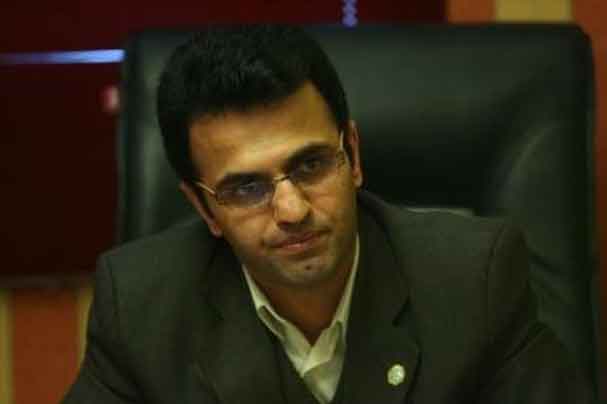
: Saeed Dehghan: Refugees are not greedy/ Mani TehraniSaeed Dehghan: Refugees are not greedy/ Mani Tehrani

Mani Tehranian
Their number is estimated to be between fifty thousand to two hundred thousand people who are living in inhumane conditions in camps in Greece, Macedonia, Czech Republic, and others. As a result, there is no accurate information about the severity of their situation. According to reports, problems such as lack of bathrooms, access to hospitals, medicine, and food make the journey on foot, which they have taken to cross the borders of the European Union, very difficult. Citizens of countries such as Syria, Iraq, Afghanistan, Iran, and Pakistan can be seen in these camps, and their first gateway to the West is through Turkey.
According to a new agreement between Turkey and the European Union, which came into effect at the beginning of April, NATO patrols control Turkey’s exit routes in the Aegean Sea and Greece is obligated to forcibly return individuals who do not apply for asylum in the country or whose requests are rejected, to Turkey. In return, Europe will accept refugees through the UN office in Turkey. However, this is only a part of the crisis, as in other parts of the oceans, refugees who have reached Australia by boat have been exiled to the islands of Manus and Papua New Guinea. These camps have seen some refugees die or commit suicide. Following Iranian Foreign Minister Mohammad Javad Zarif’s recent visit to Australia, the Prime Minister announced that, according to an agreement with the Iranian government, 9,000 Iranian refugees will soon be returned to the country. Zarif, in an interview with an Australian reporter, called these claims false. Human rights activists have accused the Australian government of being profit-driven and
“Saeed Dehghan is a lawyer and the director of the legal institute (Logam Form) and a people’s advocate in Tehran. We have discussed the refugee crisis, the failure of open-door policies, and possible solutions with him.”
In 2015, Chancellor Merkel’s open-door policy did not work and now thousands of refugees are stranded in inhumane conditions behind the borders of the European Union. Is the West responsible for the crisis and what is the solution?
Yes, apparently this policy has failed and there have been multiple factors involved in this failure. Of course, Germany may have played a bigger role and used its power to enforce this policy. However, this policy affected the entire European Union and we must see if other members of the Union have fulfilled their role and responsibilities properly or not. As for the responsibility of the crisis, there have been multiple factors involved and one of these factors is the wrong and sometimes greedy policies of Western politicians. Currently, there are at least three solutions for managing this crisis: first, the accurate and complete implementation of the 1951 Geneva Convention on Refugees, second, the respect of countries for the provisions of Article 14 of the Universal Declaration of Human Rights, and in the short term, there should be a reasonable and desirable organization along with careful planning and consideration by the host or transit countries.
Is the agreement between Turkey and the European Union for organization or forced expulsion of refugees, and what are its consequences?
As announced, this plan is for the purpose of organization and we should hope for its success. However, if there is any intention to forcibly expel refugees, it goes against the explicit provision of Article 33 of the Geneva Convention, which prohibits the expulsion or return of refugees. This coercion can lead to the reproduction of violence. Although all reasons for seeking asylum cannot be summarized as anger and terrorism.
The translation of the Farsi text is:
“Caption for attachment 5045, aligned to the right with a width of 300.”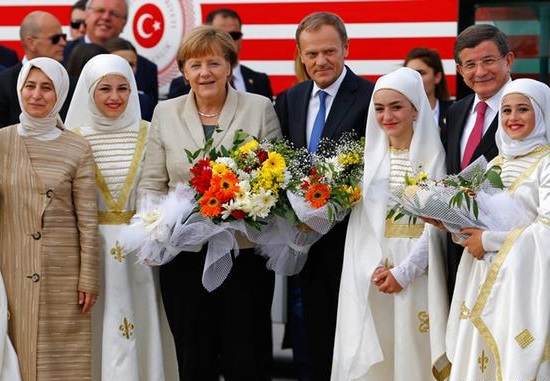
Angela Merkel visits Syrian refugee camp in the border city of Gaziantep, Turkey – photo by D.P.I.
One of the reasons for Ms. Merkel’s failure was cultural. Is it legally acceptable for people to change their beliefs? For example, for fundamentalist Islamists to be transferred to Islamic countries and for atheists to be transferred to Europe…
The New Year’s Eve incidents in Cologne and similar cases in Europe are disturbing and incomprehensible. These issues must be taken seriously and addressed in Muslim societies. However, these incidents are not only affecting refugees, as some individuals are taking advantage of the situation. Categorizing people based on their beliefs is not only unreasonable, but also goes against international human rights declarations and Article 3 of the Geneva Convention.
Australia is also returning nine thousand refugees to Iran under a contract, Mr. Zarif has said that you are encouraging them and most of their claims are lies, and on the other hand, he has said that Iran does not accept anyone to be forcibly returned. Can the return of non-combatant refugees put the country of origin at risk? On the other hand, in Iran, the judiciary has tried to defeat President Rouhani’s government’s email problem-solving plan…
Returning refugees by force, whether through a formal or informal agreement, or based on the assumption that they have lied, is fundamentally illegal and goes against all international conventions and treaties on refugee rights. Even if the claim of refugee dishonesty is true, the root cause must be addressed – what has happened in the country that has driven its citizens to risk their lives and even resort to lying in order to seek refuge in another country.
The email plan is also a problem solver, its name is new and such plans existed in previous governments, especially in Mr. Khatami’s government. The main idea of returning or allowing Iranians to travel to other countries is beneficial. Yes, some parts of the government may not only feel threatened by the return of Iranians, but also by the coming and going of tourists to the country. Removing barriers to travel to the country is one of the prerequisites for development, and a proper solution must be considered for it.
With the current conditions, how will the world be in the next ten years? Will the population structure of Europe change or will immigration laws be altered?
Predicting future conditions is difficult. However, if we compare statistical indicators between the years 2002 and 2012, we can see that over the course of ten years, there have been significant changes in the cultural fabric of the population of Europe. I believe that while maintaining the principles and fundamental rules of the Universal Declaration of Human Rights, the Geneva Convention, and other relevant treaties on refugee rights, it is inevitable that there will be relative changes in the legal laws of immigration in Western countries. Unless a person does not have security, no one is willing to leave their homeland and seek refuge in another country, enduring suffering and hardship. There are always exceptions, but often these individuals cannot return to their country, and it is not accurate to say that they are greedy. This is a understandable issue that needs to be addressed.
Thank you for the opportunity you have given us.
 Created By: Admin
 April 28, 2016
Tags
"Attorney of the people" Angela Merkel Magazine number 60 Mani Tehran Refugees 2 Refugees in Australia Saeed Dehghan