


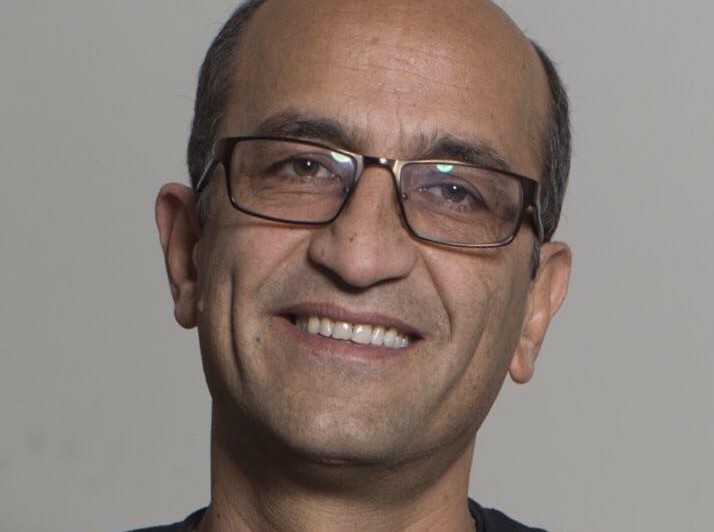
Fake peace while ignoring human rights; a conversation with Siamak Ghaderi/ Simin Rouzgar.

Conversation with Simin Rouzgar
Siamak Ghaderi, a journalist who was released from prison less than a year ago after serving four years in prison and has recently won the International Press Freedom Award in 2014, has answered our questions in this issue of the monthly magazine “Peace Line” about the reasons for the necessity of raising and addressing the issue of human rights violations in Iran in the current negotiations, as well as the impact of the successful outcome of the negotiations on the quality of life, security, and livelihood of citizens.
Siamak Ghadiri believes that “having a political perspective on everything and having political activists tell us to hold off until the issue of nuclear talks, which is a priority, is resolved and a timeline is presented, is not a fair view.”
Mr. Ghaderi says in favor of peace: “A country like Iran, which is itself a violator of human rights and does not respect the basic rights of its own citizens, is certainly not in a position to speak, for example, about the situation of African Americans or Native Americans in America.”
Do you believe in the necessity of including human rights in negotiations?
As a journalist and someone who witnesses and monitors human rights violations in our country, I consider human rights as the foundation and believe that there is no higher priority than negotiating and reaching an agreement on human rights issues. Without respecting human rights, no peace among humans is imaginable. It must be said that in certain situations, the priority is given to nuclear, arms, or terrorism issues, which are addressed in the Universal Declaration of Human Rights and international treaties.
Basically, how much pressure from the international community on the Iranian government regarding human rights violations can be effective in changing the behavior of the Iranian government in this regard?
I do not impose this name and I call it conversation and interaction, and I believe that because nearly six decades have passed since the adoption of the Universal Declaration of Human Rights and about three decades have passed since the adoption of its covenants and protocols, these provisions are like a law that is binding and necessary among nations. Iran, as a country that has accepted these laws and is committed to their implementation, has even included some of them in its domestic laws; if it does not implement them, it becomes necessary for the global community to remind this country of its obligations and commitments in its interactions and conversations with Iran.
Some interpret bringing up the discussion of human rights in negotiations as a way to undermine President Rouhani’s government, and believe that this issue should be postponed until the government achieves victory in the negotiations. What is your opinion on this viewpoint?
We must answer this question from a specific standpoint; priorities for someone who is facing execution and will be deprived of their right to life, for someone who is imprisoned and deprived of their freedom, for someone who is prevented from working and earning a living, for someone who is deprived of education, for someone who lives in an inhumane and polluted environment; their rights must be respected. Having a political view on everything and for political activists to say to hold off until the issue of nuclear negotiations, which is among the priorities, is resolved and a timeline is presented, is not a fair approach. We must consider individuals whose fundamental rights have been violated and are suffering for it, and whose lives and the future of their children are at risk. How can we tell such individuals or their families to focus on negotiations for now?! They want to hang someone above the gallows and it is clear that their priority is their right to life.
Naturally, and considering this introduction, the answer to this question is very clear; those who prioritize certain things and do not consider human rights as important, act unjustly. We must put ourselves in the place of these individuals; in the place of a Bahai child who is not allowed to study at any level – let alone university – and is forced to migrate from their country and face numerous difficulties. Based on this, I believe that we should not have a political view on these issues. Respecting fundamental human rights, which are essential requirements of modern society, takes priority over any action, even peace, which is a desirable ideal and the world is pursuing it; peace cannot be achieved unless fundamental human rights are respected.
Do you believe that the successful conclusion of negotiations will only fulfill the desires of the global community or the Iranian government, or do you believe that it will also have a positive impact on the quality of life, security, and livelihood of Iranian citizens?
If we look at this issue from the perspective of human rights, sanctions are a clear violation of human rights. In our country, as a result of sanctions, educational and health indicators have declined and the overall economic and living conditions of the people have been affected. Such pressure is contrary to the principles of human rights; that is why I believe that when we engage in dialogue, we can solve issues within a different framework and hold Iran accountable for respecting the rights of its citizens and fulfilling its obligations.
What we see in the discussions and analyses of the officials of the Islamic Republic is that all the inefficiencies that directly violate and disregard human rights are attributed to the lifting of sanctions and they say that we are under pressure from sanctions and the international community. Therefore, if the sanctions are lifted, not only will one of the tools of human rights violations be eliminated, but also the government will lose this excuse and the society will be freed from the emergency state that the rulers create to violate human rights. At the same time, space is opened for the middle classes to raise their demands for human rights in society.
Mr. Ghaderi, do you believe in the lifting of all or a significant portion of sanctions in the short term?
In any case, these sanctions have been imposed for specific reasons and, as it is evident, should be lifted upon the removal of those reasons and Iran’s commitment to fulfilling its obligations. If the Islamic Republic – as it currently is – seeks to engage with the international community and alleviate their concerns, it is unlikely that powerful countries negotiating with Iran would want to maintain the sanctions.
Some believe that in case of failed negotiations, Iran will resort to more suppression internally to maintain its security. What is your opinion on this matter?
“All the facilities that a government is obligated to provide to its citizens according to the constitution that they have agreed upon, are related to normal circumstances. During war and emergencies, these rights are suspended for a period of time. Even in the context of fighting terrorism, wiretapping and eavesdropping on conversations happens in the United States, violating citizens’ rights to privacy. However, this is due to non-normal circumstances. Therefore, I believe that if the situation becomes normal, the government will feel more capable and powerful, and in such a situation, it will respect the rights of its citizens, even for its own longevity. In non-normal circumstances, governments are usually not willing to take the risk of respecting the rights of their citizens because they feel that they will lose control.
Many Iranian officials accuse the United States government of having a double standard when it comes to human rights issues; for example, they accuse the US of turning a blind eye to the poor human rights situation in a country like Saudi Arabia and instead using pressure on Iran as a political tool for human rights issues. How much do you believe this claim to be true?
This is not a claim and includes a political view. America has a key role in equations and interactions with countries, which is to protect and pursue its own national interests. America sees Saudi Arabia as one of its military bases in the region and naturally, when someone is beheaded or a blogger receives a thousand lashes, its forgiving attitude towards it compared to Iran, which creates chaos in the region, interferes in the internal affairs of countries and supports terrorist groups; but on the other hand, a large part of the US Constitution is the Universal Declaration of Human Rights and America is obligated to uphold it in its own country and then for other countries. However, as a responsible country and a global power, America is also obliged to speak out on various issues, including human rights, and pursue them. It is not a skill for the Islamic Republic to make such a weak and baseless argument that you have a double standard; the skill is for Iran to respect human rights in its own country to the
As a final question, please state your prediction regarding the outcome of the negotiations.
My personal prediction has always been that the desires of the global community from Iran on one hand, and the path that Iran has taken during this time and the structure that this country has with its various institutions on the other hand, cannot be reconciled and lead to an agreement. Personally, I have a pessimistic view on this matter, but considering that the priorities of the United States have changed in the region and their foreign policy has also shifted in this regard, there is a possibility that with the US turning a blind eye to some of the extreme and radical demands of the Iranian government, negotiations may lead to a result. This is because they may need Iran as an ally.
Thank you…
 Created By: Simin Rouzgard
 June 27, 2015
Tags
Peace Siamak Ghaderi Simin Daytrip