


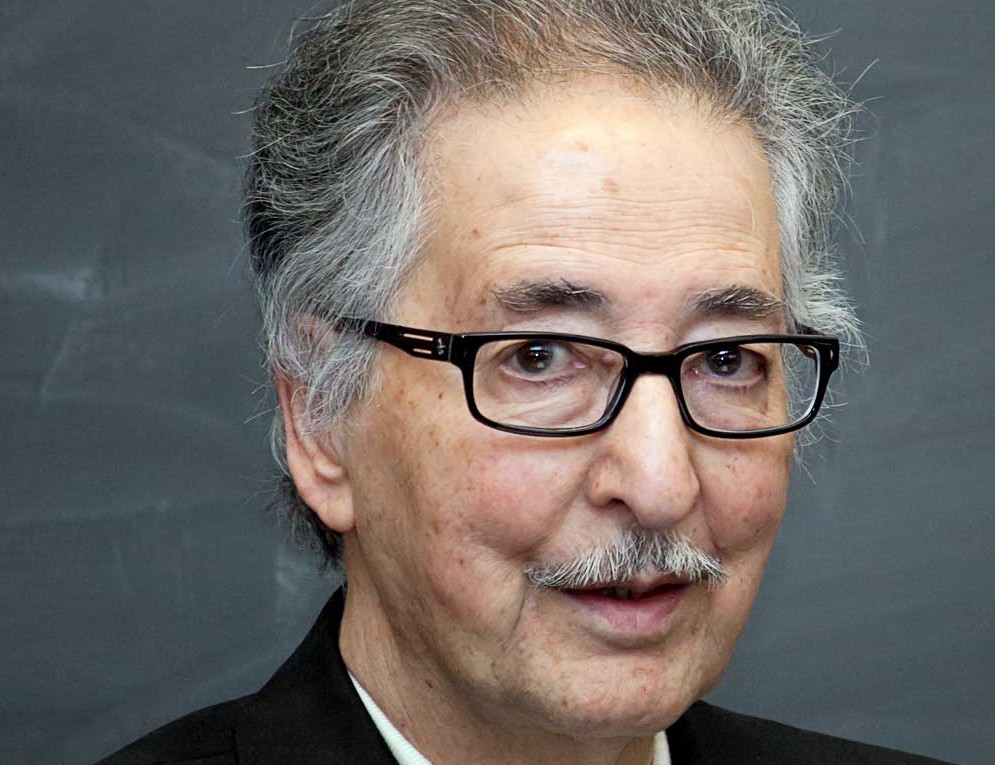
Seyed Abolhasan Bani Sadr: They said, “You are not a Muslim if you oppose execution/Ali Khamenei.”
Dr. Seyyed Abolhassan Banisadr, the first president of Iran, does not need an introduction. Although after many years, through numerous interviews and writing books, he has answered many questions regarding human rights violations in the early months and years of the revolution in Bahman 57, we deemed it necessary and opportune to approach him in light of the special dossier of this issue of the Khat-e-Solh magazine, and inquire about his positions and views as the first president of Iran regarding the issue of human rights and his importance in addressing its violations during his presidency through his statements, reactions, and necessary actions, in his own words.
Mr. Banisadr has also been asked about topics such as the execution of Amir Abbas Hoveyda, the longest-serving Prime Minister during the reign of Mohammad Reza Pahlavi, and the events in Turkmen Sahra and Kurdistan which, despite the efforts of historians and human rights activists, still remain shrouded in uncertainty after many years. I have asked questions in hopes that the readers of this letter for peace will help in resolving these uncertainties to the best of their abilities.
Mr. Banisadr, as one of the revolutionaries close to Mr. Khomeini’s circle in Paris and during the events after the revolution, how much were you concerned about human rights? In other words, how much were you striving to ensure that the rights of citizens, especially political activists, both supporters and opponents of the newly established government, were not violated as they were during the Pahlavi era?
In a situation where the issue of human rights violations was not raised for many ideologies, such as Marxist-Leninists (although they defended political prisoners, those they deemed acceptable were given priority), we based our actions on human rights and advocated for the general defense of political prisoners, not just those who were deemed acceptable. We believed that whether a political prisoner was a member of a mass party or a clergy, they should be defended. If we did not act in this way, our words would have no impact in the European public opinion. In this regard, we established an organization called “Defense of Human Rights” in France, which was an Iranian organization.
In addition, when I entered France, the engineer and the late Talaghani were supposed to be tried. Therefore, I went to non-governmental scientific and political figures and also met with Jean-Paul Sartre. Sartre asked me to give him the files of these cases. Prominent scientific and political figures in France accepted membership in Sartre’s committee, whose job was to defend the general and accurate rights of political prisoners and human rights violations. We had to provide accurate information to this committee through the Iranian committee. In addition to establishing an organization for the defense of human rights and cooperating with Sartre’s committee, the third field of work was sending observers to Iran for political trials, which were held in military courts at that time. Of course, besides us, the student confederation also sent observers to Iran. In addition to these, there was a fourth field of work related to cooperation with non-Iranian student organizations. We also collaborated with Amnesty International by
These were our set of activities in pursuit of defending human rights during that short period…
Dear Dr. Banisadr, you are the first president in the history of Iran. Many executions took place in the early days of the revolution and if you allow me to give an example, let’s talk about two famous cases that still have ambiguities; what was your position in the cases of Hoveyda and Taghi Shahram?
See, when they were discussing my dismissal in the parliament, one of the criticisms they brought up was that Banisadr is a defender of Western human rights, while during the previous regime, all these clerics who were in Shah’s prison had benefited from the same defense; but still, this issue was raised. Regarding executions, which I was constantly against, even Mr. Khomeini once told martyr Lahouti that Banisadr is not a Muslim because he is against limits and executions… Of course, Mr. Khomeini had sworn to him not to tell me this issue. But when martyr Lahouti came to me and said that an important issue has been raised but I cannot tell you, I told him that you had no right to go against justice and based on this mistake, your commitment is also invalid and you should discuss the issue with me. In the end, he said and I also gave a closed-door response to Mr. Khomeini. While publicly I
But the first cases that I took a position on were related to Taqi Shahram and Abbas Amir Entezam. My objection to Taqi Shahram’s case was that the documents presented to the Revolutionary Council were not enough to label him as a spy. As for Mr. Amir Entezam, I asked Mr. Khomeini, “By what rule did you take him?” No one in the world takes a mediator, and he was a mediator for those who were your representatives in Tehran. He only went to them and sent messages to the American embassy and received messages from them. Mr. Khomeini said that Amir Entezam had betrayed. I asked what his betrayal was, but he was not willing to explain. Of course, in the documents of the American embassy, it is mentioned that they talked about sidelining Mr. Khomeini, and it is possible that they have written this to Amir Entezam, but in any case, what they had as a
Regarding Mr. Hoveyda, when Mr. Mobasheri, the Minister of Justice, called me and informed me that Mr. Hoveyda had written him a letter and expressed his readiness to reveal everything, and said that if we arrange for an international public court, it would be a great opportunity for the whole world to understand what the Shah regime did to Iran and for the current and future generations to know why this revolution happened in the first place; I said it was a great proposal. Then we went together to Qom to meet with Mr. Khomeini and explained the issue to him. Mr. Khomeini also agreed. We were very happy that there would be a trial where international observers could be present and it would be long enough for Hoveyda to speak his mind. We returned to Tehran with peace of mind, but the next morning it was announced that Hoveyda had been executed. Well, this was a hard blow for us.
But Mr. Ghafari has denied this issue several times so far…
Well, I am surprised that everyone has become a believer and Muslim! First of all, why didn’t he say it at the time when he didn’t do this? Secondly, if Mr. Ghafari comes and denies it, he should also say that if he didn’t shoot the bullet, then who did it? Thirdly, the result of all our investigations is that Mr. Ghafari did this… When you are supposed to be on trial and you do this at night, you have actually committed a crime.
What was your stance on the events in the Turkmen Sahra, which of course occurred before your presidency, their demands, and the assassination of some of the leaders of the movement who came to Tehran for talks? Additionally, what was your position on the events in Kurdistan? If you were opposed, why did you remain silent as the president?
Regarding Kurdistan, some groups have been falsely promoting for years that Bani Sadr said not to suppress Kurdistan and not to bring your boots. Fortunately, that document has reached outside the country and is now in our hands, proving that my words had nothing to do with Kurdistan. My words were directed towards that group of bandits and armed individuals who had taken some people hostage in Khoy, not towards Kurdistan; I had said not to bring your boots until those armed individuals were arrested. Well, this statement had nothing to do with Kurdistan. In fact, in that speech that took place in Azadi Square, I also talked about Kurdistan, saying that we are ready to accept those proposals and let it become autonomous, but not only did they censor that statement, they also fabricated such a lie.
Or about the massacre that took place in a village called Qarna, even though I was not yet the president, I wrote a headline in the Islamic Revolution newspaper titled “In Mourning for Qarna”. I also strongly protested the executions that took place at the Sanandaj airport, both in my speeches and in the Islamic Revolution newspaper. Among those executed, there was even someone who was sick and had been placed on a stretcher and shot.
Regarding the situation in northern Iran; as you yourself mentioned, I was still in the process of establishing the presidency and the inauguration ceremony had not yet taken place. One thing that I remember and must emphasize is that in any case, they had carried out an armed operation in Gonbad. The Revolutionary Guards had managed to suppress this armed action. In this regard, they had also arrested four people. So in reality, these individuals were not coming to Tehran for negotiations, they had been arrested and were killed on the way to Tehran. This matter was reported to me and I took it upon myself to follow up on the issue. According to investigations, it became clear that these individuals were killed on the orders of Mr. Khalkhali. Mr. Khalkhali had stated that they were executed for their involvement in armed rebellion and were deserving of death. Of course, Mr. Khalkhali – like Mr. Ghafori who denies the killing of Hoveyda – also denied this
Mr. Banisadr, during the end of your presidency, the issue of cultural revolution emerged; an issue that Dr. Mohammad Maleki, the first president of Tehran University after the victory of the revolution, referred to as a cultural coup and the events that took place in the universities of Shiraz and Ahvaz, which were clear violations of human rights. How do you evaluate your performance as president during that period?
Coincidentally, I believe that was a coup. However, that coup was actually against the president. Even the tapes of Mr. Ayat were obtained and released at the same time. In those tapes, it is said that if we had prepared a plan (the same initial plan that I ruined and was not implemented, and then they put the second plan into action), the father of Bani Sadr would not have been a rival. Well, they believed that the motivating force at the disposal of the president were the universities, and the goal was to take such a force away from us in order to cut off the relationship between the president and the people; they wanted to either separate the people from him or him from the people.
It means that there was no discussion about the presence of armed forces in universities…!?
No, it wasn’t about that. The discussion was about closing universities to weaken the influence of Bani Sadr and sever his connection with the people. Two people, one of whom I remember was Dr. Taghizadeh, the president of the National University, had sent me a report about the closure of universities. I was in Khuzestan at the time and returned to Tehran. A meeting was held at Mr. Hashemi Rafsanjani’s house. There, I asked why they wanted to close universities. They said that university professors fall into three categories: 10% revolutionary-ideological, 10% anti-ideological, and 80% indifferent. We want to eliminate the 10% anti-ideological and by doing so, the 80% indifferent will also follow the ideology. I said, well, that’s exactly what I am against. The university is not a place for such purges and games. If you do this,
But regarding the issue of clashes in universities, I must say that the Fedayeen leaders came to me and said that they realized this university incident is actually a coup against you. I said, well it’s great that you were aware of this issue before it happened and unlike the Tudeh party, you didn’t realize it was a coup after it happened! Therefore, before any excuse is made and a bloody incident occurs, you should evacuate the university; you can still have a base and activities outside the university. After all, the university is not a weapons depot and should not be used as an excuse. They accepted my suggestion but unfortunately, it didn’t happen in practice… My nephew came to me and said that the university has been taken over by a committee and people have gathered there. I told him to go and grab one of those handheld megaphones and address the people, telling them that this is a conspiracy and they want to spill blood today, tell them to clear the
Mr. Doctor Banisadr, besides being the President of Iran and a political activist, you also have another character that works as a religious intellectual. Specifically, if you accept this trait, how do you see the relationship between universal human rights and religion?
I do not accept the religious intellectual that I am not a religious intellectual myself. Religion is either a statement of independence and freedom, or it is not. If it is not, it is a statement of power and it must be reclaimed as a statement of human independence, freedom, and rights. This is what I believe and it is completely contradictory to this discussion of explaining religion in today’s context and saying whether it can become modern or not. In my view, this is a completely futile effort. Religion has been born as a statement of power throughout the centuries and it has become a rights-oriented, duty-oriented religion. It must be returned to its original state, where it represents human independence, freedom, and inherent rights. As for the relationship between religion and human rights, you know that I have written a book titled “Human Rights in the Quran” which has been published in various languages. If religion is not a statement of rights, it is a statement of power and nothing else exists;
Regarding the same legal issue that you brought up, the issue of women’s rights and freedom of religions and beliefs is being discussed. What is your opinion on these two issues, especially why, from the early days of the revolution and during your presidency, there were very harsh and unjustifiable treatments towards the Baha’is?
First of all, let me say that women do not have equal rights. Humans have human rights and there is no difference between men and women in terms of rights. However, the fact that women’s citizenship rights are violated as a member of society, for example, according to men’s interpretation, is a different discussion. A member of society, in addition to having inherent human rights, has citizenship rights, meaning political rights and is a partner in the right to sovereignty. They also have social or cultural rights, meaning the right to preserve or have their own culture, and economic rights, which are related to the right to effort, depending on whether you accept it or not. If you accept it, it means that every person should have all the necessary resources to work based on the level of justice. If this right to effort is not accepted, it becomes a system of exploitation where every person sells their work and if there is a buyer, they buy it, and if not, they remain unemployed
In our society, considering that women have been under the domination for centuries, in my opinion, they should be granted certain privileges. I said it at that time, and I repeated it regularly, and I also addressed this issue in my book “Betrayal of Hope” that human freedom begins with women’s freedom.
Regarding the Baha’is, they must also refer back to the same citizenship rights that, naturally, results in Baha’is having the same rights as all citizens. However, two discussions are brought up here. One is the discussion of freedom of religion and its expression and practice, which in my opinion, everyone has the right to, because freedom of speech is not limited and I have explained in detail in the book “Elements of Democracy” why I am in favor of freedom of speech; I even believe that individuals should be free to curse or blaspheme if they wish, and otherwise censorship must be imposed and the use of force is necessary for censorship. The second discussion that is brought up and is very important is that criticism must also be free and every religion must be open to criticism. In any case, if the goal of that religion is to express independence and freedom, then it will benefit from criticism, and if not, one must be concerned that the truth will be revealed and
I was against the issue of violating the rights of Baha’is and being persecuted for being Baha’i. They themselves also thanked me for the positions I took in support of their rights. I think it was also agreed in the Revolutionary Council that they should have the right to work, go to school, live, and have all other customary rights at that time. However, we know that throughout human history, especially in our country, one of the constant issues has been that minorities, especially religious minorities, have always been the scapegoats! Even now, when even the lives of dervishes – who are not even affected by the criticisms that Baha’is receive – are in danger. This oppression has no logic and no valid reason. In Islam, such a religious crime does not exist. Even Islam says that you can leave the religion and come back. But now, they say that they are apostates and their punishment is execution…
Thankful for the opportunity you have given us.
 Created By: Ali Kalaei
 February 24, 2015
Tags
Ali Kala'i Magazine number 46 Monthly Peace Line Magazine Seyed Abu al-Hasan Bani Sadr The Revolution of Bahman 57 ماهنامه خط صلح