


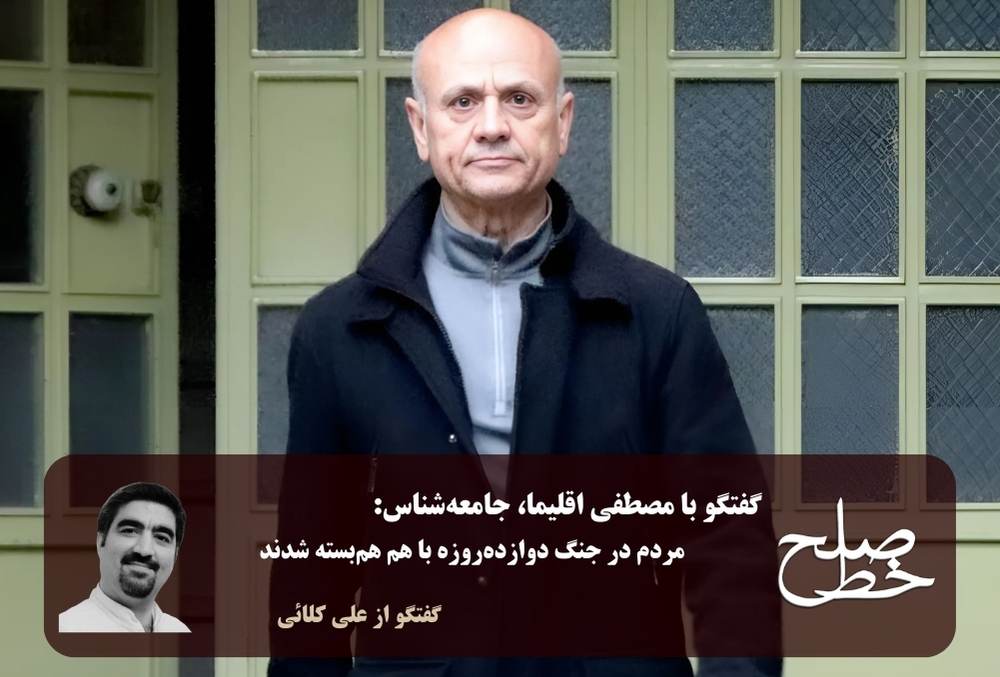
Mustafa Eghlima: People united during the 12-day war/ Ali Kalaei
The twelve-day war between Iran and Israel left deep and lasting consequences in Iran, bringing to light issues that are not only undeniable but also vital for understanding the social and political conditions of the country. This event, like a mirror, revealed hidden layers of inequalities, social divides, and structural challenges. In this conversation with Dr. Mostafa Aghlima, a pioneer in social work in Iran, the head of the Social Workers’ Scientific Association, a sociologist, and a social harm expert, we will try to delve deeper into the developments after this short but impactful crisis and examine its consequences from the perspective of a prominent expert. Dr. Aghlima, with a candid language and a structural approach, critiques the official narratives, reexamines the role of the people and the government’s reactions, and explores the true position of critics and the opposition. He believes that the spread of distrust, intensified poverty, and lack of accountability and transparency are among the most significant factors contributing to social
You can read the detailed explanation of the peace talks with Dr. Mostafa Aghlima in the following.
In light of the current situation in the country, what is your perspective on the post-12-day war environment for critics and opponents of the Iranian government? Has this event made it easier for criticism and activism, or on the contrary, has it increased restrictions and pressures?
When we want to examine issues in a country, we must see if that issue is the cause itself or a result of other causes. The situation in Iran before the war was a result of other causes. The people had many problems and were criticizing. On the other hand, some were taking advantage of the situation. But the people continued to criticize. During the twelve-day war, the people held back and waited for the war to end. Usually, after every war, previous problems become twice as apparent and people’s expectations rise. After the war, people expected many of their problems to be solved and for the government to stop issuing orders and directives. But the government came and issued some directives. Various price increases also occurred. The government was unable to meet the previous expectations of the people and these expectations only increased. In such conditions, new problems arise after the end of the war; this is not unique to Iran. Many issues that were not mentioned before become apparent after the war because people have
Before the war, the president had also spoken about the forty percent inflation and imbalance. The criticism towards presidents has always been that you, who know the situation and say we don’t have a solution, should offer a solution. We also know this lack, what have you done so far about the issues that put pressure on the people? So we should examine the critics and see what benefits they have in certain places. Let’s take the reformist group for example. Many of them have had responsibilities in the country from the beginning and have ruined the country without doing anything. Some of them are still in their government positions. Let’s also take the fundamentalists, when they are removed from their positions, they start criticizing. Some of them who have been out of power for a long time may even be arrested. But these are not critics for the people, they criticize and make noise for their own interests.
Critics are everywhere on the streets and in life, they are the “people”. Then the government comes and arrests and imprisons the teacher. The teacher, who has done nothing wrong, says, “Give me my rights.” The voices of these real critics cannot be silenced, because they are protesting and criticizing for their lives, not for personal gain or position. They just want their basic rights, they don’t want more. Look at the increase in salaries of university professors or retired government employees in a year, they cannot live with this income. Considering the real poverty line in Iran, the income of university professors and retirees is not enough to make ends meet. So how do they live? These problems exist. Therefore, criticism has increased in the country, and day by day, the pressure on the people increases and the government also takes action against some political activists.
Usually, after a major crisis, governments present their own narrative to shape public opinion. In your opinion, what prominent elements and deliberate omissions were present in the official narrative of the 12-day war?
The main point is that people wanted to cooperate with the government. However, during this war, the people did not support the government. Those in power are not the ones that the people want to vote for. During this war, the people faced problems together, came together, and worked together. Why do we sometimes want to take credit for what the people have done for themselves? The people were united in their struggles: in their lives, in their work, in their income, and in how the current war situation affects them. In this situation, they came together in solidarity. But the rulers who claim that the people came together for their benefit, did not have any problems of their own, neither before nor after the revolution and war. But sometimes, what happens is that some people take credit for the work of others. In third world countries where anyone can do anything and no one stops them or holds them accountable, anyone can change things for their own benefit. But this is not what the
We have spoken critically. But we know that the government has emphasized dialogue and Masoud Pezeshkian has also recently spoken with the opposition. Can these dialogues be considered genuine and based on accepting criticism, or are they more of a show and artificial?
When the President says opposition, who does he mean? Mr. Khatami or the President after him? They themselves have caused a lot of damage. Mr. Khatami has lost the trust of the people. They promote themselves and make someone else look great. Mr. Rouhani also betrayed the people. They are not the opposition, they are the entire people of Iran. Does anyone want to pay attention to that opposition? In any part of the world, human rights activists, such as truck drivers and teachers and university professors, would speak up and they would come and address their issues and solve their problems. Which one of them came to solve these problems? They only made the problems worse. The argument that “I can’t do it” and “the country doesn’t have a budget” didn’t work. If you don’t have it, then what are you doing? Where did the extra money go? Workers say our rights and wages are low, these are the opposition.
Do you think that this conversation that Mr. Pezeshkian is having right now is staged and artificial?
Yes. It’s all talk. If they really want to talk to the opposition, they should talk to the same people who are protesting for their rights. They should form a group to go and talk to their associations and see what they have to say. If you tell them we don’t have money, they have many reasons why we do. Why does it cost so much in some places? Why does the budget for some organizations, which are not even government, become thirty times more than the budget for health care? The people have legitimate grievances that they themselves know. These are the same groups that are not political and are not trying to destroy the government. They say give us our rights, and the rights of these individuals must be given. But not for everyone to do whatever they want. Those who say they are the opposition in the country, they are their own friends who have been friends for a long time and now one is on one side and the other is on the other side.
In the post-war era, some critics decided to self-censor and justified this action by arguing that it would prevent the enemy from taking advantage. As a father of social welfare in Iran, in your opinion, what social and psychological mechanisms lead to such behavior and what are the consequences for the critical space?
Those who censored themselves were the ones who ate bread at the daily rate. If I see a problem, I must speak up. I cannot say that now that there is war, I will not say these things. The people’s problems have nothing to do with war. If there are problems, they must be addressed. Unless they say that from this date to that date, we will not open our mouths. If there is something to say, it must be said. We also see opportunists, people who, when they reach a position or status, change completely. Meaning, these people talked until they got a position. After the revolution, those who were placed in administrative positions, when they took on responsibility, became ten times worse than before. Meaning, they got the position and now they could do whatever they wanted. See, we are people who believe that we do things for the people. The leader also always says that the president must first be just and secondly accountable. We
During and after the war, it was observed that some individuals who had previously avoided even listening to or performing national anthems such as “Ey Iran”, became fervent defenders and showed emotional reactions. How can this change in behavior be analyzed from a sociological perspective?
“We must analyze this from a perspective of pathology. In society, people take advantage of things for their own benefit. The government saw that people were standing up despite the attack on Iran. That’s why they started spreading these songs and using them to elevate themselves and say that they are just like the people. In some places, they did these things and easily touched on sensitive issues for the people. Some religious leaders used to say, “What are you taking Iran’s name for? We want Islam.” Then they put up signs and played the national anthem of Iran. They did this on billboards and in the streets, trying to use this issue to their advantage and give the people a sense of calm that everything has changed and they have accepted the issue of Iran. Of course, this is only temporary and eventually the people will see that everything is still the same. Then we will witness an explosion from the people. You see, it is possible to take advantage of people’s trust and bring up
Do you think that the government has taken advantage of people’s nationalist sentiments?
Yes. You see, the government is also made up of the people of Iran. It is true that their interests require them to do certain things, but deep down they know what the issue is. They themselves also know what the people are saying, but they are in a position where they cannot speak up. They saw that the best thing to do is to bring up the issue of Iran and start working on it and see that it has a better effect. But the people have seen so many wrongdoings that they no longer easily believe anything.
The point here is that after the 12-day war, we witnessed a surge in racist and discriminatory attitudes towards Afghan immigrants. Do you confirm this phenomenon? If your answer is yes, what were the reasons for such a surge during this period of time?
Before the war, we had this problem. You see, during Mr. Raisi’s time, the doors of the country were opened and anyone who wanted could enter the country. In some cities, you could see that everyone was Afghan and they didn’t look Iranian to you. Some of them were also taken to war in Syria as part of the Fatemiyoun brigade. These Afghans helped the people and did things that no one else was willing to do. But as their numbers grew, the people’s voices were raised. Then the government saw that they needed bread and water, so they suddenly started to push them out. The government doesn’t listen to the people’s words. They see that something is happening and the problem’s voice is rising, but they can’t manage it, so they started to push out the Afghans. Part of the problem goes back to the conflict between Iran and the Taliban. Maybe they thought that by sending back four or five million Af
But we were also faced with a kind of wave of confirmation from a part of the society in this regard.
See, did these people come with the approval of the people to leave with the approval of the people? Sometimes we are far away and we think the people have approved. The people had problems and said they should not come into the country like this. The people who did not say to expel them like this. The people and those who worked for them, said to investigate the matter or give them a visa or not, that’s all. But when you open the doors of the country and everyone comes in, the issue is different. If they entered the country illegally, it is the responsibility of the government to let them in. No one said anything about a permit or identification card. Why was such a decision made, while the people were against it from the beginning? The people were against the arrival of these people from the beginning. However, the government is carrying out its own policy to expel these Afghans. Do not involve the people of Iran in these issues.
They said that Afghanistan used to be part of Iran. But what happened and the problems that occurred and what happened to these Afghans was clear. If the government accepts refugees like other countries, it should provide them with a place, money, education, and work. But we did not give them any of these things, they did it themselves. From the day they came to Iran, they did not take any money from the government. They worked and lived on their own and had children. Their children were not even given birth certificates. After a few years, when a law was passed, its implementation faced problems. We have to have rules and laws for immigrants, if we don’t want them, we shouldn’t let them in. But when they came and we wanted to kick them out, we shouldn’t kick them out ourselves, we shouldn’t harm the people. See, our people are finding a way for their rights and protesting. A teacher says that his salary is low, he
What role did social media play in shaping and directing public opinion during the twelve-day war? After the end of the war, how did they act in terms of reproducing or breaking the boundaries of dialogue between the people and the government?
In these social networks, there are active individuals who have programs and facilities and their own thoughts. Now, families and friends may also have groups, but the point here is that when we gather somewhere and talk about a topic, we must always know that others can follow these discussions and even zoom in on them. Networks are also created, for example, social workers create networks and talk and discuss problems together, these groups also include families, friends, and colleagues. During the war, people spoke on some social networks and people became active on those networks. Now, I don’t know what the policy was for activating these social networks. In many social networks, for example, something is written that it is not clear who wrote it and people read and see that it is a good thing. People speak their hearts on these social networks, just as they speak their hearts on the street. If they speak less to each other now, it is because they are afraid of each other. Citizens are in these
What has happened that people are afraid of each other?
Confidence has been lost. There is absolutely no trust left. Now tell me Behnam, who do you trust? The president? Your father? I am telling you, I have no trust in anyone. Because I have been hurt by each one in different ways. No one trusts anyone and this is the worst problem. Several years ago, it was revealed in a study that there is a high percentage of distrust in society.
Has this level of social insecurity increased or decreased after the twelve-day war?
It has become more common. Because today someone talks to someone and tomorrow they warn that person, and they think that the other person has spread their words to others. People are afraid of each other and don’t talk to each other. The good thing about the virtual world is that they can’t stop it and news spreads through it. But the problem is that it is not clear on what basis this news is given? Is it for the people or for personal interests? People are also afraid to be asked why they took the news? Why did you spread it? The majority of the rights holders in society say that they have nothing to do with it and we want to reach our wife and children. Their voice is not heard.
In light of the experience of the twelve-day war and the events that followed, if a similar crisis were to occur in the future, what fundamental differences do you think there will be in terms of societal reactions compared to the past?
If a war happens, people will still be together despite all the problems. They won’t do anything in the war. When there is a war, people become more united and it has nothing to do with the government or others. People try to have their own lives and preserve them. Today’s wars are not like old wars on the ground and in the streets. People make their own lives, they try to manage their lives. If the government cannot provide the basic necessities of life, people may stand against the government in order to protect their lives. Because they need to at least provide for their lives. If they can’t, then a wave of poverty and pressure will be created and people cannot be stopped. They say a hungry person has no religion. Now, during the twelve-day war, there were financial facilities that they were finally able to provide their needs and get by, but if they cannot do this, it is clear that they will take to the streets. The richer class may remain
But to conclude, do you think there are any unsaid points?
Finally, let me say this: in order for any country to move forward, its laws must be enforced for everyone, not just for some and not for others. If someone steals a small amount of money, they should be punished, but if someone steals billions of tomans from the people, they should be punished a hundred times more. If the law exists in a country and is enforced, the people of that country will live well. If there is no accountability in a country, it will fall apart. Also, it is necessary for everyone to be worthy of their position and to be just rulers. The problem here is that people have not been properly educated and those who are in positions of power are worse than their subordinates. Until everyone understands their place and does their job properly, nothing will be right. Even if there is a hundred revolutions in that country, the same thing will happen. Unless we slowly reach a point where everything is in its proper place…
Thank you for the time you have given to the monthly magazine of the peace line.
 Created By: Ali Kalaei
 August 23, 2025
Tags
Fire extinguisher Peace Line 172 Twelve-day war