


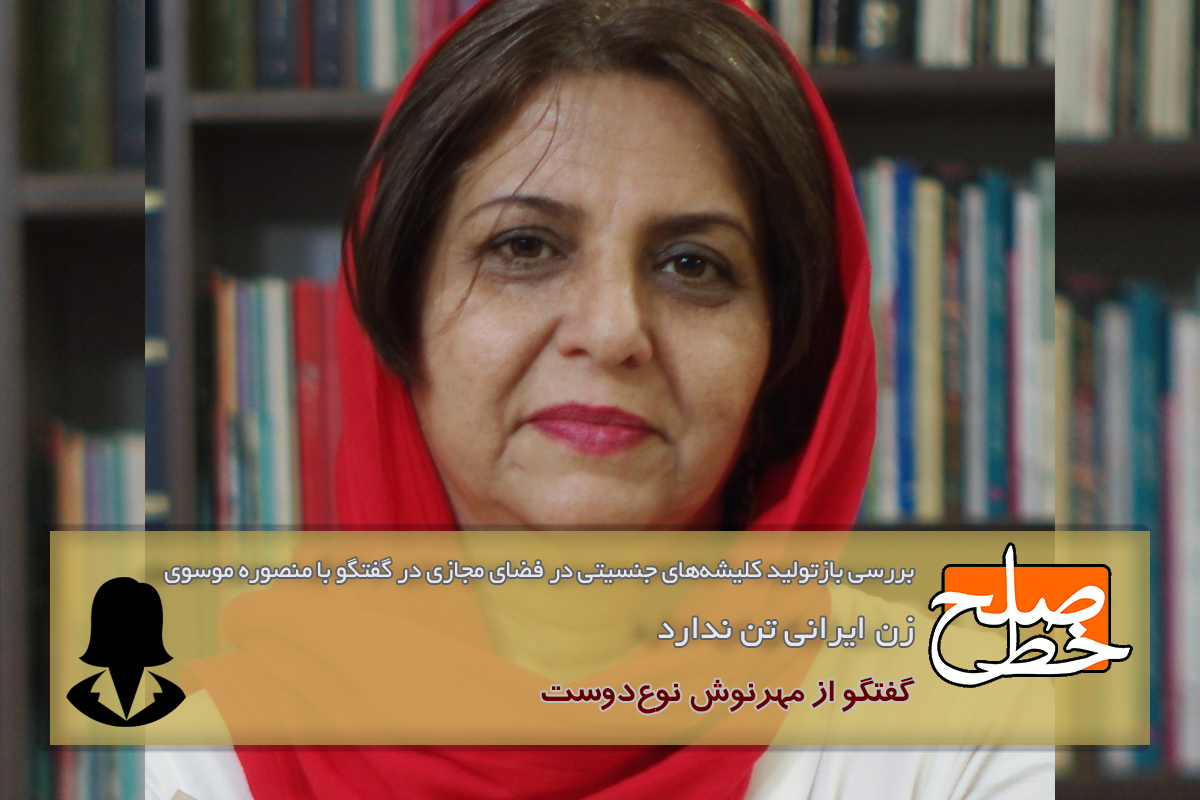
Iranian women have no body; A study on the reproduction of gender stereotypes in virtual space in conversation with Mansoureh Moosavi / Mehrnoush No’edoust.
For centuries, or perhaps thousands of years, Iranian women have faced oppression and limitations, which continue to this day. However, it seems that the younger generation is experiencing different conditions compared to women of past generations in Iran, thanks to the internet and virtual space. Patriarchy still exists and both the government and society are anti-women; factors that have led young girls to imitate masculine behaviors in order to find a way to express themselves in society or reclaim their denied human rights.
A few days ago, images of teenage girls playing with knives and spears were circulated on social media and then news of their arrest came. It seemed that in these videos, girls were imitating boys’ behaviors by holding knives or spears and sharing them on social media. But can the occurrence of such behaviors by girls and their spread on social media be the cause of reproducing gender stereotypes in this space, which has even forced girls to imitate boys’ behaviors? Is this behavior a reaction to authority? And what is the future of a generation whose life is intertwined with the digital space in Iran? To answer these questions, we turned to Mansoureh Mousavi, a writer and sociologist.
Considering the spread of videos showing teenage girls fighting on social media, do Iranian teenage girls imitate boys’ behavior?
It seems that teenage boys and girls in Iran have become similar to each other in terms of clothing; not only do they imitate each other in behavior, but they have also become very similar in terms of clothing; for example, boys’ hair has become longer and girls’ hair has become shorter; of course, these cases are seen in specific areas of the city and at specific times, and usually in higher neighborhoods, and it cannot be taken as a general example.
In my opinion, this is a good thing; it is a form of protest against the situation that girls face in society; for example, girls have to constantly justify their hijab: why their scarf is pushed back, why their coat is short or open in the front. I think it is due to oppression that this phenomenon has occurred. Now, if we want to evaluate and say whether it is good or bad, that is a separate discussion.
Do you think that imitating masculine behavior is girls’ reaction to societal oppression?
Exactly. I think this is a reaction of girls towards suppression. According to a research I conducted a few years ago on the puberty of Iranian girls, which is published as a book.سازی
Femininity and bodybuilding
Income, the majority of girls in response to the question of whether they are satisfied with their gender and being a girl, said no and unfortunately they were not satisfied; the number of girls who wished they were born as boys was very high. The reason for this wish was that as soon as they reached puberty, they were faced with a large amount of restrictions and oppressions, but they saw that boys not only did not face this amount of oppression and restrictions, but also gained some freedoms due to reaching adulthood. Based on this research, I believe that such behaviors indicate that the societal atmosphere is still against girls and they react in this way.
Some behaviors involve forms of violence; for example, hitting or cursing. Can this issue be seen as a warning that girls are forced to resort to violent behaviors in order to obtain their rights?
One of these “values of masculinity” is this very violence; meaning that a person must be able to curse, speak rudely, and have aggressive behavior, and if they are polite or, in other words, weak, they are not desirable; so if they want to have a position in society, they must exhibit these masculine values, but these behaviors are not intentional and it is the unconsciousness of society that has risen after all this suppression and shows itself in this way.
It seems that the behaviors of today’s adolescent and young adult age groups are more rebellious compared to previous generations. Can this group, with these behaviors, overcome these oppressions and reclaim their lost rights from society? For example, can they obtain freedom in clothing or have personal freedoms?
But if we think that major changes only occur in the hands of this age group that still have shaky steps and have not yet found themselves in the real world, we will have an unrealistic and mirage-like perception of change. Naturally, many factors must come together for these changes to happen; just as teenagers have great challenges in order to find themselves. They are still struggling with puberty, physical changes, and countless questions, and have no reliable and safe source to even obtain basic information about their puberty.
Does the avant-garde behavior of young people herald significant changes or not, and should we expect changes that this generation is supposed to take responsibility for? In my opinion, this shows a generational apathy where their minds and bodies are even entangled in various political and social taboos. We cannot leave changes to the future and the next generation. Every generation has a share and a role in changes, and the current generation seems to either refer to the past and blame all the faults on past generations, or pass them on to the future generation and create potential changes and be a mere spectator.
In the past two weeks, I have had short conversations with some teenagers to see where they get the information they need about puberty, physical changes, and their needs. I asked them where they ask their questions from. The majority of this age group asks their questions from the internet; they search on Google, ask their peers, or get their answers from pornographic films.
Sometimes they visit Telegram channels, Instagram pages, or Twitter. We all know that with a simple search on Google or other virtual spaces, many things are available. The internet is like a mountain and our action is a call. This means that whatever model you search for on the internet, you will get the same model as an answer; therefore, teenagers cannot obtain the answer they want through this method. The teenager is lost and this confusion is clearly visible and it seems that major crises are on the way.
Is the lack of education and proper communication with adolescents in families and schools crisis-inducing?
Yes, in my opinion, a bigger crisis occurs after such behaviors arise. Because teenagers have no reliable source to ask their questions. They do not trust the answers of their parents, nor the cliché answers of teachers and the education system, nor the official and governmental media. Therefore, they turn to the virtual space and trust it. And as I mentioned, no matter what mindset we enter this space with, we receive the same answer.
We know that groups of women are also producing content to promote gender equality in the virtual space, but we cannot ignore the fact that there are also groups producing gender-biased content, and they are much more prevalent. In this situation, how can teenagers access non-gendered and non-stereotypical content?
I have a positive view of Instagram because this media allows the audience to have a relatively open space. Adolescents or anyone else may follow certain pages based on their own beliefs and strengthen their thought patterns and move forward, but because Instagram is based on advertising and suggests things to the audience based on what they follow, the possibility of accessing new pages is very high. Therefore, it is very likely that a teenager who enters Instagram with a sexist mindset and gender stereotypes will have access to appropriate and effective pages that are active in this field and provide information, especially since these pages are increasing.
However, based on conversations I have had with teenagers, I do not have a positive view of Telegram. Many teenagers become members of Telegram channels that have a large number of members. They find these channels based on their own interests, and these channels constantly expose teenagers to a series of gender and sexual stereotypes. These channels feed them incorrect stereotypes with a series of lies and deceptions; for example, they may tell them that you are a feminist, while what they are teaching them is far from feminist perspectives and beliefs. They may also defend the idea that women should not have social freedom, and teenagers trust this information and believe it to be true.
On the other hand, after Telegram was filtered and VPNs were also restricted, people enter Telegram through proxies. These proxies are financially supported through popular channels, and it is interesting to note that the most gender-biased channels support these proxies and they rise up and become accessible to everyone. These channels provide incorrect sexual and gender information to their audience; of course, in all fields from the stock market to the market, they publish the worst and most incorrect data and unfortunately have a large number of viewers and members. Therefore, teenagers cannot obtain accurate information through a platform like Telegram.
A few days ago, some teenagers in Shiraz were confronted by the government for appearing in a park without hijab and behaving aggressively. However, after their arrest and government intervention, a video was released from the same location showing some teenagers gathered there with chadors and skating. What is the message of such videos? Did the teenagers mock the government with this reaction? Can it be inferred that teenagers are against the Islamic Republic?
What do you see as the outcome of these events? Can we hope for a future where women, especially these young girls, can live in a freer society? Will the women’s social movement in Iran have a positive outlook?
According to the sociological approach to the body, I must say that the first interactions of humans with the outside world are done through the body from birth to death, and it can be said that currently, the body of women in Iran has become alienated from itself. Iranian women are alienated from their bodies and see it as a problem outside of themselves, because from the moment an Iranian woman is born, she is restricted by her body and all taboos are imposed on her body. As she grows older, these taboos and restrictions also increase; therefore, identifying her free identity as a human being will be very difficult. That is why these adolescents also experience these conflicts and we see these alienated bodies in society, where girls tend to behave and dress like boys or play skateboarding with a chador. Therefore, I believe that hijab is one of the most important issues that needs to be solved for Iranian society, because this alienated body creates one of the biggest challenges
Thank you for the opportunity you have given us to have access to the peace line.
 Created By: Mehrnoush Noudoust
 August 22, 2022
Tags
3 Peace Treaty 1363 Beautiful generation Breeding Digital natives Gender Generation Z Hijab Internet Mansoureh Mousavi Mehrnoush is a kind friend. Social networks The eighties Virtual space Women Zomraha