


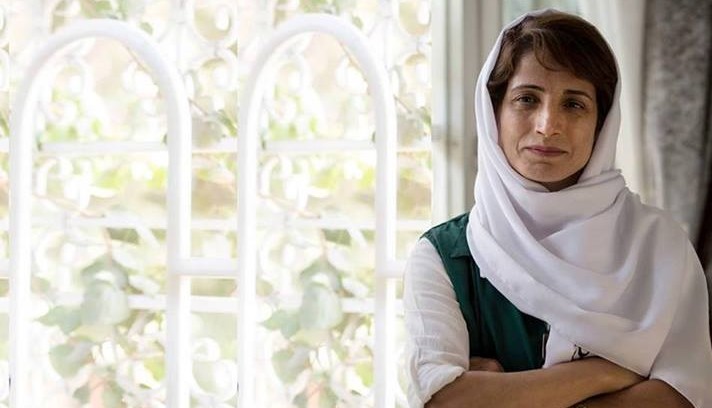
Nasrin Sotoudeh: In the law, there is no definition for political and security crimes.

In the law, neither political crime nor security crime is defined, but the term “security prisoners” has been used repeatedly, although they have a situation similar to political prisoners.
This section of the short peace talks is with Nasrin Sotoudeh, a lawyer, prosecutor and social activist. She received the Human Rights Award from the International Human Rights Organization in 2009. This lawyer was also responsible for the cases of human rights activists, victims and executed individuals in the aftermath of the June 2009 elections. Nasrin Sotoudeh herself was arrested on September 4, 2010 on charges of “acting against national security” and was imprisoned in Evin Prison until September 18, 2013. In response to the question of what is the definition of a political crime and a security crime in the law, she said: “In the law, we have examples of criminal acts that are considered political crimes in any system; such as attempting to change the government, which is considered a political crime. We also encounter examples of these crimes in the law that are considered criminal acts against the security of the country, but according to the
According to Nasrin Sotoudeh, according to the Iranian Constitution, there are formalities for dealing with political crimes that are not observed in the handling of these crimes.
This lawyer, who in November 2012 jointly received the “Sakharov” Prize from the European Parliament with Mr. Jafar Panahi, an Iranian director, continued: Referring to those who violate Article 168 of the Constitution in dealing with political crimes, the fact is that political crimes have not been defined. The lack of definition of political crimes not only does not reduce the responsibility of the courts and the judiciary in violating the Constitution, but also adds another failure to political trials, and that is the lack of definition of political crimes by the government. It should be noted that Article 168 of the Constitution emphasizes that the trial of political and media crimes is public and is carried out with the presence of a fair jury in the judiciary courts. The law determines the method of selection, conditions, powers of the fair jury and the definition of political crimes according to Islamic standards.
This lawyer and prosecutor, in response to the question of what basic rights a prisoner is entitled to during their sentence, said: In most judicial systems, respect for human dignity is one of the basic rights guaranteed to prisoners. For this reason, degrading methods that were previously used for prisoners are now prohibited. According to prison laws, prisoners must be kept in an environment where they are deprived of the freedom of movement, and during this time, their other rights such as communication with family, regular weekly visits, interaction with other prisoners, furlough, sending letters to relatives and official authorities, access to a telephone, and in newer systems, even access to the internet, are all protected. Additionally, the right to health and access to essential necessities for living must be respected. In some systems, regular visits with family in a green space are also provided for, although many of these basic rights are still denied to prisoners.
Nasrin Sotoudeh was among the prisoners who were deprived of many of their basic rights during her detention period.
The lack of definition of political crimes is a cover-up for the judicial system in Iran.

Over the past three decades, despite the repeated arrests of political activists, parties, human rights activists, journalists, and writers, and the execution of some of these activists, we have witnessed that the Islamic Republic government still claims that there are no political prisoners in Iran and that it is still open to defining political and security crimes in the law. This is while interrogators in many cases during different stages of interrogation and explaining the charges, explicitly refer to security and political crimes.
Farshad Ghazi, a journalist who was arrested in 2004, in response to the question of what crime he was detained for, said: “My charge was political, not security-related. I was arrested for collaborating with the internet website Emrooz, which was the first Persian-language website to be launched and active inside the country at the time. I was also arrested for some of my own writings and articles. However, it should be noted that the judicial system and officials of the Islamic Republic do not accept the title of political prisoner. So far, political crime has not been defined in Iran’s laws, and this is an excuse for them to claim that we do not have political prisoners and to label political prisoners as security prisoners.”
This journalist spent 40 days in detention, 30 of which were in a secret detention center outside the supervision of prison authorities, before being transferred to Evin prison. During his detention, he was deprived of all basic prisoner rights and stated, “Throughout my detention, I did not have any of the normal rights of a prisoner and these rights had no meaning for my interrogators, case officials, and detention center.” One of my co-defendants had met with his family and had obtained a copy of the Citizen Rights Charter (issued by the former head of the judiciary), but when they found this paper in his cell, he was met with harsh and aggressive treatment from prison officials and was even sent to a completely dark cell with terrible conditions for one night. It was considered a crime to even mention or be aware of citizen rights and prisoner rights, let alone have them respected. During the entire time, we were blindfolded in our cells and were interrogated facing the wall. Physical abuse
Angel Judge continued, “Regarding the definition of interrogators for political and security crimes, they did not have a specific definition. They only wanted to complete the accusations that had been prepared for us by forcing us to confess to lies. Apart from that, as I mentioned before, for them, all political prisoners are considered security prisoners and they do not make any distinction. They completely deny the existence of political prisoners in Iran and even judicial authorities have repeatedly stated that we do not have political prisoners!”
Actions against national security
“Actions against national security” is another accusation that has been written in the files of many detainees in the Iranian judicial system in recent years. One of the journalists who was arrested after the presidential election in 2009 during protests against the announced results said about this: “Considering that the government believes there are no political prisoners and all those who are detained are considered security prisoners, I was also charged with the very broad accusation of “actions against national security”. This accusation was not even explained to me in detail. Therefore, during the entire period of interrogation, on the top of the page where questions and answers were supposed to be collected, this general accusation was written. The reason for this accusation was simply my media activities. I was not a media prisoner for the media court or media court to deal with, nor was I a political prisoner. They called me a security prisoner. It was a big accusation for me because I thought of myself as a simple journalist, how could “actions against national security
He was asked if he had any basic rights as a prisoner during his detention. He replied, “I was not aware of my rights and this is generally bad. My lawyer used to say that journalists are rarely aware of their rights during detention. On the first day, a temporary detention order was issued for me, which is a heavy sentence. It is the heaviest sentence, but I didn’t even know that I could object to it. They don’t explain anything. So two things happened to me. First, my charges were never clearly explained to me, and second, they never told me what my rights were.”
The journalist continued, “Even the law does not have transparency when it comes to political prisoners. The solitary confinement itself is a great torture. I heard that they want to define a maximum time for a political crime, so that solitary confinement can be considered an inhumane act. I don’t know if even separating these two will make a difference, because interrogators behave however they want, unless the law clearly defines the rights of political prisoners. They can easily label someone as a security prisoner. Just like they never recognized me as a journalist and labeled me as a security prisoner. A prisoner in solitary confinement has almost no rights. Even their phone calls are at the discretion of the interrogators. They only have a Quran and some keys in their cell. Once or twice a week, they can go outside for some fresh air, whenever they decide. That’s all their rights. Even in the general ward, where there are specific laws and regulations, they are not given any importance. There are
Security detention
A – A, one of the journalists who was arrested in 1390, in response to the question of whether the interrogators saw a difference between security and political crimes, said: Let me start by saying that I had not committed any crime. If you mean “accusation”, I was detained in a security situation and was not informed of the charges! Early in the morning, when I was going to work, I was arrested on a street near my house and then the officers entered my house for inspection or as they say, searching, and then they took my handbag and cellphone. After putting me in the car, they showed me a photocopy of an A5 paper with the Sepah emblem on it, which stated that Sepah’s information protection had issued an arrest warrant for me. There is no belief in a political crime and no definition has been presented by the judicial system. When the verdict is issued by the Revolutionary Court and Sepah’s information protection takes action,
The journalist concluded: I was arrested on charges of anti-government propaganda. Before my release on bail, I was informed of the exact accusation. However, from the first interrogation after my arrest, all the pressure was to confess to spying for England and BBC (I have no idea what this phrase means, as they do not spy for the media) and even threats that if I don’t accept the charge of collaborating with a married woman, my father will surely have another heart attack and the people will also accept it!…
 Created By: Admin
 June 23, 2014
Tags
Monthly magazine number 38