


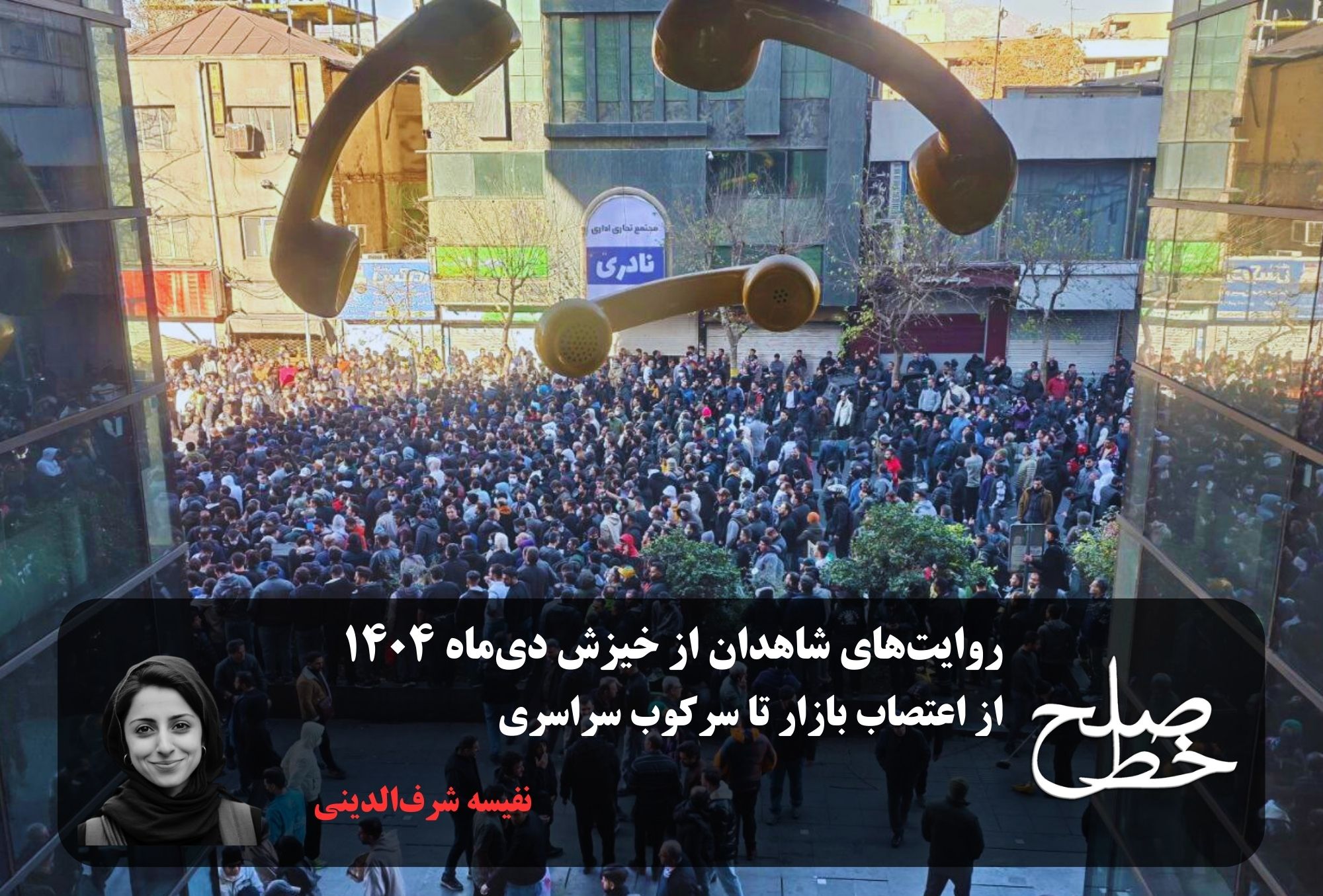
Witness accounts of the January 1404 uprising/ Nafiseh Sharaf al-Dinini
The accumulated crises in the political, economic, and social structure of the Islamic Republic reached an explosive point in January 1404, which, in terms of geographical scope, the intensity of government violence, and the depth of popular demands, constituted the most unprecedented challenge to governance in Iran’s contemporary history. The January 1404 uprising, which sprouted from budget imbalances and the unprecedented fall in the value of the national currency, quickly transformed from union protests into a full-scale uprising for regime change, encompassing all 31 provinces of Iran and taking on a completely nationwide and class-based nature.
Protests begin in Tehran
The collapse of the national currency, along with severe energy imbalances and widespread gas and electricity outages in industries, created a wave of hidden unemployment that prepared the powder keg for protests. On January 27, merchants in the Alaeddin and Charsu shopping malls in Tehran went on strike to protest the unstable exchange rate and the inability to supply goods. With slogans such as “Death to the dictator” and “We are taking back Iran,” the protesters shifted their demands from the economic sphere to the political sphere. On January 28, the markets of Karaj, Isfahan, Shiraz, and Mashhad also joined this wave. Students from the Tehran University dormitory also declared their support for the marketers.
Since January 10, cities such as Kohdasht, Azna, Lordegan, and Malekshahi have witnessed violent clashes and attacks on Basij centers and the office of the Friday Imam. In Ilam, security forces showed no mercy even to the wounded in hospitals, and in Malekshahi, Ilam, the funeral of the dead turned into a huge protest rally. On January 12, the people of Zahedan organized a large march against Seyyed Ali Khamenei after Friday prayers.
The peak of the uprising: January 18 and 19
The publication of Reza Pahlavi’s call for the 8th and 9th of January brought the scale of the protests to millions. Over these two days, more than 200 cities in Iran witnessed the presence of people on the streets. In response to this widespread presence, the government launched an unprecedented bloodbath in various cities of the country by completely cutting off the internet and issuing an order by the Leader of the Islamic Republic to “suppress by any means possible.”
“Ramin,” an eyewitness in Tehran, recounts: “The crowd was so large that it seemed as if the entire city had come out onto the streets. Then, all of a sudden, officers poured in like ants and locusts, firing tear gas and sound bombs. The security forces fired automatic weapons at the people. They didn’t even spare those who were watching or filming from rooftops or balconies.”
“Farzad,” who lives in Tehran, also says of his observations during the protests in Tehran against the peace line: “Snipers were shooting people with live ammunition on the rooftops of buildings. All the Basij and Sepahi had weapons; I saw Kalashnikovs in their hands. The civilian uniforms had G-3s and Colts on their waists. They were running people over with cars. They were shooting the wounded with live ammunition because they didn’t want anyone to survive. If they didn’t have ammunition, they would cut their throats with cutters.”
Another citizen named “Sephehr” told the Peace Line about his participation in the Shahran and Punak rallies: “I was in the protests on January 8, 9, and 10. Most of those who came had lost their lives. I had gone to the front, to the front line. To be honest, I didn’t really care if I died anymore. I had gone to the trash can, chanting slogans and throwing stones. I also prepared stones for people to throw. At one point, I was hit by so much tear gas that I almost fainted. I saw a lot of people next to me who had been shot in the head and face. When I went home, there was still a lot of gunfire coming from outside, I think it was something like a machine gun.”
“Arian,” a protester living in Tehran, also said: “In one of the neighborhoods of Tehran where the demonstrations were very intense and numerous, a clash occurred between the people and the Basijis. The suppression forces and the Basijis fired at the people with batons, tear gas, and shotguns, and the people also increased in number and surrounded the Basijis. Apparently, two Basijis were killed. At the end of the night, plainclothes forces and the IRGC came with combat weapons and bulletproof vehicles, severely suppressed the people and carried out a brutal massacre, so to speak, rounding them up. A few days later, about 12 officers broke into the house of one of those who allegedly participated in the demonstrations at 2 a.m. and searched everything. They ransacked his house, took his tablets, cell phones, and computers, and arrested one person. Then, for about a week or ten days, there was no news of the person who had been arrested until we were able to find out where he was by following up. It was the large prison of Iran (Fashafoye). Two weeks after this incident, they were able to contact his lawyer. The lawyer said that his crime was not serious, but we did not trust him, we thought that he was accused of a serious charge that led to his arrest. After a lot of investigation, we found out that the only evidence they had of him was the street cameras and the home’s CCTV, which showed that he had left the house during the protests and then returned at night. And that he had bought burnt oil, which according to the bailiff, he was accused of using to make Molotov cocktails or spreading on the asphalt to make it slippery and the motorbikes of the suppression forces fall. In short, because they could not find any evidence that any Molotov cocktails had been made or used, they simply used the burnt oil to set the motorbike on fire, and for now, that person is still in custody. According to the person himself, apparently in the first week, all those arrested were taken blindfolded and handcuffed to an unknown location, and hundreds of people were kept in each shed for a week to ten days. The only food they were given was four spoonfuls of rice for lunch, and for dinner, a piece of dry lavash bread with tomatoes. His mother was finally able to see her son up close, which gave her some peace of mind. They were able to get an experienced and knowledgeable lawyer, who said he would most likely be acquitted.
At the same time, terrible events occurred in other cities. The Rasht Bazaar fire occurred on January 8, in which security forces set fire to the bazaar and shot people fleeing the fire, causing a humanitarian catastrophe. Eyewitnesses reported that protesters had taken refuge in the winding alleys of the bazaar to escape the security forces’ fire, but were suddenly confronted by a wall of fire. According to field surveys, more than 30 commercial units in the Rasht Bazaar were completely burned down.
Ardalan described the situation in an interview with Peace Line as follows: “Special forces and plainclothes officers were shooting with Kalashnikovs and shotguns at people trapped in the market amidst smoke and fire. They didn’t even let fire trucks come to put out the fire.”
Another witness named “Hamid” from Rasht recounted: “In Rasht, the streets around Moalem and the Municipality were crowded. From the sounds I could hear, I guessed that people were being shot. Every day, several thousand people came to the streets, which was much more than in previous years’ protests. People were wearing masks, wrapped their scarves around their faces, and wore hats, and they were walking in groups. I saw many who had come with their families. The Golsar area of Rasht, which is considered the upper city, was also crowded. That is, even those who could make ends meet and had no livelihood problems had come; because the reason for the protest was not purely economic. People were really fed up.”
According to Hamid, many families have buried their loved ones in their yards, gardens or farmlands for fear of their bodies being confiscated. Hamid also talks about the transfer of many bodies to “Bagh Rezwan” on the peace line: “They would take the bodies to Bagh Rezwan and charge people a fee for their work. When people went to collect the bodies of their loved ones, they would charge them huge sums of money to return the bodies, otherwise they would either not hand over the bodies or they would say that they were from the Basij forces.”
“Hadi,” an eyewitness from Mashhad, recounts that on Vakilabad Boulevard, officers fired shotgun pellets directly into the eyes of protesters. Hadi added in an interview with Peace Line: “They shot from above and below. Snipers shot from the top of the towers. They shot in the face and eyes with shotgun pellets. I saw teenagers getting shot. One of our relatives was shot several times, but he did not go to the hospital for fear of being arrested. A nurse in the house took out the pellets with tweezers.”
***
The January 1404 uprising should be seen as the meeting point of accumulated structural crises with the collapse of political legitimacy; an event that demonstrated that public discontent had transcended the level of economic demands and transformed into an explicit demand for change in the ruling system. The geographical scope of the protests, the cross-class composition of the protesters, and the unprecedented intensity of the means of repression all confirm that the government is faced with a fundamental challenge that can no longer be contained by ad hoc, security, or propaganda solutions. Although the government was able to temporarily halt the street presence by resorting to organized violence, digital repression, and creating a climate of fear, the social, political, and psychological consequences of this uprising remain active and alive.
January 1404, as a historical turning point, transformed the equations of power and society in a way that makes a return to the previous situation practically impossible and will define the path of future developments in Iran within a new framework.
 Created By: Nafiseh Sharafaldini
 February 20, 2026
Tags
Arrow of Fire Criminal Detention of a villa Kahrizak Market strike Massacre 1404 Nafiseh Sharafaldini 2 Objection peace line Peace Line 178 Strike Suppressing protesters Suppression The Di 1404 Uprising Uprising of 1404 ماهنامه خط صلح